

创作上传
VIP
收藏下载
登录 | 注册有礼
查看完整案例

收藏

下载

分享
Algeciras, Cádiz. Spain
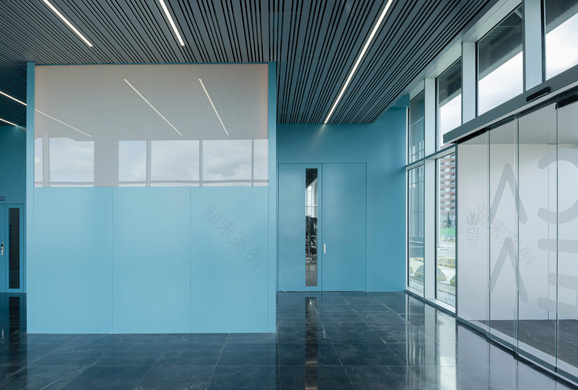
UCA-SEA Innovation Center
Estudio Carbajal SLP | José Antonio Carbajal Navarro, Nicolás Carbajal Ballell, Rodrigo Carbajal Ballell




Description
Technical file
This attractive project was conceived under a strict geometric modulation that allows for industrialised construction systems and finishes that have a favourable impact on execution times of the works and on the necessary energy efficiency, these factors being a major requirement in this case given that the building is subject to European funding and Breeam certification.
The project, the result of a public competition and situated on harbour land that had become vacant and had been allocated for new public spaces in Algeciras, as is happening in many other port cities, represents a milestone in its urban renewal and a new understanding of its maritime fronts in which the city recovers its relationship with the sea. In this case it forms part of the built-up complex promoted by the Algeciras Port Authority together with Cádiz University on the harbour front known as Llano Amarillo, an emblematic action for both the city and these administrations, constituted by three constructions of which this one is the first of its construction phases
The functional programme of the UCA-SEA (laboratory and administrative areas and teaching spaces) has the purpose of addressing the contents derived from the European Union having appointed Cádiz University to the role of coordinator in the European University of the Seas project, an alliance of nine European universities that aims to redefine education for the 21st century and to facilitate interdisciplinary collaboration and the exchange of knowledge. A programme that in practice is highly diverse, with research teams working on topics as wide-ranging as engineering associated with telecommunications and mechanics, which translate into spatial needs or concrete endowments.
On a general level, the project argues that architecture should be tied to a broadly understood place, not only in terms of geographic location but also as a cultural and environmental context. Specifically, the proposal seeks to respond to its exceptional position next to the dock and, in anticipation, to surrounding conditions that will soon change (as the area is developed), reconciling factors such as orientation, accesses or position with regard to future constructions, with demanding functional and technical requirements. The vestibules thus face the pedestrian boulevard that will soon be created, while the work areas look south in a quest for the best lighting conditions. Ultimately, it was sought to give the building a contemporary imprint in its integration into this harbour context, making it easy to access and control, clear in its internal organisation, flexible and versatile in its compartmentalisations and mode of occupation and comfortable in its work areas.
A cubic volume, with a shell protected from sunlight with bespoke-designed motorised slats, with three levels and a landscaped roof storey covered in photovoltaic panels spread over this open level, the result of seeking to fully integrate these solar installations into the building to thus obtain an added benefit. A roof finished as if it were another façade, which is visible from the constructions of the city’s harbour front.
In its interior the relational areas open onto the future boulevard that will connect the city with the dock, which means that the users will enjoy fantastic views over the landscape and port activity. Meanwhile, the transparency of its north façade will display to passers-by the university’s open character and work.
Aluminium, steel, glass and natural stone are the basic materials that configure the building. A construction that applies a reduced number of technical solutions and materials and that also establishes certain exceptions within the systematisation and seriation proposed by this construction. Certain industrialised products were adapted to the project’s purposes, such as the motorised aluminium slats, the result of an in-house design using pieces from the Schüco brand. The inner ribs, the folding of the sheet metal with its inertia despite being so thin or its asymmetrical perforation depending on its rotation (clockwise on the east façade and counterclockwise on the others) are the result of having modified its pieces: even the diameter and perforation density of the sheet metal seeks a balance between avoiding the dotted shade in the interior and preventing the orifices from clogging up with the abundant ambient dust.
Plans and other extras
Localización Location: Llano Amarillo – Recinto portuario de la Bahía de Algeciras, Cádiz. Spain. Arquitectos Architects: Estudio Carbajal SLP | José Antonio Carbajal Navarro, Nicolás Carbajal Ballell, Rodrigo Carbajal Ballell. Arquitectos técnicos Quantity surveyors: Jesús Bozzo Fernández de Tirso, Manuel Ballester Diana. Arquitectos colaboradores Collaborating architects: Manuel Matoses Rebollo (anteproyecto), Fernando Moreno Humanes (proyecto básico y ejecución). Estructura Structure: Edartec Consultores, S.L. Instalaciones Installations: Miguel Sibón Roldán. Promotor Developer: Universidad de Cádiz. Superficie Area: 1.895,63m². Fecha de finalización de la obra Completion date of the works: 2023. Fotografía Photography: Fernando Alda.
Suppliers list
Ascensores
: Orona
[email protected]
José Antonio Carbajal Navarro
Sevilla, sevilla
Nicolás Carbajal Ballell
Sevilla
Rodrigo Carbajal Ballell
Sevilla
Estudio Carbajal
Sevilla, sevilla
Photography
Fernando Alda Calvo
Sevilla
南京喵熊网络科技有限公司 苏ICP备18050492号-4知末 © 2018—2020 . All photos and trademark graphics are copyrighted by their owners.增值电信业务经营许可证(ICP)苏B2-20201444 苏公网安备 32011302321234号
苏公网安备 32011302321234号客服
消息
收藏
下载
最近