

创作上传
VIP
收藏下载
登录 | 注册有礼
查看完整案例

收藏

下载

分享
How Can Architecture Influence Office Routines? Princeton University Grad Domenica Massamby Explores Innovative Workspaces

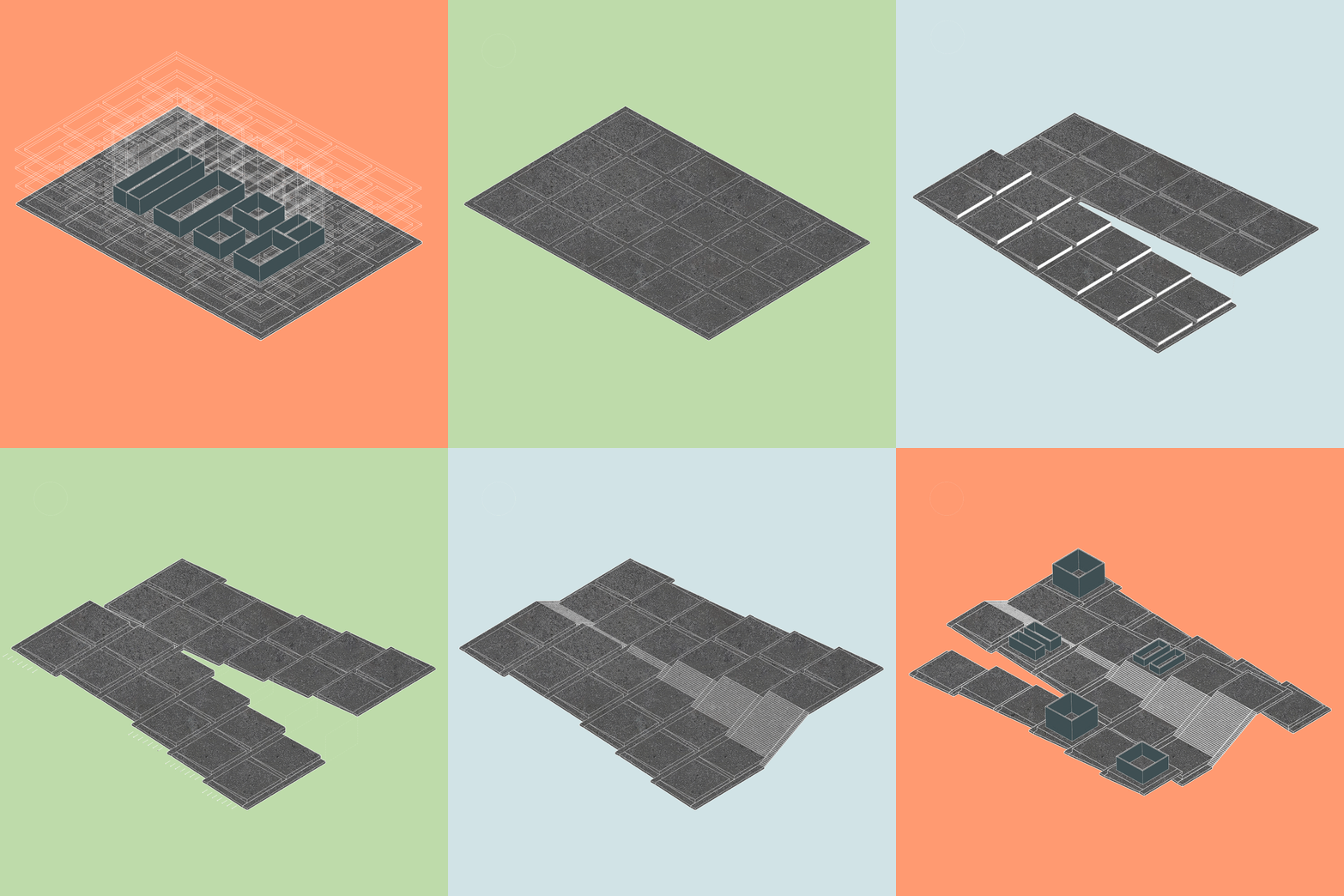
This atypical typology inserts friction into the typical plan. The unsmoothing of floor plates tries to create the necessity for a deliberate movement and modes of interaction, as the circulation expands and attenuates. Flying floorplates diverge from common nodes, creating niches and distinct local addresses and eliminating the concept of a well-defined central core. — All imagery and captions by Domenica Massamby.
Domenica Massamby is a recent graduate from
Princeton School of Architecture
. Archinect connected with Domenica to learn more about her final thesis project, which explores how spatial characteristics can influence the typical routines of daily office life
.
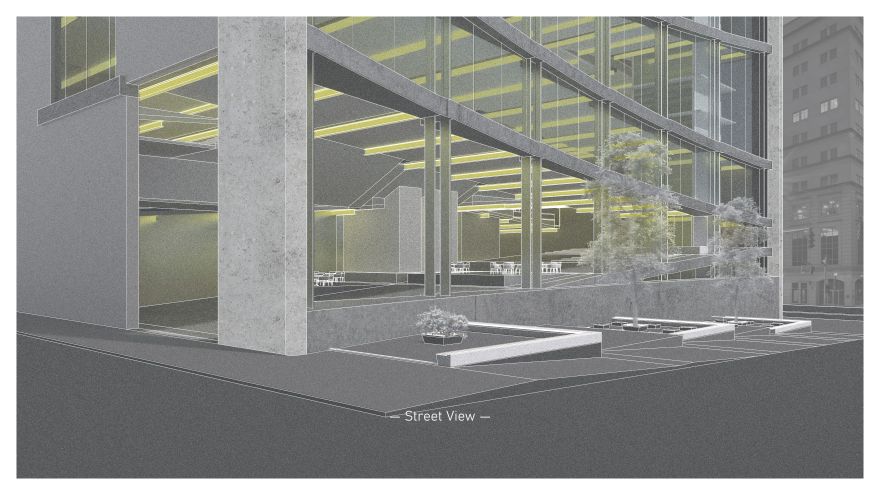
The building occupies a block in downtown Wilmington, DE, absorbing the sloping street avenue, and so, the street indicates the
beginning
of a sequence that continues into a sheltered plaza.
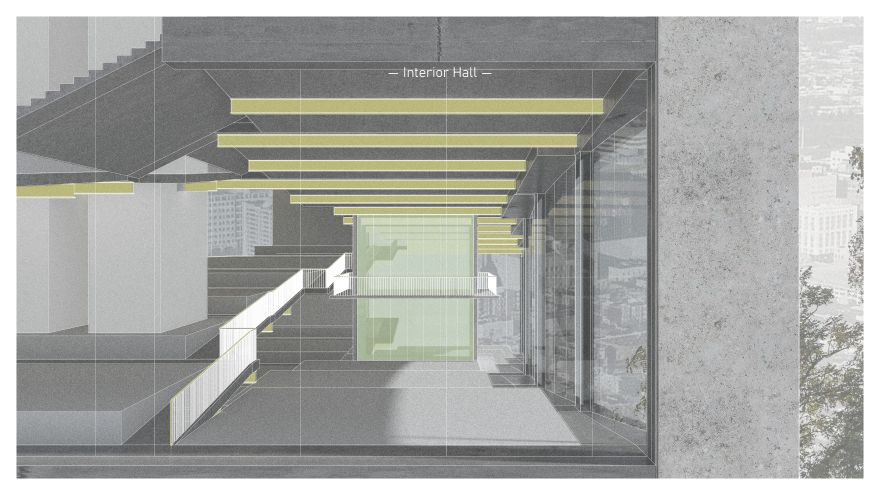
View of a typical—or atypical—interior hall reveals a
directional bias
in favor of navigating and experiencing multiple “floors” at once.

Aisles link big and small, but they strip the notion of the corridor as social condensers, leveraging actual trays as the real space for local interactions, and encouraging a determined movement through space.
My thesis was a speculation about a new mode of work that could challenge the tenets of efficiency and productivity that produce very predictable patterns of use of space, and ultimately determine the routine of office life. The project developed from thinking about the role of leisure and the ascribed values of time that dictate the value of work itself. Its an attempt to restructure worker relationships and introduce autonomy in the way they navigate their careers (both spatially and socially).

Early prototype models of general vertical organization, exploring relationships between floor-to-floor heights, centralized cores and overall drifting of floors.

Perspective sections show interiors that are
discrete
and
varied
in one axis, requiring minimal vertical partitions, and
continuous
and
repetitive
in the other, operating as more conventional open floor configurations.

Domenica Massamby presents during Fall 2019 final reviews. Photo by Ali Nugent, courtesy of Princeton School of Architecture.
It’s hard to determine exactly what would have changed, but I do know that the ability to produce models in real time would likely have pushed the eventual design in different directions. Issues like distancing, work-life separation, and balance became more prominent questions in the last couple months. I don’t believe they’ve been totally answered, but it’s made the thesis more dynamic in its development.
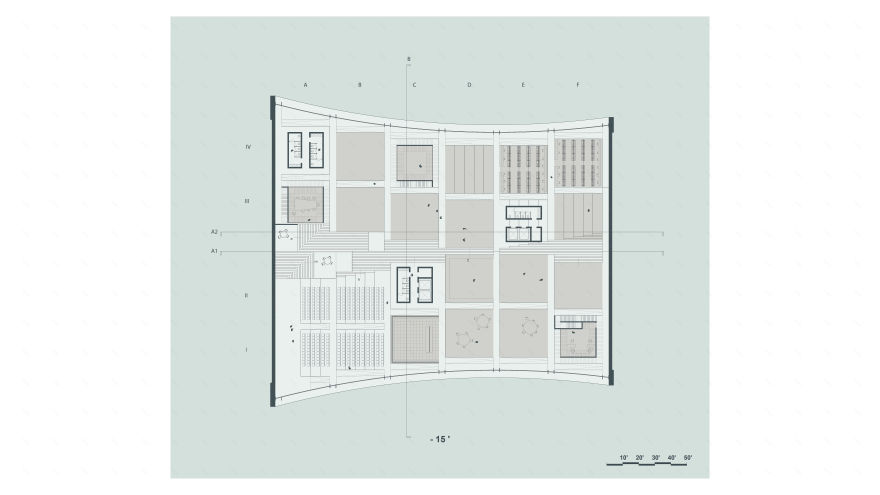
Floor plates are arranged in 30-by-30-foot trays in a shifting grid that accommodate different local programming which expand and shrink accordingly, for public (open) needs and private offices.
Although it’s difficult to have to constantly validate your own ideas, and easy to become swayed by other voices—whether it’s advisors, reviewers, peers—I think it’s important to not just submit a cohesive thesis but one that you believe in. Having said that, it’s only an experiment of our ideas, so taking it too seriously as the only/final/pivotal project of your career is a disservice to possible developments it could see throughout the process and possibly later in a professional journey. I wish anyone starting soon the best of luck!

The metrics of the platforms maintain a high degree of flexibility which can absorb different density of programming, whether it be cubicles, archives, and libraries, or gardens and kitchens. They accumulate to create varied interior spaces which are animated with a diversity of views and access through
aisles
instead of corridors,
landings
instead of lobbies, and
balconies
instead of foyers.
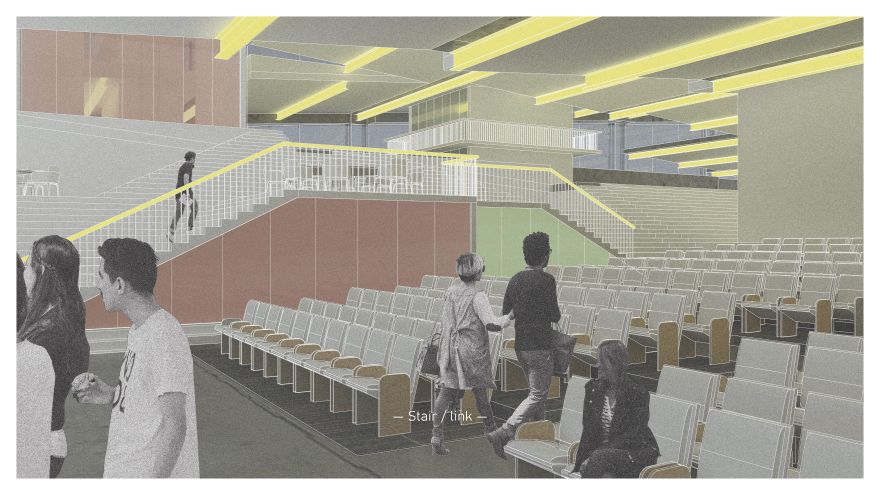
Aisles link big and small, but they strip the notion of the corridor as social condensers, leveraging actual trays as the real space for local interactions, and encouraging a determined movement through space.

The divergence of opposite-running plates creates the need for occasional shortcuts between adjacent plates. The communication stair as a trope is embedded with function, folding up to provide additional private rooms and views to spaces below.
南京喵熊网络科技有限公司 苏ICP备18050492号-4知末 © 2018—2020 . All photos and trademark graphics are copyrighted by their owners.增值电信业务经营许可证(ICP)苏B2-20201444 苏公网安备 32011302321234号
苏公网安备 32011302321234号客服
消息
收藏
下载
最近