

创作上传
VIP
收藏下载
登录 | 注册有礼
查看完整案例

收藏

下载

分享
第19届威尼斯建筑双年展(以下简称“双年展”)于5月10日在意大利威尼斯开幕。中央美术学院建筑学院副教授、PILLS建筑工作室主持建筑师王子耕受邀为中国馆创作装置作品《苍穹》。作品以中国城市化进程为时代背景,选取中国建设现场无处不在的绿色防护网为主材,融合非遗竹编工艺,构建起一座当代“藻井”。并通过圈层旋转形成动态叙事,以故事性的手法诠释“天人合一”的东方智慧和人与自然共生的自然哲学观。
The 19th InternationalArchitecture Exhibition/Biennale Architettura 2025 (hereinafter referred to as “the Biennale”) opened on May 10th in Venice, Italy. Zigeng Wang, Associate Professor of the School of Architecture at Central Academy of Fine Arts (CAFA) and the principal architect of PILLS Architects, has been invited to create the installation titled The Vault of Heaven for the China Pavilion. Set against the backdrop of China’s urbanization, the work uses the ubiquitous green safety netting from construction sites as its primary material, interwoven with bamboo weaving techniques recognized as intangible cultural heritage. Together, they form a contemporary reinterpretation of the traditional zaojing (caisson). Through a layered, rotating structure, the installation unfolds a dynamic narrative that embodies Eastern wisdom and poetically expresses the philosophical concept of harmony and symbiosis between humans and nature.
▼《苍穹》实景照片,“Vault of Heaven”©La Biennale di Venezia.

▼《苍穹》实景照片,“Vault of Heaven”©PILLS Architects

展览背景
Project Background
在极端气候事件频发的背景下,全球平均气温已突破《巴黎协定》的 1.5°C 警戒线,气候变化的加速程度甚至超出了最好的科学模型。在这样一个历史转折点,本届威尼斯建筑双年展以“智能、自然、人工、集体 (Intelligens, Natural, Artificial, Collective)”为主题,呼吁大家超越对 AI 和数字技术的关注,回归“以人为本”的思考,探索建筑对未来环境的主动“适应”。中国馆策展人马岩松则提出“容·智慧”(CO-EXIST)的策展理念,与双年展主题形成了跨文化的共鸣——强调天人相融的世界观,认为人与天地宇宙万物是一体的关系。呼吁从根本上以开放和包容的智慧看待世界,并特别邀请对此理念有思辨的中国建筑师以各自的方式,从历史精神中寻找智能时代的新答案。
In the context of frequent extreme weather events, the global average temperature has exceeded the 1.5°C warning line of the Paris Agreement, and the pace of climate change exceeds even the most advanced scientific models. At such a turning point in history, this year’s Venice Architecture Biennale, under the theme of “Intelligens, Natural, Artificial, Collective”, calls for a shift beyond the current focus on AI and digital technologies, and a return to human-centered thinking—urging architecture to explore how it can actively adapt to the environmental future. Yansong Ma, curator of the China Pavilion, puts forward the curatorial concept of “CO-EXIST”, which resonates cross-culturally with the theme of the Biennale – emphasizing the Eastern philosophy of unity between heaven and humanity, and envisioning the cosmos, nature, and humankind as interconnected and inseparable. It calls for a fundamentally open and inclusive way of understanding the world, and extends a special invitation to Chinese architects engaged in critical reflection on this philosophy, encouraging them to seek new answers for the age of intelligence through their own approaches—rooted in the spirit of history.
▼《苍穹》实景照片,“Vault of Heaven”©PILLS Architects

1天人合一——中国独特的自然哲学观
Chinese Philosophy of Nature
中国人一直以来有自己独特的自然哲学观。《庄子·齐物论》:“天地与我并生,万物与我为一。”主张“天人合一”的中国传统自然哲学观,否定了绝对的生死边界,强调人与自然的整体关联。《易经》的“生生不息”同样揭示了宇宙万物自生自化,循环不止的动态秩序。这些哲学视角不仅解释了中国人的循环的时间观和物质观,也是非人类中心视角的东方阐释。这种循环的宇宙观始终贯穿于中国古典叙事体系的艺术表达。从创世神话、寓言史诗到诗画意象、哲学写作:盘古开天辟地,身体化为山川草木;女娲以黄土造人熔五色石补天;文人画有”四时循环“、”草木枯荣“的主题;道家经典《化书》则描述了一个动态转化的宇宙模型,阐释物我界限消弭,万物生灵循环不息。所有这些艺术形式共同构成了“万物有灵,生生不息”的认知框架。
▼以北极星为中心的南宋石刻天文图(1247年),Astronomical Chart Centered on the North Star, Stone Engraving from the Southern Song Dynasty (AD 1247)©网络

The Chinese have always had their own unique philosophical view of nature. As Zhuangzi wrote, “Heaven and earth exist together with me, and all things are one with me.” The traditional Chinese philosophical view of nature, which advocates the “unity of heaven and man”, denies the absolute boundary between life and death, and emphasizes the overall connection between man and nature. The I Ching‘s “The ceaseless generation and transformation of all things.” also reveals the dynamic order of the universe in which everything is self-generating and self-creating, and the cycle is endless. These philosophical perspectives not only explain the Chinese cyclical view of time and matter, but are also Eastern interpretations of non-anthropocentric perspectives. This cyclical view of the universe has always permeated the artistic expression of the classical Chinese narrative system. From creation myths and epic fables to poetic imagery and philosophical writing: Pangu’s body transformed into mountains, rivers, grasses and trees as he opened up the heavens and created the earth; Nüwa used yellow earth to create man and melted five-colored stones to mend the heavens; literati paintings have the themes of “the cycle of the four seasons,” and “the withering of grasses and trees;” and the Daoist classic, Hua Shu, describes a dynamic model of the transforming universe that illustrates the dissolution of the boundaries between matter and self, and that the cycle of all living things is unceasing. All of these art forms together constitute the cognitive framework of “Everything is imbued with spirit; life regenerates in an endless cycle.”
▼《苍穹》实景照片,“Vault of Heaven”©PILLS Architects

2 藻井与须弥座——作为叙事载体的建筑形制
An Architectural Interpretation of Chinese Philosophy
作品《苍穹》将中国传统的自然哲学观具象化为一组“天、地、人、神”的循环叙事:从中国传统绘画和工艺中汲取灵感,通过借鉴和重构汉代画像砖中生动的人与动物,中华传统纹样中的忍冬纹、祥云纹等图案形成文明切片,演绎一个人与自然万物和谐共栖的叙事。同时作品还加入了日月星辰的意象,北斗七星作为中国传统文化中的永恒指引,天穹的象征,与日月光华、万物生灵共同表达了“生生不息、道法自然”的深层哲理,也诠释了“周行而不殆”的循环本质。《苍穹》以故事性的手法邀请观众从非人类中心视角重新审视自然。
▼《苍穹》循环叙事线稿图,Line Drawing of the Rotating Circular Totem©PILLS Architects
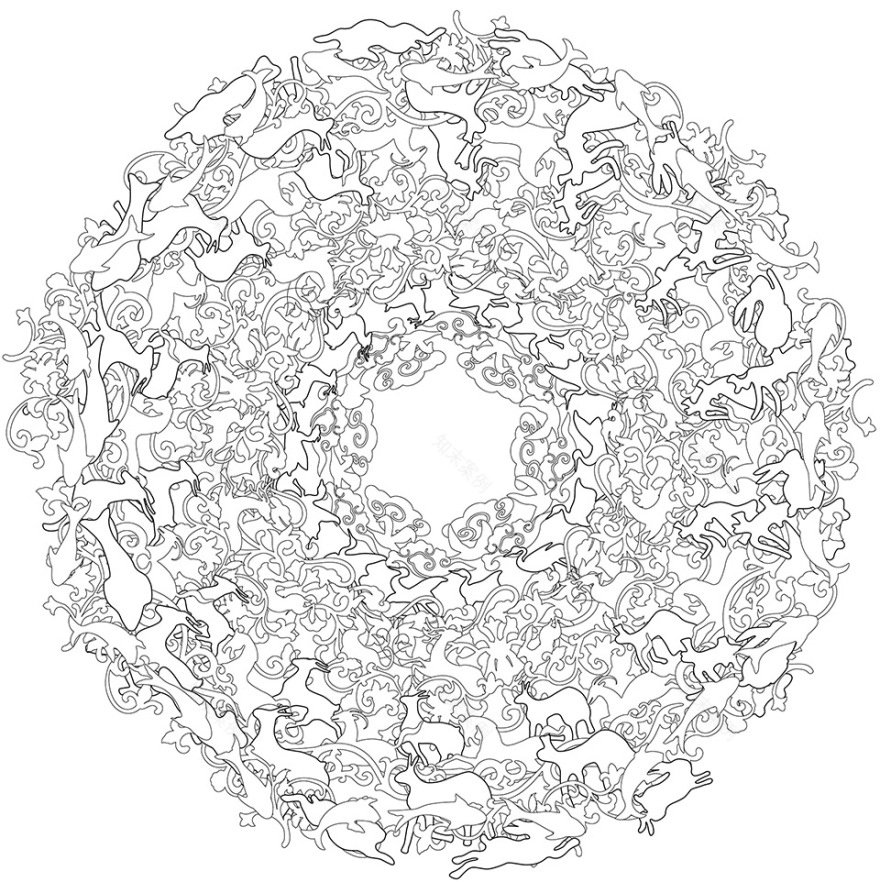
The work “Vault of Heaven” materializes the traditional Chinese philosophical view of nature into a set of cyclical narratives of “Heaven, Earth, Man and God”. Drawing inspiration from traditional Chinese painting and craftsmanship, the piece reimagines vivid human and animal figures from Han Dynasty pictorial bricks to express the harmony between humans and nature. It also weaves in traditional Chinese patterns such as Lonicera and auspicious clouds, creating a symbolic “slice of civilization” that poetically narrates the interconnectedness of humanity and the natural world. Additionally, the work incorporates celestial imagery, including the sun, moon, stars, and the Big Dipper, which serves as an eternal guide in traditional Chinese culture and a celestial symbol of orientation and cosmic order. Together with the light of the sun, moon, and all living things, it conveys the profound philosophy of “unceasing birth and the Tao of nature,” illustrating the cyclical essence of “continuous motion without peril.” Through storytelling, “The Vault of Heaven” invites the audience to reconsider nature from a non-anthropocentric perspective.
▼《苍穹》实景照片,“Vault of Heaven”©PILLS Architects
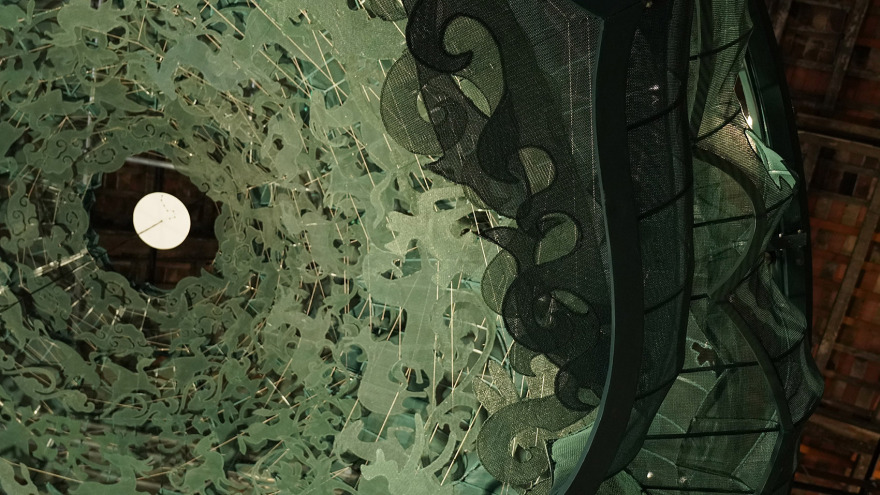
中国传统建筑一直以来作为古人智慧的载体,其形制与空间组织深刻体现了人与自然共栖的哲学思想。藻井作为极具代表性的一种天花(装饰)结构,其发展演变历程贯穿中国建筑史,它不仅见证了多元文化的交融,更是古人仰观天文,俯察地理所得宇宙图景的微缩载体,诠释着中国传统文化中“天人合一”的思想精髓。同样地,作为中国传统建筑中常见基座的莲花须弥座,也承载着佛教对生命轮回和因果的深刻理解。其在佛教中具有宇宙中心的寓意,象征世界的平衡稳定,人与自然的和谐共生。设计团队将中国传统建筑形制创新性地融入装置设计,在穹顶之下精心绘制连续的场景故事,化文化叙事为沉浸体验,再现了中国人对天堂的美好想象。
▼《苍穹》造型轴测图,Axonometric Drawing©PILLS Architects

Traditional Chinese architecture has always been the carrier of the ancient wisdom, and its form and spatial organization profoundly embodies the philosophical idea of cohabitation between man and nature. Zaojing (caisson), a highly representative decorative ceiling structure, has evolved throughout the history of Chinese architecture. It not only reflects the fusion of diverse cultures, but also embodies the ancient practice of observing the heavens above and the geography below, serving as a miniature vessel that interprets the essence of traditional Chinese thought—the unity of man and nature. Similarly, the Lotus Sumeru Seat, a common pedestal in traditional Chinese architecture, also carries the deep understanding of Buddhism on the cycle of life and cause and effect. It is the center of the universe in Buddhism, symbolizing the balance and stability of the world and the harmony of man and nature. The design team has innovatively integrated traditional Chinese architectural forms into the design of the installation, meticulously drawing successive scenes of storytelling under the dome. It transforms cultural storytelling into an immersive experience, recreating the Chinese idealized vision of paradise.
▼《苍穹》实景照片,“Vault of Heaven”©PILLS Architects

3 费纳奇镜——从静态纹样到动态叙事
Phenakistiscope: From Static Images to Moving Pictures
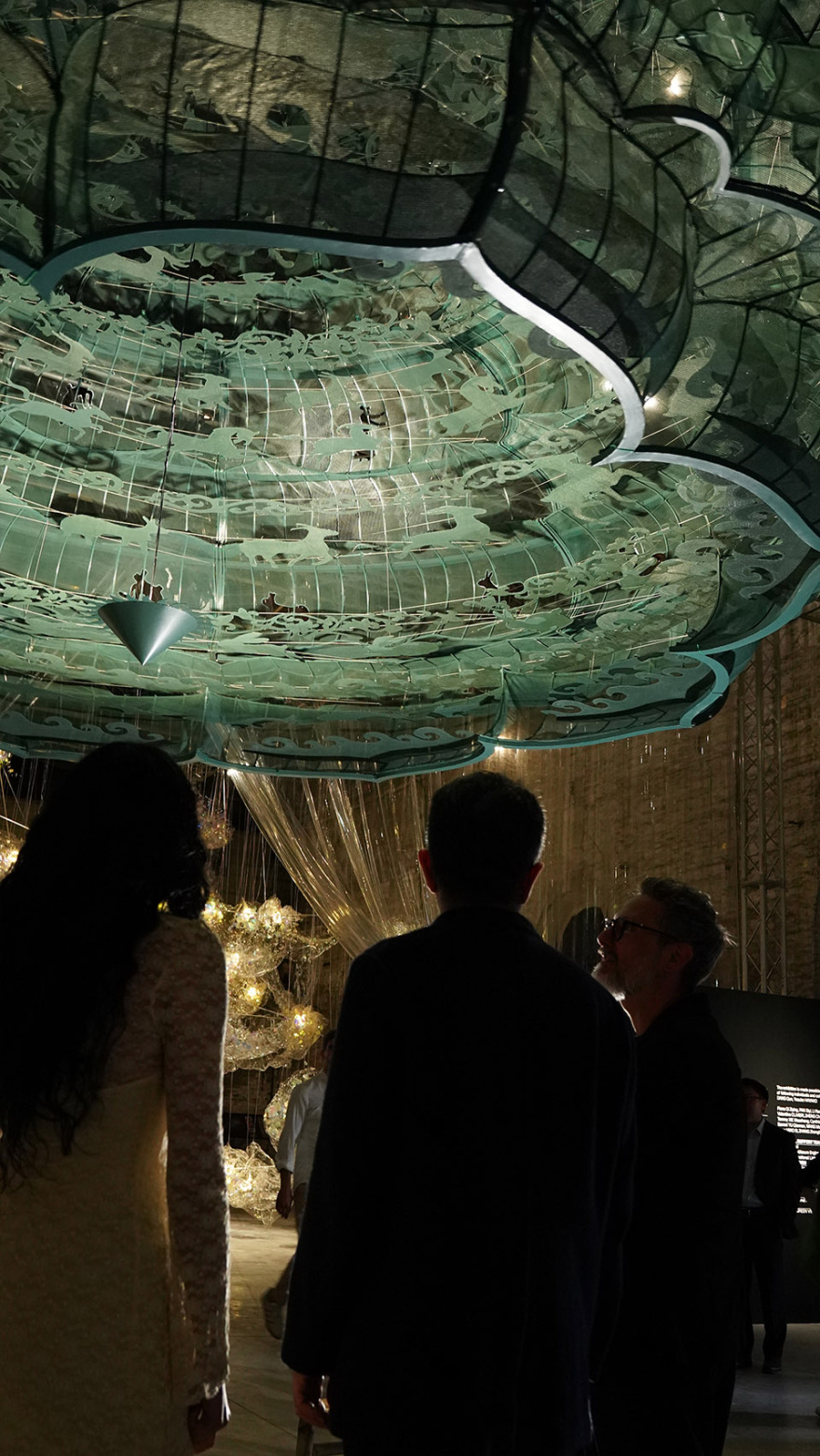
在《苍穹》装置作品中,我们借鉴了19世纪早期动画装置——费纳奇镜(Phenakistoscope)的原理,即通过旋转的圆盘和镜面反射,利用人眼的视觉暂留效应,将静态图像转化为连续的动态影像。作品结构分为“天、地、人、神”四个章节,围绕装置中心轴,逐层旋转,静态图像逐渐转化为动画——飞鸟幻化为鹿,鹿蜕变为人,鱼形流转为兔,云纹交织生变——一系列循环往复的意象转化,将观众带入万物生生不息的动态叙事。观众从外部便能通过镂空纹样窥探故事的片段,进而被吸引,不由自主地步入装置内部,在“苍穹”之下,通过循环的影像,全身心地体验沉浸式的动态叙事,感受中国人对美好生活的想象与憧憬。▼运用费纳奇镜原理创作的剪纸作品,
A paper-cutting work created using the principal of the phenakistoscope©Matthias Brown

▼《苍穹》中的万物流动转化的循环图腾,
Celestial Totem of the Cyclical Flow and Transformation of All Things©PILLS Architects
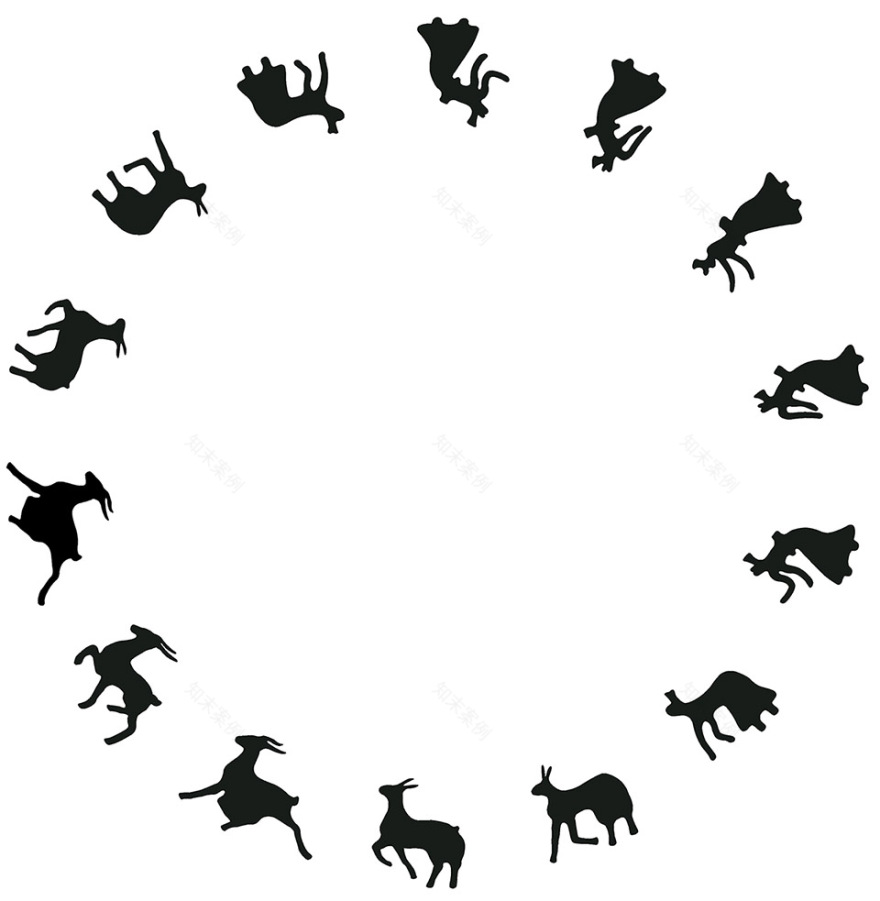
In the installation “The Vault of Heaven”, we draw inspiration from the principle of the Phenakistoscope, a 19th-century animation device that transforms static images into continuous motion through a rotating disk and mirror reflection, leveraging the visual retention effect of the human eye. The structure of the work is divided into four chapters: “Heaven, Earth, Man and God”, rotating layer by layer around the central axis of the installation. The static images gradually transform into animations—the flying bird morphs into a deer, the deer into a human, the fish flows into a rabbit, and the cloud patterns interweave and shift. This series of recurring image transformations immerses the viewer in the dynamic narrative of the endless cycle of life in all living things. The audience, drawn in by glimpses of the story through the intricate, hollowed patterns, are naturally led into the heart of the installation. Beneath the “vault of heaven,” they experience an immersive dynamic narrative through looping imagery, fully engaging with the Chinese vision and longing for an ideal life.
▼《苍穹》中的动态叙事,The Dynamic Narrative in Vault of Heaven©PILLS Architects
4 绿网再生——废料变展品的可持续实践
Upcycling As a Practice of Transforming Waste into Exhibits
中国是世界上建筑业规模最大的国家,每年产生大量废弃的建筑垃圾。在建设施工工地中,常见的围挡设施——工程防护绿网,成为了我们关注的对象。设计团队邀请了11家国内建筑事务所,从不同地域的正在施工的工地采集回收了施工绿网,作为装置的主要材料,让废弃物资源化,完成了“废料-设计-展品”物质循环的全过程。这样的设计创作本身犹如一场“微型策展”,构筑起一个象征性的中国建设现场集合图景。
China has the largest construction industry in the world, generating a large amount of discarded construction waste every year. The green safety net, a common fencing feature at construction sites, has become the focal point of our attention. The design team invited 11 Chinese architectural firms to collect and recycle green construction nets from ongoing sites across different regions of China, using them as the primary material for the installation. This approach transforms waste into a resource, completing the full material cycle of “Waste-Design-Exhibit.” This design creation itself is like a “micro-curation,” constructing a symbolic panorama of a Chinese construction site.
▼施工防护网作为装置的主要材料,Construction Safety Mesh as the Primary Material of the Installation©网络

▼《苍穹》防护网的编织制作过程,Weaving Process of the Safety Mesh©PILLS Architects

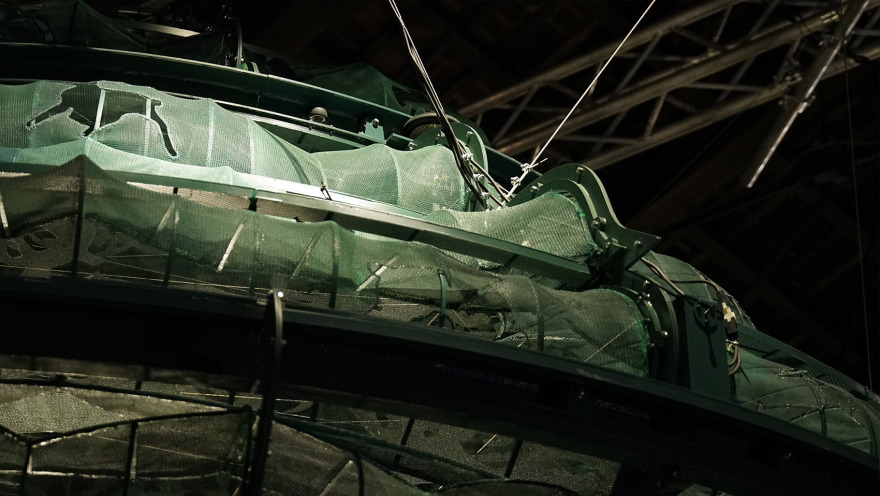
在制作过程中,团队刻意保留网布原有的使用痕迹和自然褪色,通过手工缝制强化材料的真实质感。这种带有不同工地记忆和痕迹的材料,经过拼贴重构,又产生了新的文化表达和价值。最后呈现的作品突破物质循环的框架,成为具有人类学价值的中国建造现场的样本。“不完美”的拼贴,反而赋予了作品独特的叙事张力和体验。
▼《苍穹》结构平面示意,Diagram of Structural Layout©PILLS Architects

During the production process, the team deliberately preserves the original traces of use and natural fading colors of the mesh, and reinforces the authentic texture of the material through hand-stitching. This material, which carries the memories and traces of different construction sites, is reconstructed through collage to create new cultural expressions and values. The final work breaks through the framework of material cycles and becomes a sample of Chinese construction sites with anthropological value. The imperfect collage, on the contrary, gives the work a unique narrative tension and experience.
▼《苍穹》实景照片,Onsite photo©PILLS Architects
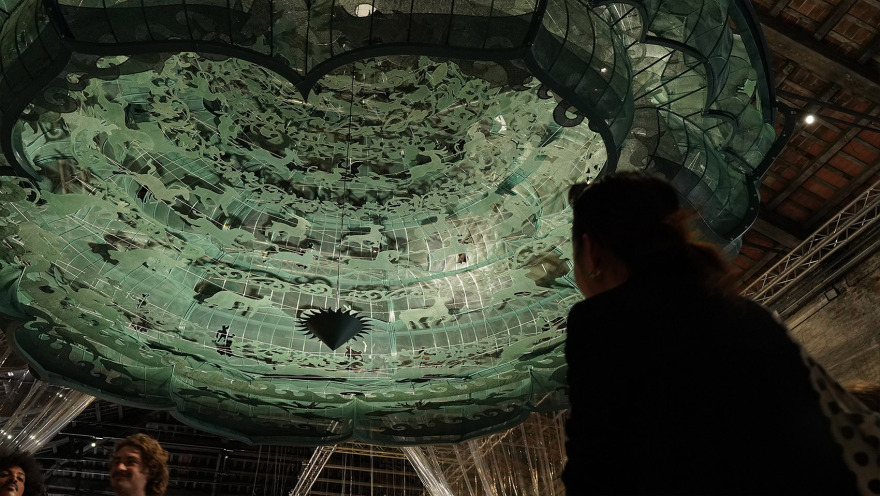
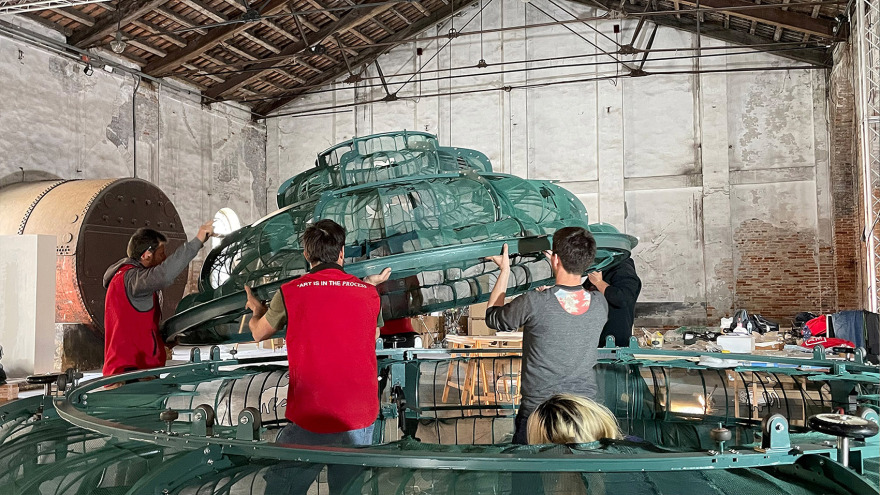
装置的主体结构采用铝制框架配以机械传动系统,次级结构则运用了中国传统灯彩的非遗竹编工艺,展现传统工艺与现代技术的融合。整体结构分为三部分:中央稳固而立,顶部轻覆其上,底部灵动悬垂,均由八个预制单元构成,并于现场螺栓拼接。每处细节皆经精密的结构设计,以确保装置的运行精度与整体美感,将最初构想转化为富有文化意蕴的实体作品。
The installation’s main structure is constructed from an aluminum frame with a mechanical motor system, while the secondary structure is crafted using bamboo weaving—a traditional Chinese lantern technique recognized as intangible cultural heritage. This technique exemplifies the fusion of traditional craftsmanship and modern technology. The overall structure is divided into three parts: the central layer remains static, the top is elevated, and the bottom is suspended, all composed of eight prefabricated units bolted together on-site. Every detail of the structure has been meticulously designed to ensure both precise functionality and aesthetic coherence, transforming the initial concept into a tangible work of cultural significance.
▼《苍穹》运动结构细部,Detail of the Kinetic Mechanism©bespoke

5 四维声场——用音乐编织循环宇宙的万象交响
Quadraphonic Soundscape: Music Weaving an Immersive Cosmos
▼《苍穹》中的四维声场,Quadraphonic Soundscape within Vault of Heaven©PILLS Architects
The music, composed by musician Xiao He, perfectly aligns with the creative concept of “The Vault of Heaven”. Four speakers are accordingly placed in the four cardinal directions—East, West, South, and North—representing “Heaven, Earth, Humanity, and the Divine,” each facing the center of the installation. On-site, a four-track audio loop plays simultaneously. Because the actual duration of each track varies, the ensemble creates an intertwined soundscape with no single repeated moment. The overlapping tracks of the work reveal a cyclical and ever-changing universe. At this point, the grand musical narrative and the work become one, providing the audience with an ultimate audio-visual experience.
▼《苍穹》实景照片,Onsite photo©PILLS Architects

结语
Conclusion
在气候危机加剧的今天,《苍穹》的叙事超越了可持续理念在技术层面的探讨,它通过建设现场废弃围挡的回收再设计,将工业文明的废弃物转化成了诗意的动态叙事装置,将“天人合一”、“生生不息”的自然观带入现代语境。作品表达了人与自然和谐共栖的理想愿景,唤醒建筑界与公众从根本上反思:如何以谦卑之姿重塑人与自然的关系,共同走向万物共生的未来。
In today’s escalating climate crisis, The Vault of Heaven goes beyond a technical exploration of sustainability. It reimagines the abandoned safety nettings from construction sites, recycling and redesigning them into a poetic, dynamic narrative device. By transforming the waste of industrial civilization, the work brings the philosophical concepts of the “unity of man and nature” and “unceasing life” into a modern context. The work expresses the ideal vision of man and nature living in harmony, awakening the architectural community and the public to reflect fundamentally on how to reshape the relationship between man and nature with humility, and work together towards a future of coexistence.
▼《苍穹》实景照片,Onsite photo©PILLS Architects
▼现场搭建过程照片,Construction image©PILLS Architects

▼主结构加工制作,Fabrication of the Main Structure©PILLS Architects

▼中国传统竹结构骨架加工制作,Fabrication of Traditional Chinese Bamboo Framework©PILLS Architects

项目名称:苍穹(Vault of Heaven)
项目类别:装置
参展建筑师:王子耕
设计团队:PILLS / 王子耕,汪曼颖,刘晨瑶,吴芳妮,任宇晴
结构团队:bespoke. Sur-Mesure Engineering Studio / Florian Rochereau
音乐:小河
装置制作团队:UAP
手工竹编制作团队:潍坊天成飞鸢风筝有限公司
创作时间:2025年2月
施工安全网来自以下事务所(排名按字母顺序):BUZZ建筑事务所,大舍建筑设计事务所,家琨建筑事务所,矶崎新+胡倩工作室,line+建筑事务所,MAD建筑事务所,趣城工作室,汤桦建筑设计,URBANUS都市实践建筑设计事务所,纬图设计,源计划建筑师事务所
展期:2025年5月10日至2025年11月23日
地点:威尼斯国际建筑双年展中国馆
Title: Vault of Heaven
Type: Installation
Dimensions/Duration: Diameter 5 meters, Height 2.8 meters
Exhibiting Architect: Zigeng Wang
Design Team: PILLS
Structural Team: bespoke. Sur-Mesure Engineering Studio
Music: Xiaohe
Installation Production Team: UAP
Handmade Bamboo Weaving Production Team: Weifang Tiancheng Flying Kite Co.
Design Period: Feb. 2025
Construction Safety Nets from the following companies (ranked in alphabetical order): ARCity Office, Atelier Deshaus, BUZZ Architects, ISOZAKI+HuQian Partners, Jia Kun Architects, line+ studio, MAD, O-Office Architects, Tanghua Architect & Associates, URBANUS, WTD GROUP
Exhibition dates: Saturday 10 May to Sunday 23 November 2025
Location: China Pavilion, Biennale Architettura 2025


南京喵熊网络科技有限公司 苏ICP备18050492号-4知末 © 2018—2020 . All photos and trademark graphics are copyrighted by their owners.增值电信业务经营许可证(ICP)苏B2-20201444 苏公网安备 32011302321234号
苏公网安备 32011302321234号客服
消息
收藏
下载
最近