

创作上传
VIP
收藏下载
登录 | 注册有礼
查看完整案例

收藏

下载

分享
Multi-material House
Amplifying Nature
a research project, CENTRALA, 2021-ongoing, first presented at SAFE SPACE exhibition at Dizajn BWA Wrocław, 17 June – 18 September 2022
Weathering: Chronobiological Architecture and Handing Over Control
solo exhibition, VI PER GALLERY, Prague, 16 December 2022–18 February 2023
a research project, CENTRALA, 2021-ongoing, first presented at SAFE SPACE exhibition at Dizajn BWA Wrocław, 17 June – 18 September 2022
Architecture as a sensual appreciation.

The multimaterial house, in which each room is made from a different natural material, is a challenge to our understanding of domestic comfort. It allows us to experience the way in which natural matters modulate the temperature, air circulation, humidity, microclimate, acoustics, smell. It encourages us to perceive domestic space in all its sensory components. The variety of materials in terms of thermal properties lets us appreciate the nuances of thermal efficiency—harmonizing architecture with the diurnal rhythm of the surroundings. At the same time, natural matter allows us to share space with species other than human. It tests our sense of permanence/ephemerality. To what extent the unpredictable powers of putrefaction or decay, noises and traces of destruents decomposing the architecture we inhabit form clusters of fear/peace.

Who knows, matter living in perpetual transition may as well strengthen rather than repel us. The presence of neighbours may reinforce our sense of participation in natural phenomena, the trajectory of the planet’s life. The edifice lives and decomposes, although in a different pace than our body. A house in which we can spend each night of a week in a room from a different natural material checks which complex of sensations is our favourite. The rooms: stone, earth, clay, ceramic, wood, straw, linen. The project refers to the old Polish tradition of ogacanie—insulating houses, barns, cowsheds and beehives for winter by wrapping them in a layer of conifer needles, moss and manure, which emitted warmth and decayed during the winter season.
Multi-material House follows Bernard Rudofsky’s notion of architecture as a sensual appreciation, creating different microclimates and encouraging us to perceive domestic space in all its sensory components. The project is inspired by CENTRALA’s workshop experience at the Kharkiv School of Architecture, as well as conversations with Ola Kędziorek and Janek Dowgiallo.

Multi-material House, material sample – wood, Dizajn BWA Wrocław, 2022, photo: Simone De Iacobis
The wooden room
Walls: of thick 25×25 cm square logs, North wall with [pl.] ogata –a fence made of planks and wicker weave; it refers to the old Polish tradition of ogata, insulation of houses by wrapping them in a layer of pine needles, moss and manure, which emitted heat, rotting away in winter.
Roof: of wood shingles.
Floor: wooden paving, a terrace of planks from fruit-bearing trees that give smell when heated.
Thermal efficiency: heavy mass is slow to cool down and to heat up.
Co-residents: common furniture beetle (Anobium punctatum), woodboring beetle (Hylotrupes), jet ant (Lasius fuliginosus), [pl.] Gryzyk, confused flour beetle (Tribolium confusum)
Biocorrosion: slow.

Multi-material House, material sample – stone, Dizajn BWA Wrocław, 2022, photo: Simone De Iacobis
The stone room
Walls: heavy stone walls, 80 cm in thickness.
Roof: of slate.
Floor: stone floor, neighboring rock garden, erratic boulders on gravel.
Thermal efficiency: very high, always keeps cool, one may shiver with cold in it on hot nights.
Co-residents: lichen, moss, silverfish (Lepisma saccharinum), mineral efflorescent, grove snail (Cepaea nemoralis), spider (Tegenaria domestica), common earwig (Forficula auricularia), cellar fungus.
Biocorrosion: very slow.

Multi-material House, material sample – straw, Dizajn BWA Wrocław, 2022, photo: Simone De Iacobis
The straw room
Walls: of compressed cubes of dry stalks of threshed crops, 40 cm in thickness, covered with straw, braids and weavings of fibrous plants.
Roof: thatched, following the tradition of [pl.] chochoły – sheaves covering plants in cold weather.
Floor: of mats and straw mattresses, raised for ventilation.
Thermal efficiency: heats up quickly after dawn and cools down quickly after dusk.
Co-residents: elymus (plant), house sparrow (Passer domesticus), house mouse (Mus musculus), mold, flour mite (Acarus siro), caddisflies (Trichoptera), bloodworm (midge larvae), wheat weevil (Sitophilus granarius).
Biocorrosion: rapid.

Multi-material House, material sample – textile, Dizajn BWA Wrocław, 2022, photo: Simone De Iacobis
The textile room
Walls: linen mesh fabric, wool rigging.
Roof: linen mesh fabric.
Floor: plant fiber mats.
Thermal efficiency: zero, the space is entirely in tune with the environment, only sunlight exposure can be leveled.
Co-residents: common clothes moth (Tineola bisselliella), aeroplankton, neighboring linseed meadow and pond microcosm.
Biocorrosion: rapid.

Multi-material House, material sample – earth, Dizajn BWA Wrocław, 2022, photo: Simone De Iacobis
The earth room
Walls: dugout (earth lodge) made of rammed earth, 100 cm wide, partially dug in.
Roof: turf-covered, hill-shaped, slope windows with bioactive windowsills – soil containers.
Floor: earthen floor.
Thermal efficiency: very high, perpetual cold.
Co-residents: turf, actinomycetes Gram-positive bacteria releasing the smell of geosmin, earthworm (Lumbricus terrestris), fly (Drosophila melanogaster), mole, potworms (Enchytraeidae), tardigrades, fungus.
Biocorrosion: fairly slow.
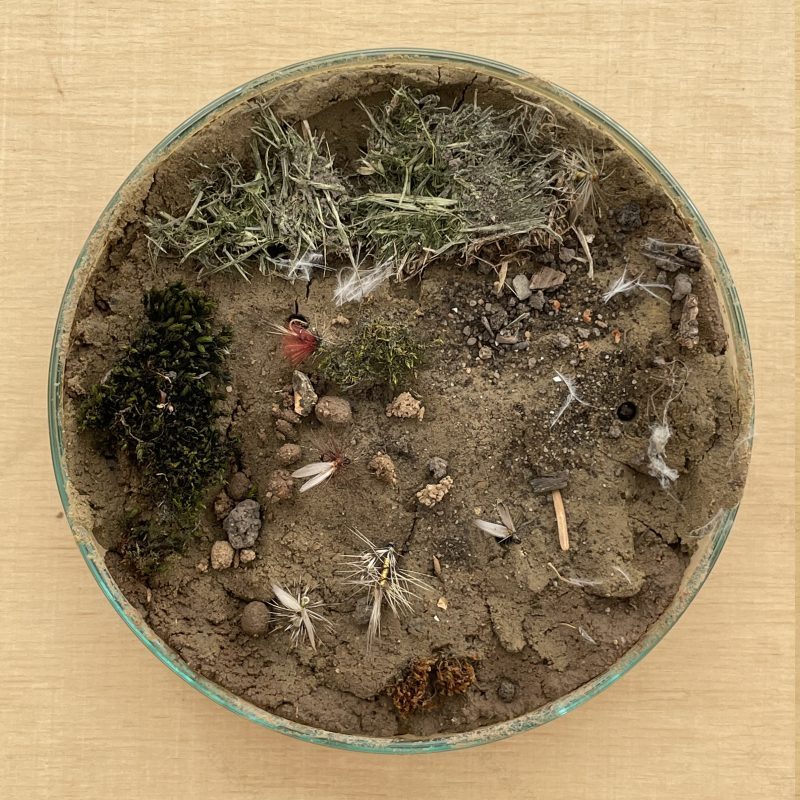
Multi-material House, material sample – clay, Dizajn BWA Wrocław, 2022, photo: Simone De Iacobis
The clay room
Walls: 60 cm in thickness, made of unfired clay bricks with fibrous admixtures (fur hair, dung); on the outside insects nest at a depth of ca. 6 cm; interiors finished with smearing [pl.] mazanka.
Roof: of [pl.] glinoszkudły (made of straw shingles, adhered with clay).
Flooring: clay layer.
Thermal efficiency: thermal stability results in long periods of heating up and cooling down while absorbing and releasing moisture quickly; relative humidity of 50-60%, very beneficial for humans.
Co-residents: hairy-footed flower bee (Anthophora plumipes), earth-boring dung beetle (Geotrupes stercorarius).
Biocorrosion: slow.
Inspirations


Wood for wardrobes was chosen not only for its appearance – mahogany neutralizes unpleasant odors, and orange wood repels moths. Villa Stiassni in Brno. Photo Simone De Iacobis, 2020


“Słomianki” (straw mat) warmed the wall next to the bed and gave off a soothing smell (like Japanese tatami mats). Photo Małgorzata Kuciewicz, 2021
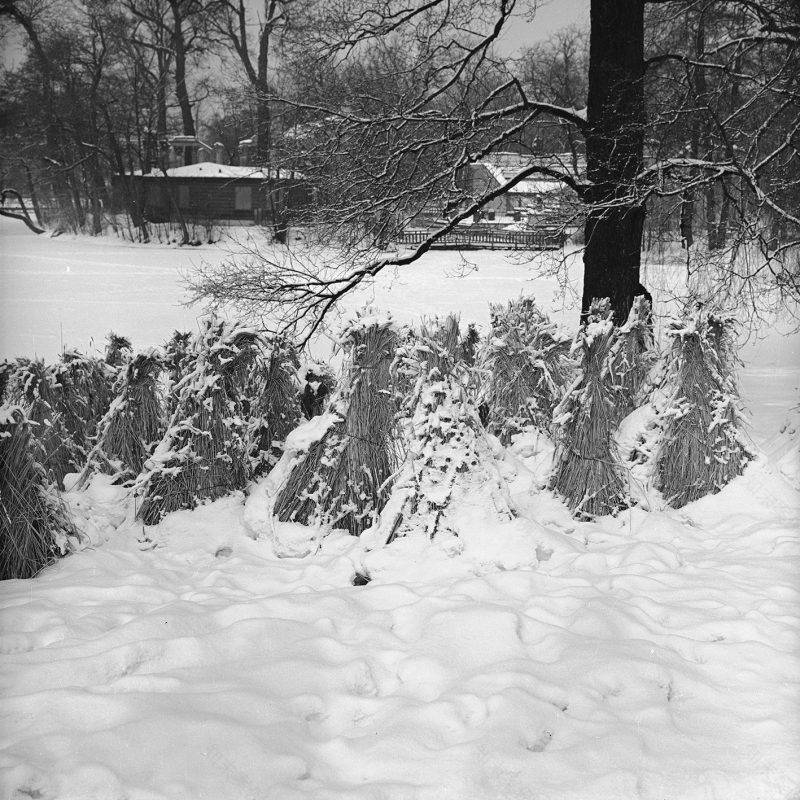
Chochoł roughly translated as “sheaf”, is a word describing the straw covering that had been prepared for the autumn and winter seasons in order to protect delicate shrubs. Photo Grażyna Rutowska, 1978, NAC 40-W-239-17
Multi-material House was first mentioned in frame of the Second Climate Plateau of Contemporary Art. Watch the video (in Polish but English subtitles available):
Climate Plateau of Contemporary Art is a platform for cooperation to reduce the art world’s negative impact on climate and the environment and share knowledge and best practices. More information at:
on view
Weathering: Chronobiological Architecture and Handing Over Control solo exhibition, VI PER GALLERY, Prague, 16 December 2022–18 February 2023
南京喵熊网络科技有限公司 苏ICP备18050492号-4知末 © 2018—2020 . All photos and trademark graphics are copyrighted by their owners.增值电信业务经营许可证(ICP)苏B2-20201444 苏公网安备 32011302321234号
苏公网安备 32011302321234号客服
消息
收藏
下载
最近