

创作上传
VIP
收藏下载
登录 | 注册有礼
查看完整案例

收藏

下载

分享
Okana center for change
Okana, Kenya
Laura Straehle, Ellen Rouwendal
Okana center for change is a pavilion in Kenya designed with a goal to build an empowering place for the local community to share knowledge and establish meaningful relations with the place. The project is a successful example of a low-tech solution that can be replicated in other regions of Africa.
“What if students were able to make change for the poor regions of the world with a small scale intervention in architecture?’’ was a challenge Laura Katharina Straehle and Ellen Rouwendal, master students of TU Delft, had decided to take in 2016.
Laura and Ellen, during their final year of studies, set up their own Design-Build-Studio and made their decision to design and build in Okana after reaching out to the local NGO. They flew to Kenya and spend 3.5 months doing research, interviewing local inhabitants and coming up with a design that would respond to the local community needs.
At the beginning, there was no design task defined, no partnerships, budget or guaranteed financing. The students took the challenge and started from zero, defining the design task, acquiring the funds and realising the project not just as architects but also as project managers, entrepreneurs and coordinators of all workers and stakeholders.
They collected financial support from private donors, companies, organisations and the German Federal Ministry for Economic Cooperation & Development.
Acquiring funding, managing the 2nd phase of construction and organising the project management on site challenged this Design-Build-studio. Laura reached out to Architecture-in-Development which eventually helped scout the site manager and many passionate volunteering architects supporting the realisation of the second construction phase.

Pavilions aerial view

Pavilions street view
Okana is a rural village of 5000 inhabitants in west Kenya lying next to Victoria lake. The local society is very united, sharing in happiness and sadness and relying heavily on rural activities and communal living. The locals see the future by investing in the young generation and giving them opportunities to realise their potentials.
In many African societies, families have limited access to education. The community of Okana also lacks access to the internet and ICL trained professionals.
The design idea for the community centre in Okana was inspired by the local Acacia Tree which is a popular meeting point for all community members. Underneath the tree, people find a shadow place to hide from the bright sun or protection from heavy rains during the rainy season. This tradition was translated into an architectural roofscape - a pilot building principle suitable to be applied in other locations than Okana, yet able to be modified by individual spaces underneath.
Named as the Center for Change, the project consists of six pavilions providing space for ICT facilities, a library, office space for the NGO, a tailoring workshop, a cafeteria & bakery and a community space underneath the big Acacia tree for social interaction where people could gather, learn, discuss and celebrate. Although the main focus was the youth, the centre has transitioned from its initial program and currently runs projects and events for the whole community. During the pandemic, the tailoring workshops and exterior space was used to organise informational days and receive donations to cover the costs. From that point onwards, the local community has been very active, coming up with creative and new projects, like tree planting block the wind around the site.
Completed within two years, the pavilion gained recognition widely, winning several awards including the Dezeen award of Small building of the year in 2018.
Judges comments: "A thoughtful and surprisingly rich collection of spaces. There’s evidence of care and thought across the scale, from the bookcases cast into the columns to the perforated facade that casts dappled light into the interior and provides natural ventilation. A successful marriage of architectural ambition and the needs and practicality of setting up a school."

Entrance

Cafeteria Terrace
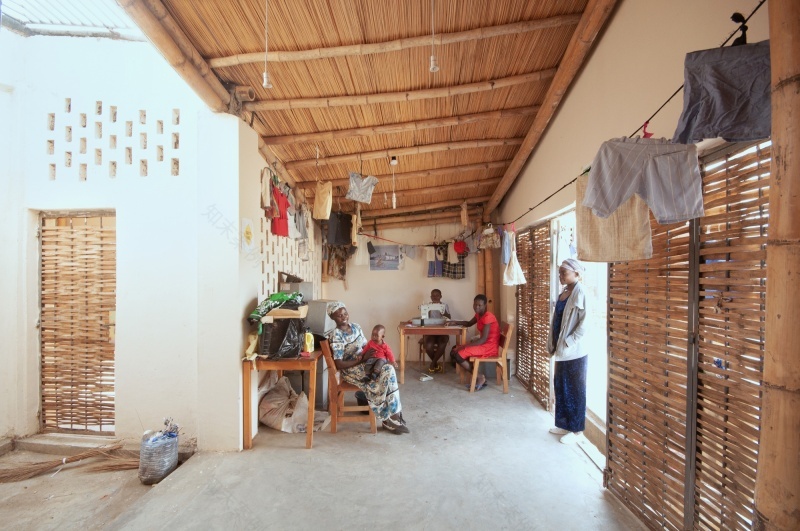
Tailoring Workshop

Tailoring Workshop Shop

Library

Community space

Community space
The regions around Lake Victoria have tropical rainforest climate with heavy rainfall during the rain season. The design goal was to find answers to how climate, local methods and materials can be brought together with smart and understandable construction principles and an appealing design feasible in the context.
The abundance of local bamboo and rainwater collection was taken into consideration when defining the materials and building techniques. An innovative roof construction coupled with bamboo as a building material (instead of eucalyptus) enables rainwater collection and sun power and provides naturally ventilated spaces. The main structure made out of bamboo creates a 64sqm column free space underneath. The shape of the roof, the open courtyard and the permeable walls provide optimal water catchment and a constant breeze creating optimal living conditions during the hot season.
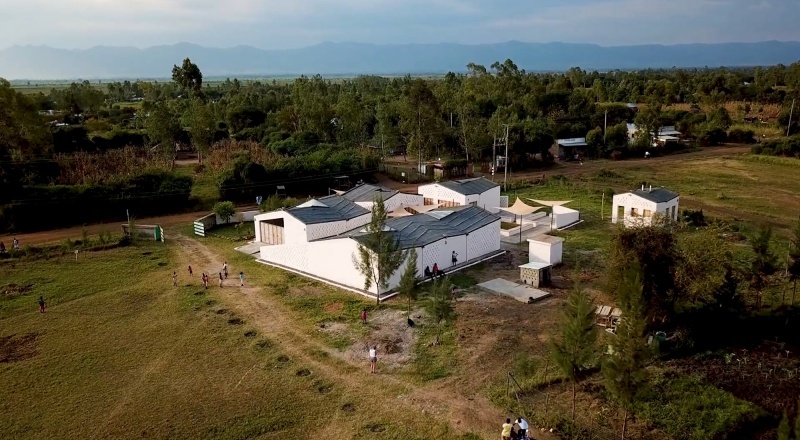
Site
Site
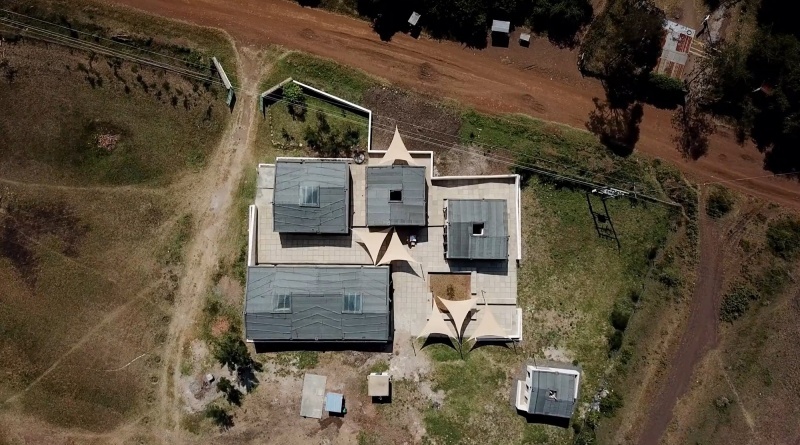
Aerial view
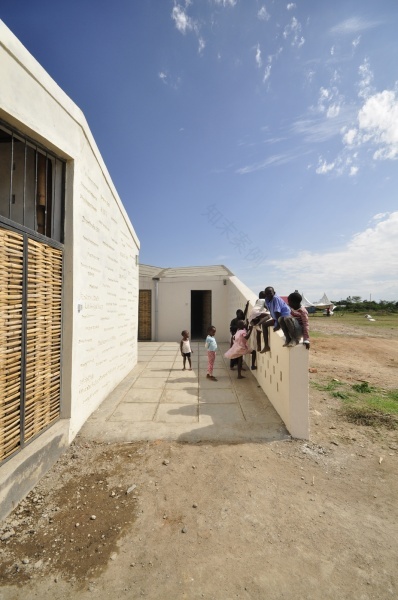
Entrance

Cafeteria Bakery

Kitchen

Tailoring Workshop

Tailoring Workshop

Local workers
南京喵熊网络科技有限公司 苏ICP备18050492号-4知末 © 2018—2020 . All photos and trademark graphics are copyrighted by their owners.增值电信业务经营许可证(ICP)苏B2-20201444 苏公网安备 32011302321234号
苏公网安备 32011302321234号客服
消息
收藏
下载
最近