

创作上传
VIP
收藏下载
登录 | 注册有礼
查看完整案例

收藏

下载

分享
项目位于浙江宁波郊区的山里,旁边是一个仿唐朝建筑风格的寺院,四周青山环绕,绿树成荫。业主从事文化艺术工作,在这里已经有一个工作室兼住宅,工作室旁边是一块不规则形状的空地。业主非常喜欢小动物,除了养狗和猫,还养了一些不同种类的鹅,其中一个水池里养了几只南美洲黑天鹅。为了在工作之余能和这些小动物们经常在一起,业主决定在天鹅池边建造一个小书屋,在里面能看到黑天鹅,可以边读书边和小动物们近距离互动。
The project is located in the mountains of Ningbo, Zhejiang, next to a monastery in the style of Tang Dynasty architecture, surrounded by green hills and shaded by trees. The owner is engaged in cultural and artistic work and already has a studio and residence here, with an irregularly shaped vacant lot next to the studio. The owner loves small animals very much, besides keeping dogs and cats, he also keeps some different kinds of geese, and there are several black swans from South America in one of the ponds. In order to spend more time with these small animals after work, the owner decided to build a small book house by the swan pond, where he can see the black swans and interact closely with the animals while reading.
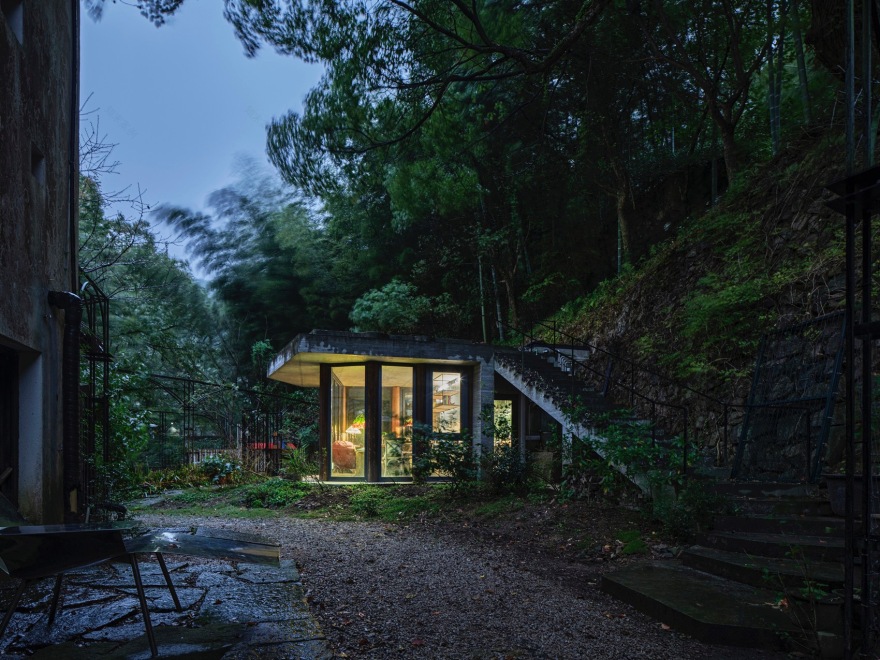
▼环境中的书屋,Bookhouse in the Environment © 胡文杰


▼外侧立面,Exterior Facade © 王善祥
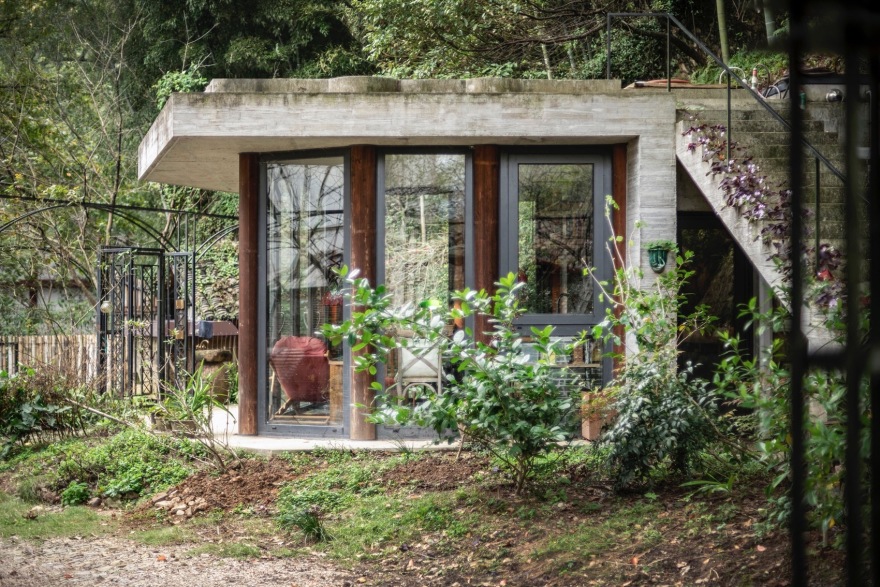
▼开着门的正立面,Front Elevation with Open Door ©胡文杰
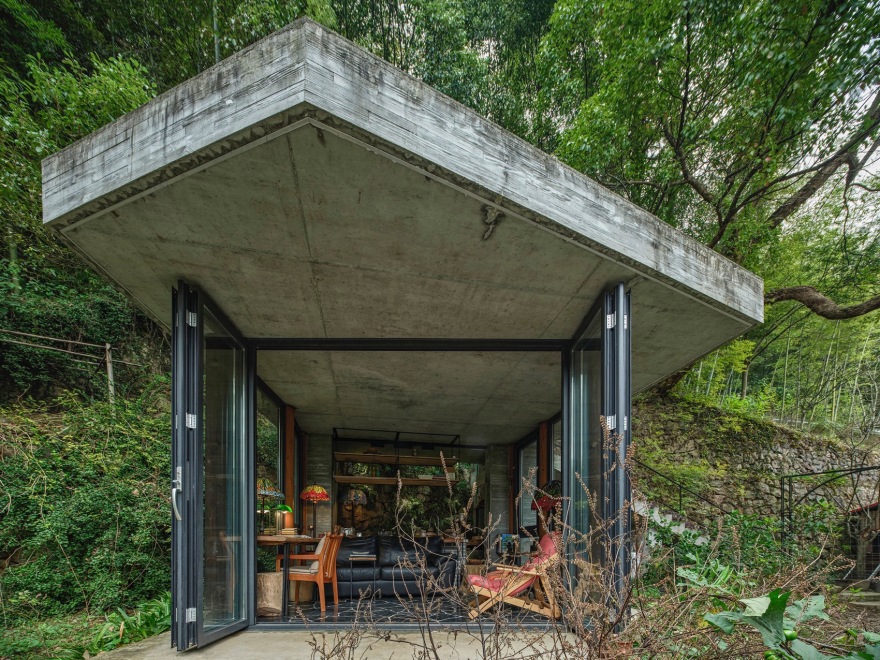
▼关着门的正立面,Front Elevation with Closed Door ©胡文杰

▼书屋与主建筑的关系,Relationship between the Bookhouse and the Main Building ©胡文杰

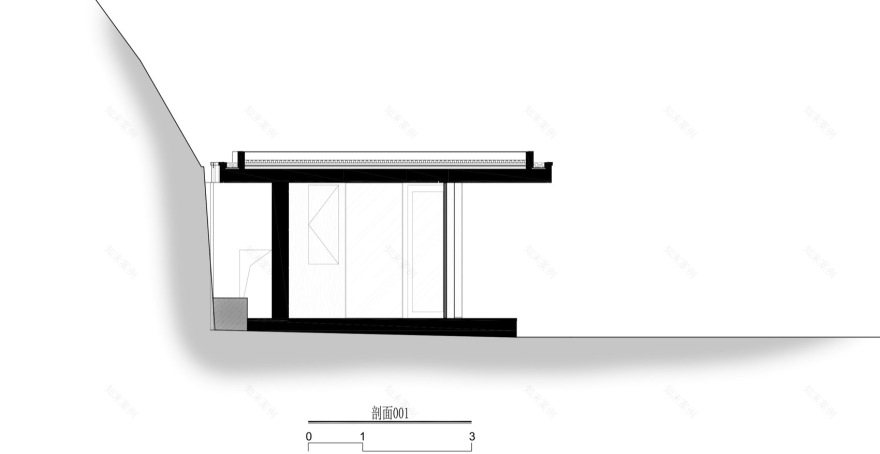
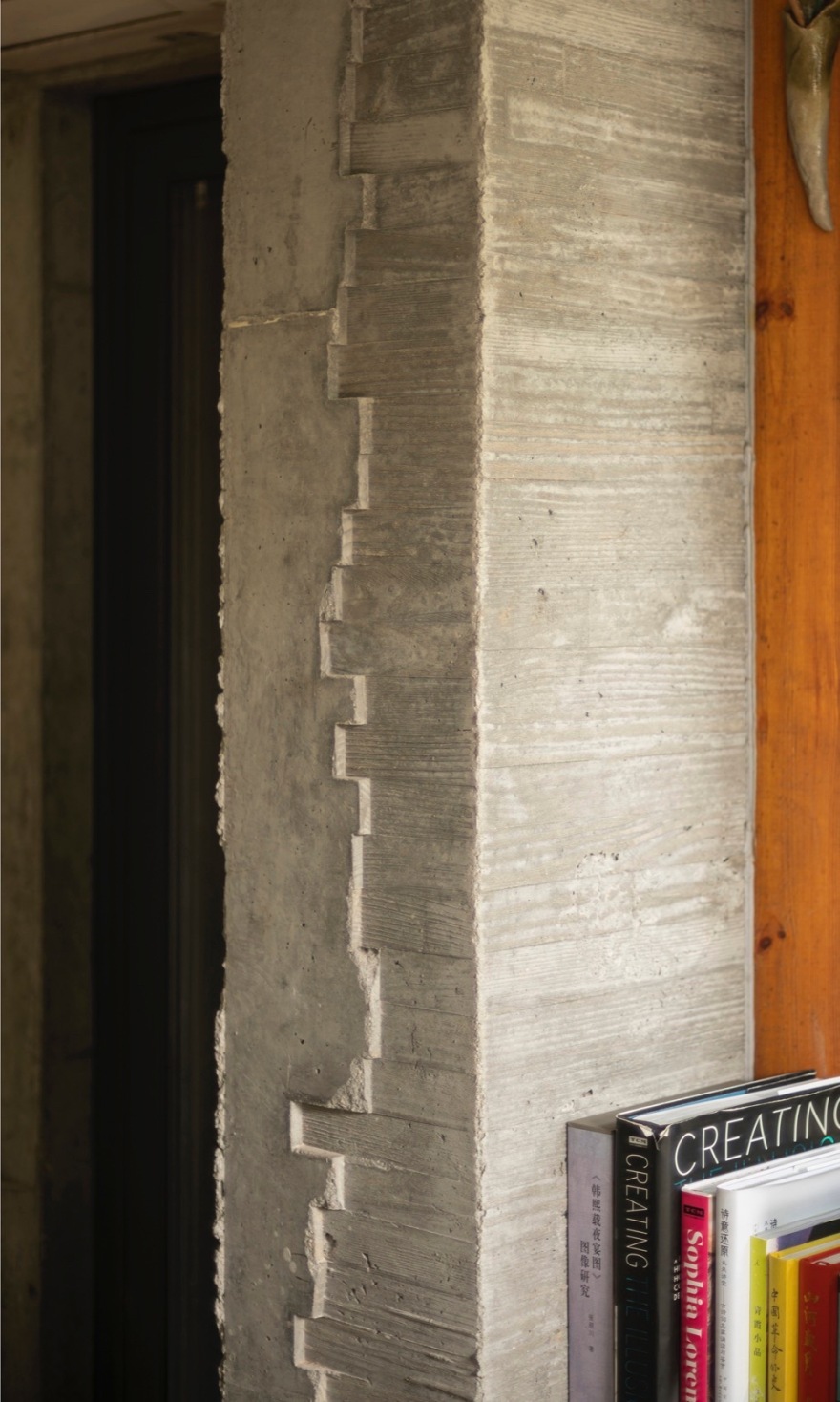
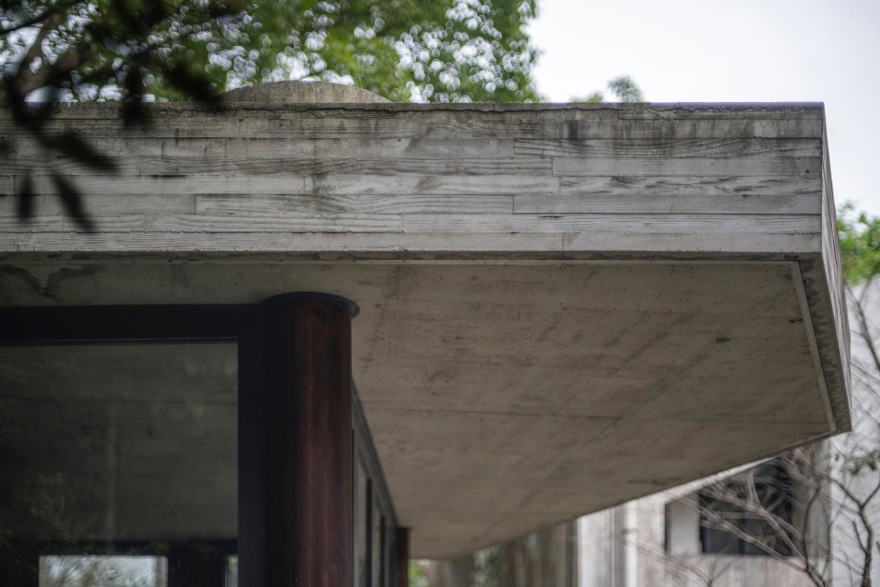
书屋并不大,建筑面积仅30平方米,背靠一片山坡下的石彻挡土墙。有一个楼梯可以上到平屋面上去,平屋面上种植花草,也有一定的保温作用。场地是个不规则的形状,业主现有的工作室也是一个不太规则形状的建筑,鹅池也是一个不规则形状,于是,书屋也设计成一个不规则平面的小建筑。相对于四平八稳的建筑布局,略有点异形的布局显得更加轻松一些。主体用钢筋混凝土建造,采用木条模板清水混凝土的效果。由于三个立面都是落地门窗,因此墙面并没有多少,屋顶最为突出。支撑屋顶的是一片后墙和五根钢管柱,钢管柱外部包了木材,使柱子看上去像是木柱子,包了木材的柱子也不会有冷桥问题,也是为了小空间尽量紧凑。平屋顶上可以种植花草。
▼构思草图,Sketch © 上海善祥建筑设计有限公司

▼方案模型,Scheme model © 上海善祥建筑设计有限公司
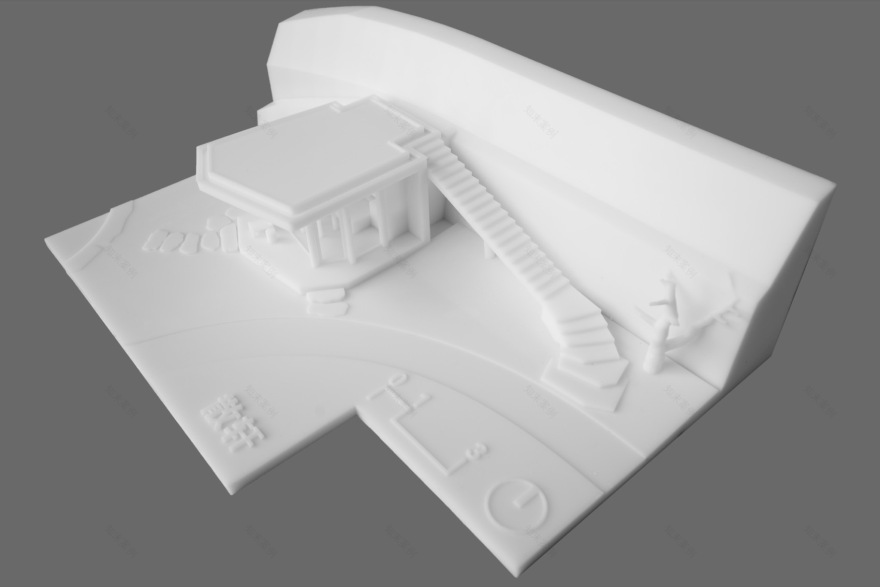


The book house is not large, with a building area of only 30 square meters, backed by a stone retaining wall at the foot of a hillside. There is a staircase leading to the flat roof, where flowers and plants are planted, also providing some insulation. The site is irregularly shaped, the owner’s existing studio is also an irregularly shaped building, and the goose pond is also irregularly shaped, so the book house is designed as a small building with an irregular plan. Compared to a stable and balanced architectural layout, the slightly irregular layout appears more relaxed. The main structure is built with reinforced concrete, using wooden formwork for the fair-faced concrete effect. Since three facades are floor-to-ceiling doors and windows, there are not many walls, and the roof is the most prominent. The roof is supported by a back wall and five steel pipe columns, which are wrapped in wood to make them look like wooden columns, avoiding cold bridge issues and keeping the small space as compact as possible. Flowers and plants can be planted on the flat roof.
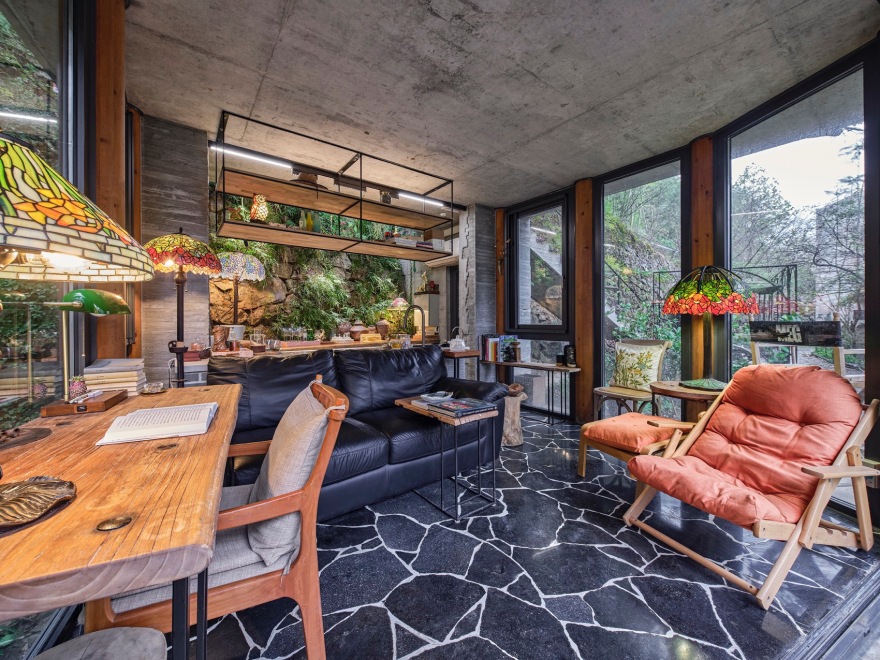
▼室内,Interior ©胡文杰


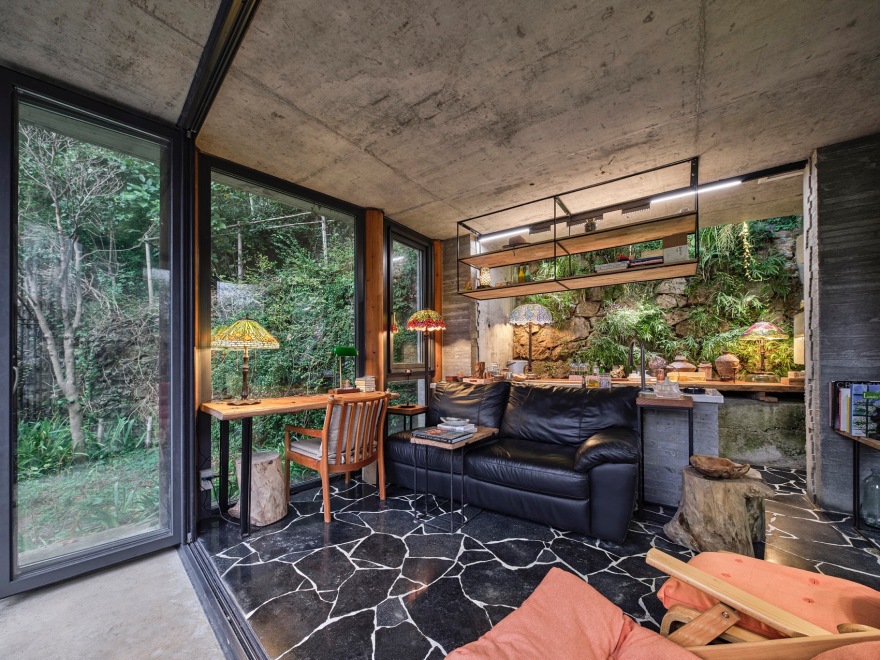
▼开门的状态,Open Door State ©胡文杰

▼关门的状态,Closed Door State©胡文杰
▼茶水吧,Tea Bar ©胡文杰

▼茶水吧后的原有挡土墙长满植物,Original Retaining Wall Behind Tea Bar Overgrown with Plants ©胡文杰

▼茶水吧上方的书架,Bookshelf Above Tea Bar © 王善祥

施工完成后与设计有一些偏差。在施工前业主改变了一些想法,比如靠挡土墙一侧原来设计了一面混凝土后墙,与挡土墙有800-1000mm间距,一是为了阻隔挡土墙后面山体的渗水湿气,二是为了防止挡土墙万一滑坡等隐患。业主取消了这面挡土墙,室内空间扩大到了挡土墙,又在石砌墙缝隙里种了些蕨类植物,充分利用了挡土墙的渗水湿气,当然平时也要一直开着空调除湿,否则室内湿气很重。植物墙成为了室内空间的一个重要元素。挡土墙前增加了一个水吧台,使用起来更方便。
There are some deviations from the design after the construction was completed. Before the construction, the owner changed some ideas. For example, a concrete back wall was originally designed on the side of the retaining wall, with a spacing of 800-1000mm from the retaining wall. One purpose was to block the seepage and moisture from the mountain behind the retaining wall, and the other was to prevent potential hazards such as landslides. The owner canceled this retaining wall, and the indoor space was expanded to the retaining wall. Some ferns were planted in the gaps of the stone wall, making full use of the seepage and moisture from the retaining wall. Of course, the air conditioner must be kept on for dehumidification, otherwise the indoor humidity would be very heavy. The plant wall has become an important element of the indoor space. A water bar was added in front of the retaining wall, making it more convenient to use.
▼取消了原设计后墙露出原有山崖挡土墙一条地梁,Original Design Rear Wall Removed, Exposing a Ground Beam of the Original Cliff Retaining Wall ©胡文杰

▼露出原有挡土墙,Exposing Original Retaining Wall ©胡文杰

▼露出原有挡土墙和一条地梁,Exposing Original Retaining Wall and a Ground Beam ©胡文杰

▼茶水吧后的原有挡土墙长满植物,Original Retaining Wall Behind Tea Bar Overgrown with Plants ©胡文杰
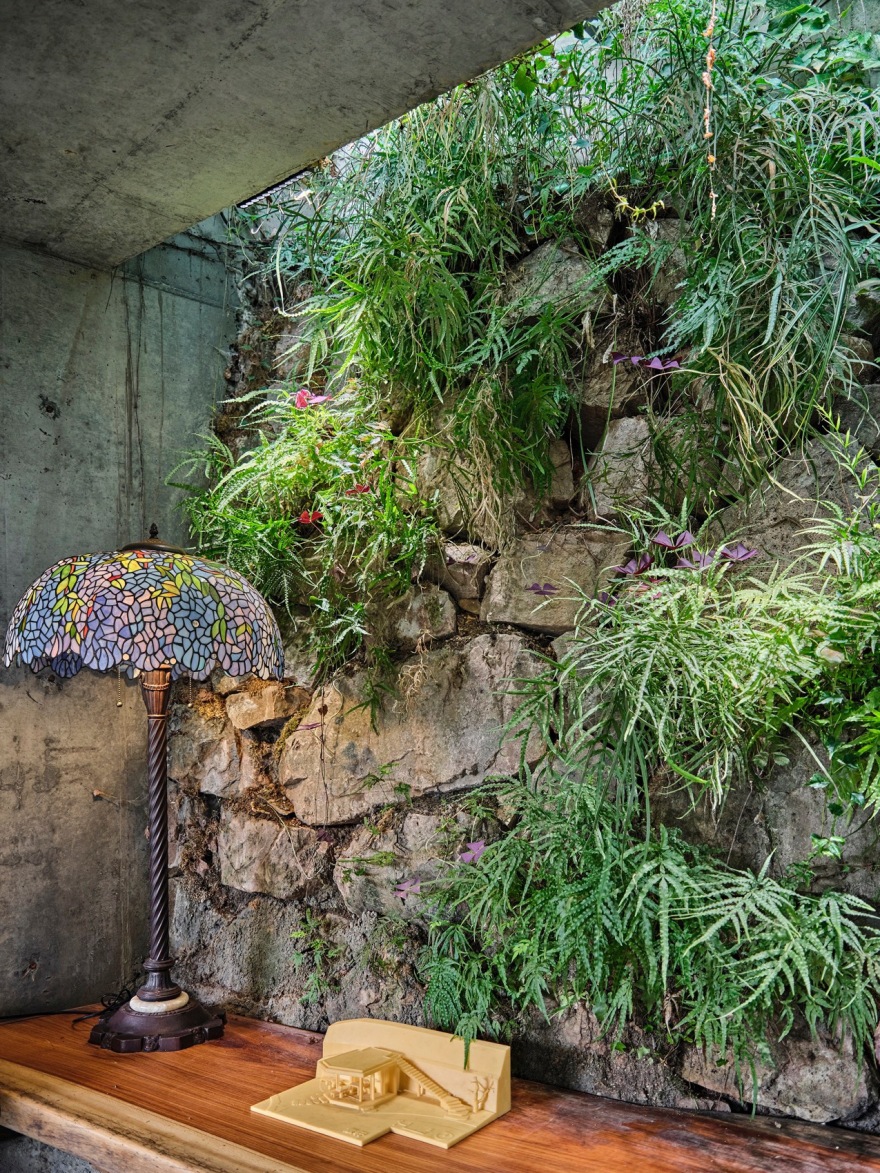
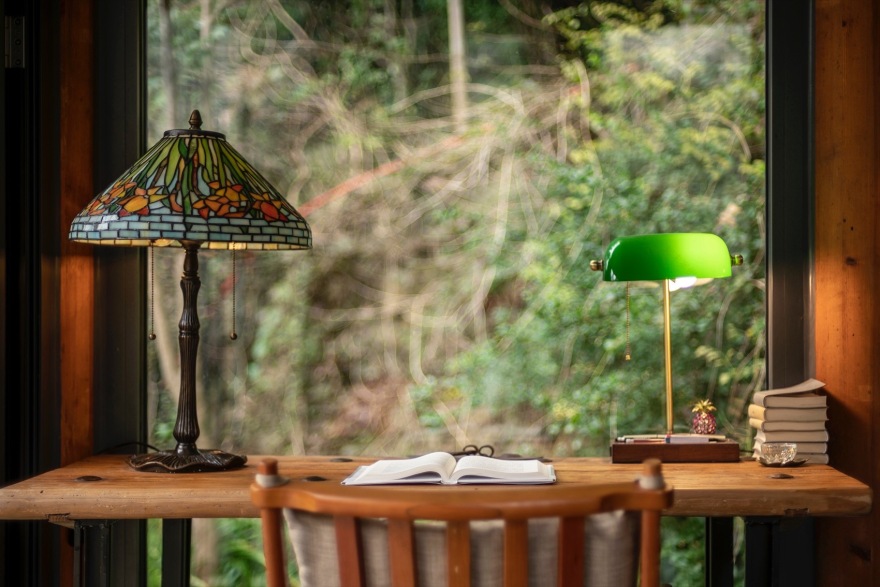
朝向鹅池原来设计的是一整块固定落地大玻璃窗,从室内看出去取景更完整。业主改成了可以推拉折叠的门窗,虽然空间的互动性更强了一点,但取景视角不如大玻璃完美。原设计的室内空间更加简约,主要是一个床榻、一个小书桌,还有一个茶水柜。业主改了室内的设计,装饰建材类型由业主自己做了确定。除了水吧台,放了一张大沙发、躺椅、角几等,另外还收藏了一些彩绘玻璃台灯,比之前更加丰富饱满。
Originally, a large fixed floor-to-ceiling glass window was designed facing the goose pond, providing a more complete view from the inside. The owner changed it to sliding and folding doors and windows. Although the spatial interaction is slightly stronger, the view is not as perfect as the large glass. The original design of the indoor space was more minimalist, mainly consisting of a bed, a small desk, and a tea cabinet. The owner changed the interior design, and the types of decorative building materials were determined by the owner. In addition to the water bar, a large sofa, a lounge chair, a corner table, etc., were added. Some stained glass table lamps were also collected, making the space richer and fuller than before.
▼书桌,Desk © 王善祥

▼书桌,Desk © 胡文杰


▼书桌细部,Desk Detail ©王善祥
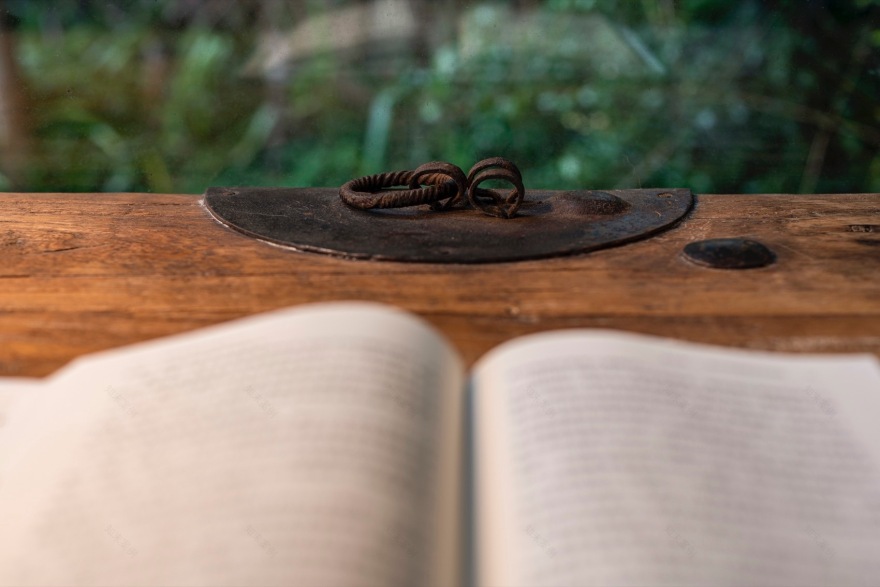
▼室内细部,Interior Detail ©王善祥

▼室内地坪细部和家具细部,Interior Floor Detail andFurniture Detail©王善祥


▼由室内望向室外鹅池,View from Indoor to Outdoor Goose Pond ©王善祥

▼从屋顶望向不远处的寺院,View from the Roof to the Nearby Temple ©胡文杰

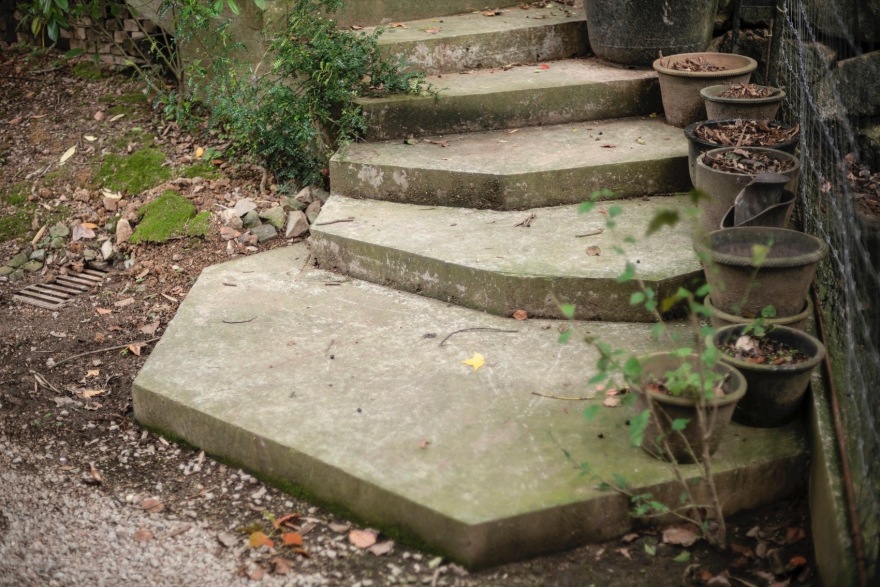
▼户外通向屋顶的楼梯,Outdoor Stairs Leading to the Roof ©王善祥
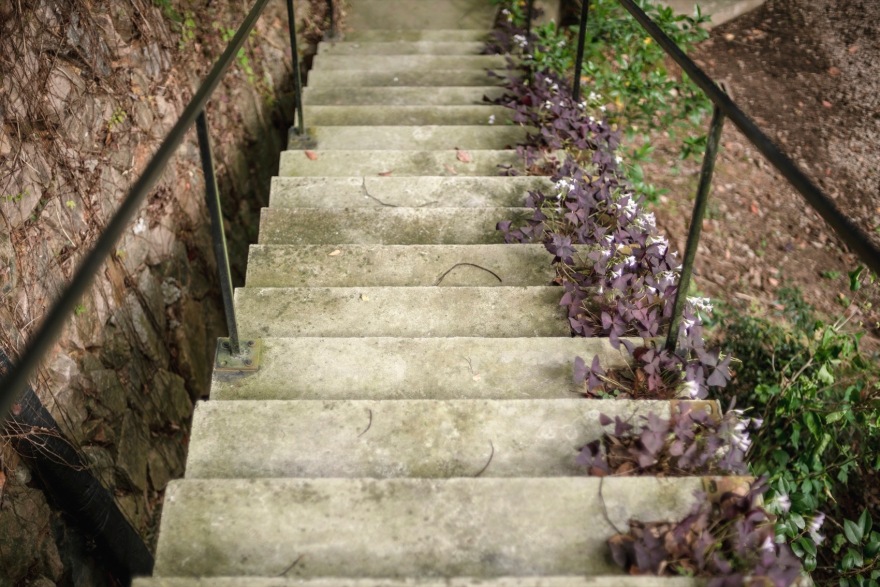
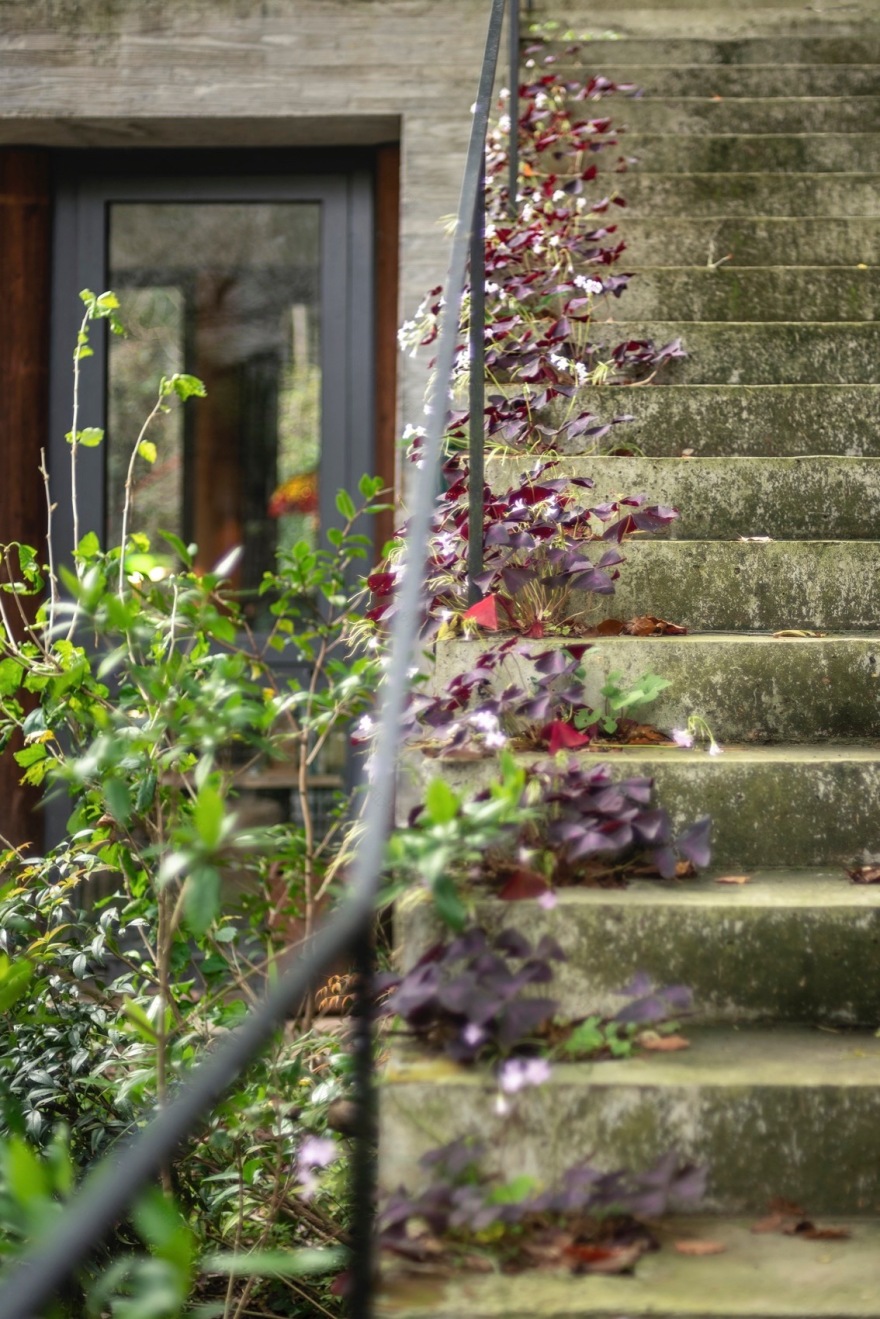
▼户外楼梯细部,Outdoor Stairs Detail © 胡文杰

▼户外楼梯边的花草,Flowers and Plants Beside the Outdoor Stairs ©王善祥

▼屋顶的花草,Roof Plants ©王善祥

作为设计师,当然希望每个项目的业主都完全按照设计实施,但是现实中其实每个项目都是与业主合作的结果,只是每个项目甲乙双方意见比例不同而已。
As a designer, of course, I hope that the owner of each project will fully implement the design. But in reality, each project is the result of collaboration with the owner, it’s just that the proportion of opinions from both parties varies in each project.
▼夜景,Night view©胡文杰

▼场地总平面,Master Plan © 上海善祥建筑设计有限公司

▼方案平面,Scheme Plan © 上海善祥建筑设计有限公司

▼实施平面,Implement the plan © 上海善祥建筑设计有限公司
▼方案立面,Scheme Elevation © 上海善祥建筑设计有限公司


▼方案剖面,Section © 上海善祥建筑设计有限公司
▼方案详图,Details © 上海善祥建筑设计有限公司

工程名称:散轩书屋
完成时间:2023年
地址:浙江省宁波市
设计内容:建筑及室内设计
面积:30㎡
设计单位:上海善祥建筑设计有限公司
参与设计:王善祥 王善辉 龚双艳 业主
关键词:山野 寺庙 尺度
摄影:胡文杰(渡影傳播) 王善祥
Project Name: Sanxuan Study
Completion Time: 2023
Address: Ningbo City, Zhejiang Province
Design Content: Architecture and Interior Design
Area: 30㎡
Design Unit: Shanghai Shanxiang Architectural Design Co., Ltd.
Participating Designers: Wang Shanxiang, Wang Shanhui, Gong Shuangyan, Owner
Keywords: Wilderness, Temple, Scale
Photography: Hu Wenjie (Duying Communication ), Wang Shanxiang




南京喵熊网络科技有限公司 苏ICP备18050492号-4知末 © 2018—2020 . All photos and trademark graphics are copyrighted by their owners.增值电信业务经营许可证(ICP)苏B2-20201444 苏公网安备 32011302321234号
苏公网安备 32011302321234号客服
消息
收藏
下载
最近