

创作上传
VIP
收藏下载
登录 | 注册有礼
查看完整案例

收藏

下载

分享
在墨西哥城由Infonavit于20世纪下半叶建设的所有住宅小区中,规模最大的当属Culhuacán。该住宅区位于城市东南部,坐落于Coyoacán区,邻近Iztapalapa边界,总计约有15,000套住房。其全名为“墨西哥工人联合会Culhuacán住宅区”(西班牙语为Confederación de Trabajadores de México,简称CTM),不仅呼应了Culhuacán这一原始聚落的名称,也直接体现了当时支持工人阶级的社会福利政策。CTM Culhuacán的建设始于1974年,旨在为超过10万人,主要是不断壮大的工人和中产阶级,提供住房。
Of all the housing complexes built by Infonavit in Mexico City during the second half of the 20th century, the largest is Culhuacán. Located in the southeast of the city, within the borough of Coyoacán and near the border with Iztapalapa, this development comprises approximately 15,000 housing units. Its full name—Confederation of Mexican Workers Culhuacán (Confederación de Trabajadores de México, or CTM, in Spanish)—reflects both a reference to Culhuacán, one of the area’s original settlements, and a direct nod to the social welfare policies of the time, which championed the working class. Construction of CTM Culhuacán began in 1974, with the aim of providing housing for over 100,000 people, primarily from the growing working and middle classes.
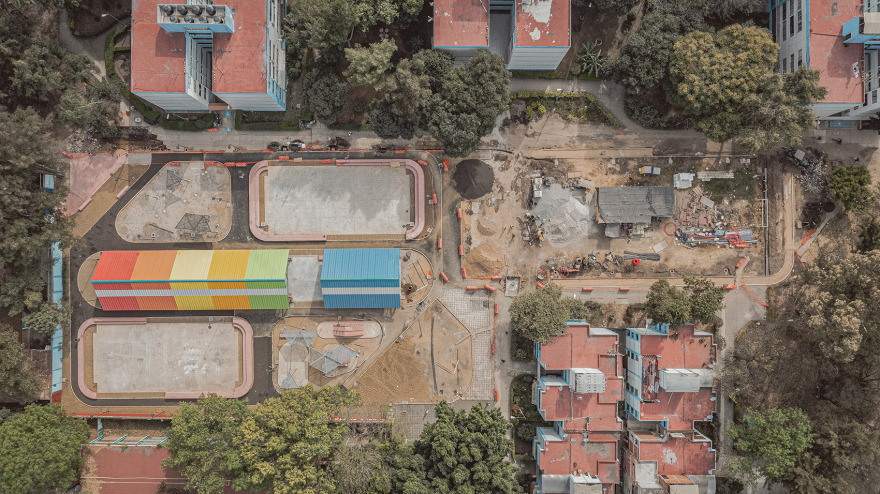
▼项目鸟瞰,aerial view of the project©Andres Cedillo

▼项目鸟瞰,aerial view of the project©Andres Cedillo

▼项目概览,overview of the project©Andres Cedillo


▼项目概览,overview of the project©Andres Cedillo

如今,这一住宅区面临着墨西哥城许多大型住房开发项目共有的问题:公共空间缺乏维护。这一问题的根源,在于相关行政与法律职责的不明确,使得各方对这些共有区域的管辖权与管理责任模糊不清。而维持这些公共区域所需的集体组织与协作难以达成共识,进而阻碍了有利于公共利益的决策与执行。
Today, the complex faces a challenge common to many large-scale housing developments in Mexico City: a lack of maintenance in shared public areas. This issue stems largely from administrative and legal ambiguity regarding the jurisdiction and responsibilities associated with these communal spaces. The collective organization necessary to manage and care for these areas is difficult to coordinate, making it hard to reach decisions in favor of the common good.
▼檐下空间,space under eaves©Andres Cedillo

在社会事务检察署(PROSOC)与地方区政府之间错综复杂的责任划分之中,“谁来管理哪些事务”成为一个直接影响社区空间功能与形象的问题。这种不明确导致的后果多样,从公共区域被私自占用,到任其废弃与破败,反映出社区社会结构的断裂。
Amid a web of shared responsibilities between the Social Attorney’s Office (PROSOC) and the local borough administration, the question of “who takes care of what” directly impacts both the functionality and appearance of community spaces. This lack of clarity has led to a range of outcomes—from informal appropriation of common areas to their neglect and decay—tangible signs of a fractured social fabric.
▼檐下空间,space under eaves©Andres Cedillo

其中一个关键点位于CTM Culhuacán第十区与最终一区附近——一处急需整修的破败广场。2023年6月22日,Infonavit以“交钥匙”模式发布了一项设计-建造招标,委托在墨西哥城的四个住宅区开展干预项目,包括Iztacalco、Culhuacán、Santa Fe和Ignacio Chávez。
One such critical point was located near the tenth and final section of CTM Culhuacán: a deteriorated plaza in urgent need of attention. On June 22, 2023, Infonavit issued a design-build tender under a “turnkey” scheme, commissioning the design, management, and execution of four intervention projects across various housing complexes in Mexico City: Iztacalco, Culhuacán, Santa Fe e Ignacio Chávez.
▼全新的社区公共核心,a new social hub©Zaickz Moz


在这样的背景下,AMASA Estudio事务所的Andrea López与Agustín Pereyra提出了一项广场改造的概念设计,最终中标。
It was in this context that Andrea López and Agustín Pereyra, of AMASA Estudio, developed a conceptual proposal to rehabilitate the plaza—ultimately winning the tender.
▼色彩斑斓、双坡屋顶的结构,a colorful gabled structure©Andres Cedillo

在改造前,该场地包含破旧的运动场、老化的儿童游乐设施、室外健身器材,以及一些利用率极低的边角空间。该区域被两所学校的围墙所包围:Pablo Martínez del Río小学和Héroes de 1810幼儿园。这样的格局形成了一些易被随意占用、垃圾堆积和滋生不良行为(如吸毒)的边缘区域。
Before the intervention, the site contained worn-out sports courts, aging playground equipment, outdoor gym apparatus, and several underutilized residual spaces. The area was enclosed by the perimeter walls of two neighboring schools: the “Pablo Martínez del Río” primary school and the “Héroes de 1810” kindergarten. This condition created residual corners prone to informal use, waste accumulation, and antisocial behavior, including substance use.
▼色彩斑斓、双坡屋顶的结构,a colorful gabled structure©Andres Cedillo

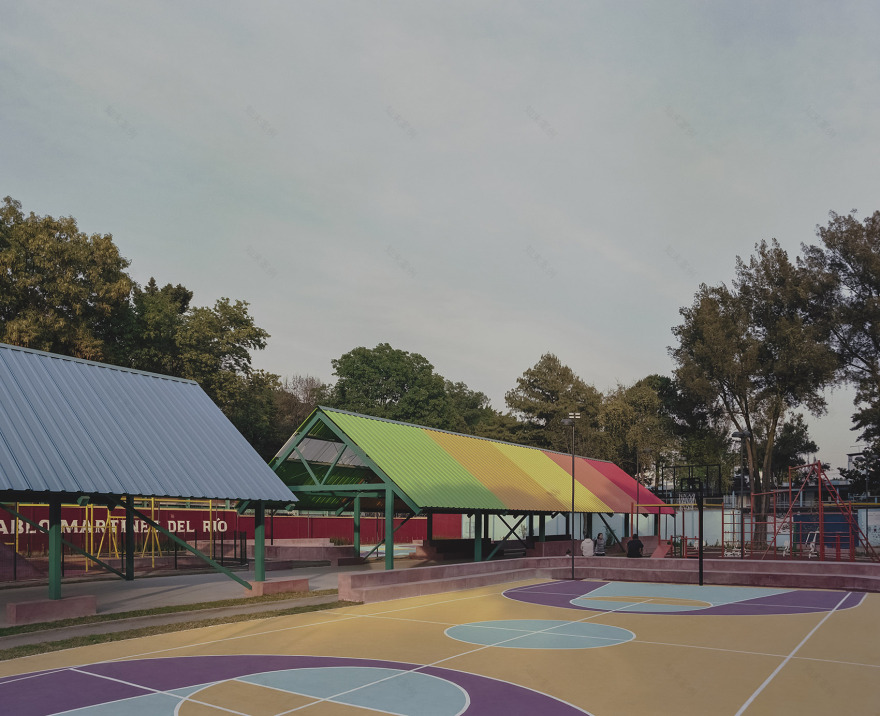
如今,随着改造完成,这片空间已焕然一新,成为一个全新的社区公共核心。每到放学时间,孩子们便聚集在干预设计的核心建筑元素周围——一座色彩斑斓、双坡屋顶的结构,为曾经暴晒空旷的场地引入了尺度、空间定义与独特气质。将这座结构置于场地中央的决策极具策略意义,不仅防止未来被侵占,还保留了开放的边界,确保了空间的可视性与自然监督。
Today, with the intervention complete, the space has been transformed into a new social hub. At school dismissal, children gather around the central architectural element of the intervention: a colorful gabled structure that introduces scale, spatial definition, and character to what was once a bleak sun-exposed court. The decision to place this structure at the heart of the site was strategic—discouraging future encroachments, preserving open perimeters, and ensuring continuous visibility and natural surveillance.
▼为曾经暴晒空旷的场地引入了尺度、空间定义与独特气质,introduces scale, spatial definition, and character to what was once a bleak sun-exposed court©Zaickz Moz


▼保留了开放的边界,preserving open perimeters©Zaickz Moz


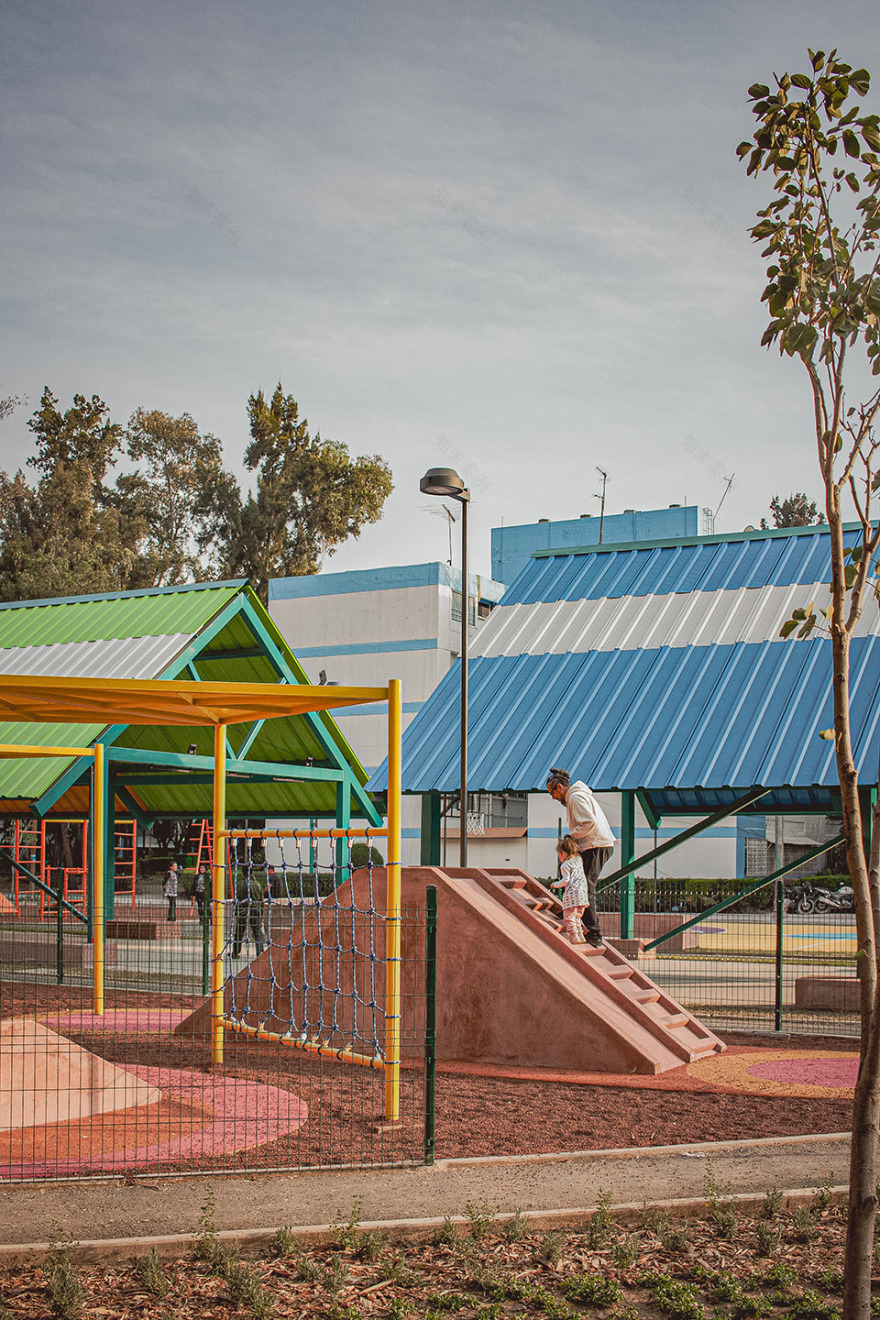
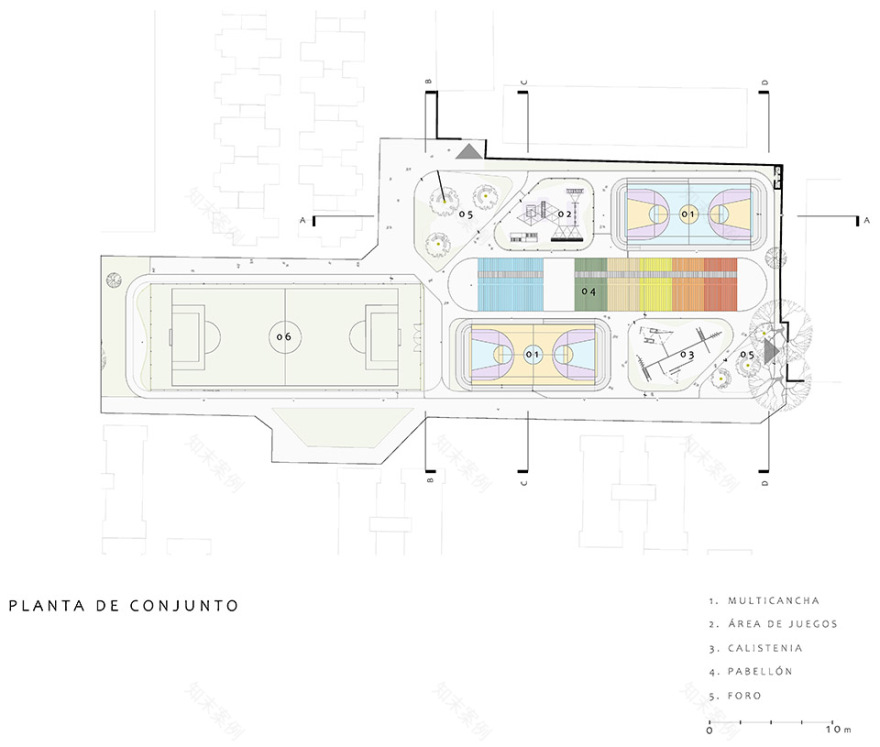
围绕这一中心“脊柱”——如今成为公共空间民主化的骨架——设置了多个功能分区。这些功能既源于招标书的原始要求,又通过与居民的参与式讨论不断优化,最终包括:两个篮球场、一处徒手健身区、一座带侧座的半露天看台、一个儿童游乐场,以及一条600米的跑道,跑道巧妙嵌入人行步道中,以最大化空间使用、预算效益与技术可行性。
Organized around this central spine—now the backbone of a democratized public space—are the various program components, defined initially by the tender brief and refined through participatory sessions with local residents: two basketball courts, a calisthenics area, a covered forum with lateral seating, a children’s playground, and a 600-meter running track, creatively integrated into pedestrian pathways to maximize space, budget efficiency, and technical compliance.
▼围绕这一中心设置了多个功能分区,the various program components organized around this central spine©Zaickz Moz

▼围绕这一中心设置了多个功能分区,the various program components organized around this central spine©Zaickz Moz

该项目的实现离不开与Desarrolladora de Ideas y Espacios(由Alberto Cejudo领导)的密切协作,从概念阶段便与AMASA Estudio携手,致力于在招标预算调整的前提下依然确保项目质量。同时,四个项目之间共性的识别也至关重要,推动了材料与施工方法的策略性复用,适用于公共空间干预及更具建筑复杂性的方案中。
This achievement was made possible through close collaboration with Desarrolladora de Ideas y Espacios (led by Alberto Cejudo), who partnered with AMASA Estudio from the conceptual phase to deliver an integrated solution that maintained quality despite the budget adjustments imposed by the tender. It was also crucial to identify the shared characteristics among the four commissioned projects, enabling the strategic reuse of materials and construction methods across both public space interventions and more architecturally complex proposals.
▼半露天看台,a covered forum with lateral seating©Andres Cedillo
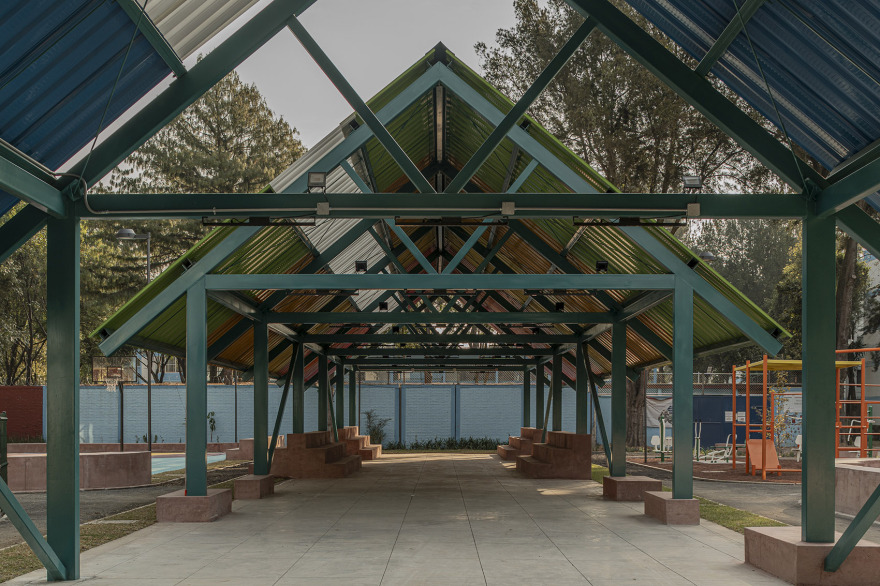
▼半露天看台,a covered forum with lateral seating©Andres Cedillo
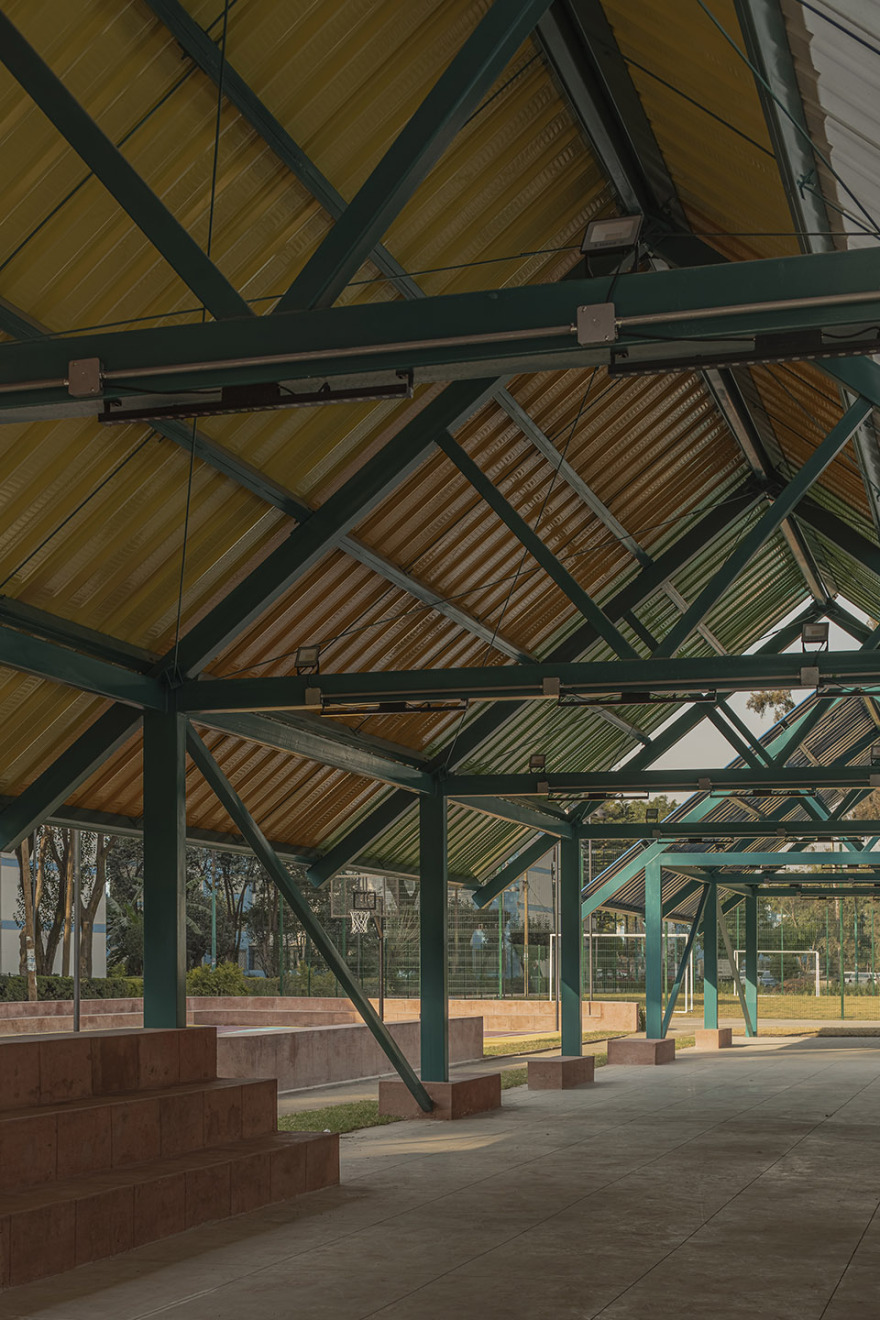
该项目还包含景观改善策略,设有雨水渗透区,并以回应原有行人流线的方式提升无障碍通达性——从“穿行路径”转变为“交流动线”。色彩运用、路缘模数、铺装设计与材质肌理的变化,共同构筑出一个清晰、统一、和谐的空间系统。
The project included a landscape improvement strategy with rainwater infiltration areas and a design that prioritizes universal accessibility by responding to existing pedestrian flows—formerly paths of passage, now routes of gathering. Elements such as color, curb modulation, paving design, and texture variation articulate the different components into a coherent, legible, and harmonious composition.
▼清晰、统一、和谐的空间系统,a coherent, legible, and harmonious composition©Andres Cedillo

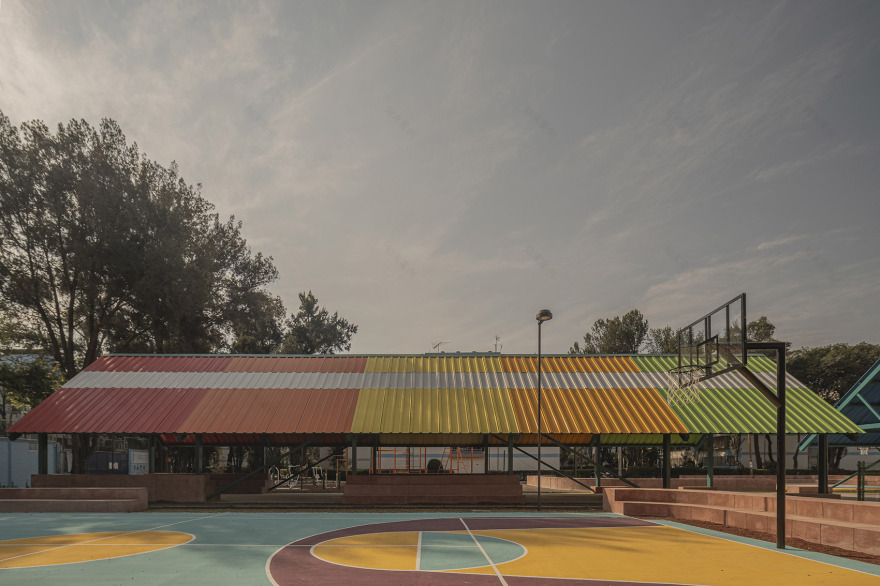
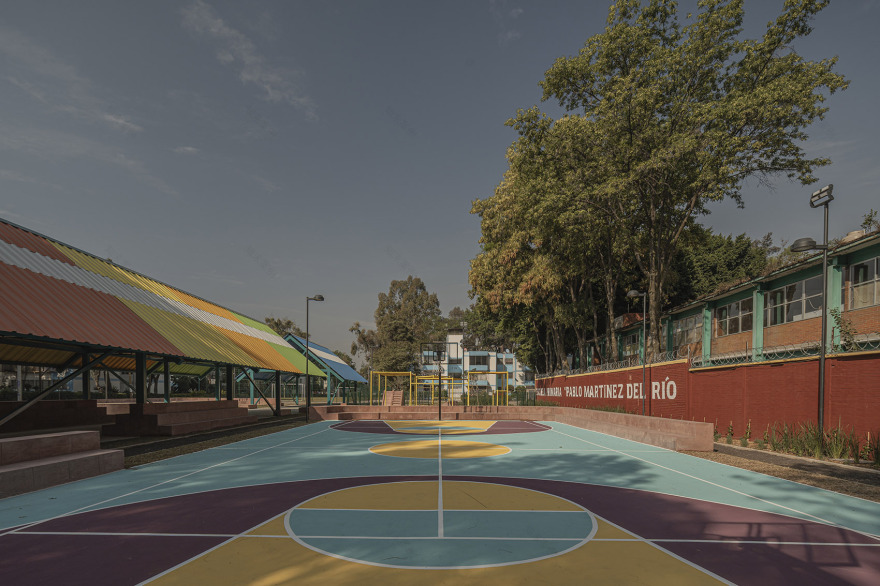
▼清晰、统一、和谐的空间系统,a coherent, legible, and harmonious composition©Andres Cedillo

近五十年后的今天,作为墨西哥城最大住宅区的一部分,这项改造成为Culhuacán居民、Infonavit与AMASA Estudio设计团队协作的典范。通过一系列看似朴素的建筑元素——钢结构、着色混凝土与波纹金属板,他们共同重塑了公共空间的社会价值。曾被遗忘的角落,如今成为居民自发呵护的共享庭院。
Almost fifty years after the construction of Mexico City’s largest housing complex, this intervention stands as an exemplary collaboration between the residents of Culhuacán, Infonavit, and the design team at AMASA Estudio. Through a series of seemingly simple architectural elements—structural steel profiles, pigmented concrete, and corrugated metal sheets—they have restored the social value of public space. A once-forgotten site has become a shared courtyard, now proudly cared for by its community.
▼重塑了公共空间的社会价值,restored the social value of public space©Andres Cedillo


▼建造过程,construction progress©Gerardo Reyes

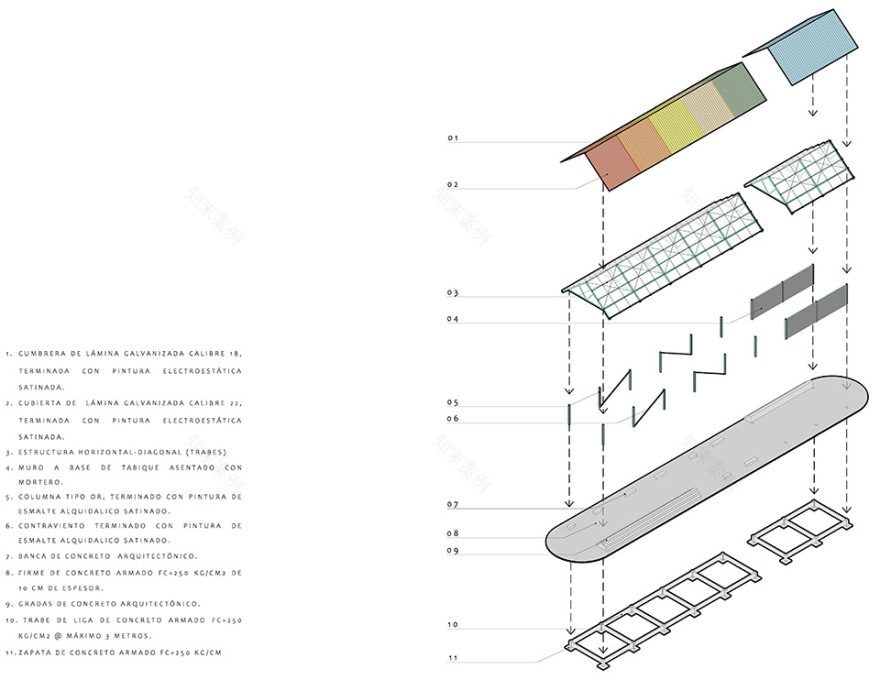
▼轴测图,axonometric©AMASA Estudio
▼平面图,plan©AMASA Estudio
▼立面图,elevation©AMASA Estudio


▼剖面图,section©AMASA Estudio

▼细部,detail©AMASA Estudio

Project Name: UH INFONAVIT CTM Culhuacán
Architecture office: AMASA Estudio, Andrea López + Agustín Pereyra
Use: Public
Area: 4,180 M2
Location: Ciudad de México, México
Status: Built
Year: 2024
Architects: Andrea López, Agustín Pereyra
Client: INFONAVIT
Construction: Desarrolladora de Ideas y espacios,
Structural Engineer: Juan Felipe Heredia
Landscape: Maritza Hernandez
Team: Luis Flores, Gerardo Reyes, Roxana León, Cesar Huerta, Yanahi Flaviel
Photographer: Zaickz Moz, Andres Cedillo, Gerardo Reyes Bustamante




南京喵熊网络科技有限公司 苏ICP备18050492号-4知末 © 2018—2020 . All photos and trademark graphics are copyrighted by their owners.增值电信业务经营许可证(ICP)苏B2-20201444 苏公网安备 32011302321234号
苏公网安备 32011302321234号客服
消息
收藏
下载
最近