

创作上传
VIP
收藏下载
登录 | 注册有礼
查看完整案例

收藏

下载

分享
近日,德国波恩的联邦艺术馆(Bundeskunsthalle)开幕了其最新展览《WEtransFORM:建筑的未来》,展览由MVRDV操刀空间设计。该展被誉为联邦艺术馆“可持续与生态变革之年”的重头项目,聚焦建筑与城市主义的可持续未来,探讨在气候友好型的建筑文化重塑过程中所需的基本设计原则。MVRDV的空间设计以策展团队设定的八个章节结构为基础,营造出一系列神秘而沉浸式的展区,几乎完全由馆内现有材料构建而成。这种循环设计方法使展览本身成为其所倡导之新建筑文化的范例。
On Thursday the Bundeskunsthalle in Bonn, Germany opened its latest exhibition, WEtransFORM: On the Future of Building, with an exhibition design by MVRDV. Billed as a cornerstone of the Bundeskunsthalle’s “year of sustainability and ecological change”, the exhibition presents the future of sustainable architecture and urbanism, focusing on the fundamental design principles required for a climate-friendly renewal of our building culture. The spatial design reflects the curators’ eight-chapter structure with a series of enigmatic, immersive spaces made almost exclusively from materials already available at the museum. This circular design approach makes the exhibition itself an example of the new building culture it advocates.
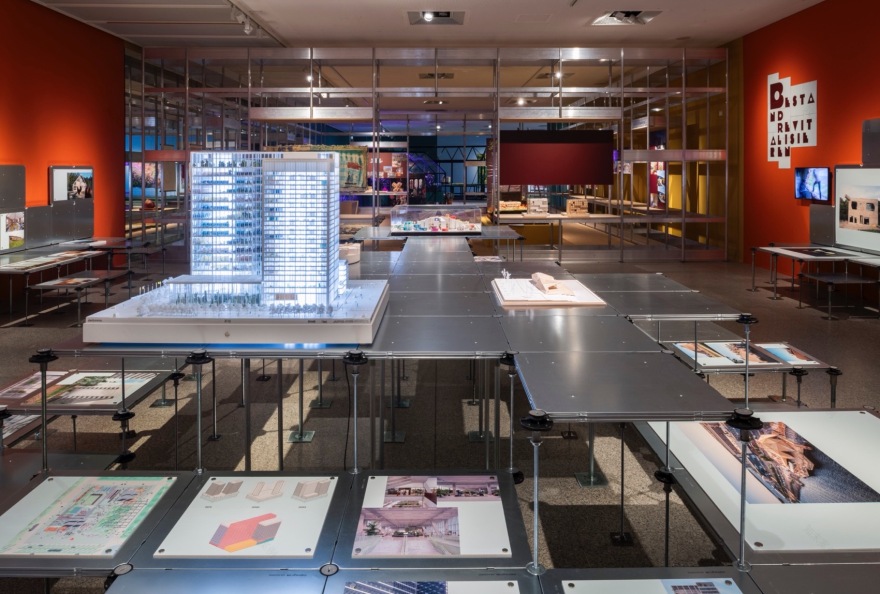
▼章节五:重振空间,Chapter 5: Revitalising © Kunst- und Ausstellungshalle der Bundesrepublik Deutschland

“多年来,我们通过为自身项目设计展览以及从汉诺威到波哥大、台北等世博会展馆的设计,积累了丰富的展览设计经验。”MVRDV联合创始人Jacob van Rijs表示,“现在能将这份经验应用于像联邦艺术馆这样声望卓著的机构,并服务于‘建筑可持续革命’这样的重要议题,令人振奋。”
“Over the years we’ve built quite some expertise in exhibition design thanks to creating many exhibitions of our own work, as well as a number of exhibition pavilions for expos from Hannover to Bogotá to Taipei”, says MVRDV founding partner Jacob van Rijs. “It’s exciting to now apply that expertise in accessible, diverse, and informative exhibition-making to an institution as prestigious as the Bundeskunsthalle, and a topic as important as the sustainable revolution in construction.”
▼章节四:适度生活,Chapter 4: Sufficiency © Kunst- und Ausstellungshalle der Bundesrepublik Deutschland

▼章节四:实践适度,Chapter 4: Practising Sufficiency © MVRDV / Miruna Dunu
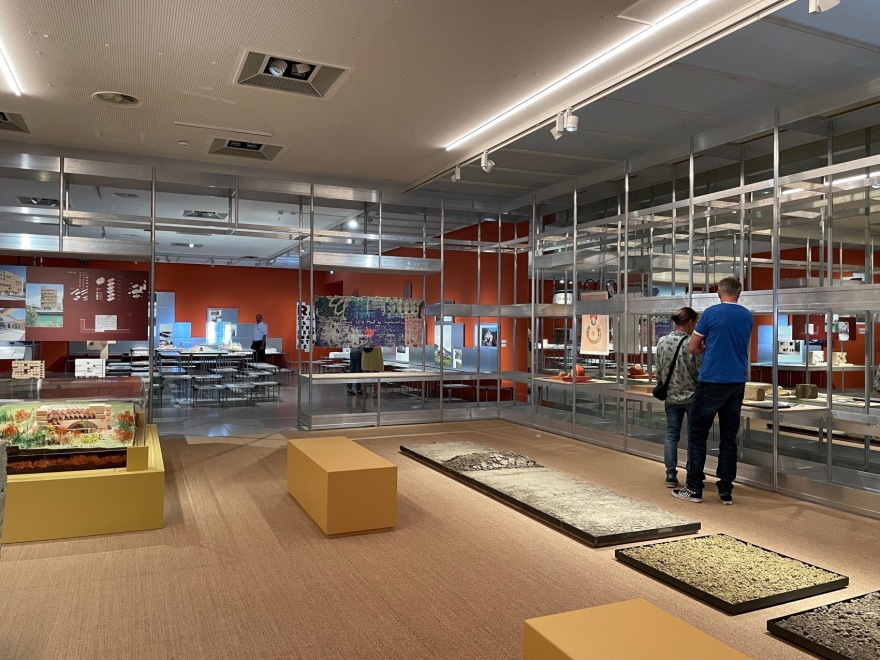
此次展览由策展人Eva Kraus与Sven Sappelt策划,依照“新欧洲包豪斯”(New European Bauhaus)的理念展开,共设八个主题章节:从“地球生态系统”出发,依次为“增强气候韧性”、“促进生物多样性”、“实践节制理念”、“激活既有建筑”、“优化循环体系”、“勇于实验探索”以及“积极行动参与”。MVRDV将这八章设想为独立空间,并为每一章节选配艺术馆现有的展览道具,兼顾展示材料的属性与其所传递的信息或体验效果。八个展区的墙面还辅以渐变色图形设计,强化各自独特性。
Developing the exhibition based on the principles of the New European Bauhaus, curators Eva Kraus and Sven Sappelt created an outline of eight thematic chapters through which to explore the sustainability of the building industry: starting with an introductory chapter on Earth’s Ecosystem, the exhibition continues with chapters titled Strengthening Climate Resilience, Promoting Biodiversity, Practising Sufficiency, Revitalising Existing Buildings, Optimising Cycles, Daring to Experiment, and Getting Actively Involved. Imagining these eight chapters as a series of discrete spaces, MVRDV tasked themselves with pairing the Bundeskunsthalle’s existing props with each theme, always keeping in mind the type of material exhibited, and the message or experiential impact conveyed by each form of presentation. These eight spaces are enhanced by a graphic treatment of the walls, with colour gradients emphasising the individual character of each.
▼章节四:实践适度,
Chapter 4: Practising Sufficiency © MVRDV / Miruna Dunu

▼章节二:增强气候韧性,
Chapter 2: Strengthening Climate Resilience © Matthias Jung

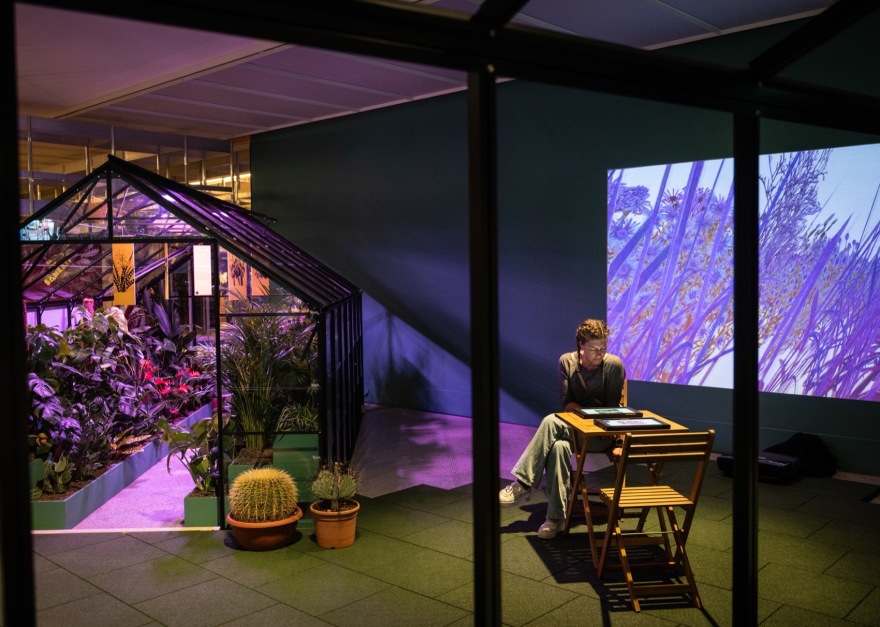
▼章节三:促进生物多样性,Chapter 3: Promoting Biodiversity © Matthias Jung

▼章节三:促进生物多样性,Chapter 3: Promoting Biodiversity © Matthias Jung

第五章“激活既有建筑”重点展示大量建筑模型,化为一个“像素城市”:众多小型基座构成结构体系,按项目尺度分类展示,从微型干预到城市更新不等。第六章“循环优化”中的展品则放置于几何与环保意义上皆为“循环”的圆形展台上,这些展台曾用于其他展览。第七章“实验”设于黑暗空间中,以奇物陈列室形式展示从真菌砖到藻类构筑物等先锋材料。最后一章“行动”则以共享长桌邀请观众共想未来。
The fifth chapter is revitalisation – a chapter particularly heavy on architectural models – and is thus presented as a “pixel city”, with a structural system of many small podiums grouping projects by scale, from small interventions to city-scale regenerations. The chapter on circularity presents exhibits on podiums that are circular both in a geometric sense and – since these elements had already been used in previous exhibitions – in an environmental sense too. The chapter on experimentation provides a journey through cabinet of curiosities, from mycelium bricks to shelters made of algae, in a darkened room. Finally, visitors find themselves activated in the last chapter thanks to a room of communal tables that invite them to imagine alternative futures together.
▼章节五:激活既有建筑,Chapter 5: Revitalising Existing Buildings © Matthias Jung


▼章节五:激活既有建筑,
Chapter 5: Revitalising Existing Buildings © Matthias Jung

本次展览对馆内物料的再利用远超“再用展台”的范畴,许多常规展览构件被巧妙转化为全新功能。例如第二章的信息隧道与第四章的资源图书馆均采用Octanorm结构系统(通常用于临时墙体)重新诠释为书架等构件;“像素城市”则将模块化地板系统转化为起伏有致的展示地景。即便是新增组件,如第三章的温室,也是在与艺术馆达成“日后可复用”协议的前提下使用。
The approach to reusing the museum’s existing materials goes far beyond simply reusing podiums; in many cases, ordinary exhibition staples were cleverly adapted for purposes other than their intended use. Elements such as the information tunnel in chapter two and the library of resources in chapter four make use of the Octanorm structural system, which is typically used to make temporary walls, carefully reinterpreting it as a system to create shelving and other structures. Similarly, the pixel city adapts a modular flooring system to create a “landscape” of podiums. Where the exhibition does use new materials – the most notable example being the greenhouses in chapter three – this was done with the Bundeskunsthalle’s agreement that they will be reused in the future.
▼章节七:敢于试验,Chapter 7: Daring to Experiment © MVRDV / Miruna Dunu


▼章节七:实验,Chapter 7: Experiment © Kunst- und Ausstellungshalle der Bundesrepublik Deutschland

除了负责展览设计,MVRDV本身的项目也在展览中多处亮相:在“气候韧性”章节中展出了其《WHAT IF 2100》的未来城市设想模型;在“激活既有建筑”章节中展出了地拉那金字塔的新模型;最后一章则展示了来自Fuggerei NEXT500展馆的一张十字长桌,鼓励共创设计。展览共展出约80个来自全球的项目,参展者包括51N4E、Office for Political Innovation、Anna Heringer、Hermann Kaufmann等知名设计事务所,以及德国卡尔斯鲁厄理工学院与斯图加特大学的研究项目。《WEtransFORM:建筑的未来》现于波恩联邦艺术馆展出,展期至2026年1月25日。艺术馆开放时间为每周二至周日10:00–18:00(周三延长至21:00)。
In addition to contributing the exhibition design, MVRDV’s work is also featured in three locations throughout WEtransFORM: the speculative cities of WHAT IF 2100 are featured as part of the resilience chapter; a new model of the Pyramid of Tirana is included in the revitalisation chapter; and a cross-shaped table facilitating communal design, originally part of the Fuggerei NEXT500 Pavilion, is featured in the final chapter. These MVRDV projects are featured among roughly 80 designs from around the world, with designers featured including 51N4E, Office for Political Innovation, Anna Heringer, and Hermann Kaufmann, among others, as well as projects realised by the Karlsruhe Institute of Technology and the University of Stuttgart. WEtransFORM: On the Future of Building is on show at the Bundeskunsthalle in Bonn until January 25th, 2026. The Bundeskunsthalle is open Tuesday-Sunday from 10:00 until 18:00 (and until 21:00 on Wednesdays).
▼章节六:优化循环,Chapter 6: Optimising Cycles © Matthias Jung


▼章节八:积极参与,Chapter 8: Getting Actively Involved © Matthias Jung


南京喵熊网络科技有限公司 苏ICP备18050492号-4知末 © 2018—2020 . All photos and trademark graphics are copyrighted by their owners.增值电信业务经营许可证(ICP)苏B2-20201444 苏公网安备 32011302321234号
苏公网安备 32011302321234号客服
消息
收藏
下载
最近