

创作上传
VIP
收藏下载
登录 | 注册有礼
查看完整案例

收藏

下载

分享
吧台的设计灵感源于“木漏日”——阳光透过树叶间隙洒落的景象——试图在建筑内部营造一种人为的自然现象。木漏日般的光影自黑暗中轻柔浮现,空间随之被光与影的沙沙声充盈。
The counter is designed to be infused with something like Komorebi―the sunlight filtering through the trees―creating an artificial natural phenomenon inside the architecture. Komorebi gently emerges from the darkness, and the space fills with light and shadow rustlingly.
▼餐厅概览,overview of the restaurant ©Hayato Honda

本项目为位于东京港区白金一栋独立住宅内餐厅的改造。业主的要求是在二层增设一个设有六个座位的吧台。我们并未将吧台仅仅视为室内设计元素,而是作为建筑本身来进行构思。设计过程中,将整个建筑作为一个“场地”,深入思考吧台所在空间与周围既有空间之间的关系,包括与整栋建筑的关联。通过柔和处理新旧元素的边界,吧台悄然融入原有结构中。二层的墙纸、门窗构件及设备被有意保留原貌,吧台及其周围区域的饰面则经过细微调整,以回应一层入口与原始空间保持不变的状态。
This project is a renovation of the restaurant located in a standalone house in Shirokane, Minato, Tokyo. The request was to add a counter with six seats on the second floor. The counter was designed not as just interior design, but as architecture. The relationship between the space―in which the counter is placed―and the surrounding spaces―including the entire existing space―was carefully considered by designing the counter while regarding the entire building as a site. The boundary between the existing and the new elements was gently softened. The wallpaper, fittings, and equipment on the second floor were intentionally left as they were and the finishes of the counter and its surroundings were slightly adjusted, because the entrance and first floor remain unchanged.
▼吧台与所在空间的关系,the relationship between the counter and its space ©Hayato Honda

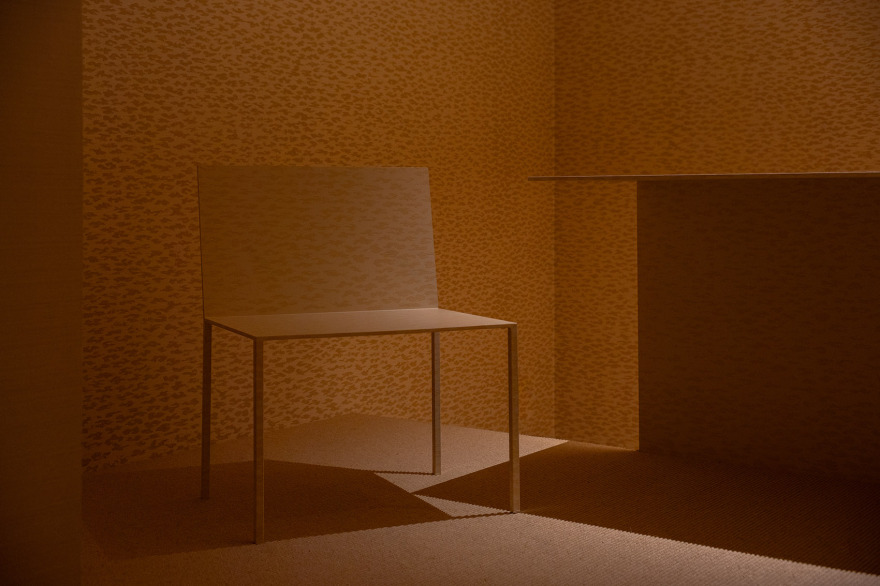
具体而言,吧台与椅子被设计为与周围空间相同的色调,并在新家具、现有墙纸与构件上手工盖印图案。这些印章图案覆盖了基底,使周围的留白空间自然凸显。印章的尺寸与间距经过精心推敲,营造出“底”(既有部分)与“图”(印章图案)之间的平衡关系,从而实现新旧元素的无缝融合。手工盖印的图案因渗墨与晕染产生不规则的肌理,柔和地覆盖在基底之上,同时又保留了其本身的肌理与痕迹。为了控制这种“非精准性”,在正式施工前进行了大量样品测试,最终的盖印过程是一气呵成、极为细致的操作。
Specifically, the counter and chairs were designed in the same color as the surrounding space, and the stamps were hand-pressed onto both the new furniture and the existing wallpaper and fittings. The stamps cover the base, while the space around them is emphasized as negative space. The size and spacing of the stamps were carefully chosen to create an equivalent relationship between the ground (the existing) and the figure (the stamps), and to seamlessly blend the existing and the new elements together. The hand-pressed stamps, with their irregularities―such as bleeding and blurring―softly cover the base while still allowing it to show through. Many samples were tested in advance to plan for these irregularities, and the final work was done carefully as a one-time process.
▼吧台表面的柔和肌理,Soft texture on the surface of the bar ©Hayato Honda


当人们触摸吧台或椅子时,会感受到这些印章不规则而微妙的厚度。在这个以“微妙厚度”贯穿整个空间的改造项目中,新家具的设计刻意避开了任何“厚重感”,而是将注意力聚焦于图案本身的轻微厚度,使其成为空间的主角。吧台由厚度仅9毫米的钢板焊接而成T形框架,支撑长4855毫米、深990毫米的桌面。六把椅子的比例各不相同,靠背与坐面为8毫米厚,椅腿为16毫米见方。
When you touch the counter or chairs, you notice the irregular and delicate thickness of the stamps. In this project―where the entire space was renovated with delicate thickness, the new furniture was designed to avoid feeling thickness, allowing only the thickness of the stamps to emerge in the space. The counter is constructed from 9mm thick steel plates welded into a T-shape, supporting the tabletop that is 4855mm long and 990mm deep. All six chairs vary in proportion, with the backrest and seat being 8mm thick, and the legs 16mm square.
▼不规则而微妙的纹理,the irregular and delicate texture ©Hayato Honda
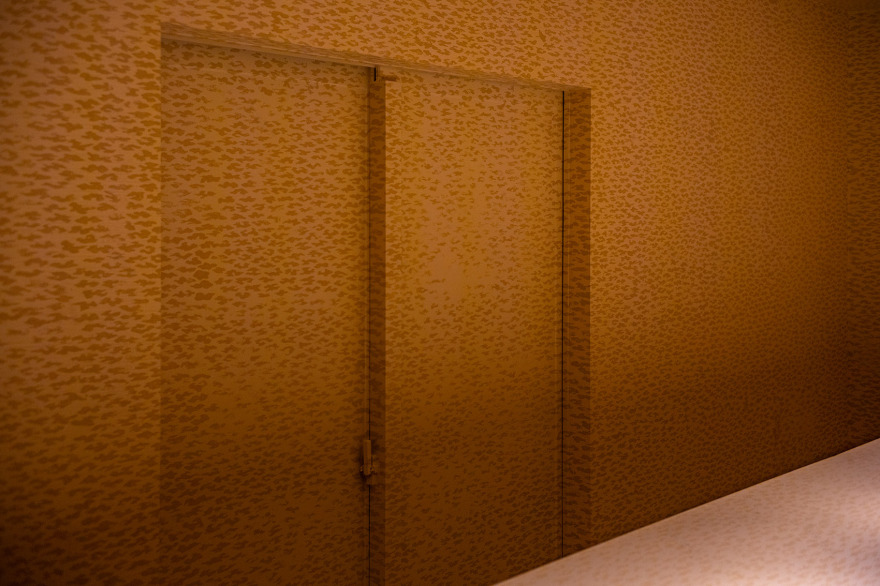
▼纹理细部,texture detail ©Hayato Honda


这些构成空间的印章图案,其形态被设计为模糊、抽象,使人难以将其直接联想到具象意象。这是一次回归人类“原初想象力”的持续探索,仿若人们在自然界中,通过观察月影或浮云,在不确定的形态中展开想象。印章图案在家具与墙面的转角处无缝延续,覆盖整个地面,在这片“沙沙作响的厚度”中,空间被彻底填满。整个空间呈现出一种模糊而细腻的氛围:形状似乎暗示着某种意象,却始终不被明确定义。置身其中,仿佛不断追逐着“木漏日”摇曳的光影,它总在变化,从不静止。
The shape of the stamps that finish the space was designed to be vague and abstract, making it difficult to associate them with specific images. This is the result of continuous study that returns to the fundamental imagination of humanity. It’s similar to how people expand imagination by recognizing forms in nature, such as finding forms in the moon’s shadow or drifting clouds. The stamps continue seamlessly, across the corners of the furniture and walls, and the rustling thickness on the ground is captured and fills the entire room. The space feels vague and delicate, where forms seem to suggest something, yet never resolve into anything defined. The experience of being in this space feels like endlessly following the swaying shadows of Komorebi, always shifting and never still.
▼同样延续到椅子上的纹理,the same texture carries over to the chair ©Hayato Honda


Project name: Komorebi counter
Site of the project: Shirokane, Tokyo, Japan
Building Type: Restaurant
Design team: takuya nakayama architects
Person in charge: Takuya Nakayama, Miho Iida, Daichi Nishiyama
Structural engineering: Nobuyuki Takimoto
General contractor: SK Co., Ltd. Person in charge: Yuji Oka
Contractors: counter Azumakobo Co., Ltd. Person in charge: Koichiro Azuma
chair: Gotanda Seisakusyo Co., Ltd. Person in charge: Shigeki Miyamoto, Ai Mizuta
Floor area: 21.4m2
Design phase: 2024.2-2024.6
Construction phase: 2024.7-2024.8
南京喵熊网络科技有限公司 苏ICP备18050492号-4知末 © 2018—2020 . All photos and trademark graphics are copyrighted by their owners.增值电信业务经营许可证(ICP)苏B2-20201444 苏公网安备 32011302321234号
苏公网安备 32011302321234号客服
消息
收藏
下载
最近