

创作上传
VIP
收藏下载
登录 | 注册有礼
查看完整案例

收藏

下载

分享

翻译
Architects:Wutopia Lab
Area:190m²
Year:2025
Photographs:Guowei Liu
Interior Consultant:Shanghai C-yu Space Design Co., Ltd.
Construction:China Construction Second Bureau Decoration Engineering Co., Ltd
Category:Pavilion
Chief Architect:YU Ting
Project Manager:MA Liuliu
Project Architect:Liran SUN
Design Team:HUANG He, PAN Dali, XIONG Jiaxing
Interior Consultant Team:DAI Yunfeng, CUI Xiaoxiao, ZHAO Ruyi, QIN Liyan, LUO Renwei
Structural Consultant:MIAO Binhai
Lighting Consultant:Chloe ZHANG, WEI Shiyu
Soft Furnishing:Wuto Art, H&J FF&E
Signage:Wuto Art, MEEM HOUSE
Curation:Wuto Art
Curator:LU Yan
Client:CSCEC Jiuhe Development Group Co., Ltd East China Region
Client Design Team:GU Hongfei, FU Rao, QIU Yifei, XU Jie, LU Tongtong, HU Yingzhi, BI Qiu, WEI Jin
Construction Project Manager:HUANG Jinqing
City:Shanghai
Country:China

Text description provided by the architects. On February 28, Chief architect YU Ting was invited to survey three potential sites in the park and select one for the new pavilion, we need to provide a comprehensive design—architecture, interior, landscape, soft furnishing, and exhibition—aimed at achieving completion and public opening by April 18. The final site chosen was the former water base by the bay. The only restriction from the park was to preserve the structures of two existing buildings and not disturb even a millimeter of surrounding greenery, including two trees abutting the façades. Meanwhile, the client hoped to incorporate ceramic curtain wall panels previously used in residential developments.
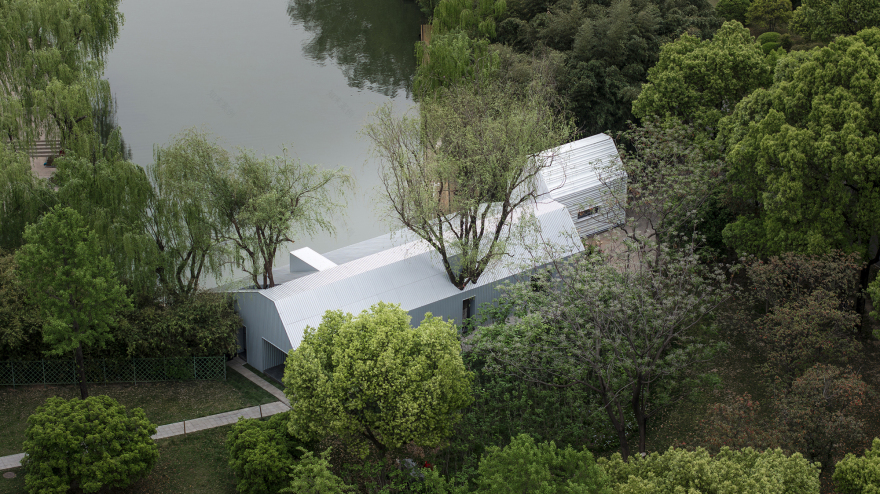

That same evening, YU applied his signature "house within a house" design strategy: two buildings were respectively wrapped in a metal and a ceramic skin. The metal shell would act as the climate boundary, while the ceramic skin would serve purely as a visual layer. The existing structure would retain its insulation and waterproofing.


By March 5, the concept proposal was approved.On March 12, we held a coordination meeting. It implemented Wutopia Lab's core fast-build design strategy:Pre-decided Standard Materials – No custom molds required.Optimized Workflow – Maximize prefabrication, minimize wet work on site.Integrated Systems – Consolidate architecture, structure, interiors, lighting, signage, curation, etc., in the design phase, locking key materials and detailing early.This dramatically shortened the construction cycle and served as a replicable template for rapid-build architecture.


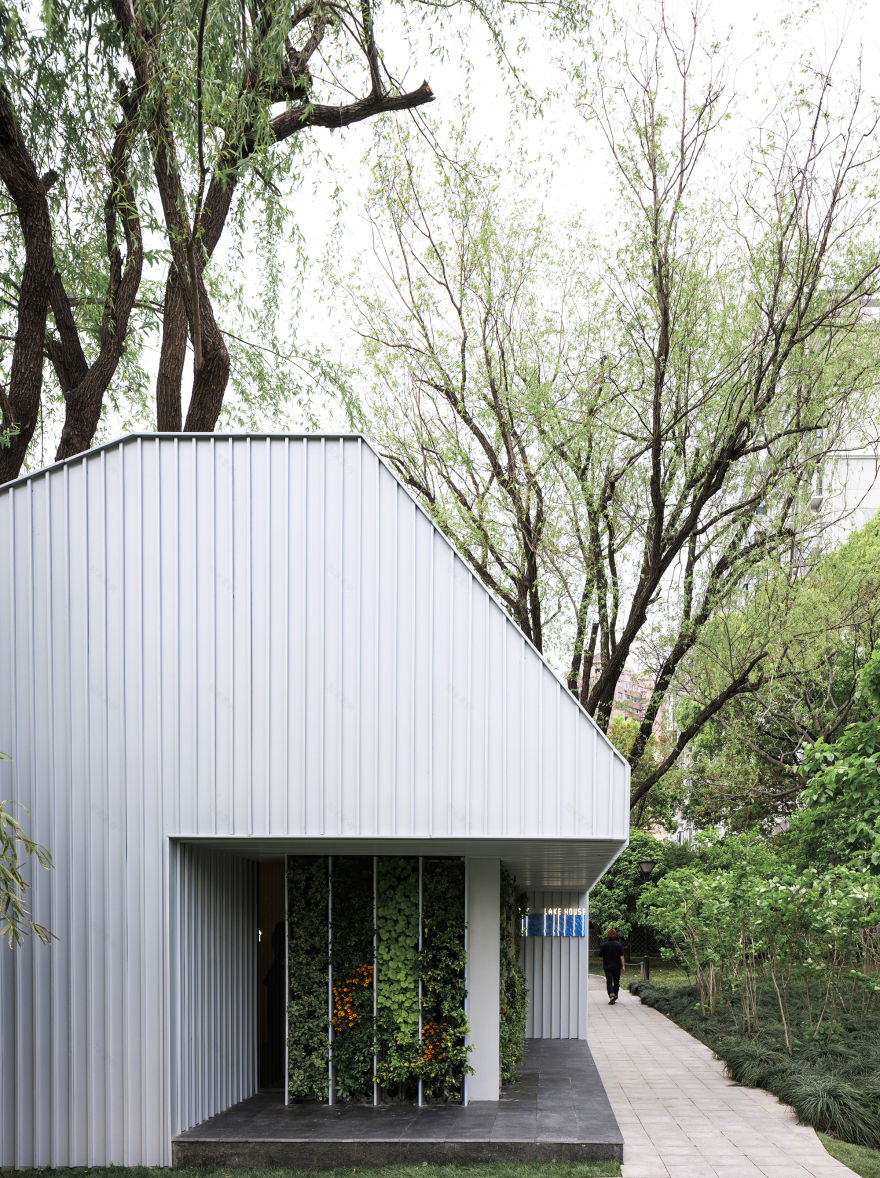
On March 13, MIAO proposed downsizing beams and columns to 150×150 mm steel profiles. These were integrated with the façade system, allowing the envelope and structure to become one. The combined system incorporated aluminum panels, vertical greenery, sliding glass partitions, light steel studs, and ceramic panels—achieving both formal unity and material coherence. The foundation, particularly on the waterfront and the lower southwest corner, used cantilevered bases to create a raised platform, facilitating rapid assembly.


In a follow-up call, YU and ZHU decided to replace aluminum-magnesium-manganese panels with more waterproof aluminum plates. Decorative aluminum trims (20×20 mm) were set at 100 mm intervals. With that, the 190-square-meter Life Experience Pavilion entered full-speed construction.March 20: Signage system completedMarch 21: All construction drawings issued; exhibition and furnishing design initiatedApril 11: Final site review by YUApril 14: Main structure completedApril 16: Soft furnishings, exhibition, and signage installedApril 18: The Lake House officially opened
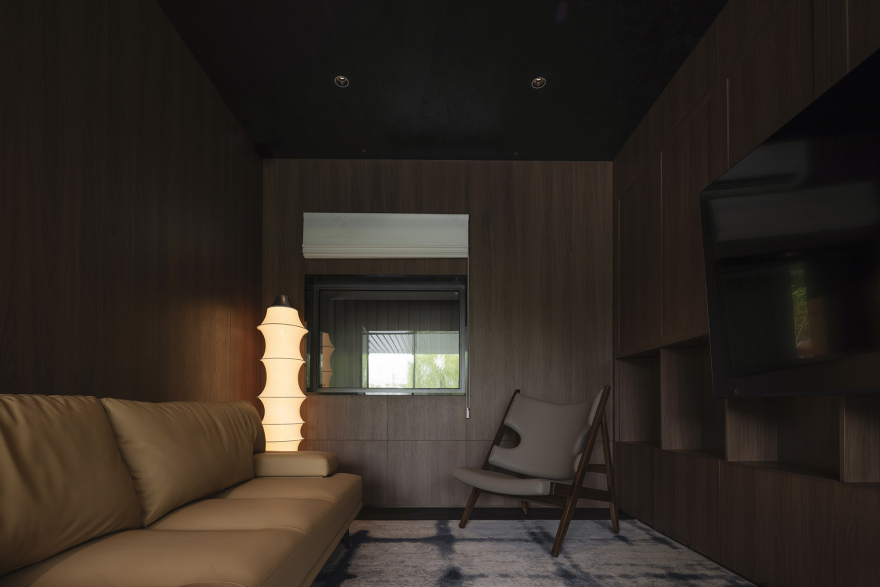
Part II: ConceptThis pavilion uses ceramic panels, recycled tiles, marine plastic plaster, marine plastic panels, mushroom leather, and light to form an undercurrent—a zero-carbon narrative that lies beyond light and space. It reflects a core cultural belief: to cherish. From this, we move toward zero-carbon living and a beautiful life.


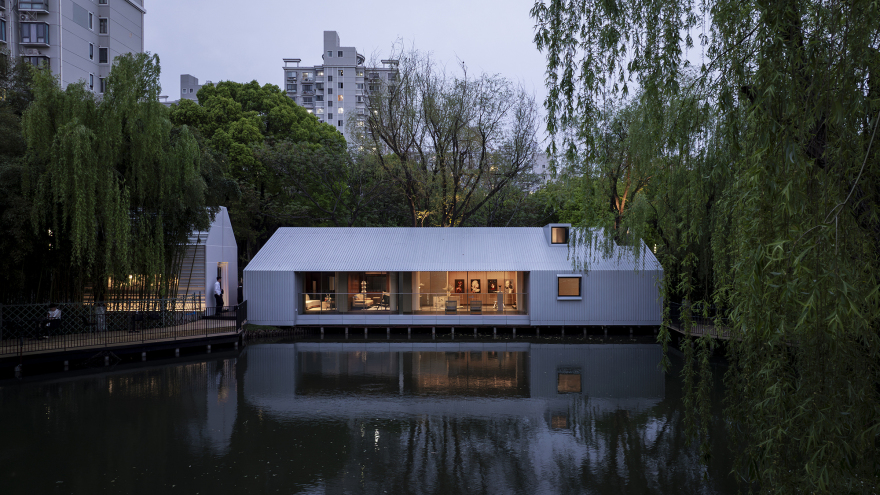
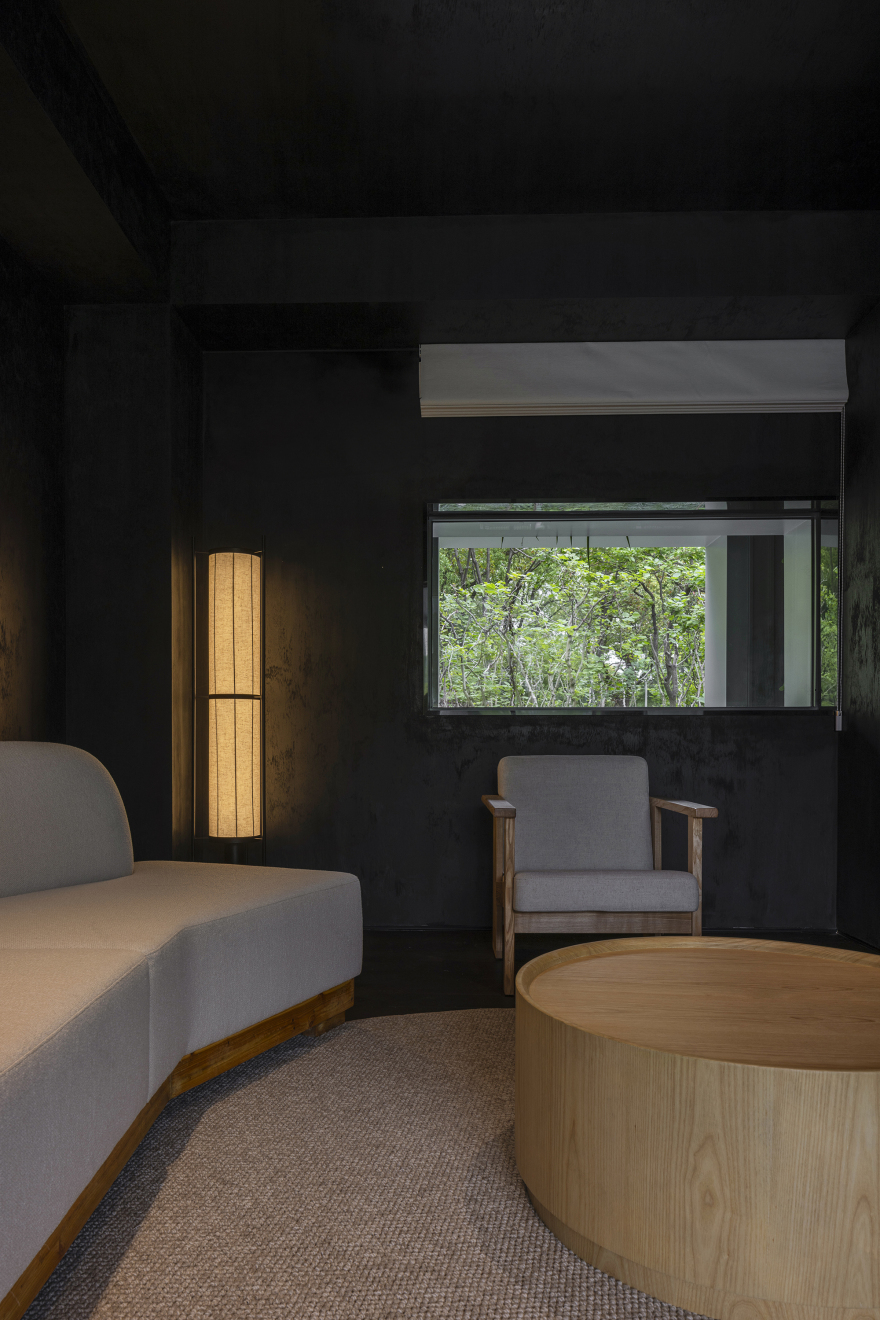
Using horizontal layers of light and shadow, I organized the preserved trees, vertical greenery, lobby, exhibition hall, three uniquely themed VIP rooms, willow-lined colonnade, terrace, boardwalk, and café into a linear spatial journey—inhabitable, walkable. The boundaries between inside and out dissolve. Orientation is gently disoriented, not in fear, but in delight. In VIP Room 1, you can sit and gaze at a window that becomes a living painting. The skylight above disperses quietly across you and me. Words fail.


I originally wanted a staircase under the skylight as a lookout, but the park didn't allow it. We kept the skylight anyway. It now recalls old Shanghai tiger windows, or contrasts with the nearby tree hole as positive and negative space. It was not part of the original design—just improvisation. And isn't that the charm of Chinese design? Controlled surprise within a plan. On opening day, a passing elderly man reached out and gently touched the pearlescent ceramic wall. He stood for a long while, then smiled and walked away. That moment—was beautiful.
Project gallery








南京喵熊网络科技有限公司 苏ICP备18050492号-4知末 © 2018—2020 . All photos and trademark graphics are copyrighted by their owners.增值电信业务经营许可证(ICP)苏B2-20201444 苏公网安备 32011302321234号
苏公网安备 32011302321234号客服
消息
收藏
下载
最近