

创作上传
VIP
收藏下载
登录 | 注册有礼
查看完整案例

收藏

下载

分享
栋梁轩位于长江太仓段的“长江林场”中。场地充满各种限制与想象,让其中的栋梁轩成为特殊的案例。建筑师尝试在已经完成工业化的江南水网地区建构一套建造体系。它基于长三角实木集成材、预制装配和水循环利用等在地产业,也延续了江南传统的空间语言和榫卯工艺。在这个体系下,新的建筑形式和类型将会慢慢涌现,或许预示着水网地带建造的某种未来。
Dongliang Xuan is located within the “Yangtze River Forest Farm” along the Taicang section of the Yangtze River. The site is shaped by numerous constraints and possibilities, making Dongliang Xuan a unique architectural case. The architects sought to develop a construction system suited for the already industrialized water-town region of Jiangnan. This system is grounded in local industries of the Yangtze River Delta—such as solid wood glulam, prefabrication, and water recycling—and also continues the spatial language and mortise-and-tenon craftsmanship of traditional Jiangnan architecture. Within this framework, new architectural forms and typologies are beginning to emerge, perhaps signaling a future mode of construction for regions shaped by dense water networks.
▼项目概览,Overall view© 朱雨蒙

▼鸟瞰,Bird’s eye view© 朱雨蒙
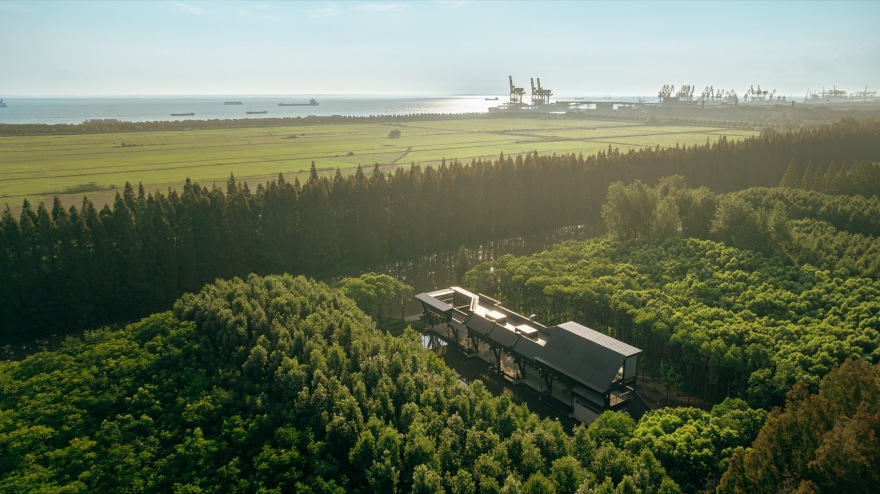
▼栋梁轩建造于林场的浅水塘内,Built in a shallow pond in a forest farm © 杨易欣
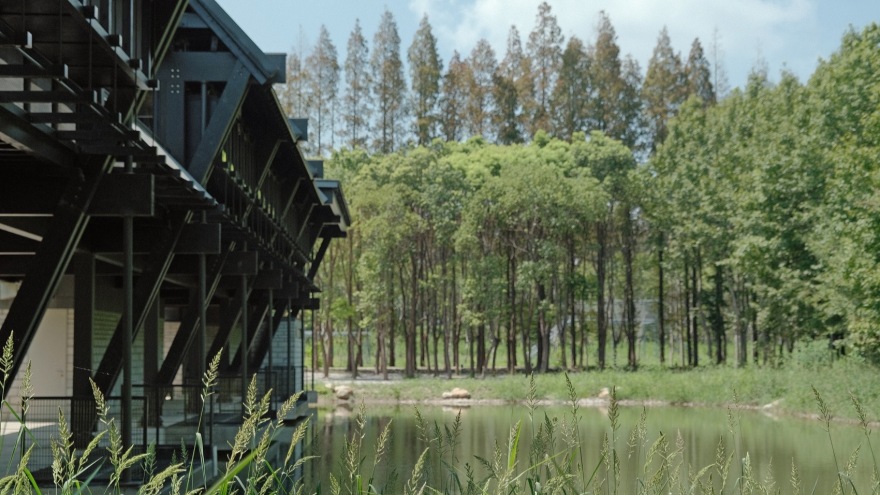
▼栋梁轩临水塘侧立面,Side elevation facing the pond ©杨易欣

▼浅池上的栋梁轩,On the shallow pond © 朱雨蒙

▼室内穿行视角,Indoor walking perspective © 朱雨蒙

1.神奇的“长江林场”
The Enchanting “Yangtze River Forest Farm”
几千年来,长江三角洲的地理变化,几乎是对“沧海桑田”的最好注解。毗邻入海口的太仓段,更是这种变迁的典型。
▼形式原型之一:苏州拙政园卅六鸳鸯馆老照片,Old photos of the 36th Yuanyang Pavilion in Suzhou’s Humble Administrator’s Garden © 网络图片

Over thousands of years, the shifting geography of the Yangtze River Delta has exemplified the saying “seas change into mulberry fields.” The Taicang section, near the river’s estuary, is a prime example of this transformation.
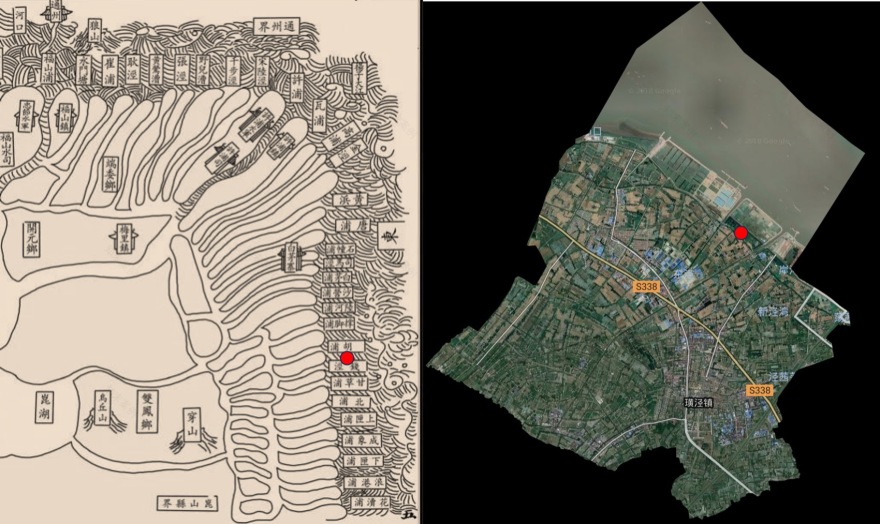
▼左图南宋宝祐常熟县乡村之图中的钱泾口地区(红点位置为基地)右图当代卫星图中的钱泾口长江林场(红点位置为基地),原江面已成陆地,Left: Qianjingkou area in a rural map of Changshu County during the Southern Song Dynasty (the red dot is the base). Right: Qianjingkou Yangtze River Forest Farm in a contemporary satellite map (the red dot is the base). The original river surface has become land
▼当代卫星图中的长江林场(白色虚线框)【图下方为正南】,The Yangtze River Forest Farm in the contemporary satellite image (white dotted frame) [the bottom of the image is due south] © 神奇建筑研究室

1974年冬,来自鹿河、璜泾、王秀三个公社的壮劳力在一个叫滨海村的位置大兴土木。除了增筑外江堤,他们还在圈进堤内的滩涂上排涝运土,植树种稻。狭长的滨江湿地被改造成林地和农田,“长江林场”就此诞生。林场占地1285亩,除了林地,另有103亩的生活区。最盛时,这里安置了周边城镇近一半的初高中毕业生,是太仓当时规模最大的农业场圃。
In the winter of 1974, strong laborers from the Lu He, Huang Jing, and Wang Xiu communes launched an ambitious land development project in a place called Binhai Village. In addition to reinforcing the outer river embankment, they drained and filled the intertidal flats enclosed within the new levees, planting trees and cultivating rice. The narrow riverfront wetland was transformed into farmland and forest—thus, the “Yangtze River Forest Farm” was born. Covering 1,285 mu (approximately 85 hectares), the forest farm includes not only woodlands but also a 103-mu (around 7 hectares) residential area. At its peak, it accommodated nearly half of the junior and senior high school graduates from surrounding towns, making it the largest agricultural settlement in Taicang at the time.
▼1970年代长江太仓段河塘治理,River and pond management in Taicang section of the Yangtze River in the 1970s © 网络图片

▼左图为70年代滨江河塘疏浚工程,右图为今日长江林场随塘河,The left picture shows the riverside pond dredging project in the 1970s, and the right picture shows the Suitang River in the Yangtze River Forest Farm today© 长江林场探险公园

在半个世纪人工与自然的合力塑造下,林场的景象已超出当年的构想:高大的水杉,沿随塘河密布。它们根系错综,重构了岸线,最早种植的一批,需要两个人才能合抱。林场内各地块依旧分界清晰,林木各具姿态。樟树、栎树、枫树与桂花树因时节不同,展示着绚丽的色彩。林场北侧的地块,已化为连片的荷塘与鱼池,成为南北候鸟和小型野生动物的迁徙驿站。
Half a century of human effort intertwined with nature has shaped the forest farm into something far beyond its original vision. Towering dawn redwoods now densely line the Suirentang River. With interwoven root systems, they’ve reshaped the riverbanks. Some of the earliest planted trees now require two people to fully encircle their trunks. Distinct forest patches remain clearly defined, each with trees of varied character. Camphor, oak, maple, and osmanthus trees dazzle with seasonal changes in color. The northern part of the forest has evolved into a mosaic of lotus ponds and fish pools, serving as a migratory stopover for birds and small wildlife moving between north and south.
▼改造前的长江林场(2021),Yangtze River Forest Farm before renovation (2021) ©长江林场探险公园

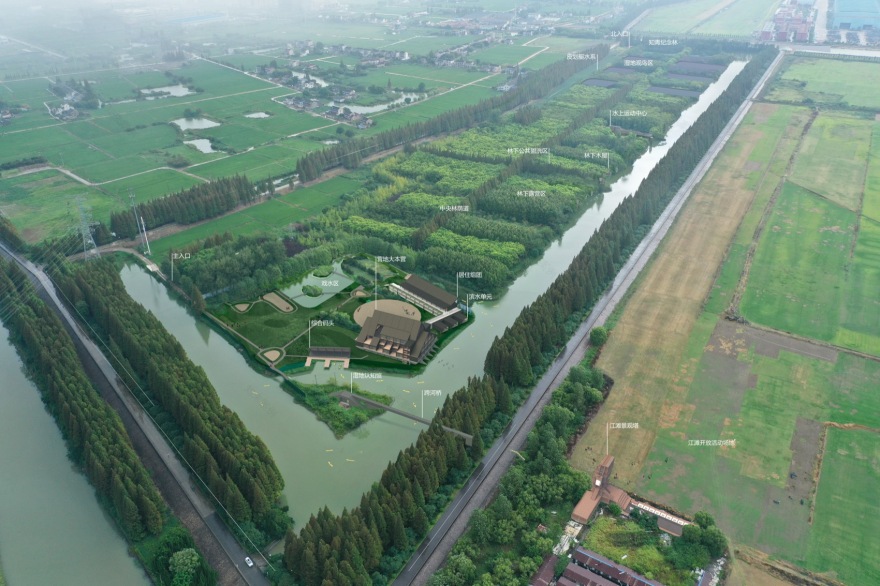
开发林场的动议, 2021年就被提出。基于场地的独特性,神奇建筑研究室曾建议将建设集中于东南角原本的林场生活区,保留完整的林地景观。可惜无论从土地的出让时序,还是使用的需求,都只能选择林木最为茂密的林场腹地启动建设。不过这也未必是坏事。这里具备了林场最典型的环境场景:河滨、林下和坑塘。如果能应对好这些问题,就可以形成一整套适合长江林场的开发模式。即使后续要面对更大的开发压力,也能与景观和谐共处。
The idea to redevelop the forest farm emerged in 2021. Given the site’s uniqueness, Wonder Architects originally proposed concentrating construction in the southeastern corner—the former residential area—thus preserving the forested landscape in its entirety. Unfortunately, due to land allocation schedules and functional needs, construction had to begin in the densest core of the forest. Yet this may not have been a drawback. This central zone offers the most quintessential forest farm scenery: riverside zones, under-canopy clearings, and pit-pond systems. If these conditions can be handled thoughtfully, it could establish a replicable development model for the entire forest farm. Even under greater future development pressure, harmony between architecture and landscape can still be achieved.
▼长江林场保护性开发规划,Yangtze River Forest Farm protective development plan © 神奇建筑研究室
2.重复风景中的长屋
A Longhouse in a Repetitive Landscape
林场是人工自然。它建设的目的是种树,像种作物一样种树,这使它的景观较为单调。而且密植普通林木的内部地块与滨水的水杉岸线也呈现出割裂的面貌。这里需要一个枢纽,既提供人们观看林场的方式,又能完成空间与景观的转换,也给人们提供进入风景的渠道。
The forest farm is a product of artificial nature—its original purpose was to plant trees as if cultivating crops, which resulted in a relatively monotonous landscape. Moreover, the interior plots of densely planted common tree species stand in stark contrast to the waterfront lined with dawn redwoods. This fragmented visual experience calls for a spatial and visual hub—one that not only offers a way to perceive the forest farm, but also facilitates transitions between space and landscape, while serving as a point of access into the scenery.
▼栋梁轩选址,林场中心区积水浅池,Shallow pond in the center of the forest farm ©长江林场探险公园
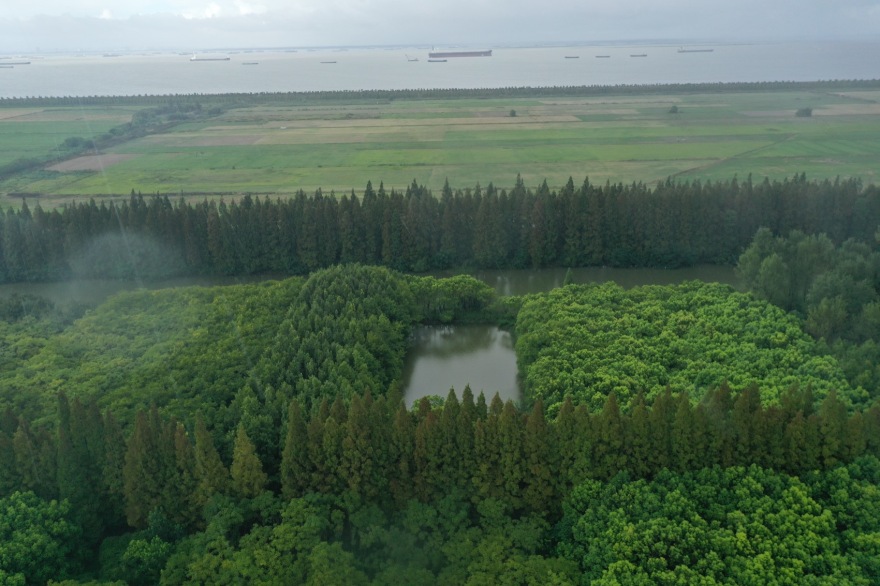
神奇建筑研究室选取了林地中的积水浅塘作为基地,这里既不挤占林地,也能利用浅池与主河道的天然联络,设置服务水上运动的码头和配套设施。对于建筑形式,干栏式长屋成为理想的模板。
Wonder Architects selected a shallow, waterlogged pond within the forest as the building site. This location avoids encroaching on forested land and leverages the natural connection between the shallow pond and the main waterway, making it suitable for a small harbor and supporting facilities for water sports. For the architectural form, the stilted longhouse (also known as a pile dwelling) emerged as the ideal prototype.
▼余姚河姆渡遗址长屋复原,Restoration of the longhouse at the Hemudu site in Yuyao ©网络图片

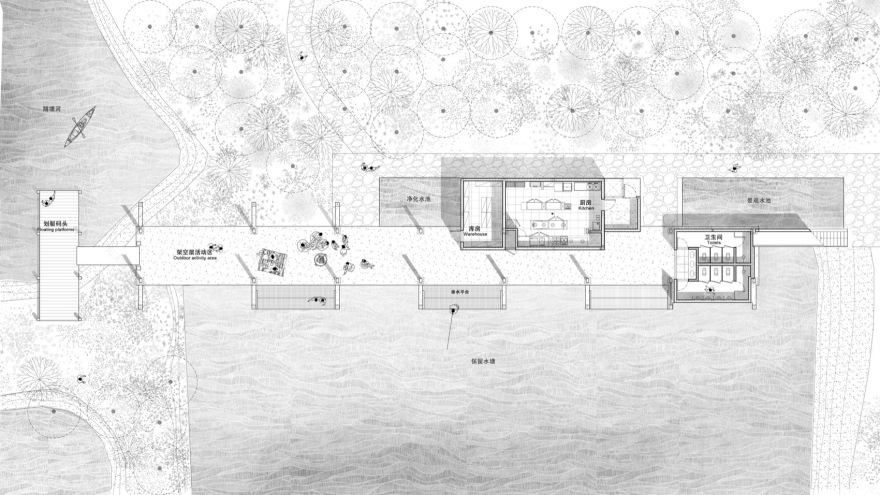
大概7000年前,距此不远的余姚河姆渡就出现了规模可观的干栏式长屋。为了应对潮湿多雨的气候,先民采用了长脊短檐式的屋顶以及高出地面的底架,有些建筑甚至直接架在水上,至今东南亚还能见到类似的场景。新建筑称为栋梁轩,用粗大的胶合木梁柱承托起七跨的水上长屋。每一跨因功能不同形成了差异化的构型,将码头、餐厅、公共盥洗室、多功能厅和库房进行了整合,沿着长方形浅池横向排列。建筑成为连通主航道码头和林地中心林荫道的“桥梁”。
▼栋梁轩纵剖面,section© 神奇建筑研究室

▼栋梁轩2层平面,second floor plan©神奇建筑研究室

Around 7,000 years ago, in nearby Hemudu, Yuyao, extensive stilted longhouses had already appeared. To cope with the humid and rainy climate, early settlers developed buildings with long ridge and short eaves roofs, elevated platforms above the ground, and in some cases, structures built directly over water. Similar architectural strategies are still found today in parts of Southeast Asia. The new building, named Dongliang Xuan , consists of a seven-bay waterborne longhouse supported by massive glulam beams and columns. Each bay features a distinct structural configuration tailored to different functions, including a dock, restaurant, public washrooms, multipurpose hall, and storage rooms. These functions are arranged laterally along a rectangular shallow pond. The architecture acts as a “bridge” connecting the main waterway dock with the central forest path.
▼随塘河主航道望向栋梁轩,The main channel of Suitang River looking towards the building © 朱雨蒙

▼栋梁轩正立面,Front facade©朱雨蒙

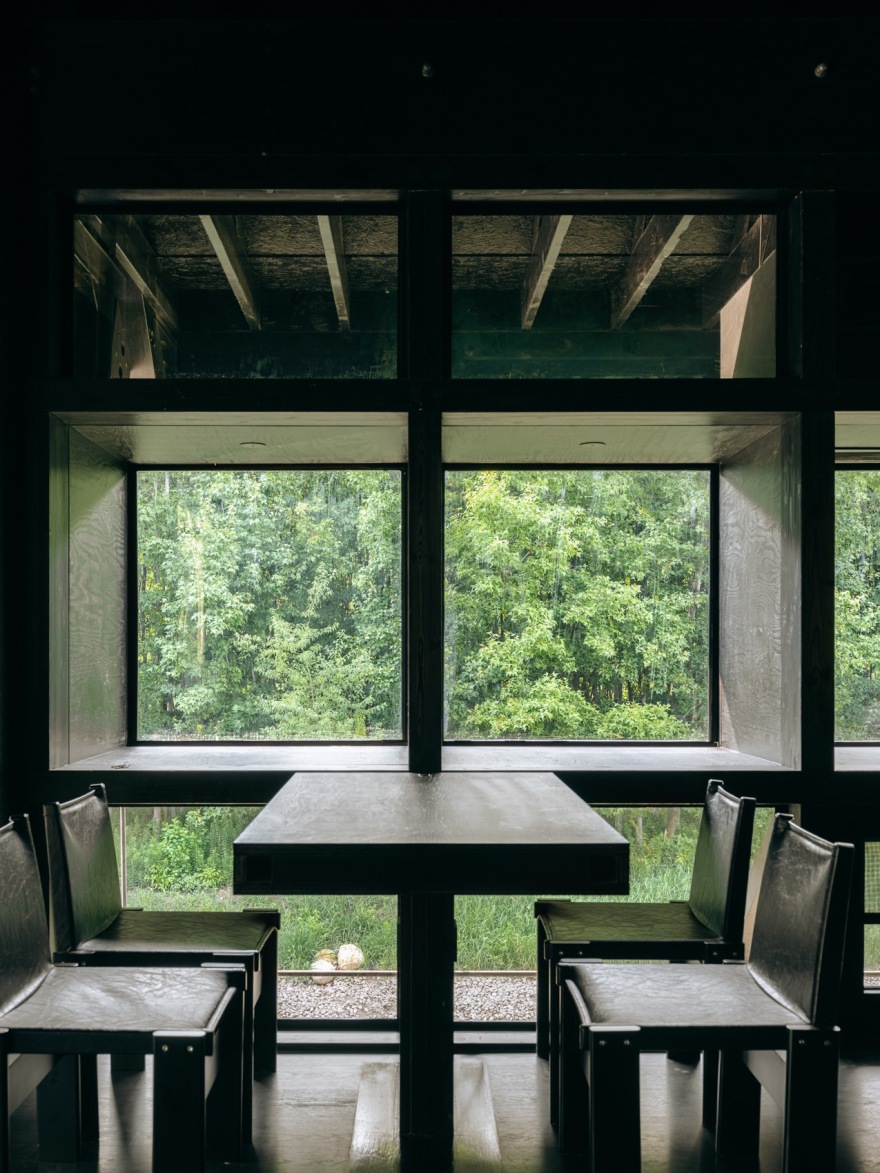
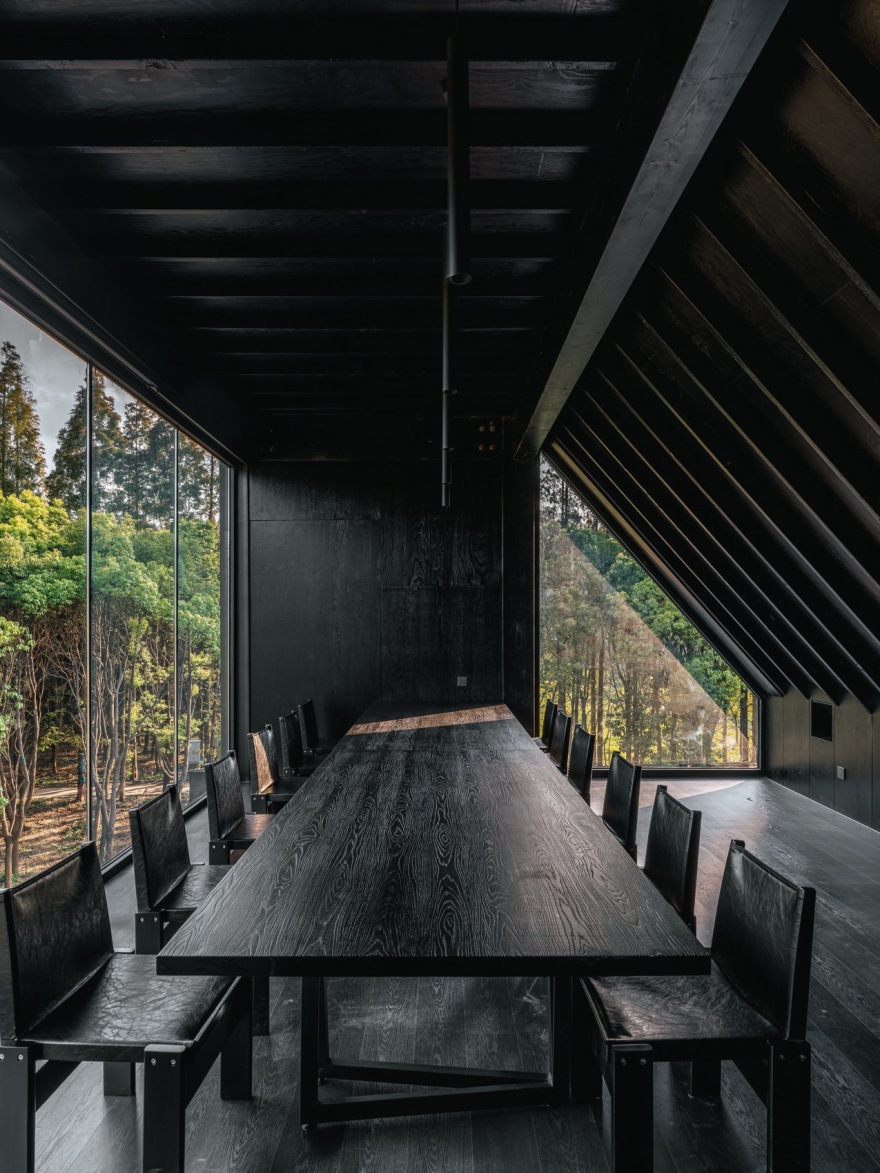
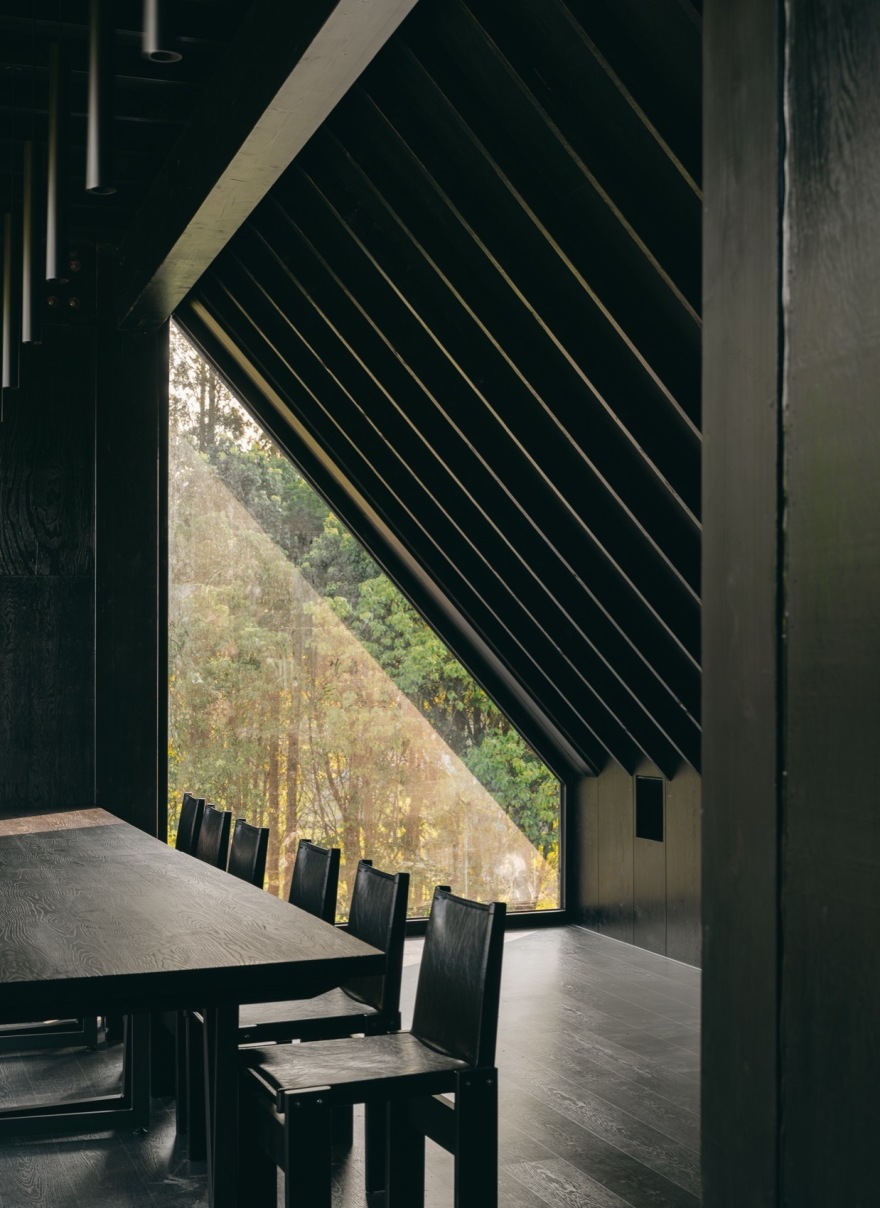
轩,在辞典里解释为“有窗的长廊”。在 “窗”的塑造下,栋梁轩形成了某种观看林场风景的方式。它们将外部风景摄入空间内部,成为可与室内活动相互渗透的氛围与背景。也把建筑转化为矗立在风景中的巨大影像装置。
▼栋梁轩单元开间模型与相机装置的关系,Relationship between unit bay model and camera device ©神奇建筑研究室

▼摄影机械对单一景物的处理模式对比,Comparison of the processing modes of single scene by photographic machinery ©神奇建筑研究室

In Chinese, the word “轩” (Xuan) is defined as “a corridor with windows.” Through these “windows,” Dongliang Xuan creates a way of seeing the forest landscape. The windows capture exterior scenes and draw them into the interior, allowing landscape and activity to blend seamlessly. In doing so, the building itself transforms into a monumental visual device—an image-making structure embedded in the scenery.▼栋梁轩风景摄取装置细节,Scenery capture device details ©朱雨蒙

▼栋梁轩内部空间:摄取风景的暗箱,Camera obscura for capturing landscapes ©朱雨蒙
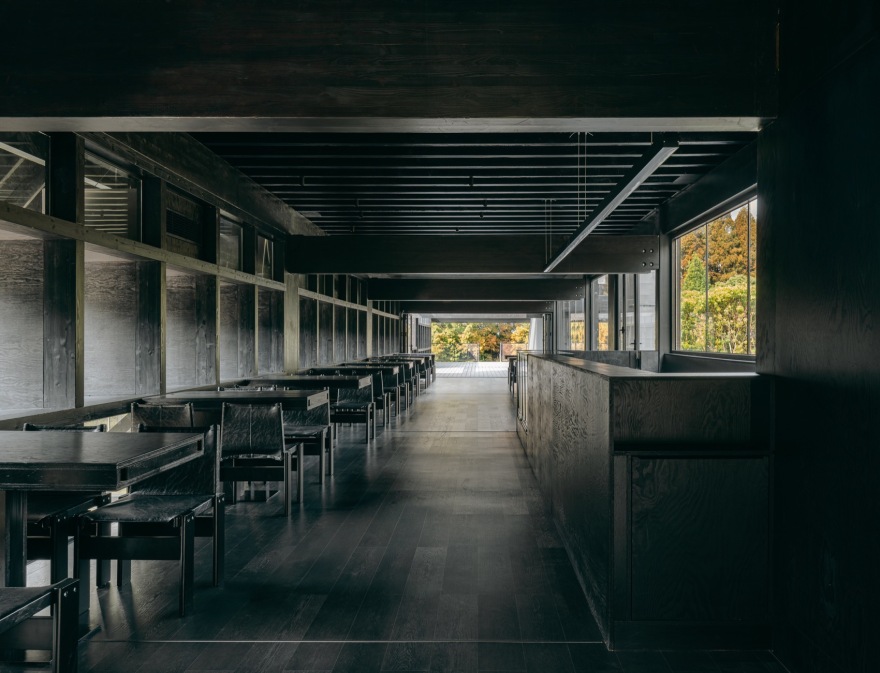
▼施工完成后的风景摄取装置,Landscape photography device after construction is completed ©朱雨蒙

▼风景摄取装置细部,Detail of the landscape capture device ©朱雨蒙
3.整合体验的廊桥
A Corridor-Bridge Integrating Experience
栋梁轩是长屋,也是廊桥。人在其中的运动是空间的线索, “窗”作为空间体验的整合媒介,将在地风景截取为若干“片段”,塑造出对雷同风景的差异化观看经验。人在建筑内行进,步移景易。观者能体验到建筑空间对人工林景观的不同诠释,也让建筑内的主要动线获得了精神意义和仪式感。
Dongliang Xuan functions both as a longhouse and as a corridor-bridge. Human movement through the structure forms the narrative thread of the space. “Windows” serve as mediating devices that integrate spatial experience, capturing fragments of the local landscape and presenting them as curated “scenes.” In doing so, they create a differentiated viewing experience within an otherwise repetitive environment. As one moves through the building, the scenery shifts with each step. Visitors encounter varying interpretations of the managed forest through the architecture itself, imbuing the main circulation route with a sense of ritual and spiritual resonance.
▼由7个不同风景装置构成的栋梁轩,It consists of 7 different landscape installations. ©朱雨蒙

▼变化的景窗序列,Changing window sequence ©朱雨蒙
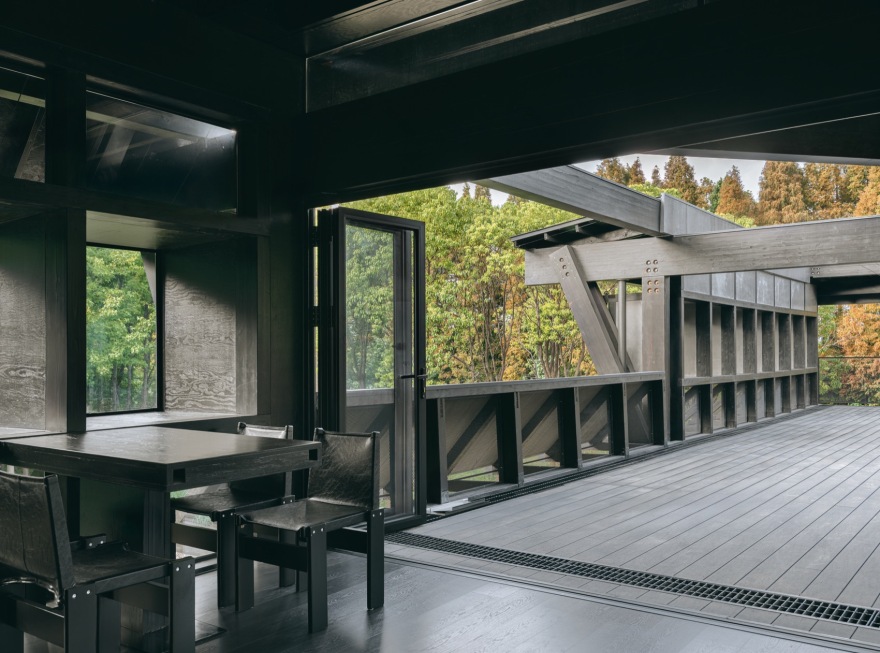


▼不同类型的景窗,Different types of picture windows ©朱雨蒙

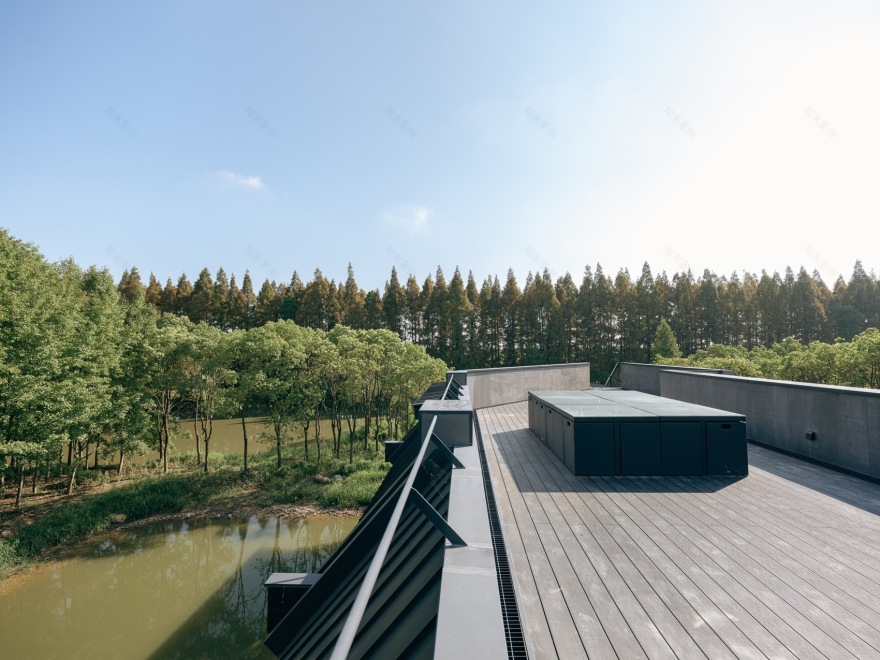
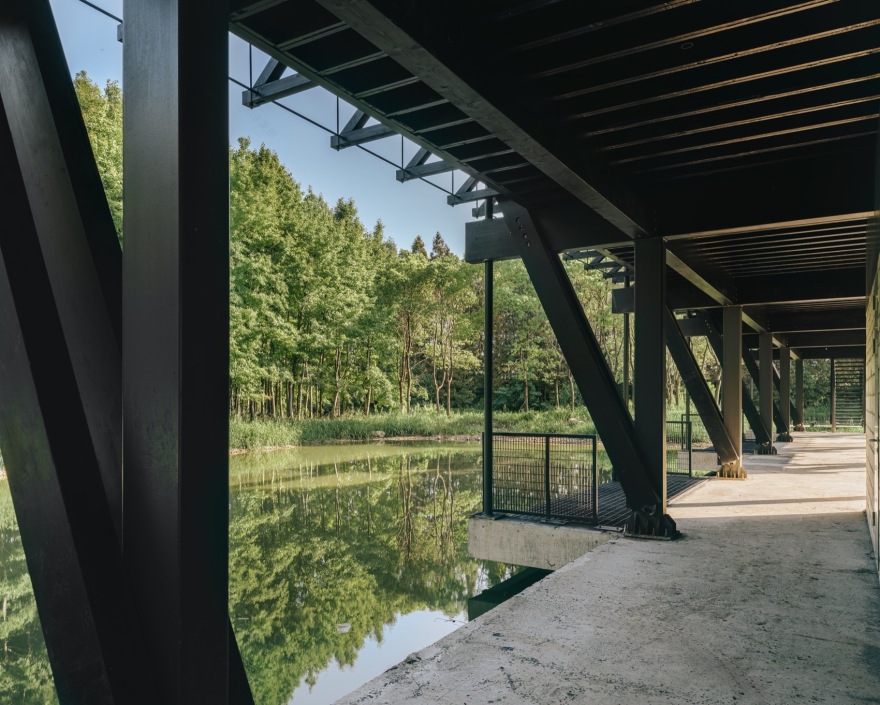
主要室内空间之外,栋梁轩还提供了高位(露台)和滨水(廊下)两条体验路径。人们在通过这些空间抵达划艇码头的过程,就是以不同方式和角度观察林场的经历。
▼屋顶露台路径,rooftop terrace path © 神奇建筑研究室

▼首层水上敞廊路径,first floor water gallery path © 神奇建筑研究室
▼栋梁轩横剖面,section© 神奇建筑研究室
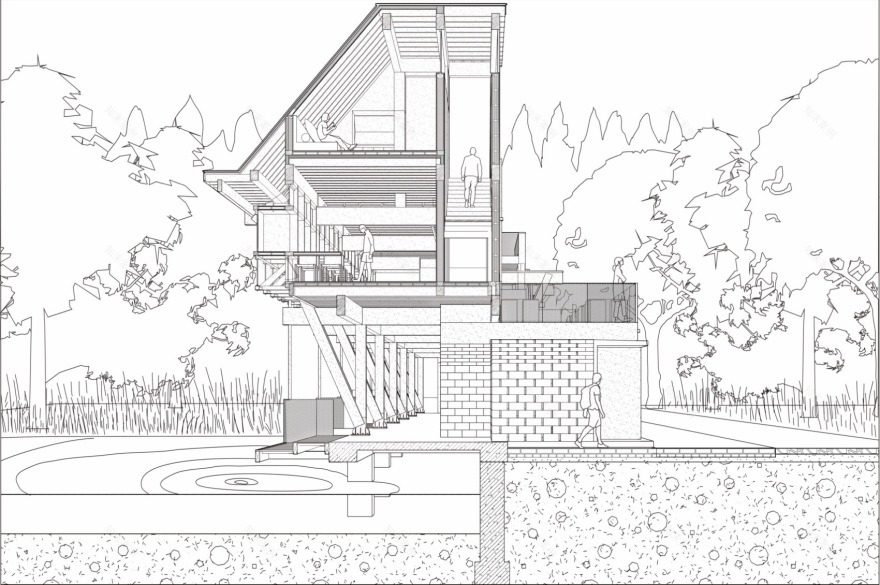
Beyond its primary interior spaces, Dongliang Xuan offers two additional experiential pathways: an elevated terrace and a waterside under-eave corridor. The journey through these spaces—leading toward the canoe dock—becomes a multi-angled and immersive encounter with the forest farm, allowing visitors to perceive the landscape from diverse perspectives and emotional vantage points.
▼林木中的栋梁轩主入口,Main entrance©朱雨蒙

▼屋顶露台路径上的各个视点,Viewpoints along the roof terrace path ©朱雨蒙


▼屋顶露台路径上的各个视点,Viewpoints along the roof terrace path ©朱雨蒙

▼水上敞廊视角,View from the water gallery ©朱雨蒙
▼首层水上敞廊与三层多功能厅,The first floor water gallery and the third floor multi-function hall ©朱雨蒙

4.轻建造与新江南
Light Construction and a New Jiangnan
栋梁轩的形式容易让人联想到江南水网地带早期的建造经验。它架空底部,存续了原有的水体,也把建造对场地的扰动降到最低。作为长屋,它适合模块化建造,可按照需求沿线性方向生长,这与林场特殊的地块形态也达成契合。
The form of Dongliang Xuan readily evokes early construction practices of the Jiangnan water-town region. Its raised foundation preserves the original water body beneath, minimizing disruption to the site. As a longhouse, it naturally supports modular construction and can grow linearly as needed—an approach well suited to the segmented and elongated plots of the forest farm.
▼栋梁轩轩窗组件榫卯插接模式拆解,disassembly of the mortise and tenon joint mode of window components © 神奇建筑研究室

栋梁轩的建造中,实木集成材(胶合木)预制构件的大量采用,使它的主体构件能在60公里外的南通工厂由计算机控制制造(CNC)。中小组件则采用了传统榫卯的形式。它们都经过预装配的测试,施工现场均为干作业,普通木工便可施工。整个过程中基本没有垃圾产生,建造的周期也被精准控制。
In the construction of Dongliang Xuan, the extensive use of prefabricated glulam (glued laminated timber) components enabled the main structural elements to be CNC-fabricated in a factory just 60 kilometers away in Nantong. Smaller components utilized traditional mortise-and-tenon joinery. All components were preassembled and tested before being delivered to the site, where construction was entirely dry and could be executed by standard carpentry teams. The process generated virtually no waste, and the timeline was precisely controlled.
▼施工过程中的栋梁轩,construction © 神奇建筑研究室

神奇建筑研究室将栋梁轩的建造总结为“轻”:用轻质材料,轻型设备,轻巧工法,对环境和周边社会也轻轻接触。建筑师基于水网人工林这个特殊场地和周边村镇的产业基础,选择了适配的形态与建造方式。这里既有江南传统的建造智慧,也有对新型木结构技术的思考。
Wonder Architects describes the construction of Dongliang Xuan as “light”—using lightweight materials, lightweight equipment, and light-touch construction methods that gently interact with both the environment and surrounding communities. Drawing from the unique conditions of a water-based artificial forest and the nearby village economies, the architects adopted a construction strategy and form tailored to the local context. The result reflects both the wisdom of traditional Jiangnan building techniques and a contemporary exploration of new timber structure technologies.
▼通向栋梁轩的林荫小径,Tree-lined paths ©朱雨蒙

▼栋梁轩与周边传统建筑木构的形式联系,The connection with the surrounding traditional wooden structures ©朱雨蒙


▼栋梁轩木构细节,Wood structure details ©朱雨蒙


尾声
Epilogue
长江三角洲是一片被人类反复干预的土地。在无数先民的开垦、疏浚和劳作下,塑造了水网地区绚丽的自然与人文景观。续写这片土地上的景色与风物,不应执着于单纯的形式写仿或符号粘贴,而是应该基于当代江南的资源、环境与社会,重新构建起在地化的建造体系。在这个体系内,更具地域性,经济性,也更高效环保的建造形式和建筑形态会不断涌现,这也许正是探索新江南建造的意义所在。长江林场是片有些突兀的人工林,在起伏的江涛旁枯荣滋长已逾半个世纪。它不断演进变化,俨如周边的沧海桑田。在这里,对新江南面貌的探索刚刚开始,每个参与者恰似五十年前在江滩上栽下树苗的年轻人,他们不知道最终的结果为何,但一定怀着对未来热烈的期望。这些人清楚,他们在书写属于这个时代的,一小段史诗。
The Yangtze River Delta is a land shaped by centuries of human intervention. Through generations of cultivation, dredging, and labor, our ancestors crafted the dazzling interplay of nature and culture that defines this water-bound landscape. Continuing the story of this land should not rely on superficial formal mimicry or symbolic pastiche. Instead, it calls for the reconstruction of a localized building system grounded in the realities of today’s Jiangnan—its resources, environment, and society. Within such a system, new architectural forms and methods will emerge—forms that are more regionally specific, economically viable, efficient, and environmentally responsible. This, perhaps, is the deeper meaning behind the exploration of a “New Jiangnan” mode of building. The Yangtze River Forest Farm is a somewhat unexpected artificial woodland, thriving and withering in cycles for over half a century beside the shifting tides of the great river. It continues to evolve, echoing the transformations of land and water that have always defined this region. Here, the exploration of a new Jiangnan has only just begun. Each participant in this endeavor is like the young laborers who planted trees on the riverbanks fifty years ago—unaware of the final outcome, but filled with hope for what the future holds. They understand that they are contributing a small yet meaningful passage to the epic of this era.
▼暮色下的长江林场,Yangtze River Forest Farm at dusk ©朱雨蒙

项目信息
项目名称:栋梁轩
方案状态:建成
项目位置:江苏苏州.太仓市.长江林场
建筑面积:400平方米
建成时间:2024.10
设计单位:神奇建筑研究室
设计主持:朱起鹏
设计团队:金泰霖、张天爱、冯超越、王舒欣、范闰婷
结构咨询:ZTJ Building Craft、加拿大木业
建设单位:璜泾镇人民政府、苏州狸猫旅游科技有限公司
施工单位:中集集团、苏州丘山营造工程有限公司
Project Information
Project Name: Dongliang Xuan
Project Status: Completed
Location: Yangtze River Forest Farm, Taicang, Suzhou, Jiangsu Province, China
Building Area: 400 m²
Completion Date: October 2024
Design Firm: Wonder Architects
Lead Architect: Zhu Qipeng
Design Team: Jin Tailin, Zhang Tian’ai, Feng Chaoyue, Wang Shuxin, Fan Runting
Structural Consultants: ZTJ Building Craft, Canada Wood
Clients: People’s Government of Huangjing Town, Suzhou Limao Tourism Technology Co., Ltd.
Contractors: CIMC Group, Suzhou Qiushan Construction Engineering Co., Ltd.


南京喵熊网络科技有限公司 苏ICP备18050492号-4知末 © 2018—2020 . All photos and trademark graphics are copyrighted by their owners.增值电信业务经营许可证(ICP)苏B2-20201444 苏公网安备 32011302321234号
苏公网安备 32011302321234号客服
消息
收藏
下载
最近