

创作上传
VIP
收藏下载
登录 | 注册有礼
查看完整案例

收藏

下载

分享
01项目背景
Project Background
光明虹桥1958生态公园,位于深圳市光明区东部,占地面积约33248平方米。场地原为旧农场,有一条水渠贯穿其中,形成南北两片区,场地内存在一定的高差。由于长期荒废、管理不善,部分区域植被杂乱,建筑垃圾乱倒,场地空旷,临时用作停车场,与周边景观不协调,未能充分发挥其生态和公共服务价值。
Located in the eastern part of Shenzhen’s Guangming District, Guangming Hongqiao 1958 Eco Park spans an area of approximately 33,248 square meters. The site was formerly a disused farm, bisected by an irrigation channel that divides it into northern and southern zones. With a varied topography and significant elevation differences, the land had long suffered from neglect—overgrown vegetation, scattered construction debris, makeshift parking, and overall disharmony with the surrounding urban fabric. The site’s ecological and public service potential had remained largely untapped.
▼整体鸟瞰,aerial view©丘文三映


02低干预策略
A Strategy of Minimal Intervention
设计团队对原场地进行实地考察、分析,以“低干预、低维护”为设计原则,对场地改造提出了多个解决方案:
利用两边高,中间低的高差地势,通过开挖洼地、填筑梯田实现土方平衡,优化雨水径流路径;
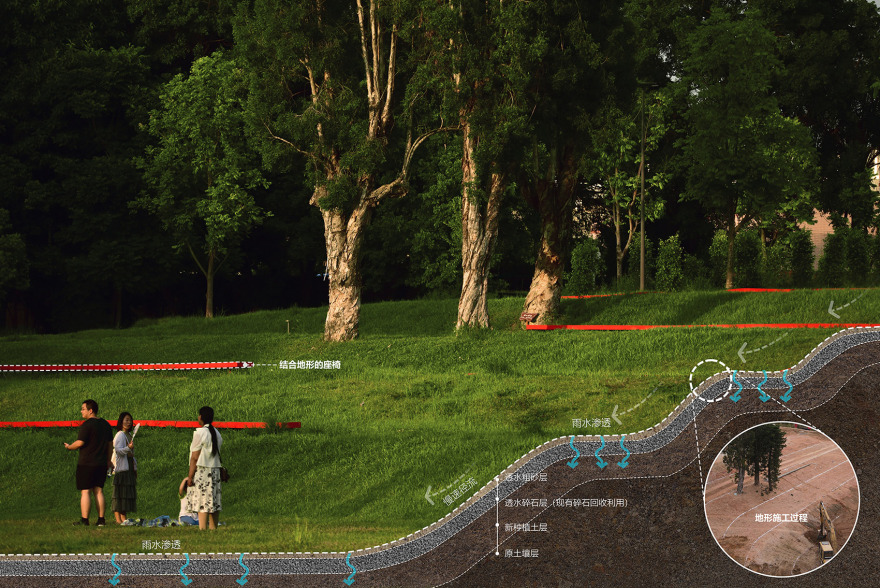
原场地长期被非法用作停车场,导致地表严重硬化,雨水径流后透水性差,造成大量径流,通过重新覆绿,透水地面铺装,从而减少雨水径流,增加渗透,从而提高场地的渗透性和保水能力。
为改善原场地的植被杂乱、场地空旷问题,场地保留部分大树,改造设计将保留和保护这些大树,增强场地生态稳定性。
采用低冲击的施工方式,最大程度减少对现有环境的破坏,使用环保材料和技术,保持自然生态系统的稳定性。
▼设计策略,design strategy©自组空间设计


Guided by the principles of low intervention and low maintenance, the design team conducted a thorough site investigation and proposed a series of strategic solutions to transform the underutilized space:
Topography Rebalancing: Taking advantage of the site’s terrain—higher on both sides and lower in the middle—the team implemented a system of excavated depressions and terraced embankments to achieve earthwork balance and improve stormwater runoff dynamics.
Surface Permeability Restoration: Years of unauthorized parking had caused severe surface compaction, diminishing permeability and increasing runoff. Through vegetation restoration and permeable paving, the design mitigates runoff, enhances infiltration, and boosts the site’s water retention capacity.
Vegetation and Ecological Stability: Some mature trees were preserved and integrated into the new design, maintaining existing biodiversity and enhancing the site’s ecological resilience.
Eco-friendly Construction Methods: The project employed low-impact construction techniques and environmentally friendly materials to minimize disruption and preserve the existing natural systems.
▼雨水花园鸟瞰,aerial view of the rain garden©丘文三映

▼低干预的原则,strategy of minimal intervention©丘文三映

▼利用地势重塑地形,Use of topography to reshape the terrain©丘文三映

▼通过重新覆绿,提高场地的渗透性和保水能力,Improve permeability and water retention capacity of the site through re-greening©丘文三映

▼场地保留部分大树,增强场地生态稳定性,Retention of some large trees on the site to enhance the ecological stability of the site©丘文三映

03雨洪探索和实践
Stormwater Exploration and Practice
对于本项目,设计团队在雨洪管理方面,进行了更深入的探索和实践:
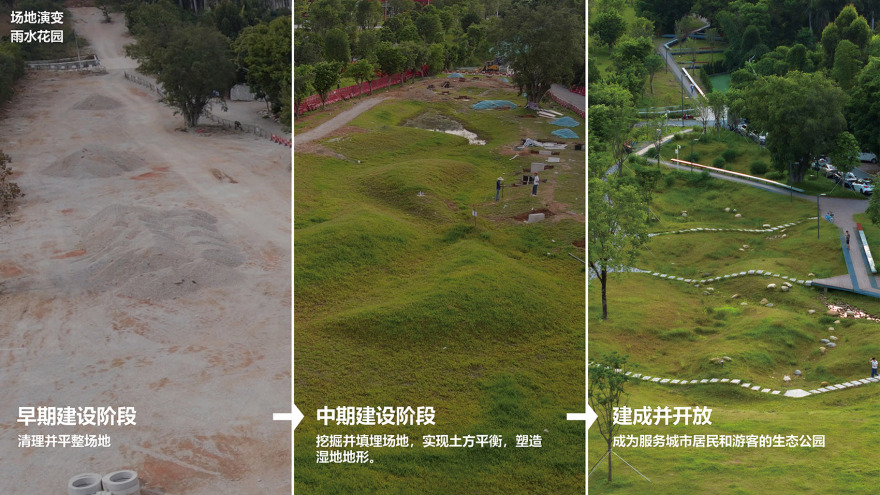
源头控制:这涉及重塑地形和增强植被覆盖,以最大限度地减少雨水径流,促进雨水自然渗入地下。随坡就势进行微地形景观重塑,旨在减少场地径流的量和速度。
过程控制:在雨水流动过程中,将整合各种结构化的雨水管理功能。场地采用可透水铺装,通过下凹地形塑造形成自然的地表径流,公园成为雨水的天然收集和滞留区域,透水铺地材料促进雨水渗透,架空路网设计改变道路的排水模式,将雨水引导到地面雨水管理系统中,这两项措施减少雨水在路面上的积聚和流失,提高场地生态的可持续性。
管道末端存储:在场地边界,将建造雨水保留池来收集和储存多余的雨水。储存的水可用于灌溉绿地、补充地下水或其他非饮用用途。通过储存和缓慢释放雨水,这些水池可以减轻暴雨事件的影响并减少城市排水系统的压力。雨水花园将降雨中的雨水收集起来,形成一个丰富的生态系统,促进城市生物多样性,同时延缓排放到排水系统的时间,有助于减轻城市排水系统的压力,降低洪水风险。
▼重塑地形和增强植被覆盖,Remodelling of terrain and enhancement of vegetation cover©自组空间设计

▼雨水花园区演变,evolution of rain garden©自组空间设计
▼场地雨水径流系统,Site stormwater runoff system©自组空间设计

▼顺应地形的步道与雨水花园相互融合,Terrain-responsive walkways and rain gardens integrate with each other©自组空间设计

For this project, the design team conducted further in-depth exploration and practice in stormwater management:
Source Control: Micro-topography was reshaped in accordance with natural slopes, increasing vegetative cover to reduce runoff volume and velocity, and to promote natural groundwater recharge.
Process Control: Various rainwater management strategies were implemented throughout the site. Permeable paving and sunken green areas collect and slow runoff, transforming the park into a natural catchment basin. Elevated walkways alter traditional drainage paths, channeling water into on-site systems, thus reducing surface pooling and runoff while enhancing ecological sustainability.
Terminal Storage: Rainwater retention ponds were placed along the park’s edge to collect surplus water for irrigation and other non-potable uses. These ponds act as buffers during heavy rainfall, relieving pressure on municipal systems. Additionally, rain gardens capture and filter rainwater, creating habitats for local flora and fauna, increasing biodiversity, and serving as educational wetland zones.
▼雨水花园,rain garden©丘文三映
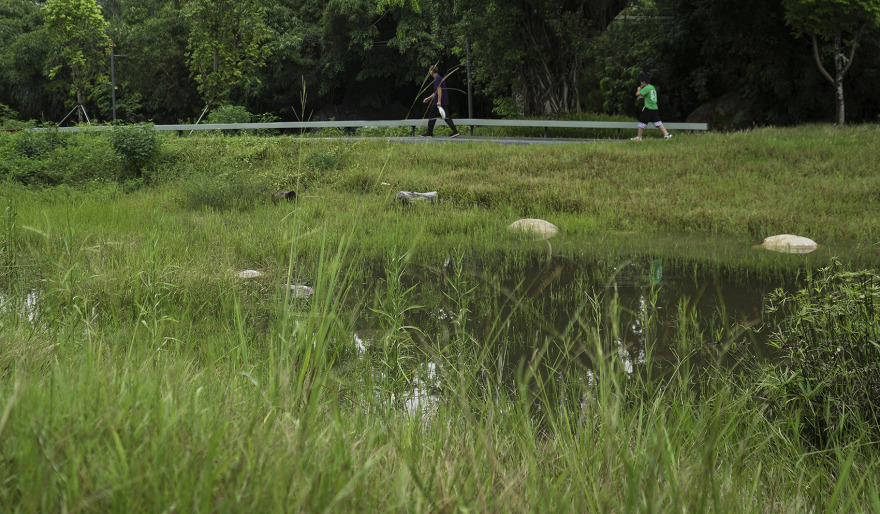
▼促进雨水渗透,延缓了地表径流,promotes rainwater infiltration and slows surface runoff©丘文三映


场地改造后,虹桥1958生态艺术公园成为一个开放自由的多样化弹性公共空间,提供灵活多样的活动区域,满足不同群体的需求。这里保留了大量原有树木,新种植各种本地树种,增加绿化覆盖率,从荒废的混凝土实地变成具有多层次绿色景观、令人放松、亲近自然的生态公园。
After the transformation of the site, Hongqiao 1958 Eco-Art Park becomes an open and free diverse and flexible public space, providing flexible and varied activity areas to meet the needs of different groups. A large number of original trees are preserved, and a variety of local species are newly planted to increase the green coverage, transforming the site from a deserted concrete field into a relaxing, nature-friendly eco-park with multi-layered green landscaping.
▼开放自由的多样化弹性公共空间,an open and free diverse and flexible public space©丘文三映

▼满足不同群体的需求,meet the needs of different groups©丘文三映


04多功能生态景观
A Multifunctional Ecological Landscape
雨洪管理与景观相结合的雨水花园,旱季是可参与的绿色景观,雨季滞留形成雨水花园,过滤和净化雨水,为生物多样性提供生态基底,提供湿地体验和教育基地,让人近距离接触自然,成为绿色放松的自然空间。
Following its transformation, Hongqiao 1958 Eco Park now serves as a vibrant, flexible, and inclusive public space that accommodates diverse user needs. Retaining much of the site’s original tree cover, and supplemented by native plantings, the former barren concrete space has been reborn as a lush, layered ecological park where nature and people coexist. The rain gardens double as engaging green landscapes in dry seasons and functional water features during wet periods, providing filtration, habitat, and immersive nature experiences for visitors of all ages.
▼雨洪管理与景观相结合的雨水花园,Rain gardens combining stormwater management and landscaping©丘文三映


建造横跨场地关键区域的架空栈桥,提供便捷的步行道与景观路线穿行于林中,提升可达性,增加场地景观的多样性。
An elevated walkway bridges key areas across the park, weaving through the forest and enhancing both accessibility and scenic variety.
▼架空路网设计改变道路的排水模式,Overhead road network design changes road drainage patterns©丘文三映


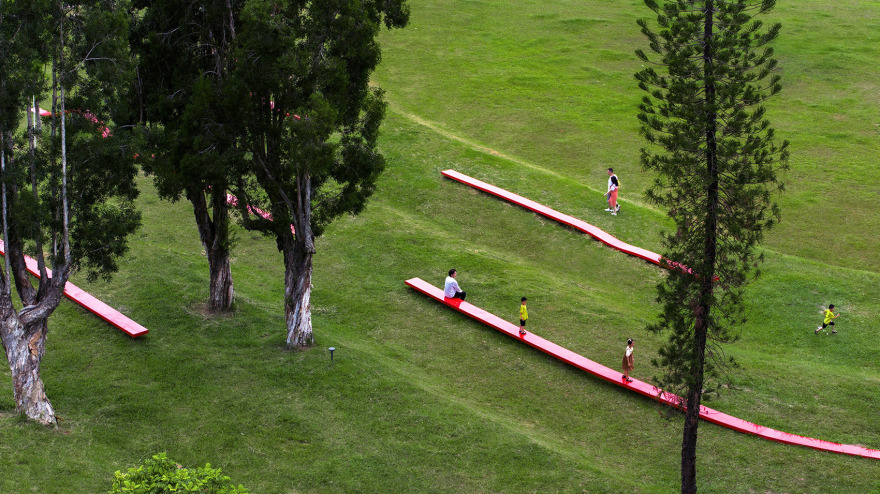
利用现有场地的挖方塑造草坪台阶赋予景观层次感,由底部逐渐上升,形成小型观景台;植入流畅曲线的红色装置座椅,与南临虹桥公园相互呼应,宛如起伏的波浪,增强场地的立体感,提供多样化的活动空间与景观视点。
Sculpted earthworks create stepped lawns that ascend into a small observation platforms, enriching spatial hierarchy and perspective. Artfully integrated red sculptural benches, with their undulating forms, echo the adjacent Hongqiao Park’s iconic curves and establish a visual and experiential connection across the urban green system. These installations offer rest spots and enrich the spatial dynamics of the park.
▼利用现有场地的挖方塑造草坪台阶赋予景观层次感,Use of existing site excavation to shape lawn steps to give a sense of landscape hierarchy©丘文三映


儿童游乐区保留了原有树林,巧妙地融合高差与儿童游乐设施。设置有机形态的立体活动平台形成丰富的竖向体验,并设置滑梯、攀爬网、沙池和汀步等游乐设施,为儿童提供亲近自然、参与户外活动的空间。
In the children’s play area, original woodland is preserved and the terrain is creatively leveraged. A three-dimensional, organically shaped play platform offers vertical exploration opportunities. Traditional playground elements—slides, climbing nets, sand pits, and stepping stones—are arranged to foster outdoor engagement and natural exploration.
▼儿童游乐区,children’s play area©丘文三映


▼有机形态的立体活动平台,three-dimensional activity platforms with organic forms©丘文三映


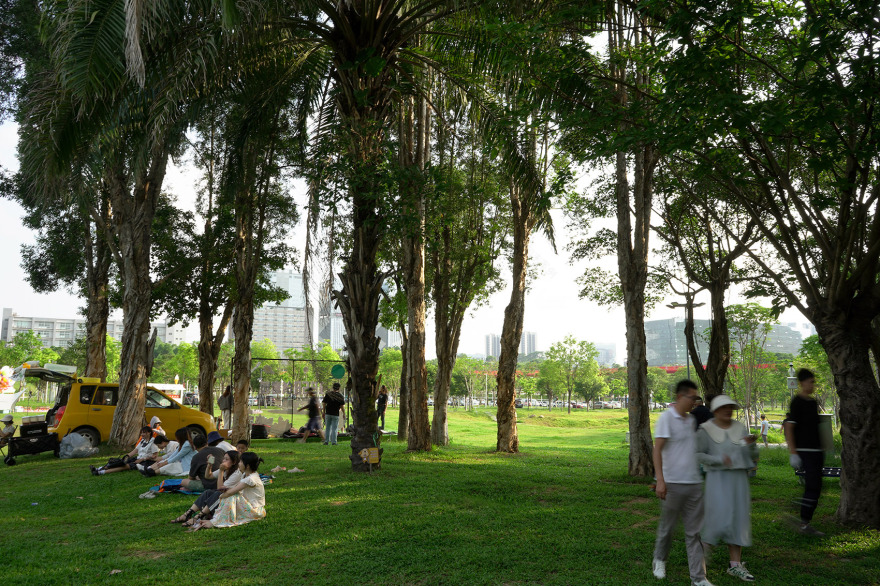
灵活的大草坪空间,供居民悠闲地进行野餐、放风筝、运动等活动,提升场地的开放感与活力。公园建成以来,已举办多次文体文化、艺术嘉年华活动。
The central lawn serves as a generous, open field for everyday leisure activities—picnics, kite flying, casual sports—and has become a favored gathering space for the local community. Since its opening, the park has hosted a variety of cultural, athletic, and artistic events, injecting new vitality into the neighborhood.
▼灵活的大草坪空间,the central lawn©丘文三映


▼提升场地的开放感与活力,enhance the sense of openness and vibrancy of the site©丘文三映

05重焕生机的土地
Reviving the Living Ground
场地通过顺势而为,因地制宜的改造,吸引了周边的居民,游客与路人进入公园活动,并为社交、亲子、休闲、不定期举办各种的社会活动提供场地。公园通过最少工程量和低冲击开发,实现人的活动与自然环境有机相融。
The transformation of Guangming Hongqiao 1958 Eco Park stands as a model of site-sensitive design—shaped by the land, shaped for the people. Through minimal earthwork and low-impact development, the project enables nature and human activity to blend organically. The park not only restores ecological function but also reactivates public life, turning a forgotten plot into a resilient, inclusive, and sustainable green urban sanctuary.
▼夜景鸟瞰,aerial view at night©丘文三映

▼场地分析,site analysis©自组空间设计


▼场地平面,site plan©自组空间设计

▼现状问题,site condition©自组空间设计

▼设计策略,design strategy©自组空间设计


项目名称:重焕生机的土地——深圳光明虹桥1958生态公园
项目类型:景观改造
设计方:自组空间
项目设计:自组空间
完成年份:2023年
设计团队:自组空间
项目地址:深圳市光明区
建筑面积:33200㎡
摄影版权:丘文三映,深圳自组空间
合作方:深圳市建科科学研究院股份有限公司
客户:深圳光明街道办
Project name:Reviving the Living Ground -Guangming Hongqiao 1958 Eco Park
Project type:Landscape Renewal
Design:Shenzhen Zizu Studio
Design year:Completion Year:2023
Leader designer & Team:Zizu Studio
Project location:Guangming District, Shenzhen
Gross built area: 33200㎡
Photo credit: Zizu Studio
Partner:Shenzhen Institute of Building Research Co., Ltd
Clients:Guangming Sub-district Office, Shenzhen


南京喵熊网络科技有限公司 苏ICP备18050492号-4知末 © 2018—2020 . All photos and trademark graphics are copyrighted by their owners.增值电信业务经营许可证(ICP)苏B2-20201444 苏公网安备 32011302321234号
苏公网安备 32011302321234号客服
消息
收藏
下载
最近