

创作上传
VIP
收藏下载
登录 | 注册有礼
查看完整案例

收藏

下载

分享
由Nice Developers与Era Contour委托,Mei建筑与规划事务所设计了“SAWA”项目——一座独特且循环可持续的50米高木结构住宅建筑,在最广义的层面上为社区与城市增添价值。这些“共享价值”涵盖了二氧化碳减排、生物多样性提升,以及建造一个可循环利用、包含可负担住房的包容性社区。
Commissioned by Nice Developers & Era Contour, Mei architects and planners designed ‘SAWA’: a unique and circular wooden residential building of 50 meters high, adding value to the neighbourhood and the city in the broadest sense. These “shared values” relate to CO2 reduction, the enhancement of biodiversity and the creation of a circular building with affordable housing for an inclusive community.
▼建筑概览,overview of the building©Ossip


▼建筑鸟瞰,aerial view of the building©Ossip


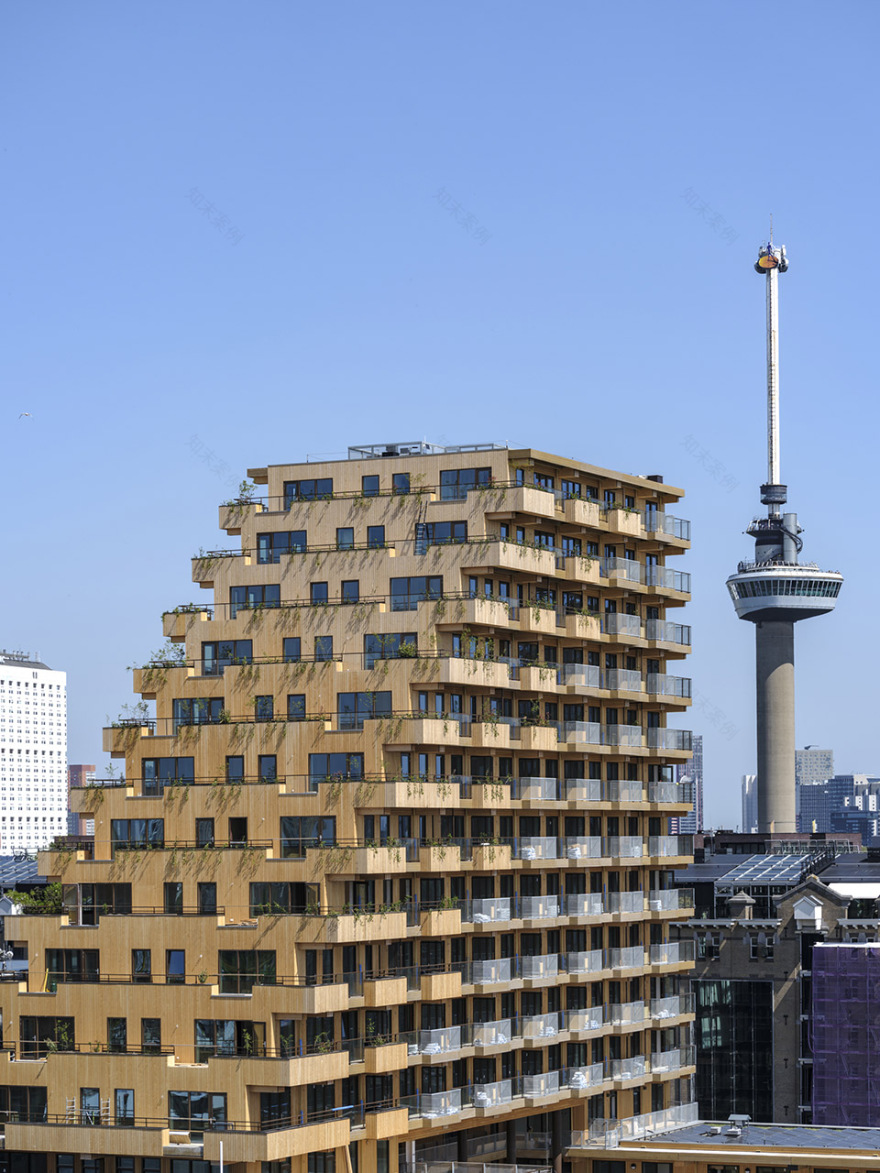
SAWA最显著的特点是其建筑结构完全由CLT(交错层压木)构成,混凝土的使用被控制到最小限度。这使得SAWA成为鹿特丹首座全高度木结构住宅楼。项目外观亦极具特色,大面积绿化露台既回应了场地的历史背景,也增强了社区的生物多样性。
SAWA’s exceptional feature is that the building is constructed entirely of CLT (cross laminated timber), with the use of concrete kept to a minimum. This makes SAWA the first full-height timber residential building in Rotterdam. The building is distinctive in its appearance due to the generous green terraces, which refer to the history of the location and at the same time reinforce the biodiversity in the neighbourhood.
▼其建筑结构完全由交错层压木构成,the building is constructed entirely of CLT (cross laminated timber)©Ossip

▼其建筑结构完全由交错层压木构成,the building is constructed entirely of CLT (cross laminated timber)©Ossip


委托方与设计师共同秉持的信念与动力不仅仅在于设计,而是付诸实现一个革命性的概念——SAWA。其目标一方面是积极应对碳排放、助力(国际)气候目标的达成;另一方面则是提供可负担的住房选择。因此,SAWA被称为“荷兰最健康的建筑”,是新一代的典范项目,是可持续目标的重要里程碑,亦是对改变建筑实践的有力证明。
The conviction and drive of both the client and the architect to not only design but also realise a revolutionary concept like SAWA is nourished by the ambition to contribute to reducing CO2 emissions and the achievement of (inter)national climate goals on the one hand, and to create affordable housing at the same time. SAWA, also known as the ‘healthiest building in the Netherlands’, is thus an exemplary project for new generations, an important step in the sustainability objectives and tangible proof that things can be done differently.
▼可持续建筑的典范,an exemplary project for sustainable architecture©Ossip

区域背景
Lloydkwartier
Lloydkwartier 区拥有悠久的海运历史,可追溯至20世纪初。Lloyd码头因Rotterdamsche Lloyd航运公司得名,彼时该公司在此设立码头,从这里启航驶向东方世界。SAWA的名字源于其阶梯式的形态与绿意露台,既象征东方稻田,也呼应了场地的历史记忆。
The Lloydkwartier has a rich maritime past that goes back to around 1900. The Lloyd pier owes its name to the shipping company Rotterdamsche Lloyd, which built a terminal on the pier from where its passenger ships departed to the east of the world. The SAWA building owes its name to the stepped shape with generous green terraces, as a reference to Eastern rice fields and to the history of the site.
▼港口鸟瞰,aerial view of the harbor©Ossip

Lloyd码头是鹿特丹市中心最亲水的区域之一,建筑形态丰富多样,从改造的历史仓库、旧港口遗产到新建特色建筑,应有尽有。因其丰富的文化与美食热点、临近市中心和公园、独特的工业气质与滨水景观,Lloydkwartier在过去15年间逐渐由工业港口区转型为受欢迎的居住社区。
The Lloydpier is one of the most water-rich neighbourhoods in the centre of Rotterdam. The district is characterised by a mix of architecture: from transformed monumental warehouses and old harbour monuments to unique new buildings. Thanks to the multitude of cultural and culinary hotspots, the proximity of the inner city and the parc, the tough character of the area and the view of the water, the Lloydkwartier has grown over the past 15 years from an industrial harbour area to a popular residential area.
▼独特的滨水景观,the unique view of the water©Ossip

共享价值
Shared values
SAWA位于Lloydkwartier核心区域。通过在设计中创造交流空间、融入社区现有行动,SAWA将为整个片区带来附加价值。建筑底层包含多种配套设施,而建筑平台则作为“绿色连接器”,将建筑与周边绿地(如社区花园)相连,为居民与邻里提供福祉。
SAWA is being developed in the heart of the Lloydkwartier district. Because of this location, by creating places in the design for encounters and by connecting to existing local initiatives, SAWA will be of added value for the entire district. The plinth of the building will contain various facilities, and the deck will act as a green connector between the building and surrounding green spaces (such as the neighbourhood garden), adding value for both residents and neighbours.
▼绿色连接器,a green connector©Ossip
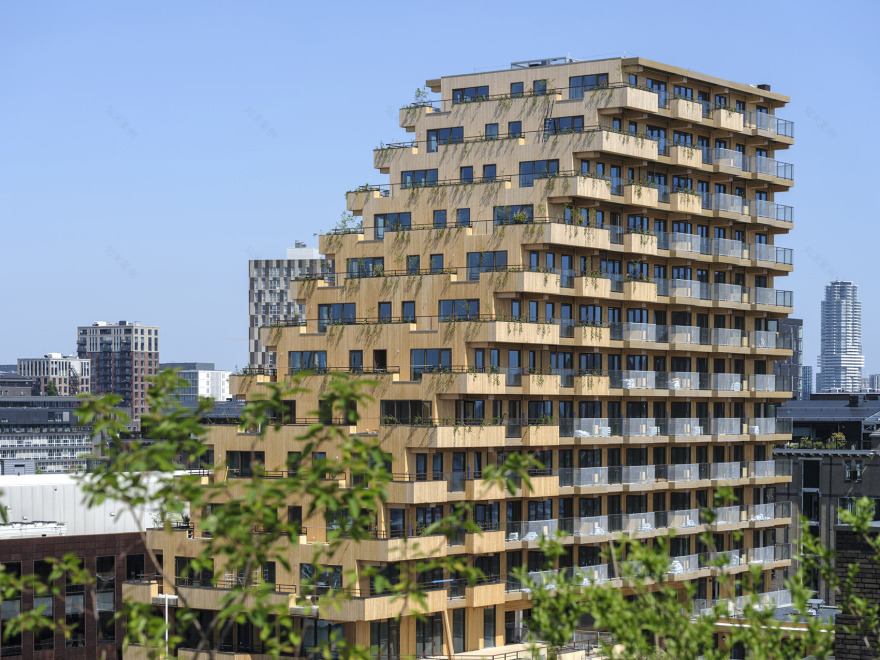

住宅单元通过外廊进入。尽管外廊在房地产市场中常被认为不受欢迎,Mei事务所却一直支持这一形式,并在本项目中坚持采用,以鼓励邻里交流。这一设计选择在其多个项目(如Fenix I)中已被证实是成功的。SAWA的居住理念还体现在多样化的共享功能上,如共享出行工具、公共维修空间与蔬菜园等,共同塑造活跃的社区生活。▼立面的外廊设计,the gallery design©Ossip


二氧化碳减排
CO2 reduction
在《巴黎协定》《格拉斯哥气候协议》、欧盟绿色协议、联合国可持续发展目标以及鹿特丹市政府减碳目标的背景下,委托方与设计方一致决定尽可能以CLT建造主体结构。相比混凝土,木材可储存CO₂,同时更轻便、施工更快、更安全、更耐用且可重复利用,并显著提升居住舒适度。
In the context of the Paris and Glasgow Climate Accords, the European Green Deal, the UN Sustainable Development Goals and the Rotterdam City Council’s targets for reducing CO2 emissions, the client and architect share the ambition to construct the building, including the main supporting structure, almost entirely in CLT. There are several advantages to building in CLT. First of all, wood stores CO2, thus reducing emissions. In addition, it is an excellent building material because, compared to concrete, it is lighter, faster, safer, more durable and also reusable. And above all, it increases living comfort.
▼采用木材以降低二氧化碳排放,using CLT for reducing CO2 emissions©Ossip


▼退台设计,terrace design©Ossip
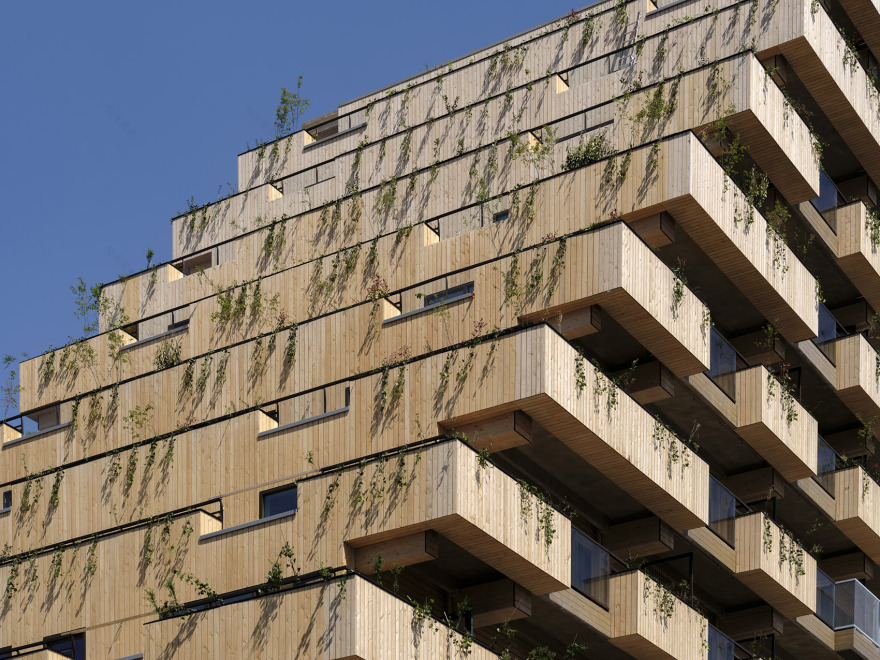
▼立面局部,facade detail©Ossip

木材在住宅、外廊和阳台中尽可能裸露展示,只有在储藏间、卫生间、浴室等木材可见性较低的区域采用粉刷处理。
The wood is left in sight as much as possible in the houses and on the galleries and balconies. Only where the perception of the wood is minimal (storage, toilet, bathroom) will the wood be finished with plaster.
▼木材在住宅内部也尽可能裸露展示,the wood is left in sight as much as possible in the houses©Ossip


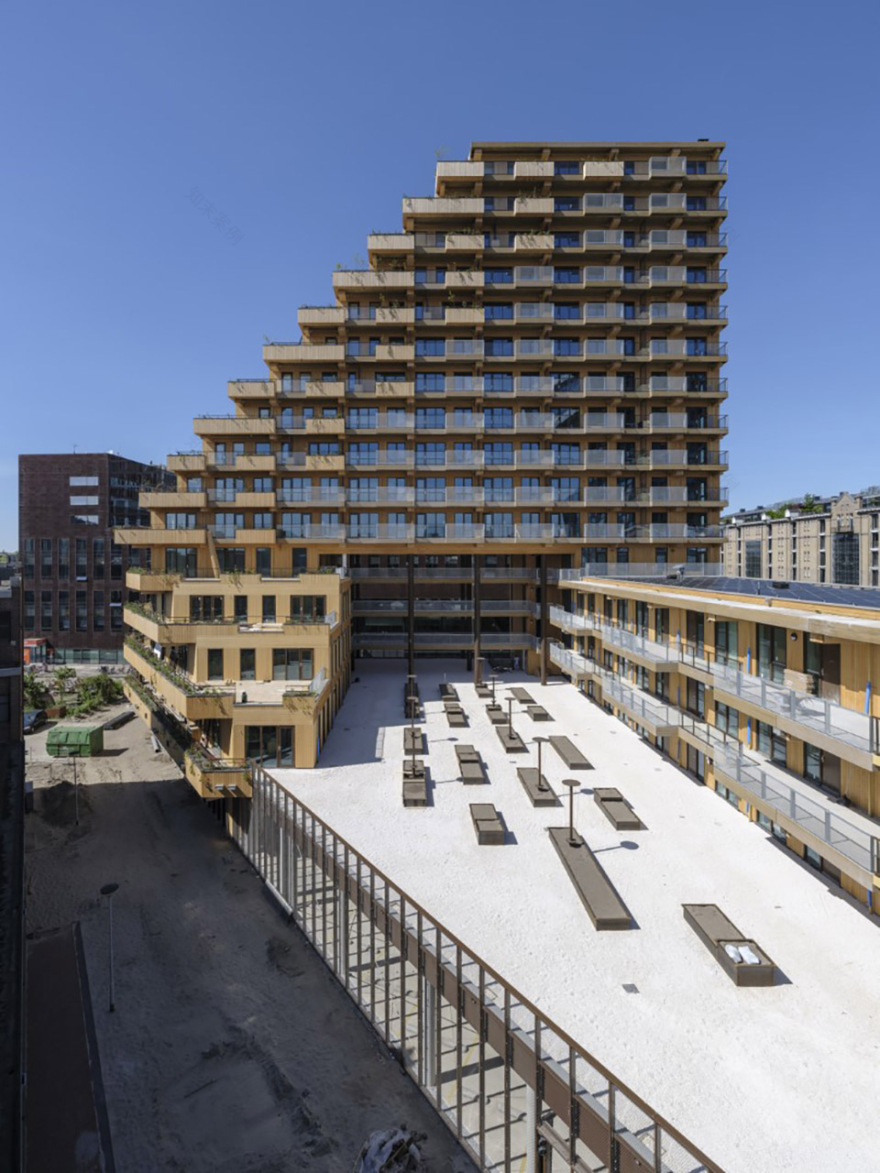
SAWA的创新在于整合各种技术,打造出一座高达50米、主要承重结构超过90%为木材的住宅楼。设计团队与国际专家合作,整合现有解决方案并开发新技术,以最大化木材使用、最小化混凝土与钢材使用,同时解决防火、噪音与振动问题。
SAWA’s innovation lies in bringing together all the elements that help to build a 50-metre-high residential building whose main load-bearing structure consists of more than 90% wood. Together with a team of international experts, existing solutions are combined and innovations are devised to optimize the use of wood; minimize the amount of concrete and steel in the design; and solve consequent fire, noise and vibration problems.
▼高达50米、主要承重结构超过90%为木材的住宅楼,
a 50-metre-high residential building whose main load-bearing structure consists of more than 90% wood©Ossip
循环建造
Circular
SAWA采用模块化木结构系统,采用干式、可拆卸结构(不灌浆)。其楼板由CLT与干式压重层组成,替代传统混凝土,使得各部件完全循环利用,未来可进行拆解与再使用(即“城市矿业”)。设计基于“开放建筑”原则,主要结构由楼板、梁与柱构成,提供极大的空间灵活性与自由布局空间,既适合首次购房者,也便于未来世代重新配置,增强建筑的可持续性。
SAWA is built using a modular construction system of wood, using dry, separable solutions (no casting). SAWA sets new standards in circular construction with a floor constructed from CLT topped with dry ballast instead of concrete. This makes the components in the floor fully circular and the materials can be detached and reused in the future (urban mining). SAWA’s design is based on the Open Building principle: the main supporting structure consists of floors, beams and columns. This creates a high degree of flexibility and freedom of layout for both first-time buyers and future generations and contributes to the building’s future-proofing.
▼采用模块化木结构系统,using a modular construction system of wood©Ossip
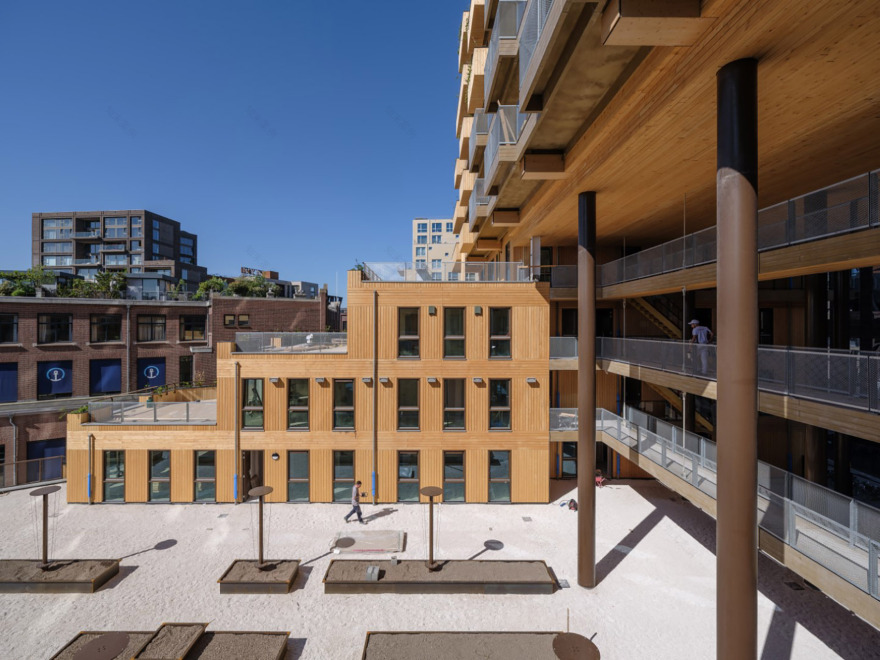

用于SAWA的木材来自可持续经营森林,每砍伐一棵树,就种植四棵不同树种作为补充。其他材料也尽可能采用生物基材料,且均具备材料护照。
The structure is made of Cross-laminated Timber (CLT). The trees used for SAWA come from sustainable production forests. For every tree that is cut down, four trees of different species are planted back. The other materials used are as far as possible bio-based and have a material passport.
▼采用模块化木结构系统,using a modular construction system of wood©Ossip

生物多样性
Biodiversity
城市化进程仍在持续。荷兰各大城市不断扩张,居民生活质量面临压力。城市化带来的生态系统问题——如洪水、热岛效应、CO₂排放增加——愈发显著。同时,城市建设的密集化与“硬质”景观逐渐蚕食了鸟类、蜜蜂、蝴蝶与其他昆虫的栖息空间。SAWA的设计试图扭转这一趋势,构建健康的人类居住环境。
The migration to the city continues. Dutch cities continue to grow and the quality of life is coming under increasing pressure. The consequences of this urbanisation on the human ecosystem – such as flooding, heat stress and increased CO2 emissions – are becoming increasingly visible. At the same time, the habitat of birds, bees, butterflies and other insects is being severely curtailed by the increasingly crowded construction of cities and the petrification of the living environment. SAWA’s design marks a turning point in this development and contributes to a healthy living environment.
▼外廊设计,gallery design©Ossip

SAWA在设计阶段便联合生态学家与生物学家开展“自然共生”设计:阳台与露台设置固定的花槽与绿植,植物选择因地制宜(考虑朝向与楼层高差),并为特定动物物种提供食物来源。项目在建筑及其周边设置鸟类与昆虫的巢箱,建立安全的栖息地,从而连接城市生态结构,提升邻里的生物多样性。
In cooperation with city ecologists and biologists, SAWA was designed to be nature-inclusive. For example, there are fixed flower and planters on the terraces and balconies. The planting is site-specific (depending on the orientation to the sun and the height in the building) and chosen in such a way that the plants provide food for the animal species. Nesting boxes will be placed on and around the building to provide a safe shelter for birds and insects. In this way, SAWA connects to the existing ecological structures in the city and increases the biodiversity of the neighbourhood.
▼阳台与露台设置固定的花槽与绿植,fixed flower and planters on the terraces and balconies©Ossip

包容性社区
Inclusive
SAWA包括50至165平方米不等的自住与租赁住房单元,形成多元化住户群体,成为城市人口的缩影。项目约一半(共50套)的住房为中等租金房源,使包括中等收入群体在内的各类居民都可在SAWA中安居,回应城市住房可负担性的挑战。
With a mix of owner-occupied and rental properties ranging from 50 to 165 m2, the future residents of SAWA will form a diverse community and a reflection of the city. Fifty apartments, about half of the number of dwellings in SAWA, are intended for mid-rent. This makes it accessible to all income groups to live in SAWA, including the group of middle-income people for whom it is increasingly difficult to find an affordable home in the city.
▼形成多元化住户群体,form a diverse community©Ossip


能源中和
Energy neutral
SAWA是一座低设备负荷建筑,提供健康的室内气候并具备未来升级潜力。住宅配备交叉通风系统与温度及二氧化碳感应通风阀。SAWA不仅是“荷兰最健康的建筑”,同时也是一座能源中和建筑。通过屋顶光伏板、“远程太阳能”、可持续区域供暖及其他绿色策略,SAWA实现了EPC值为0。项目在建设与使用阶段均实现能源中和。
SAWA is a low-installation building, with a healthy indoor climate and possibilities for future adaptations. The houses are equipped with cross ventilation and temperature plus CO2 controlled ventilation valves in the facade. SAWA is not only the healthiest building in the Netherlands, it is also energy-neutral. By using PV panels on the roofs in combination with “remote solar”, sustainable district heating and other sustainable measures, SAWA has achieved an EPC of 0. This makes SAWA as a building energy-neutral, both after realisation and during the construction process.
▼荷兰最健康的建筑,the healthiest building in the Netherlands©Ossip
竣工后,SAWA可自给自足,为公共空间供能。屋顶太阳能面板为电梯、外廊照明、共享电动汽车与自行车供电。
After completion, SAWA itself generates the energy it needs for the communal facilities. The solar panels on the roof power the lift, the lighting in the galleries and the electric cars and bicycles.
▼渲染图,rendering©Mei architects and planners


▼场地平面,site plan©Mei architects and planners

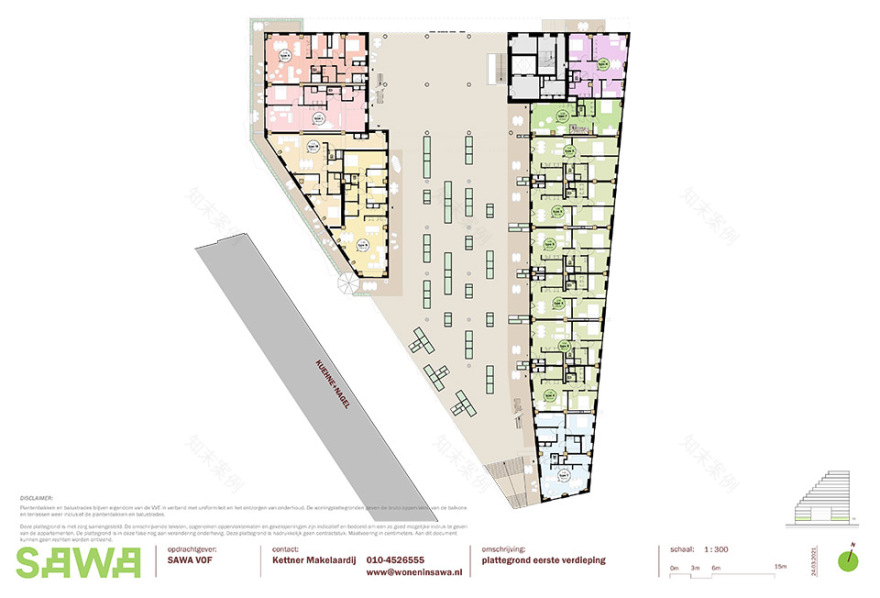
▼一层平面,ground floor plan©Mei architects and planners

▼平台平面,platform plan©Mei architects and planners
Program:ca. 100 appartementen (middenhuur en verkoop) en commerciële/maatschappelijke functies
Team Mei:Robert Winkel, Robert Platje, Michiel van Loon, Leen Kooman, Nino Schoonen, Jelle Grunstra, Chris Idema, Ceylan Yazici, Fatima el Hadji, Juraj Biros, Roberto Magnanini, Katarina Jovic, Roxana Aron, Weronika Witkowicz
Contractor:ERA Contour
Construction:Pieters Bouwtechniek
Consultant wood, innovation and sustainability:Aldus Bouwinnovatie
Consultant biodiversity:Bureau Stadsnatuur & Piet Vollaard
Consultant ecology:Copijn
Consultant fire:Adviesbureau Hamerlinck
Consultant wind:Peutz
Building physics consultant:DGMR
Building cost consultant:Maatwerk in Bouwadvies
Location:Lloydpier, Rotterdam
Visuals:WAX & Mei architects and planners


南京喵熊网络科技有限公司 苏ICP备18050492号-4知末 © 2018—2020 . All photos and trademark graphics are copyrighted by their owners.增值电信业务经营许可证(ICP)苏B2-20201444 苏公网安备 32011302321234号
苏公网安备 32011302321234号客服
消息
收藏
下载
最近