

创作上传
VIP
收藏下载
登录 | 注册有礼
查看完整案例

收藏

下载

分享
2025年波哥大国际图书博览会的西班牙国家馆被构想为一系列由流动图书馆连接的“风景”。流动图书馆在乡村地区尤为常见,它们构成了通向知识普及的重要基础设施。它们规模小巧、材料简朴,不以盈利为目的,通过在各地穿梭,将阅读与边缘社区的人们连接起来。流动图书馆在哥伦比亚和西班牙的历史中都扮演了至关重要的角色,为广大民众带来书籍,也常常是人们接触阅读的第一扇窗。▼展馆外立面,pavilion facade©Javier Agustín Rojas

国家馆将流动图书馆理解为一种连接两种知识形式的建筑媒介:一是通过书籍书写的文字知识,二是以手工毡布、手结编织、渔网和菲克植物纤维等材料为载体、通过口耳相传传承的工艺知识。这种双重性质唤起了人们对“文字(text)”、“纺织(textile)”与“故事(tale)”之间的语义关联——这一巧合不仅出现在拉丁文(textum)中,也见于哥伦比亚的美洲原住民语言中,如Wayúu语的“süchi”。
The Pavilion understands the mobile library as a form of architecture that links two kinds of knowledge: the written word, inscribed on the pages of books, and orally transmitted craft knowledge, embodied in materials such as handmade felt, macrame, netting, or fique. This dual condition resonates with universal semantic connections between words like text, textile, and tale—coincidences that appear in Latin (textum) as well as in Amerindian languages spoken in Colombia, like Wayúu (süchi).
▼以手工毡布、手结编织、渔网和植物纤维等材料为载体,
embodied in materials such as handmade felt, macrame, netting, or fique©Javier Agustín Rojas

参观国家馆的过程由“迎接—聚集—告别”三个阶段构成,并通过不同的功能空间展开:一个大型入口广场引导观众进入策展叙事,之后依次进入多个展区:西班牙摄影书展区、历史记忆与图像小说展区、一个可容纳240人的大礼堂、一个80座的公共论坛空间,以及一个大型书店与阅读区。参观者最终从一个通向平台与咖啡餐饮区的出口广场离开。
▼轴测图,axonometric©Lluís Alexandre Casanovas Blanco + Eeestudio + Paula Chalkho Rozenblum + Santiago Pradilla Hosie

The visit to the Pavilion unfolds as a sequence of welcome, gathering, and farewell, articulated through different program elements. A large entry plaza introduces visitors to the curatorial proposal. From there, they access a series of spaces: an exhibition of Spanish photobooks; another on historical memory and graphic novels; a 240-seat auditorium; an 80-seat forum; and a large bookstore-reading area. Visitors exit through a second plaza that opens onto a terrace-canteen.
▼大型书店及阅读区,a large bookstore-reading area©Javier Agustín Rojas


工艺知识
Craft Know-How
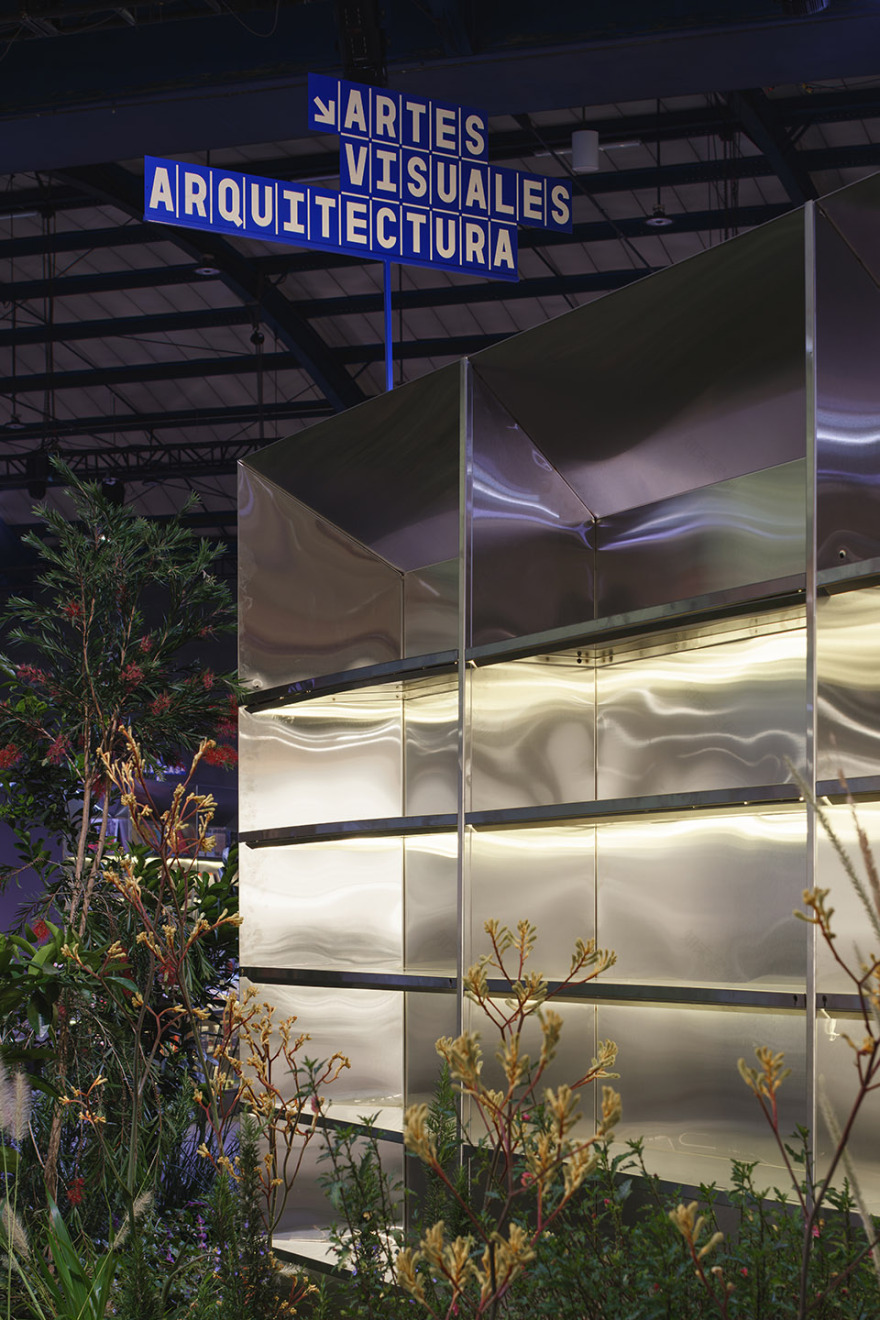
国家馆的外立面是一幅近20米高的巨型手结挂毯,由昆迪纳马卡省科瓜镇的手工编结协会共同创作,并因该项目的推动而获得新生。这幅挂毯与攀援植物交织在一起,象征着伊比利亚半岛的悬崖与亚马逊的台地,也为馆内的“纺织景观”提供了预示。挂毯在入口处折叠成一个遮阳雨篷。
The Pavilion’s façade is formed by a monumental macramé tapestry nearly 20 meters tall, created by the Macramé Artisans’ Association of Cogua (Cundinamarca), which was revitalized thanks to this project. Interwoven with climbing vegetation, the tapestry evokes Iberian cliffs and Amazonian tepuis, offering a preview of the textile landscapes found inside. The tapestry folds to form a canopy at the entrance to the Pavilion.
▼外立面的巨型手结挂毯,façade is formed by a monumental macramé tapestry ©Javier Agustín Rojas

手结编织起源于阿拉伯世界,自8世纪开始向全球传播。在扩散过程中,它与几乎所有文化的本土结绳技艺相遇。15世纪,随着西班牙殖民进入美洲,手结编织与前哥伦布时代的传统结合,发展出新的表现形式。在国家馆的立面上,手结编织化作“文字”——其缠绕的绳索(部分还以金属杆加固)成为欢迎观众的标语载体。这件纺织作品超越了传统意义上的“装饰艺术”,以其巨大的体量与协作过程,挑战了纺织物在历史上被边缘化以及与女性劳动绑定的地位。国家馆内的导视系统也运用了手结编织:大型挂毯作为标识牌,与装有本地植物的花盆共同构成空间装置。
▼由手工羊毛毡构成的悬挂天花,hanging ceiling made from suspended sheep’s wool felt©Javier Agustín Roja

▼由手工羊毛毡构成的悬挂天花,hanging ceiling made from suspended sheep’s wool felt©Javier Agustín Rojas
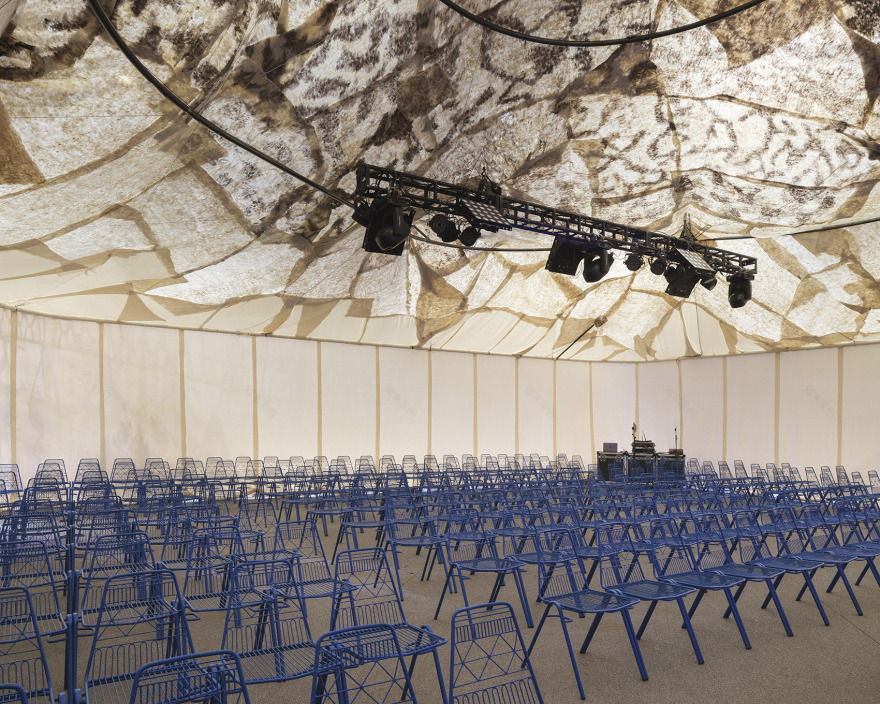
为了让观众更聚焦于舞台,舞台平台铺设了以菲克植物纤维(fique)制成的地面材料。这种原产自哥伦比亚的植物纤维由桑坦德省库里蒂镇的手工艺人制作完成,常用于编织垫子与地毯。
To focus attention on the stages, their platforms are covered with fique, a plant fiber native to Colombia commonly used in flooring. The material used here was crafted by artisans from Curití (Santander).
▼手工艺人制作的羊毛毡,the felt pieces, produced by an artisan community©Javier Agustín Rojas

展览区以渔网围合,用以引导人流并保持空间的视觉通透性。这些渔网产自科尔多瓦省洛里卡市,致敬了捕鱼文化在哥伦比亚与西班牙的重要意义。在西班牙,这一传统植根于1491公里的地中海海岸线与6409公里的大西洋海岸;在哥伦比亚,除了1760公里的加勒比海与1448公里的太平洋海岸线外,捕鱼也深深嵌入亚马逊及内陆河流流域社区的日常生活中。
The exhibition areas are enclosed with fishing nets that help control visitor flow without interrupting visual connections to the rest of the Pavilion. Produced in Lorica (Córdoba), these nets reference the cultural importance of fishing in both Colombia and Spain. In Spain, this tradition is rooted in 1,491 kilometers of Mediterranean coastline and 6,409 kilometers of Atlantic coast. In Colombia, beyond its 1,760 kilometers of Caribbean and 1,448 kilometers of Pacific coast, fishing also plays a central role in the lives of riverine communities along the Amazon and other waterways.
▼羊毛毡与不锈钢的鲜明对比,stark contrast between wool felt and stainless steel©Javier Agustín Rojas

文字知识
Written Knowledge
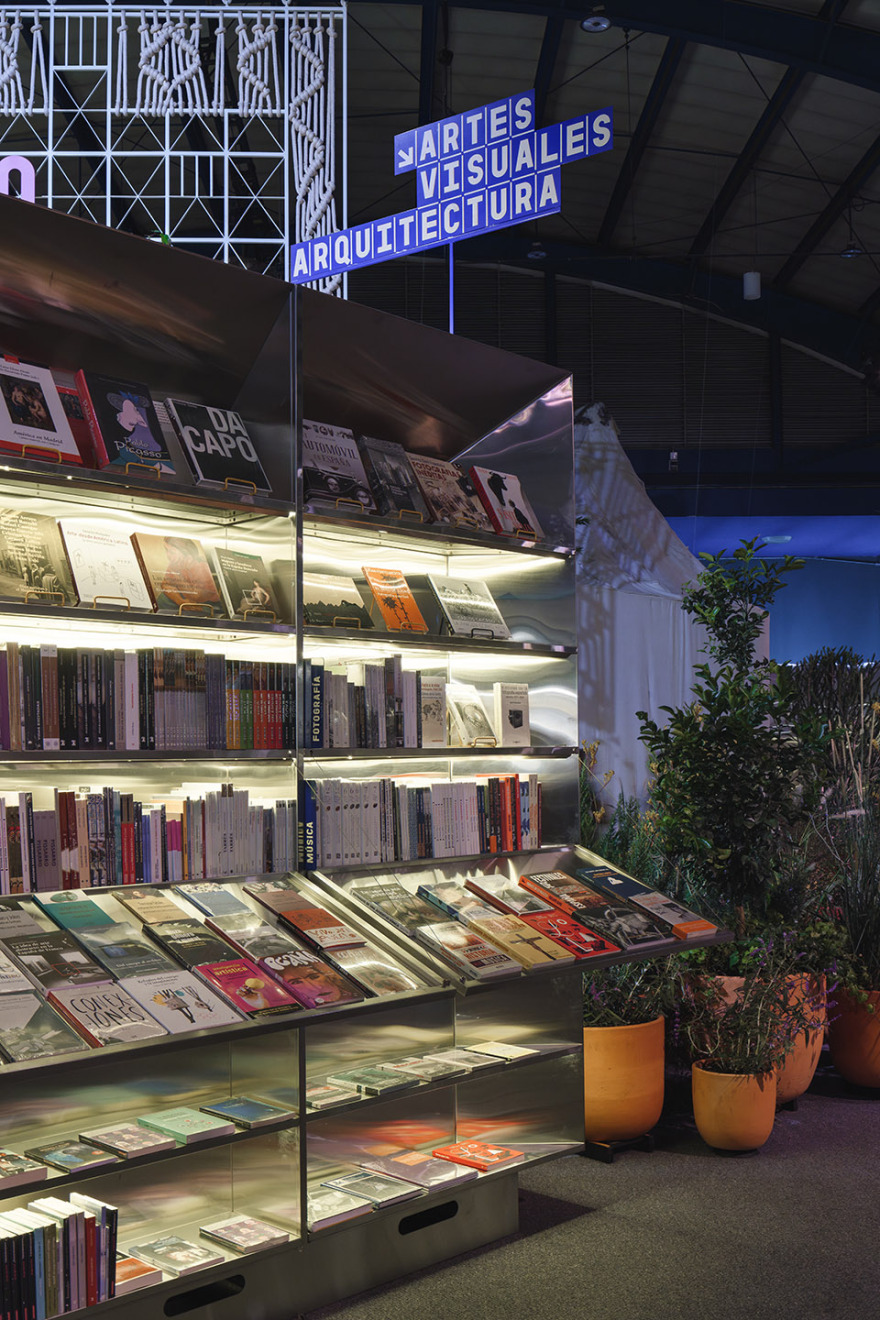
上述各要素围合出一个中心“空地”,用于布置书店空间。所有参观者都会经过这里。书店设有12组小型模块化展架,总藏书量约为1.5万册。展架采用不锈钢材质,其形式灵感来自西班牙历史上的四个乡村流动图书馆。作为一个鼓励交流的空间,书店在展架之间配置了两种固定长凳,并搭配若干可随意移动的座椅,供读者自由使用。
▼书店的不同模块化展架,library catalogue©Lluís Alexandre Casanovas Blanco + Eeestudio + Paula Chalkho Rozenblum + Santiago Pradilla Hosie

The central void formed by the peripheral arrangement of all these elements is occupied by the bookstore. A space through which all visitors must pass, it holds around 15,000 volumes distributed among 12 small-scale modules. These stainless steel units are inspired by four historic itinerant rural libraries in Spain. Conceived as a meeting space, the bookstore integrates two types of benches between its shelves, along with a scattering of movable chairs that readers can rearrange freely.
▼鼓励交流的空间,space to encourage communication©Javier Agustín Rojas
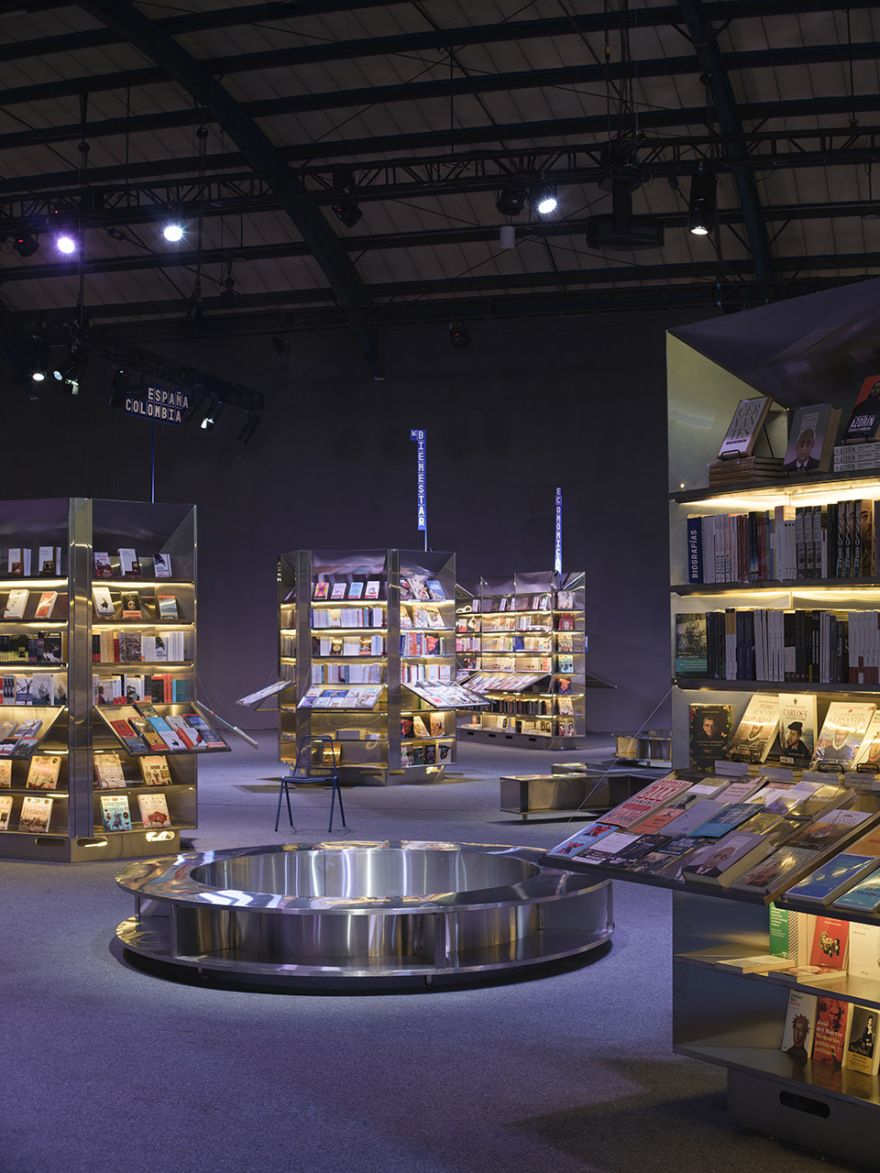
国家馆内丰富的手工纺织品与不锈钢构件形成鲜明对比,创造出“夹缝空间”——这些空间衔接建筑的各“景观单元”与展馆原有结构,容纳了后台出入口、服务机能与储藏空间。
The diversity of handmade textiles throughout the Pavilion contrasts with its stainless steel surfaces, which generate interstitial spaces between the constructed landscapes and the Pavilion’s original architecture. These in-between areas house private entrances, service functions, and storage.
▼鼓励交流的空间,space to encourage communication©Javier Agustín Rojas

第二生命
Second Lives
国家馆对流动图书馆的致敬并非出于怀旧,而是一种面向当下与未来的文化提案。根据哥伦比亚政府与FARC达成的和平协议,该国已启动600余座流动图书馆,纳入国家公共图书馆网络。西班牙目前也有82辆“书车”在运营,为超过千万生活在文化设施薄弱地区的人口提供服务。这种模式被视为一种可持续、民主的文化获取体系。
The Pavilion’s embrace of mobile libraries is not an exercise in nostalgia—it is a proposition for the present and the future. In the framework of the Peace Agreement between the Colombian government and the FARC, Colombia has launched more than 600 mobile libraries as part of its National Network of Public Libraries. In Spain, 82 bookmobiles currently operate, serving over 10 million people in areas with limited access to cultural infrastructure. This system stands as a sustainable and democratic model for cultural access across national territories.
▼书店细部,bookstore detail©Javier Agustín Rojas
展馆的大部分构件将在哥伦比亚各地参与和平重建与文化推广项目中得到再利用。为了减少浪费与材料流失,书店模块、家具、纺织品,甚至展馆的部分墙体均被设计为可运输、可重组,适应复杂环境条件。它们将作为“移动文化机构”奔赴全国各地,支持新兴的阅读社群,强化包括马格达莱纳省盖拉镇、普图马约省科隆乡、波哥大拉莫德洛监狱等地的公共图书馆与文化中心建设。
Nearly all elements of the Pavilion will be reused in cultural initiatives linked to peacebuilding in Colombia. To reduce waste and material loss, the bookstore units, furniture, textiles, and even the Pavilion’s walls have been designed for transport and adaptation in challenging contexts. These components will travel to various parts of the country, extending their lifespan as itinerant institutions supporting emerging reading communities. They will help strengthen public libraries and cultural centers in places such as Gaira (Magdalena), the corregimiento of Colón (Putumayo), and La Modelo prison in Bogotá.
▼展览后的可持续再利用,all elements of the Pavilion will be reused in cultural initiatives©Lluís Alexandre Casanovas Blanco + Eeestudio + Paula Chalkho Rozenblum + Santiago Pradilla Hosie

▼平面图,plan©Lluís Alexandre Casanovas Blanco + Eeestudio + Paula Chalkho Rozenblum + Santiago Pradilla Hosie

▼剖面图,section©Lluís Alexandre Casanovas Blanco + Eeestudio + Paula Chalkho Rozenblum + Santiago Pradilla Hosie

Authors
Lluís Alexandre Casanovas Blanco
Paula Chalkho Rozenblum
Enrique Espinosa Pérez
Santiago Pradilla Hosie
Design Team
Irene Domínguez, Sofía Marcie, Jaime de la Torre
Surface: 3,023 m²
Date: April 2025
Location: Bogotá, Colombia
Client: Ministerio de Cultura de España. Dirección General del Libro, del Cómic y de la Lectura Acción Cultural Española (AC/E)
Curator, Spanish Pavilion: Antonio Monegal
Technical Advisor: Yetta Aguado Arnold
Production and Operation of the Pavilion
DIEZ Colombia + Alexander Gümbel, Manuel Villa, Vecinas Chicoteras
Artisans
Manuela Álvarez + Asociación de Artesanos de Cogua (macrame)
Constanza Téllez + Artesanos de Sutatausa (wool)
Cooperativa Ecofibras (fique)
Emilio Doria and Amaury Rodríguez (cast nets)
Edilson Rodríguez and Rusbel Rodríguez (wrought iron)
Photos
Pavilion: Javier Agustín Rojas
Artisans’ Process: Alexander Gümbel
南京喵熊网络科技有限公司 苏ICP备18050492号-4知末 © 2018—2020 . All photos and trademark graphics are copyrighted by their owners.增值电信业务经营许可证(ICP)苏B2-20201444 苏公网安备 32011302321234号
苏公网安备 32011302321234号客服
消息
收藏
下载
最近