

创作上传
VIP
收藏下载
登录 | 注册有礼
查看完整案例

收藏

下载

分享
Portfolio: Ashleigh Killa, The MAAK
For Ashleigh Killa, co-founder of The MAAK in South Africa, buildings are an expression of care and engagement
Ashleigh Killa is shortlisted in the 2025 Moira Gemmill Prize for Emerging Architecture, part of the W Awards.
Most of the Western Cape’s sprawling Winelands towns have two stories to tell: one of idyllic luxury destinations; and the other, visible just as you take the next corner, of the lives of seasonal farmworkers and manual labourers who service that luxury. The little‑known town of Riebeek‑Kasteel, about an hour outside Cape Town along its West Coast Way, is no exception.
A few minutes’ drive from Riebeek‑Kasteel is a remnant of apartheid spatial planning which today remains a low‑income, ‘coloured’ community. This suburb has been extended in the last five years, with the municipality providing
serviced plots to the community, but no built structures
. As a result, a whole new area of self‑built zinc homes – New Rest Valley – has developed. It is among these homes that the New Rest Valley Crèche raises its head, at once a remarkable sight, and a beacon of hope not just for the families it services, but for the community at large.
Just outside the Winelands town of Riebeek‑Kasteel is New Rest Valley, a small conurbation that has cropped up around a grid of service cores. The New Rest Valley Crèche, designed by The MAAK, is the only built infrastructure on the site so far, apart from the cores. (Kent Andreasen)

Its oculi look out across the zinc roofs of the self-built neighbourhood. (Kent Andreasen)
The only built infrastructure in the area, it was completed in 2023 on a narrow plot of land, sitting flush against self‑built homes at one end, while adjacent to vacant land earmarked for a public park on the other. That this land has remained vacant throughout the design, build and opening of the crèche is telling. Government projects take a long time to come into fruition here, if indeed at all. New Rest Valley Crèche was realised thanks to donor funding co‑ordinated through the local volunteering organisation Rotary Club of Newlands, while the sustained management and maintenance of the facility is assured through the Vuya Foundation, a non‑profit organisation working in the province.
With its clean lines, simple materiality and subtle detailing, the building is made to service around 90 children in three classrooms. The playground area runs along these classrooms, shaded by a wall of perforated blocks. Large openings in the roof sheltering the playground welcome in light, as well as allow the growth of wild pear trees, which aid in ventilation and cooling. Jutting out to the skies, these trees are as much an aesthetic detail as they are functional.

Currently the only community space in the neighbourhood, it has become something of a gathering place for residents, beyond its function as a childcare centre. (Kent Andreasen)

Running along the three classrooms is a play area through which four young wild pear trees grow. Bounded by a perforated-blockwork wall, the area provides shade and passive ventilation to the classrooms. (Kent Andreasen)
The first floor of the building is designed as a caretaker’s quarters, with two rooms – currently used as storage – and a bathroom. This area is spacious enough to potentially function as an overflow classroom, though there has not yet been a need for this. The north‑facing porthole windows on this level are a defining feature of the building, and provide a vantage point not just of the playground, but of the greater area.
Pops of colour are thoughtfully used and appear throughout the crèche, which is fitting given the little end users, who range in age from two to five years. These pops extend to the rubber surface of the playground. During the building process, architects The MAAK arranged a play day for children from the community, giving them the space to share the kinds of games they ordinarily play on the street. These games informed the shapes and patterns imprinted on the rubber, and send the crucial message that these children’s voices matter. As The MAAK co-founder Ashleigh Killa observes, ‘we are not the experts in play any more’. This gesture – of carefully engaging with the people who will occupy the building – is something the practice incorporates in all their projects. Killa favours an approach that is built on empathy, which she says can only truly be achieved by keeping quiet to make room for listening.
The MAAK was founded by Killa and Max Melvill in 2016, with the goal of making social impact architecture – an idealistic endeavour at the time. Her vision for this kind of work became clear after a stint at a Cape Town‑based firm where Killa was designing extravagant homes for the 1 per cent in between her undergrad and postgrad years. It took being in that space to know where and how she wanted to focus her own practice. The MAAK’s establishment was propelled by the commission to design a significant public building for the Desmond Tutu HIV Foundation, a non‑profit in the Cape Town township of Masiphumelele. Being exposed to a project of this scale in the very early days of the practice meant that they had the freedom to carve out their own rules and methods of working, alongside the guidance of mentors. It taught Killa the importance of ‘knowing that you don’t know’.
Killa is part of a generation of South Africans who came of age in the post‑apartheid Rainbow Nation, where the need for change was very real and urgent. As a result, she was set on an architecture that could effect change, even if that meant merely chipping at the surface. She believes that change can happen slowly and incrementally, and through small initiatives that probe bigger issues. For example, The MAAK’s Follies in the Veld programme, which has taken place every year since the practice’s inception, offers a space for learning through collaboration. Comprising up to 20 volunteer participants from various backgrounds, each edition is themed around a different material, and concludes with a large‑scale installation, often in low‑income or rural settings. It provides an opportunity for experimentation and prototyping – not just with design and materiality but exploring what can be achieved by building in community with each other.

A playful use of colour continues inside, brightening up the unfussy materiality of brick, timber, perforated blocks and ceramic tiles. (Kent Andreasen)
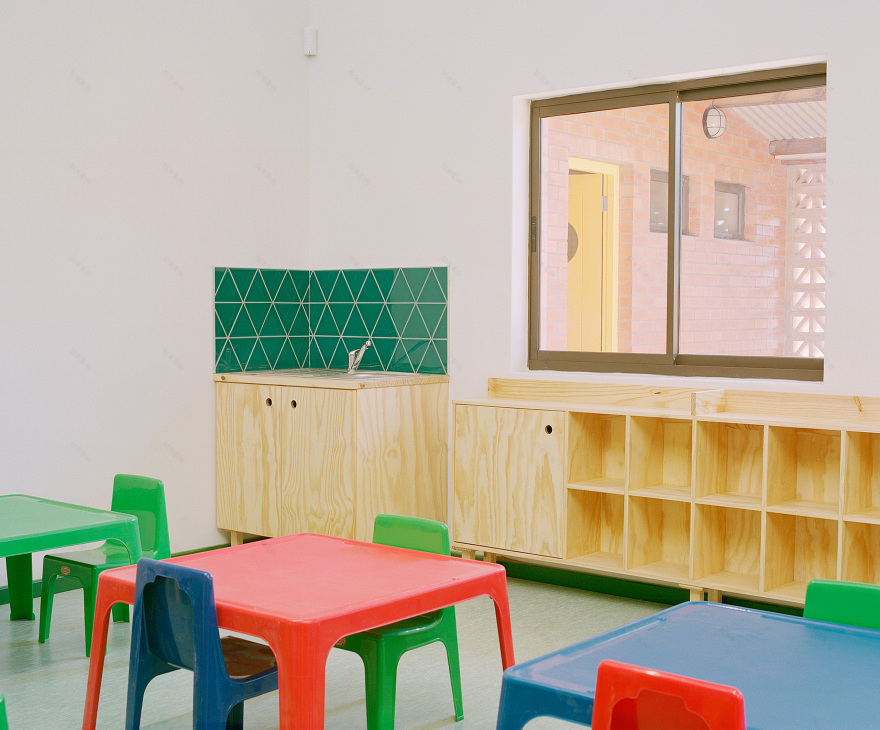
Coloured tiles are used inside as well as out. (Kent Andreasen)
The MAAK’s approach is strongly influenced by Yvonne Farrell and Shelley McNamara’s
Freespace Manifesto
, which was issued in 2018 when the pair curated the Venice Architecture Biennale. The manifesto encourages designers to think beyond form and function in favour of a more people‑centred, socially conscious approach to architecture. ‘Freespace encompasses freedom to imagine, the free space of time and memory, binding past, present and future together, building on inherited cultural layers, weaving the archaic with the contemporary,’ reads the concluding line of the manifesto.
One can see how this manifesto has been formative in Killa’s practice, and continues to inform The MAAK’s projects. For the recently completed Rahmaniyeh Primary School Library in Cape Town’s District Six, the practice thought carefully about the conditions of the site as a social space. Once more, The MAAK consulted learners in a series of workshops to get a better understanding from the expert end users themselves. For example, for the design of a bookshelf, learners were prompted to draw and ‘make’ models of the space in which they felt the books should live. At the time of writing, these ideas were in the process of being built by local designers Pedersen + Lennard. It was in these workshops, too, that The MAAK were reminded of the ways in which the children best engage with books – lying on their tummies in a calm, quiet space was the preference, and as a result, the library is fitted with soft finishings and various spaces for lying down and sitting. ‘Children’s imaginations are so untamed, it’s a joy to tap into them to free us from our practical and compliant constraints,’ says Killa.
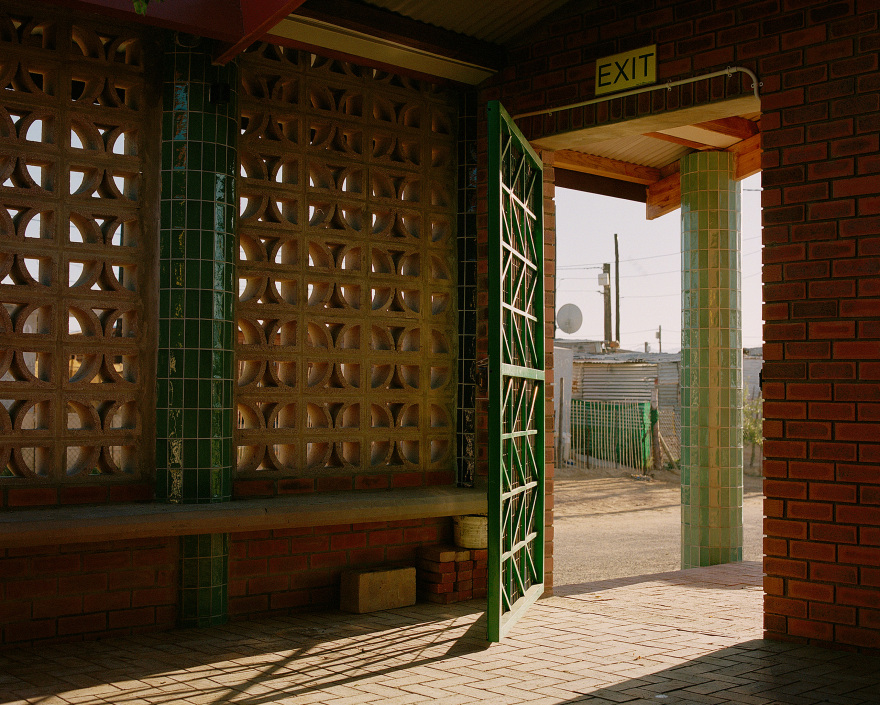
Outside, the tiles highlight the columns punctuating the outer wall of the playground. (Kent Andreasen)

The colour and patterns on the rubber flooring here were informed by a play workshop organised by The MAAK with the children of New Rest Valley. (Kent Andreasen)
Like New Rest Valley Crèche, this project was funded by the Rotary Club of Newlands, while its operations are supported by the non‑profit Otto Foundation, which champions early literacy by encouraging reading for enjoyment. The foundation has an excellent track record with similar projects, and the architects worked very closely with the child‑centred design specialist on the Otto team, Xanelé Purén.
In addition, the practice collaborated with land activist and artist Zayaan Khan to fire bricks containing rubble of the area’s tragically demolished buildings to build the structure. In the 1960s, District Six was declared a whites‑only area under
South Africa
’s Group Areas Act. As a result, the vibrant and diverse communities of District Six were forcibly removed; its homes, places of gathering and all infrastructure demolished, leaving in its wake a trauma that the victims and their families are still grappling with today. This intervention by The MAAK and Khan (herself a descendant of evictees) is a sensitive acknowledgement of the deep and troubled context within which they are working.
The MAAK has recently completed a new library for the Rahmaniyeh Primary School in Cape Town’s District Six. Working alongside child-centred design specialist Xanelé Purén, as well as the children themselves, the architects arrived at a design for the interior which will encourage the young end users to read in various ways, both seated and lying down
The principles of the practice’s ethos are also being applied to a current public work in progress in Stellenbosch, the Kayamandi MultiSport Community Facility commissioned by the Open Play Foundation. With a brief to design a sports facilities hub for the benefit of the community, The MAAK are reimagining the space as a precinct that encompasses the surrounding activity and behaviours, with the potential to bring together people from both sides of the Stellenbosch privileged/underprivileged divide.
The MAAK’s projects are threaded with their capacity for empathy and listening, which Killa says is what architecture needs now. But such projects need better financing. ‘At the moment architecture is reserved for people who can afford it,’ she says, ‘but finding the projects that are delivering to anyone and everyone is really important – otherwise we are obsolete.’ That is not to say things are at the same place they were when The MAAK founded their practice. Killa is confident that their work in this space is being recognised and understood. Corporate social investment and social impact partnerships are finally recognising these kinds of projects, says Killa, ‘in ways that are incentivised, supportive and generative’.
南京喵熊网络科技有限公司 苏ICP备18050492号-4知末 © 2018—2020 . All photos and trademark graphics are copyrighted by their owners.增值电信业务经营许可证(ICP)苏B2-20201444 苏公网安备 32011302321234号
苏公网安备 32011302321234号客服
消息
收藏
下载
最近