

创作上传
VIP
收藏下载
登录 | 注册有礼
查看完整案例

收藏

下载

分享
Power house: Balcony extensions and communal garden room in Zürich, Switzerland by Lütjens Padmanabhan
Additions to a co‑operative housing block in Zürich by Lütjens Padmanabhan aim to extend the inhabitants’ existence, both in the building and on the planet
In 2007, French practice Lacaton & Vassal with Frédéric Druot published Plus, a manifesto for ‘never demolishing, never removing or replacing, but always adding, transforming and reusing’. A cornerstone of their proposal was extending and adding balconies and winter gardens to postwar housing blocks – a theory the architects went on to realise in three renovation projects, most famously at Grand Parc in Bordeaux in 2016. Balcony extensions were not invented by Lacaton & Vassal – the augmentation of limited outdoor spaces, either formally or through more precarious or extralegal means, is nothing new – but this work brought the potentially transformative impact of extending balconies on existing apartment buildings to international attention.
If these vast, state‑funded rehabilitation programmes have a distinctly French flavour, then the latest example by Lütjens Padmanabhan, in a peripheral district of Zürich, is decidedly Swiss. The modest nine‑storey block is a far cry from the behemoths of Lacaton & Vassal’s Grand Parc, and the building is owned and managed by a non‑profit housing co‑operative (Siedlungsgenossenschaft Eigengrund), rather than a state housing provider. In Zürich, nearly one in four dwellings is managed by a co‑operative or public foundation; social housing owned by the state is rare. Inhabitants are active participants in the running of the building, rather than intermittently consulted and frequently dictated to, as is often the case for state social housing tenants.
The apartment building is located in Hirzenbach, a garden suburb designed by the city architect Adolf Wasserfallen and built between 1955 and 1967, with gardens by landscape architect Willi Neukom. The neighbourhood was conceived as a mix of four‑storey collective villas, nine‑storey blocks and a handful of 18 or 19‑storey towers, distributed like Lego blocks across a green blanket of parkland. Like the surrounding Schwamendingen district, the area was inhabited largely by Swiss workers employed in the local engineering industry.
However, following the deindustrialisation of the city in the 1980s, many original residents moved away. Hirzenbach is not a wealthy neighbourhood; eight per cent of residents received welfare payments in 2023, double the city’s average. The city has made attempts to ‘rejuvenate’ the neighbourhood: Stettbach station was opened in 1990, connecting to Zürich’s central station in 10 minutes, and a 2005 city directive advocated and offered guidance for the development of the Schwamendingen district. Today, the area is undergoing intense densification, with the population predicted to soar in the coming years.
Rents are beginning to rise and many of the current residents are having to move further out of the city.

The original building on Hirzenbachstraße was built in 1957 as part of a large garden suburb on the edge of Zürich. In 2007, stacks of large kitchen-diners were added to the street-facing side of the building. (Philip Heckhausen)

Most recently, in works completed at the end of last year, the building has been extended again, this time with a layer of additional balcony space adorned with solar panels. (Philip Heckhausen)
In contrast, the co-operative on Hirzenbachstraße is committed to maintaining low rents – but this has not manifested in a lack of investment. The building was extended in 2007; stacks of large kitchen‑diners were added to the two and three‑bedroom apartments facing the street, and the former kitchens were converted into large family bathrooms, to designs by KLP Architekten and at a cost of CHF10 million (around £9 million).
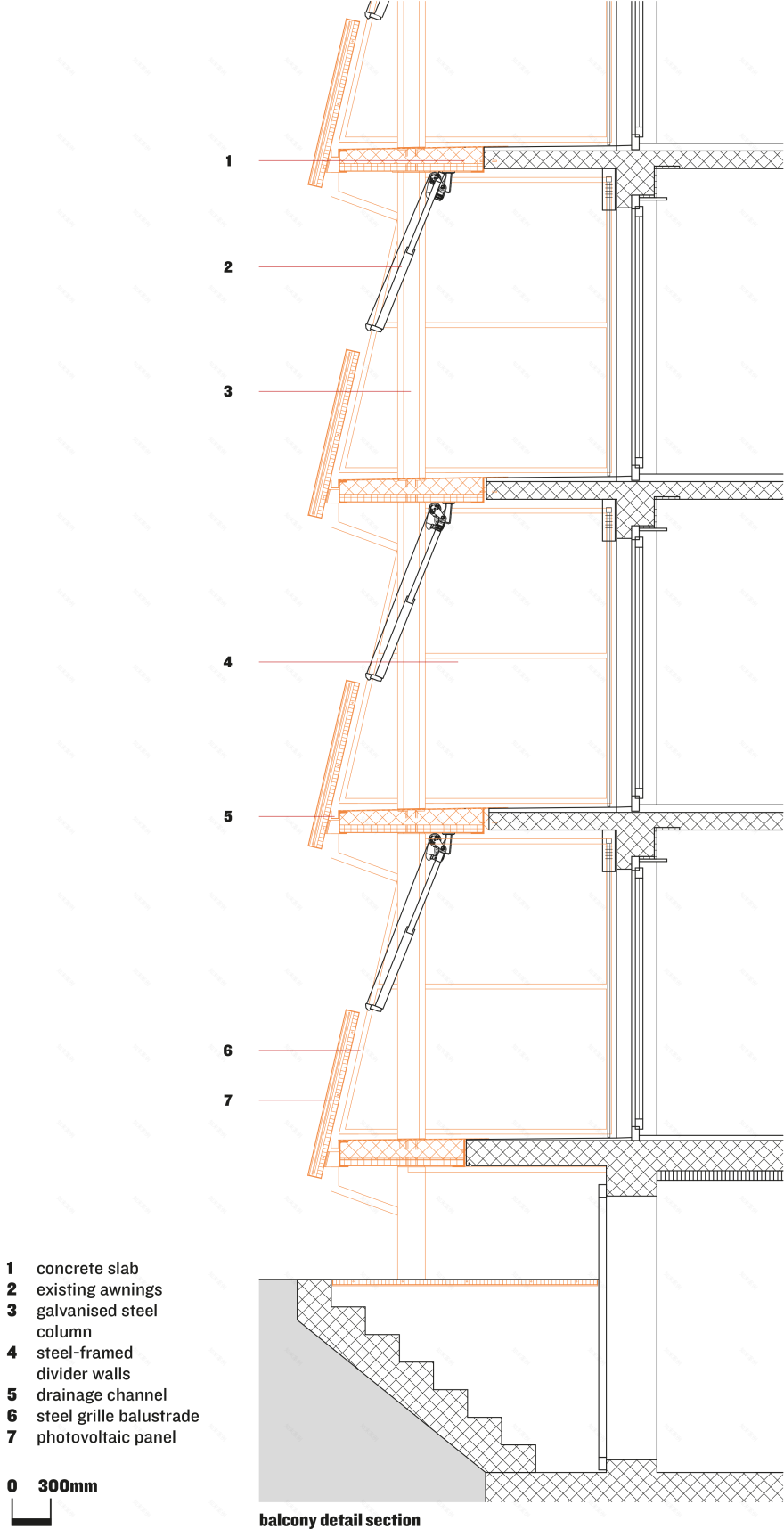
Just over a decade later, in 2020, residents decided to extend again, launching an architectural competition which was won by Lütjens Padmanabhan. Their proposal extended the existing balconies by more than a metre to a generous depth of 2.2m. The added concrete slabs are supported by a galvanised‑steel armature of I‑section columns, besides which silvery rainwater pipes snake to the ground. Balconies are efficiently separated by white metal dividers and the existing acid‑green awnings were preserved and moved outwards to the new balcony edge. Throughout the year‑long construction period, residents were able to remain in their homes.

The new balustrades are formed from angled metal grilles, jutting out like the serrated edge of a grater. The decision was made by the members of co‑operative a few months into the project, just before work had begun on‑site, to add photovoltaic (PV) modules to the grilles – an ambition which the design could gracefully adopt with few changes. The solar cells are set in a pattern that allows light through the glass around them, throwing op art‑esque shadows through the gridded balustrades. From across the garden that unfurls at the building’s base, the solar cells add a granular texture and rhythm to what otherwise appear as monumental bands stretching 65m across the building, like the slats of a monumental Venetian blind.
The grilles could easily incorporate the solar panels, the inflection benefiting the PV system’s efficiency – though the 77° angle is far from the optimal angle of 39° at this latitude. The balconies also face west, rather than south. The array, in addition to a small existing PV installation on the roof, is estimated to generate 53,200kWh annually; a rough calculation indicates this could supply around 30 per cent of the electricity for the building’s 81 apartments.
Coined Balkonkraftwerk (balcony power station), the addition of solar panels to existing balconies is enjoying a rise in popularity; to date, PVs have been installed on 1.5 million homes in Germany and are increasingly common in Spain, France, Italy and Poland – though this phenomenon refers to plug‑in panels installed in individual properties, rather than the communal array in Hirzenbach. Solar power at any scale remains something of a novelty in Switzerland: of the electricity Switzerland produces, only six per cent is solar according to the International Energy Agency’s latest figures; the majority is hydro or nuclear.
As Daniel Knott has written in The Architectural Review, ‘at a building scale, PV technology is not a silver bullet’. PVs can contribute to an increased urban heat island (UHI) effect and can often be a missed opportunity for urban greening; in this case, the original plan to trail vegetation on the balustrades was shelved with the introduction of PVs, as it would interfere with the panels’ efficiency. In the leafy, peri‑urban fringe of Zürich, this seems a compromise worth making for lower energy bills, and the carbon cost of producing the PVs (significantly, the processing of silicon) and constructing the concrete and steel armature on which to hang them, will be offset by the renewable energy they will produce within a few years. The carbon cost is dwarfed when compared with the emissions of demolishing the building and building a new one – as the architects argue, ‘the project’s sustainability is contingent on extending the building’s functionality and usability.’
It is important, however, not to overlook the ecological damage caused by both PV manufacture and concrete and steel production, which cannot be ‘offset’. The possibility of constructing the balcony extensions out of timber was not entertained by the architects, opting for steel due to structural demands (the structure is 26m tall) and fire regulations, and concrete slabs as this was ‘the simplest and structurally easiest’. These materials ‘withstand weather pressure the best, leading to a longer lifespan in Zürich’s climate’. Whether these reasons justify the use of high‑carbon materials at this critical stage of the climate emergency remains contentious, and the fact that renewable materials are still not more forcibly encouraged in a city like Zürich is increasingly urgent and disappointing.

The communal garden room was conceived as ‘a hut in a clearing’. The rippling fibre-cement board imitates the fabric of a marquee tent, while the acid-green door frames reference the green awnings on the building.
In contrast, the small garden room that also formed part of the project is largely built from timber. Conceived as ‘a hut in a clearing’, the structure borrows the language of modest, provisional peri‑urban buildings – part prefab Scout hut, part garden marquee, part woodcutter’s fairytale cottage. The tent‑like illusion is aided by the corrugated fibre‑cement board walls which undulate like pleated curtains. The building nods knowingly to the 18th‑century so‑called Guards’ Tent at Drottningholm Palace in Sweden, made of copper rather than the textile it imitates. At close quarters, the panels of fibre cement pull away at the corners, revealing the timber battens holding it together, like a house of cards that could be blown away in a strong gust.
Inside, silver stripes and strings of lights drape down from the pitched timber ceiling like the inside of a circus tent. The corner of the enclosure holding a toilet and storage is fashioned into a green column that appears to hold up the ‘tent’ like a maypole (it is in fact not loadbearing). The acid‑green column and door frames reference both the green awnings of its backdrop and, architect Oliver Lütjens suggests conspiratorially, James Stirling’s Neue Staatsgalerie. The various whispered references are there for those in the know but perfectly enjoyable for those who are not. Some are accidental – a neighbouring bike shed in the same corrugated fibre‑cement board is also inadvertently implicated in the joke.

Inside, the festive atmosphere intensifies, with string lights and silver stripes emulating a circus tent. A paved area balloons out from the hut to accommodate overspilling festivities, and a playground has been installed on the southern edge of the grounds. The perimeter fence dividing the plot from its neighbours was removed during construction; there is currently no plan to reinstate it, and Lütjens hopes it stays that way, so that the new playground can be shared with children from the surrounding blocks.
‘As we enter the second half of the 2020s, we must not be satisfied with carbon compromises’
The project’s cost was subsidised by Zürich’s city council on account of the PVs, and footed by the co‑operative, supplemented by a small increase in residents’ rent – no more than 10 per cent – which was previously agreed with residents. Compared with Lacaton & Vassal’s Grand Parc, which cost roughly €50,000 per unit, this project cost around 50 per cent more. While the balconies in Zürich were extended by just over a metre, in Bordeaux the envelope was expanded by 3.8m, with some floor plans doubling – though the Swiss residents did also gain a communal garden room and some energy sovereignty. In both cases, the considerable carbon saving of preserving the existing building and not building anew was compromised by extending using high‑carbon materials.
As we enter the second half of the 2020s, nine years on from the completion of Grand Parc, we must not be satisfied with carbon compromises. While Lütjens Padmanabhan’s project and others like it are to be commended – it is almost utopian from the perspective of many of us living in cities like London – adulation must be cautious.
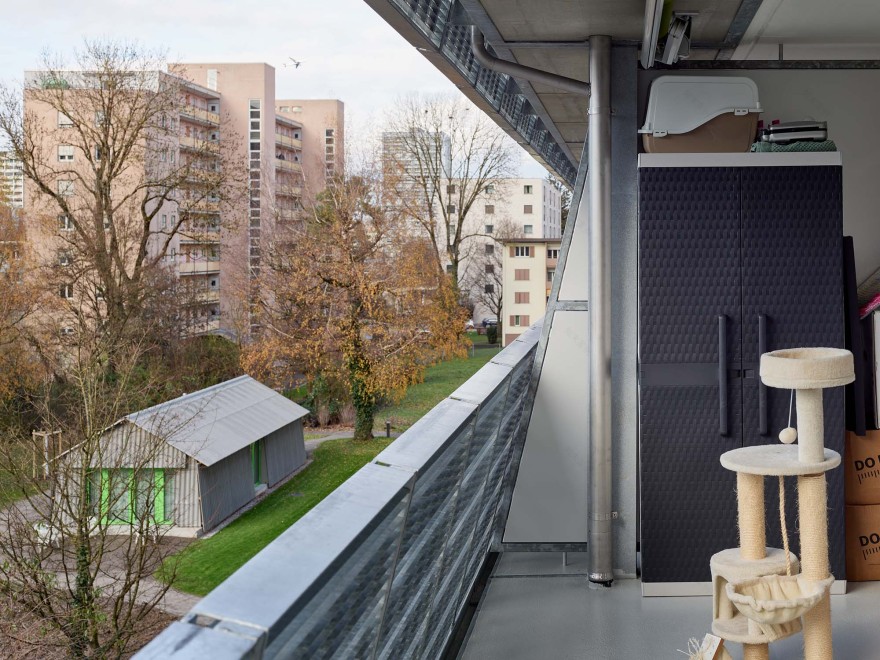
The added concrete balcony slabs are carried by a steel structure appended to the building’s facade. The existing green awnings have been preserved and moved forward. (Philip Heckhausen)

南京喵熊网络科技有限公司 苏ICP备18050492号-4知末 © 2018—2020 . All photos and trademark graphics are copyrighted by their owners.增值电信业务经营许可证(ICP)苏B2-20201444 苏公网安备 32011302321234号
苏公网安备 32011302321234号客服
消息
收藏
下载
最近