

创作上传
VIP
收藏下载
登录 | 注册有礼
查看完整案例

收藏

下载

分享
Small House by MOCT Studio in London, UK

Running parallel to London's traffic-heavy Bethnal Green Road, Voss Street is a narrow, cobbled lane

Inside, natural light cascades down from openings on the upper floor

The light travels through the stairs' perforated surfaces

The split-level entrance contributes to the feeling that the home is really just one vertical room

On a site just 3.5 by 5.5 metres, the kitchen is tucked into the lower ground level with light coming in both from the street ...
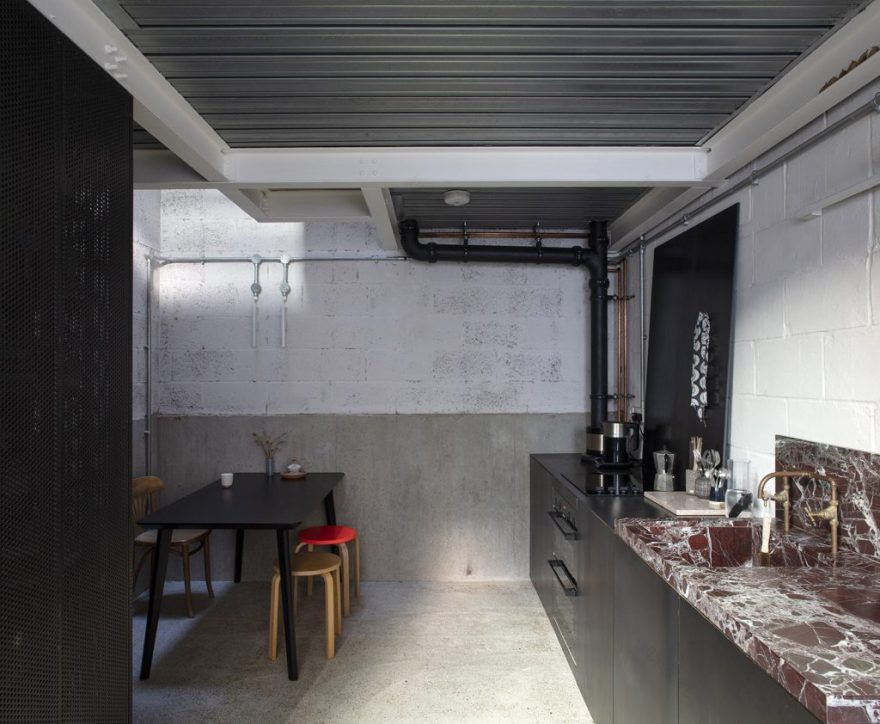
... and, more diffusely from the roof slab opening, rule that each space should receive natural light from at least two directions

The middle floor sees the unexpected juxtaposition of a small living area and a shower room

The washbasin occupies a prominent position

On the top floor, the bedroom is flooded with zenithal light

It is connected to a balcony that overlooks the cobbled alleyway
An essay in compact living, MOCT Studio’s Small House is the newest addition to one of London’s ‘architect streets’
This project is commended in the 2023 AR House awards. Read about the full shortlist
The fact that architects tend to flock together when it comes to property speculation leads to interesting streets. In 1960s north London, it was Ted Cullinan who started the small(ish) mews housebuilding trend around Camden Square with his self-built 62 Camden Mews, followed by John Howard at No 74. Word spread and, at nearby Murray Mews, Team 4, Richard Gibson, Ian Fraser, Tom Kay, and David and Anne Hyde‑Harrison are among those who experimented with houses for themselves or others. Capturing a dialogue at a moment in time on ways to invest homes with daylight and privacy in a tight-knit urban context, almost all the houses feature the fortification of integral garages as part of the ‘solution’.
In the 2000s, around eight kilometres east, narrow Voss Street’s awkward and therefore more affordable sites proved a similar mecca for a new generation of architects. Early gentrifiers included Sarah Featherstone and Birds Portchmouth Russum Architects and today, among jerry-built annexes and slumlord rentals, you can spot architecture that, while no doubt voluble in its inner worlds, is characterised externally by an expressive range that veers between introverted and defensive.

Like the mews in Camden, Voss Street was constructed as an access lane and now serves the backs of Bethnal Green Road’s shops and takeaways. Until recently, the south side consisted largely of single-storey lock ups, built on infill, for the overnight storage of market traders’ goods and barrows. Today’s passers-by are more likely to be pedestrians and delivery riders, and the cobbled lane includes houses by Cassion Castle Architects with Dunne & Raby, Studiomama, and Gordon Shrigley Architecture. Small House itself is squeezed between a double-fronted dwelling from Gauld Architecture and a four‑house terrace by Rivington Street Studio, also with twice the frontage.
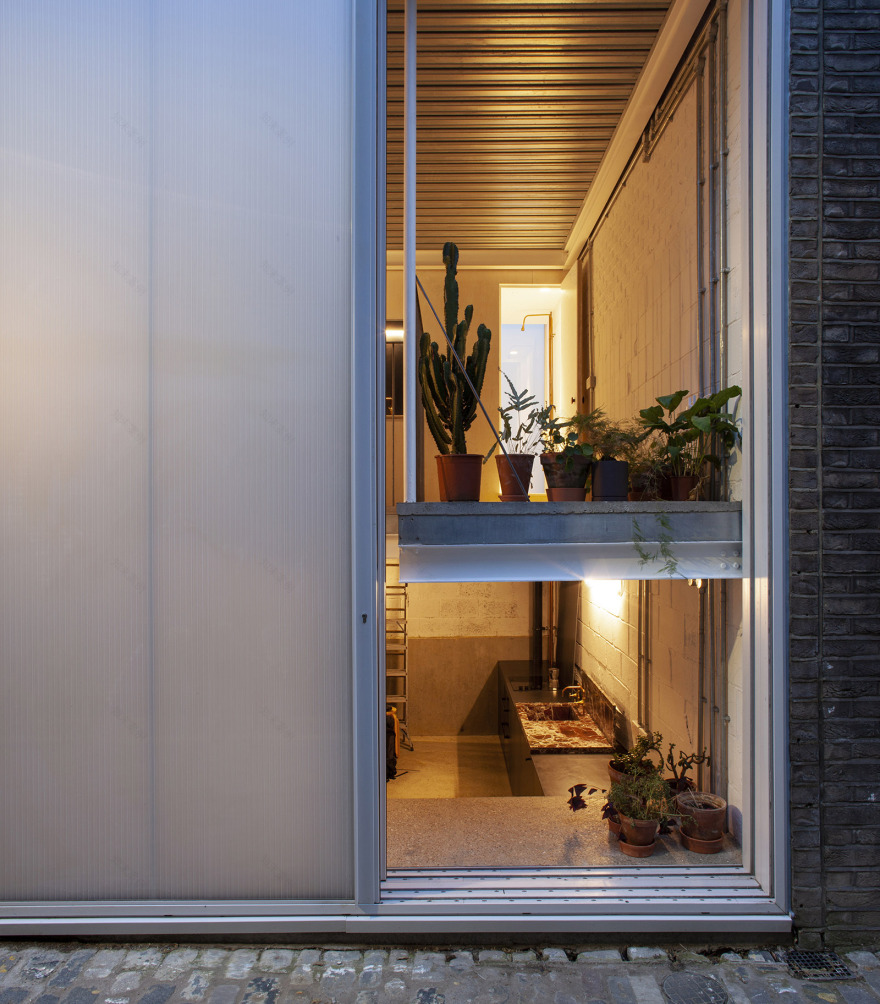
The front facade of MOCT Studio’s Small House is one oversized double‑skin polycarbonate veil with translucent sliding screens (opposite) to adjust the relationship with the street – both in terms of daylight and privacy
MOCT Studio’s founders Christopher Thorn and Mo Woon Yin Wong were living in a nearby Victorian two-up two-down when they got to know Voss Street, choosing it as a traffic-free option on the walk or cycle to work. The pair met while studying at the Architectural Association in the 2000s, where they developed a shared interest in the relationship of small domestic spaces to city streets – later expanded in their teaching roles at Central Saint Martins. The influences they cite for Small House include Takamitsu Azuma’s Tower House in Tokyo from 1966 and Atelier Bow‑Wow’s 2002 Pet Architecture Guide Book, which surveyed aspects of Japan’s kyosho jutaku, or compact living – the phenomenon arising in the 1990s as a response to land scarcity and property prices (as well as sunlight laws) that offers a notable parallel with present‑day housing economics in the UK. Thorn and Wong, however, are less interested in micro homes per se, and more interested in exploring the possibilities of a mutual contract between intimate domestic spaces and dense urban environments.
Voss Street was clearly the perfect test ground. After acquiring the site, their first move was an urbanism study investigating uses, street elevations and access conditions. This resulted in some blue-sky propositions that included inflatable street seating, foldaway wall-hung play structures and a ‘star scape’ of ground lighting. Of their approach to the design of the house itself, Thorn says: ‘We focused on the space, rather than the home as a compact or “kinetic” object. We were interested in how Small House negotiated its occupation, often shared with the public realm, and how it might contribute to the domestic city.’
With a footprint of 3.5 by 5.5 metres and a total floor area of around 60m2, the three‑storey Small House is compact rather than pushing at the boundaries of space standards. The architects’ solution to the restricted site is a three-sided box on a dozen 6m piles (necessitated by ground conditions), with the front of the house consisting of 4m-tall off-the-shelf sliding glazed panels beneath a parapet of cross‑braced galvanised steel – a nod to the extract ducts opposite. The giant north window and front door open to an up-close and personal aspect of the lane, including a brick wall and the wired glass frontage of Twofold House by Cassion Castle and Dunne & Raby. However, the all-important relationship with the street – and daylight – is negotiable via the privacy screening of a pair of external sliding panels in translucent polycarbonate, adjustable from inside.
Complete with Freudian attic and Jungian cellar, in some ways Small House follows the traditional order of things. From its open hallway, a half basement is sunk 1.2m below ground (keeping below the stair enclosure threshold). In the depths of this scullery-like space, an eating area is privileged beneath a pool of diffused light. Pointing out that the house is really just one vertical room, Wong says that a key design principle was that each space should receive natural light from at least two directions. With just two small apertures on the back wall, carefully positioned to avoid being overlooked, and a pair of lanterns in the flat roof, this has been achieved by filtering light through perforated sections of the stair. The effect is notable, with daylight and shadow balanced in a painterly way across the interior.
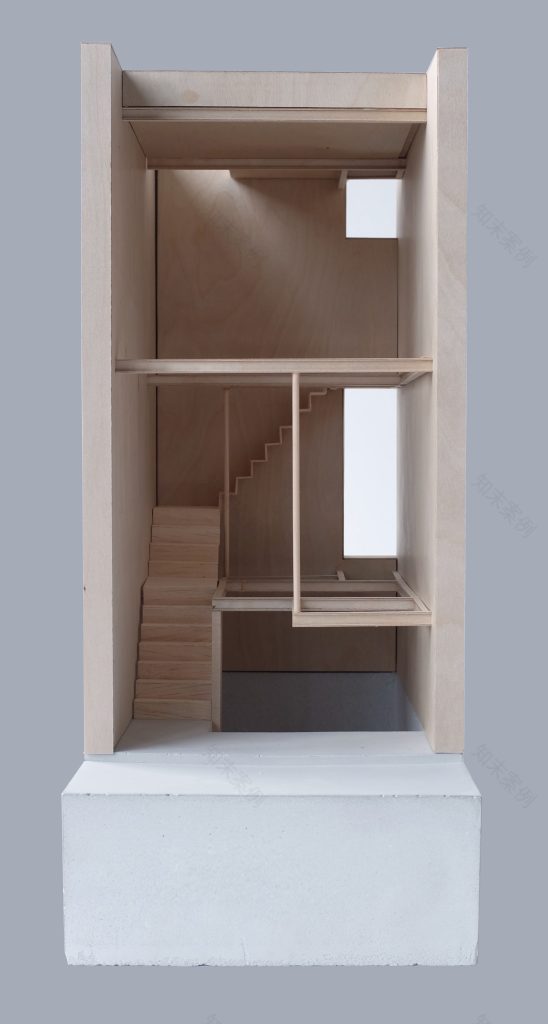
The home is articulated around a steel structure
The middle floor, part supported by two hanging columns (one on tensile show right by the entrance), feels more like a mezzanine perch than the classical expanse of the piano nobile. Adding to the sense of surprise, this floor also accommodates a distinctly non‑ensuite walk‑in shower and WC, a room bespoke‑lined in recycled Smile plastic as part of a joinery package that templated materials to the finer tolerances of steel. The space is luminously lit from a room‑height etched glass opening to the back wall, with warm south light infusing through the open door. In another unusual move, a handwashing station is incorporated into the living space like a hearth, with a Rosa Tea marble basin set in an alcove in the manner of an icon – perhaps a nod to the Covid‑19 era. The top‑floor bedroom, also open to the stairwell, provides the only south‑facing aspect and clue to neighbouring dwellings through the glance of a high-level opening. On the north side, a small balcony provides a lookout along Voss Street.
Cutting across the spaces is the experiential emphasis of the relatively generous open stair – a sculpture in mild steel that contrasts sharp right angles with contoured folds, and solid sections with perforated planes. Throughout the house, workaday and self-finish materials, including profiled steel decking with poured concrete slabs, are offset with meticulous detailing. The architects say this pared‑back approach is a response to space scarcity, but it reads more like a love letter to the art of building. The painted blockwork flank walls, for example, express where reuse has occurred, while their exposed brick ‘toothing’ indicates where blockwork lining gives way to dense structural blockwork piers.

A letting or sales agent would probably scratch their heads at the gross to net ratio. A health and safety consultant would tut at the sharp edges. My main concern would be a Shoreditch super rat entering the kitchen via the street-level window (bring it on, Freud). But I think Poetics of Space philosopher Gaston Bachelard, with his deep mistrust of horizontal living, would have approved of the little cosmos of Small House. ‘Home has become mere horizontality,’ he wrote of Paris’s ‘superimposed boxes’ of apartments in the late 1950s. ‘The different rooms … jammed into one floor all lack one of the fundamental principles for distinguishing and classifying the values of intimacy.’ To him, the essence of home was precisely the kind of verticality Small House poetically explores.
This is not how a volume housebuilder or a developer would build, and for this very reason the house contributes a rich seam of ideas to ongoing discussions about how best to live in cities, from the emotional resonance of verticality to the way domestic buildings touch the ground and commune with streets – something that’s done spectacularly badly in much of Britain’s current urban housing development. Perhaps most important, Small House’s architecture anticipates the car-free urbanism that might very soon be a reality.
南京喵熊网络科技有限公司 苏ICP备18050492号-4知末 © 2018—2020 . All photos and trademark graphics are copyrighted by their owners.增值电信业务经营许可证(ICP)苏B2-20201444 苏公网安备 32011302321234号
苏公网安备 32011302321234号客服
消息
收藏
下载
最近