

创作上传
VIP
收藏下载
登录 | 注册有礼
查看完整案例

收藏

下载

分享
'Ethical Dwellings for Generation Y' explores new forms of living and owning in a changing London

By
Nicholas Korody
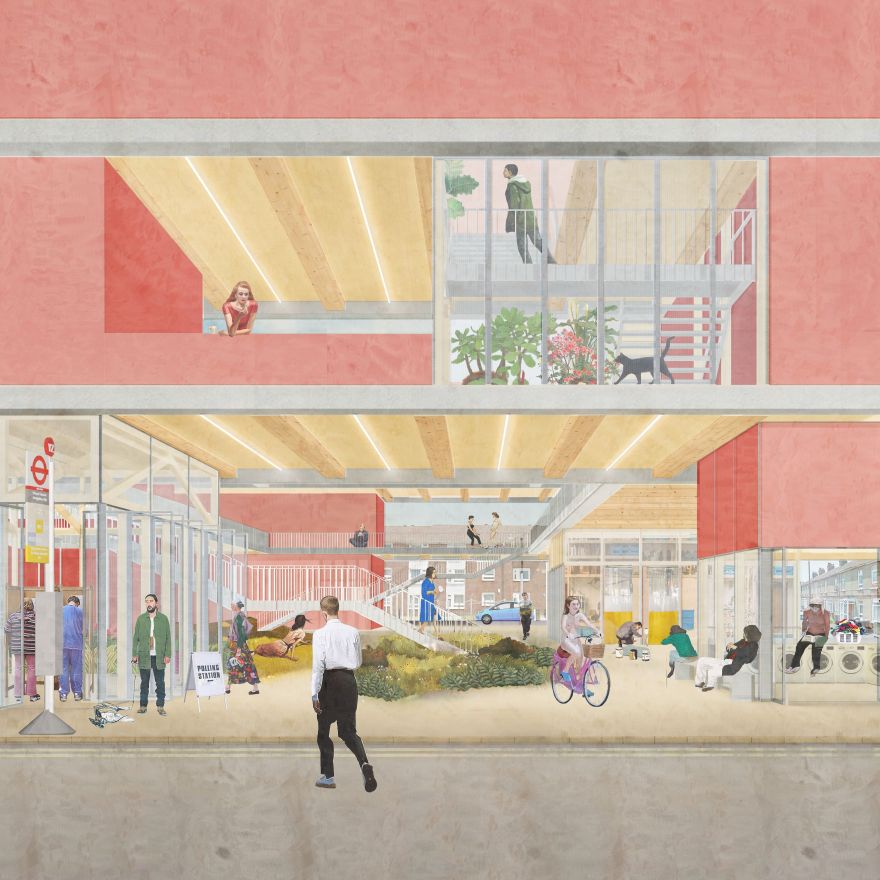
A ground-floor level view of the "mid-rise" scale proposal developed by ED/GY that "employs the holarchy of sharing in section, as an integrated piece of city at ground level, through to individual withdrawing rooms on the top storey." Credit: ED/GY
While an average of 100,000 people move to London each year, only about 25,000 new homes are built annually: a
formula
that has produced a critical lack in affordable housing. The median rent in the capital city is £1,400 and the average house price has passed £600,000. In other words, only the very rich can afford to live in London.
In particular, this housing crisis affects younger generations who are unable to buy yet are a low priority for (already scarce) social housing. ED/GY, or Ethical Dwellings for Generation Y, seeks to address this situation by "exploiting and manoeuvring within the current systems to leverage opportunities for the good life in today’s crisis."
A systematic crisis demands a systematic response
A systematic crisis demands a systematic response, and ED/GY proposes not only new forms of living, but also new models of ownership. Submitted to
July’s open call
for new models of domesticity, the project confronts the radical changes in the economy, urban environment, and modes of living that characterise dwelling in the contemporary moment.

A view of the "withdrawing room" of the mid-rise proposal. Credit: ED/GY
“The home is not an asset,” ED/GY write. “It is a place to dwell and belong.” They’ve developed a collective ownership model that allows groups of millennials to pool resources and build equity at affordable rates.
The home is not an asset. It is a place to dwell and belong.
A project of Architectural Agency, part of the Design Think Tank at the
London School of Architecture
, ED/GY operates at three scales: low-, mid- and high-rise. Respectively, these constitute an alternative to the terraced house and suburban street, an integrated “piece of the city at ground level”, and an alternative strategy for London’s existing hi-rise towers.

A section of a "low-rise" dwelling. Credit: ED/GY
Included in the proposal is an infographic detailing their development model (in the image gallery below), which begins by approaching an “ethical bank with deposits and [the] earning potential of the millennial group as collateral,” in order to receive mini-bonds with fixed terms and rates. In the second stage, ED/GY develops a bespoke unit with borrowed capital, building it as quickly as possible in order to reduce both the borrowing cost and risk, and to make a profit. Third, ED/GY repays investors from the profits as the mini-bonds mature.
Then, the residents move in and start making affordable payments. ED/GY covers overhead and the bank loan while a committed group builds equity and others pay rent.
The dwellings we propose are designed for sharing
Finally, the committed group will own 80% of the development, while ED/GY maintains 20% equity and continues to earn rent and manage the building.
“Without a specific site, our propositions are strategic re-imaginings of existing typologies envisaged as applicable to sites across London,” they write. “The dwellings we propose are designed for sharing: for us it is a luxury not a compromise.”
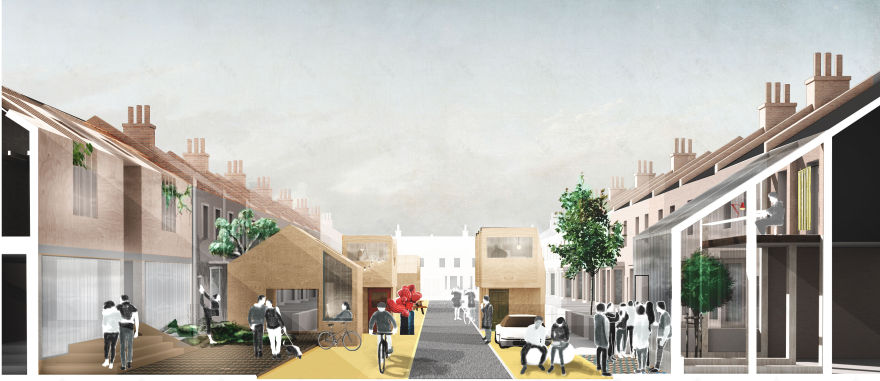
A view of a reinterpreted suburban street, part of the low-rise proposal, which fragments "the home into a series of activities across a walking distance block." Credit: ED/GY
ED/GY is formed by Architectural Agency, a Design Think Tank at the London School of Architecture. Led by Matthew Dalziel from Interrobang and Will Hunter from the LSA, Architectural Agency explores the power of the architect. Its practice members are Carmody Groarke, Haworth Tompkins, Hut, Interrobang, IF_DO, Liddicoat & Goldhill, Mikhail Riches, PDP London, and Studio Octopi; and its student members are Raphael Arthur, Chiara Barrett, Ian Campbell, Jack Idle, Fabio Maiolin, Phoebe Nickols and Fiona Stewart.

A view of the "withdrawing room" in the hi-rise proposal. Credit: ED/GY

An axonometric of a typical floor in the "hi-rise" proposal, which is described as a "light touch, affordable solution that treats all intervention as varying weights of furniture, [which] allows us to establish a horizontal hierarchy from communal to individual space." Credit: ED/GY
This project was a submission to Archinect's open call for the July theme,
Domesticity
. For August, we're focusing on all things related to
Games
. Have an idea for a Monopoly board for the contemporary city?
Submit by August 21
!


南京喵熊网络科技有限公司 苏ICP备18050492号-4知末 © 2018—2020 . All photos and trademark graphics are copyrighted by their owners.增值电信业务经营许可证(ICP)苏B2-20201444 苏公网安备 32011302321234号
苏公网安备 32011302321234号客服
消息
收藏
下载
最近