

创作上传
VIP
收藏下载
登录 | 注册有礼
查看完整案例

收藏

下载

分享
Fujian Tulou: The Resilient and Communal Hakka Walled Villages

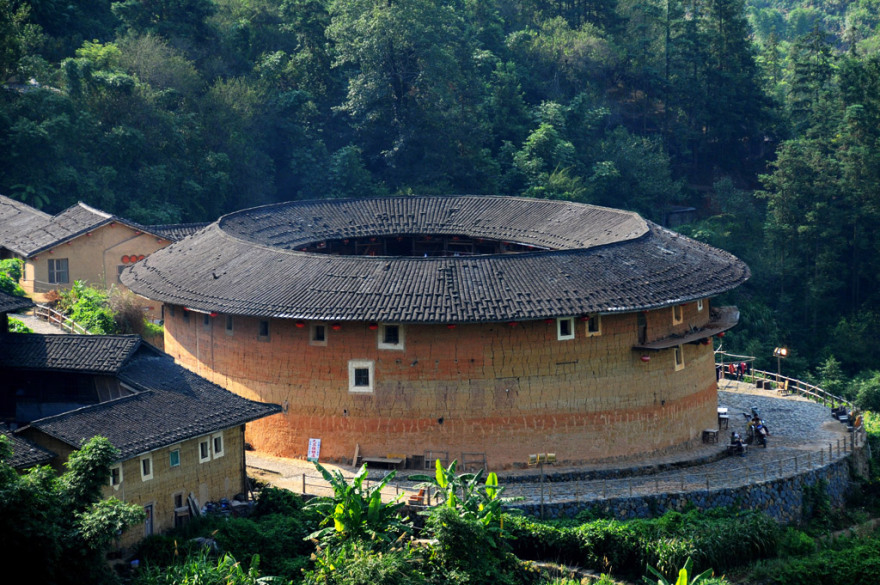
Fujian Tulou | © Motohiro Sunouchi, Flickr User
Located in the mountainous region of Fujian Province, China, the Fujian Tulou (土楼) represents an extraordinary blend of architectural innovation, cultural resilience, and communal living. These traditional Hakka walled villages, constructed from the 12th to the 20th century, showcase the Hakka people’s ingenuity in creating robust, multifunctional spaces that cater to both defensive and social needs.
Fujian Tulou Technical Information
Architects: Unknown
Location: Fujian Province, China
Primary Materials:
Outer Walls: Clay, earth, lime, stone
Inner Structure: Bamboo
Adhesive Additives: Sticky rice and brown sugar mixture
Project Year: 12th Century to 20th Century
Photographs: © Motohiro Sunouchi, See Caption Details
The Fujian Tulou are exceptional examples of a building tradition and function, exemplifying a particular type of communal living and defensive organization in harmonious relationship with their environment.
– The UNESCO World Heritage Centre
Fujian Tulou Photographs

© Vmenkov, Flickr User
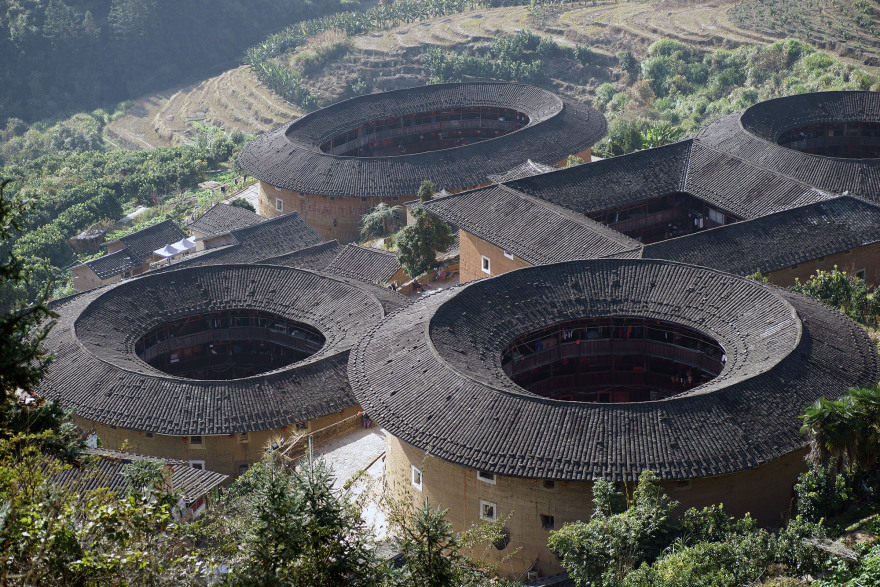
Fujian Tulou | © Motohiro Sunouchi, Flickr User

© Motohiro Sunouchi, Flickr User

© Motohiro Sunouchi, Flickr User
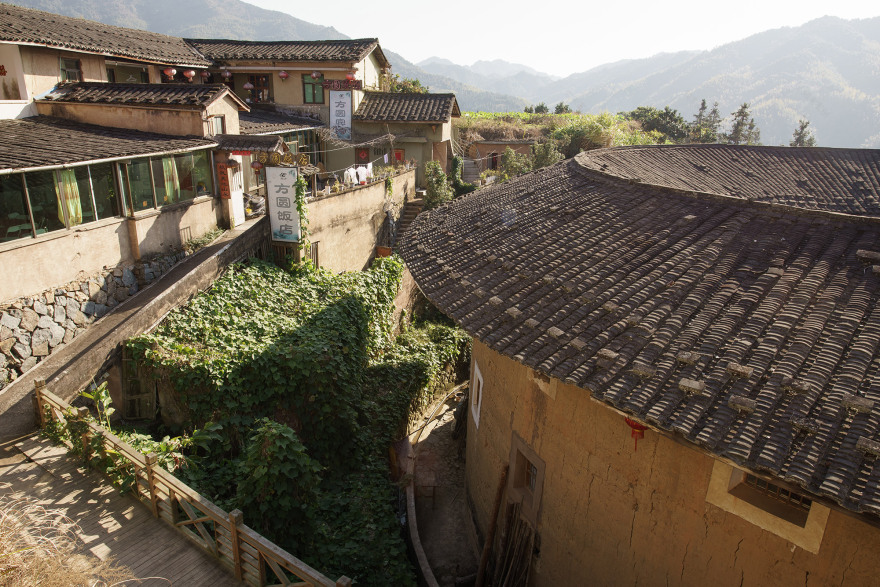
© Motohiro Sunouchi, Flickr User

© Gisling

© Motohiro Sunouchi, Flickr User
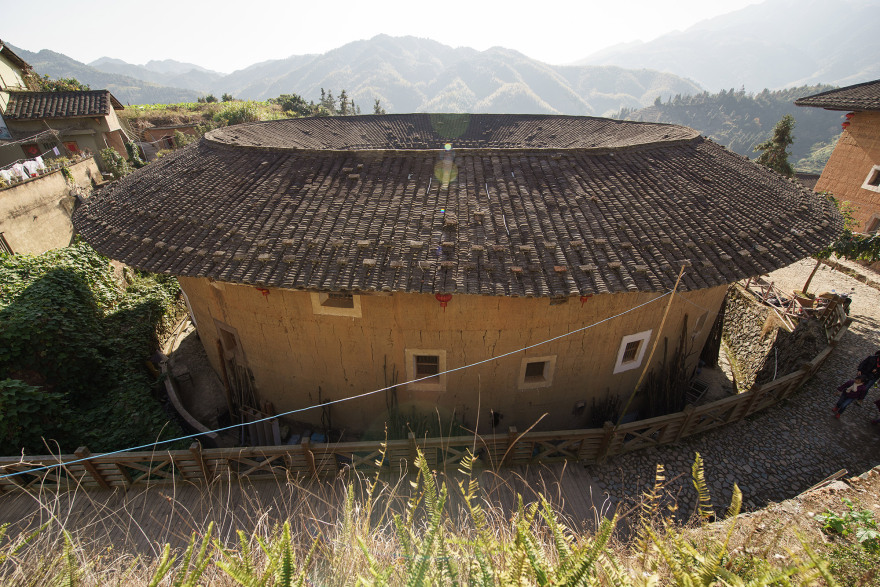
© Motohiro Sunouchi, Flickr User

© Motohiro Sunouchi, Flickr User

© Motohiro Sunouchi, Flickr User

© Motohiro Sunouchi, Flickr User

© Motohiro Sunouchi, Flickr User

© Motohiro Sunouchi, Flickr User

© Motohiro Sunouchi, Flickr User

© Motohiro Sunouchi, Flickr User

© Motohiro Sunouchi, Flickr User
Historical Context and Evolution
The Fujian Tulou’s inception dates back to the Northern Song dynasty around 1120, during a period marked by conflict and mass migration from northern provinces. The Hakka refugees, seeking safety and community, established these distinctive earthen structures in Fujian. Initially, these buildings were modest, accommodating multiple families and fostering a strong sense of community among the displaced Hakka people. Over centuries, particularly during the Ming Dynasty, Tulou architecture evolved to incorporate educational and other communal functions, reflecting Hakka society’s growing complexity and sophistication.
Architectural Features and Construction Techniques

Diagram | © 星球研究所 Planet Research Institute
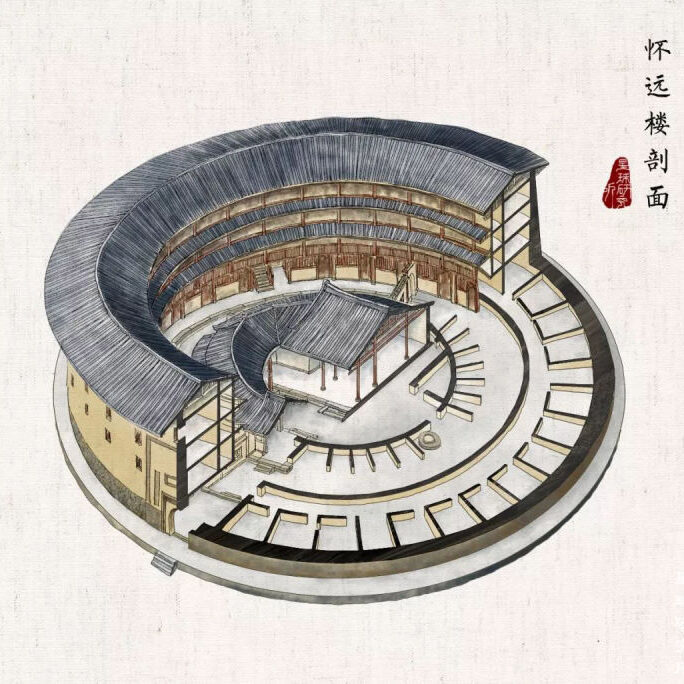
Diagram | © 星球研究所 Planet Research Institute
A Tulou’s structure exemplifies vernacular architecture, utilizing locally sourced materials such as clay, earth, lime, and stone. The walls, up to 3 meters thick at the base, tapering to about 1.5 meters at the top, provide formidable insulation and defense. The inclusion of sticky rice and brown sugar in the construction mix enhances the wall’s durability and adhesion. Internally, bamboo arranged vertically offers structural support. The thick transverse earth walls serve as fire barriers, while the rooftops, unified with tiles, overlook spacious courtyards that form the heart of these communities.
Community and Defensive Design
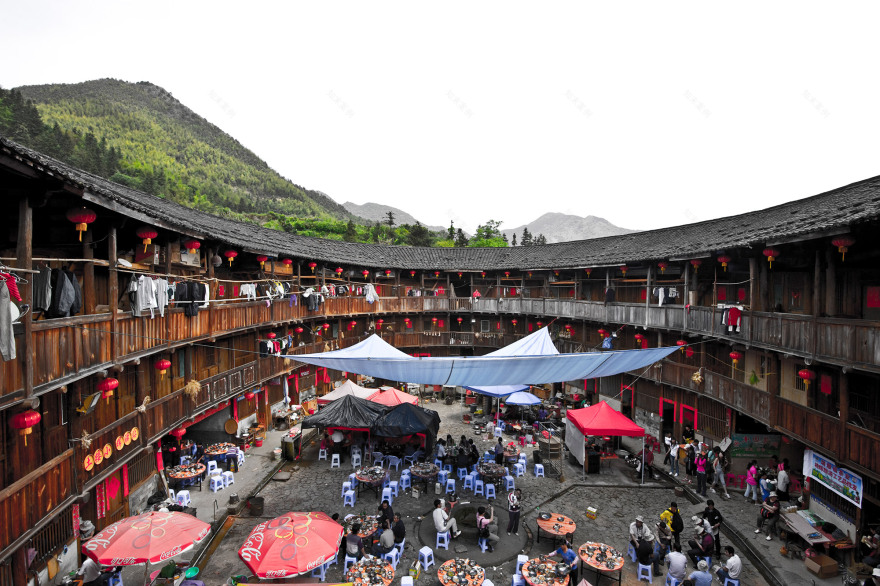
Tulou’s design embodies a dual purpose: defense and community living. These structures could house up to 800 people, offering equal living spaces to all families, thus fostering a sense of equality and shared responsibility. The inward-facing walls are richly decorated and feature numerous openings, promoting a vibrant communal atmosphere centered around courtyards used for markets, educational activities, and ancestor commemoration. In contrast, the exterior walls are stark and fortified, with minimal openings to deter invaders, reflecting the tumultuous history of the Hakka people.
Typological Diversity and Adaptation

Diagram | © 星球研究所 Planet Research Institute

Section | © 星球研究所 Planet Research Institute
Over time, Tulou architecture diversified into various shapes, including square (fanglou 方楼), circular (yuanlou 圆楼), oval, hexagonal, and even half-moon configurations. Each form had distinct advantages: while square Tulous were the earliest, offering straightforward construction, the circular ones enhanced community coherence and ventilation. These typologies allowed the Hakka people to adapt their dwellings to different environmental and social needs, ensuring their longevity and functional versatility.
Cultural and Historical Significance
The clusters of Tulous, like the Tianluokeng and Chuxi clusters, are iconic, reflecting the adaptability and unity of the Hakka communities. These clusters, often comprising a mix of shapes and sizes, create a cohesive yet diverse architectural landscape. Their historical importance is highlighted by the anecdotal Cold War incident where the CIA misidentified Tulou clusters as missile silos, underscoring their unique and unfamiliar form to outsiders.
Architectural Parallels
Interestingly, the architectural organization of Tulous shares similarities with Louis Kahn’s research on Scottish castles, particularly in the use of reinforced outer walls and communal inner spaces. Despite the distinct cultural contexts, this parallel underscores a universal architectural approach to fortification and community life.
Fujian Tulou Plans

Site Plan

Axonometric View
Fujian Tulou
Image Gallery






南京喵熊网络科技有限公司 苏ICP备18050492号-4知末 © 2018—2020 . All photos and trademark graphics are copyrighted by their owners.增值电信业务经营许可证(ICP)苏B2-20201444 苏公网安备 32011302321234号
苏公网安备 32011302321234号客服
消息
收藏
下载
最近