

创作上传
VIP
收藏下载
登录 | 注册有礼
查看完整案例

收藏

下载

分享
U.S. Pavilion for the 2023 Venice Architecture Biennale analyzes the human relationship with plastic

Niall Patrick Walsh

Externalities by Ang Li. Photo credit: ReportArch / Andrea Ferro Photography
The United States Pavilion for the
2023 Venice Architecture Biennale
has been completed ahead of the event’s May 20th public opening. Organized by the Cleveland-based alternative art organization
SPACES
, and titled
Everlasting Plastics
, the exhibition seeks to explore “one of the most ubiquitous materials in our world: plastic.”

Externalities
by Ang Li. Photo credit: ReportArch / Andrea Ferro Photography
Investigating how
plastic
has permeated modern life, the exhibition reframes attitudes and approaches toward addressing the overabundance of plastic waste in waterways, landfills, and streets. Acknowledging the global dependence on the material, the pavilion seeks to make a case for a “profound reconsideration for how we coexist with plastics and its possibilities as an agent for change.”

PROOFING: Resistant and Ready
by Xavi L. Aguirre. Photo credit: ReportArch / Andrea Ferro Photography
“In representing the United States at La Biennale, we wanted to draw a connection between an industry that is deeply rooted in Ohio, where we are based, and communities across the world, including here in Venice,” said co-curator Tizziana Baldenebro. “What emerged from the United States as a material with utopian capabilities is now contributing to a dystopian reality for our planet. In exploring this duality, the design and artistic fields can be leaders in evolving humanity’s position.”

This Will Kill____That
by Simon Anton. Photo credit: ReportArch / Andrea Ferro Photography
“The scale of plastic waste and production requires innovative design thinking to look at this material anew, bringing into focus both the visible and invisible ways it shapes our world,” added co-curator Lauren Leving. “Plastics are tied to environmental extraction and global markets and have created expectations around single-use and disposability in how other materials should behave. This exhibition provides a platform for experimentation that simultaneously acknowledges plastic’s long-term impacts and grapples with reappropriating this material in innovative ways.”
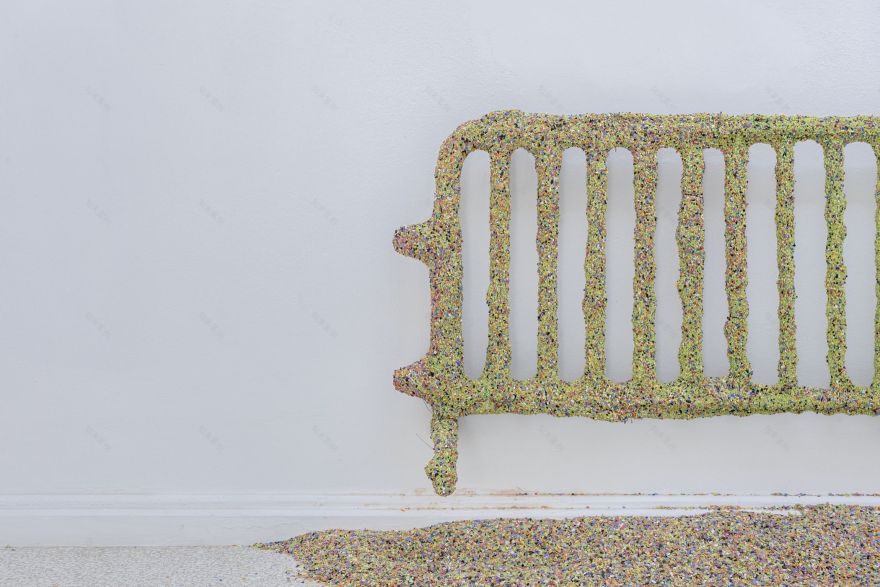
This Will Kill____That
by Simon Anton. Photo credit: ReportArch / Andrea Ferro Photography
The resulting exhibition brings together site-specific commissions by SPACES artists Xavi L. Aguirre, Simon Anton, Ang Li, Norman Teague, and Lauren Yeager. Each installation considers humanity’s relationship with plastics by exploring different aspects of its production and consumption, encouraging discussion about the various ways plastic “both shapes and erodes contemporary ecologies, economies, and the built environment.” The program also seeks to suggest potential alternatives to plastic as well as new ways in which plastics can be deployed.

Re+Prise
by Norman Teague. Photo credit: ReportArch / Andrea Ferro Photography
Xavi L. Aguirre’s installation spans two rooms of the pavilion, holding a series of partial scenographies examining indoor proofing materials such as coatings, rubbers, gaskets, bent aluminum, silicone, foam, cement board, and beveled edges. Meanwhile, Simon Anton engages in a process of grafting
waste plastic
onto metal armatures, “transforming refuse into functional objects,” while Ang Li’s installation explores the cultural legacy and material afterlives of petroleum-based materials in the built environments, anchored by a 33-foot wall filled with expanded polystyrene foam retried from U.S. recycling networks.

Longevity
by Lauren Yeager. Photo credit: ReportArch / Andrea Ferro Photography
Norman Teague’s presentation embraces plastic as a medium for exploration, creating vessel-like objects from everyday objects such as laundry detergent and milk jugs, while Lauren Yeager has created a series of geometric and columnar forms by repurposing plastic objects scavenged from trash found in Cleveland and its surrounding neighborhoods.
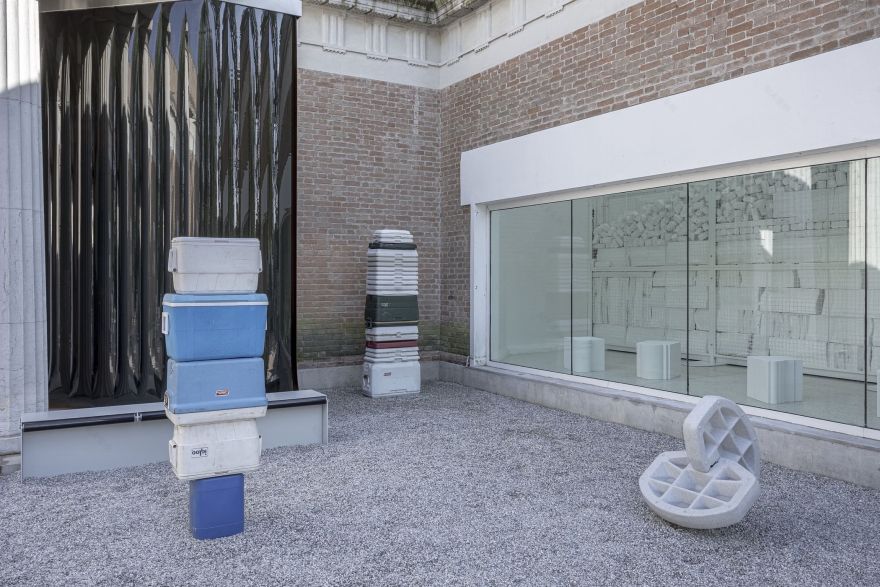
Longevity
by Lauren Yeager. Photo credit: ReportArch / Andrea Ferro Photography
The exhibition is one of several components of the 2023 Venice Biennale featured in our editorial. Earlier this week, we reported on an
exhibition exploring the NEOM megadevelopment
in Saudi Arabia, as well as
David Adjaye’s presentation
of an architectural model for his upcoming Kiran Nadar Museum of Art project in New Delhi. Last week, meanwhile,
The New York Times
profiled the event’s curator Lesley Lokko
.
南京喵熊网络科技有限公司 苏ICP备18050492号-4知末 © 2018—2020 . All photos and trademark graphics are copyrighted by their owners.增值电信业务经营许可证(ICP)苏B2-20201444 苏公网安备 32011302321234号
苏公网安备 32011302321234号客服
消息
收藏
下载
最近