

创作上传
VIP
收藏下载
登录 | 注册有礼
查看完整案例

收藏

下载

分享
Google's Sidewalk Labs to redevelop Toronto waterfront as one of the largest smart city projects in North America

Toronto's Eastern Waterfront. Courtesy of Sidewalk Labs.
Silicon Valley, and the tech industry at large, is known for reinventing the everyday. From buses to vending machines, and from the necessary to the indulgent, each week seems to bring another headline about the tech world's disruptions.
has recently comprised a good sum of this ink with the announcement of plans for a new headquarters and the subsequent bidding war straight out of Hunger Games that has cities across North America submitting over 238 proposals to host. But while
to house a new campus, another tech giant—
, that is—has decided to go in a different direction, cutting to the chase and just building the city themselves.

Digital Infrastructure Vision. Image courtesy of Sidewalk Labs.
The online empire began as a quaint search engine but has since transitioned into the business of measuring pretty much everything. In 2015, the company reorganized itself into multiples under the umbrella company
, in order to separate its core Internet business from other ambitious projects. One such company to come out of this reorganization was
, an independent start-up focused on urban technology, that announced plans last week to pilot the redevelopment of Toronto's southeastern waterfront.
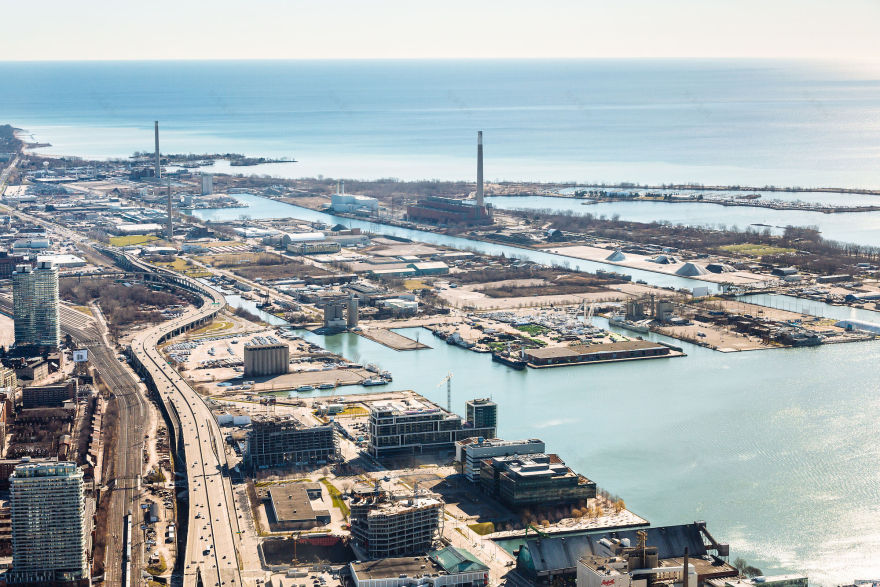
Eastern Waterfront. Photo courtesy of Sidewalk Labs.
Currently the site in question houses a few industrial buildings and some parking lots. The Alphabet subsidiary plans to redevelop 12-acres on the site, moving Google's Toronto headquarters to the waterfront with the eventual intention of redeveloping the full 800-acre lakeside area. The future community, to be called Quayside, will essentially become a full neighborhood built by Google from scratch. As to be expected, tech innovations will abound with Sidewalk Labs promising to embed sensors collecting data on traffic, air quality, energy usage, and even the enjoyment of public space.

Mixed-Use Vision. Image courtesy of Sidewalk Labs.
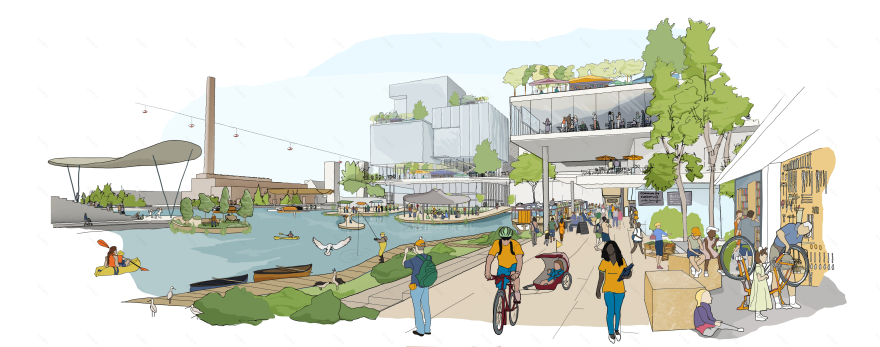
Public Realm Vision. Image courtesy of Sidewalk Labs.
The company describes the project as a city "built from the internet up" and their success will rest on how they translate data collection and information into a kind of community asset. As far as a city is concerned, for it's dwellers, "little of the value we create is about information" suspects Sidewalk's head of urban systems. Beyond the deployment of electronics and sensors and robots, the company is taking a page from some tried-and-true urban interventions and good old infrastructure. Retractable canopies like those of 11th century Damascus will shelter sidewalks and pedestrian pathways, common to most ski towns, will help melt snow. Housing will be made affordable, projected at 14 percent lower than the surrounding metro area, through timber-frame construction and the hope offered by modular units, micro-units, and co-housing.

Image courtesy of Sidewalk Labs.
Google certainly isn't the only company trying to fuse technology and urbanism to the benefit of city living. Every city from Los Angeles to Reno to Chattanooga to Toronto is clamoring to groom their own innovation districts as incubators of progress—economic, technological, but also cultural. What makes Sidewalk Labs' vision for the Toronto waterfront somewhat of an anomaly in the wide field of districts as test-beds for technology, is that the site reserved for them is a blank slate—a tabula rasa that, if all goes according to plan, will become one of the largest examples of a smart city project in North America.
南京喵熊网络科技有限公司 苏ICP备18050492号-4知末 © 2018—2020 . All photos and trademark graphics are copyrighted by their owners.增值电信业务经营许可证(ICP)苏B2-20201444 苏公网安备 32011302321234号
苏公网安备 32011302321234号客服
消息
收藏
下载
最近