

创作上传
VIP
收藏下载
登录 | 注册有礼
查看完整案例

收藏

下载

分享
Crip Camp: An Interview with Filmmaker Jim LeBrecht About Accessibility, Universal Design, and Spaces of Freedom

The politics of disability are fundamentally spatial. They respond to the struggle for equal access and representation against different forms of socio-spatial discrimination and aspire to alternative understandings of the relation between the body and space that destabilize both current constructions of an able body as well as established norms concerning the use of space. Expanding beyond design guides and regulations to encompass more broadly structural and systemic issues related to the experience of disablement and segregation, this concern continues to be relevant well beyond the enactment of the Americans with Disabilities Act of 1990 (ADA).
The goal, in this context, is not only to facilitate access to buildings for differently abled bodies but also access to society itself as equal individuals.
space. They are paradigmatically captured in different performances
taking place at the core of the spaces of political representation.
For example, in the United States, the occupation of the San
Francisco Health and Education and Welfare Offices in 1977—the
longest occupation of a federal government office in U.S. history to
date—led
to the final approval of the Section
504 of the Rehabilitation Act of 1973. In 1990, the Capitol Crawl
comprised disability right activists crawling the steps of the U.S.
Capitol Building, leaving their wheelchairs and other mobility
devices behind, to demand Congress to pass the ADA.
But beyond such dramatic moments, there exist more peripheral
locations that have provided opportunities for those politics to
unfold, helping shape and empower the collectives working to pursue
them. Camp Jened was one of them: a summer camp for people with
disabilities taking place since the sixties in Hunter, New York.
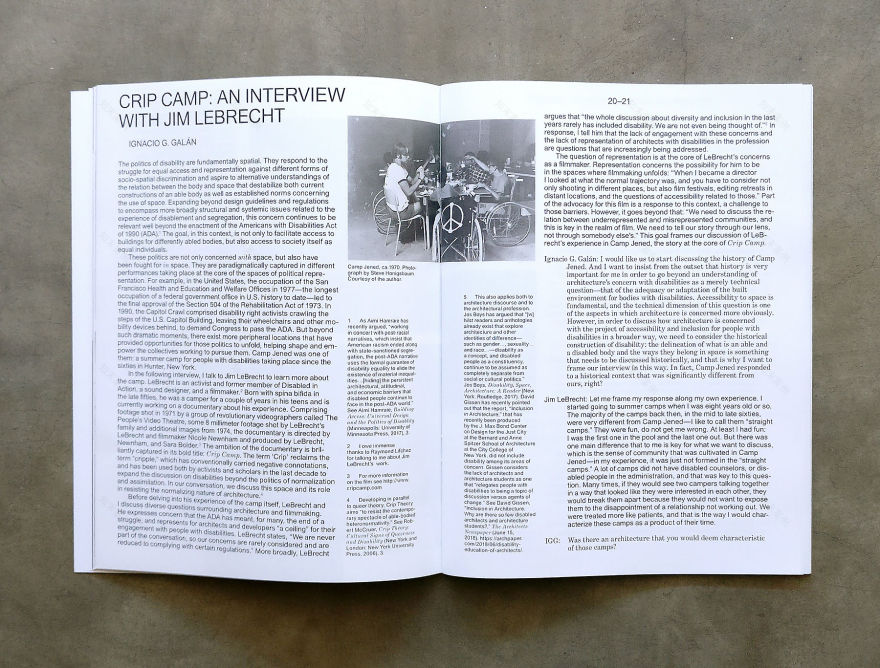
Page spread of the original article "Crip Camp: An Interview with Jim LeBrecht" published in Ed #3 Normal.
In
the following interview, I talk to Jim LeBrecht to learn more about
the camp. LeBrecht is an activist and former member of Disabled in
Action, a sound designer, and a filmmaker.
Born with spina bifida in the late fifties, he was a camper for a
couple of years in his teens and is currently working on a
documentary about his experience. Comprising footage shot in 1971 by
a group of revolutionary videographers called The People’s Video
Theatre, some 8 millimeter footage shot by LeBrecht’s family and
additional images from 1974, the documentary is directed by LeBrecht
and filmmaker Nicole Newnham and produced by LeBrecht, Newnham, and
Sara Bolder.
.
The term ‘Crip’ reclaims the term “cripple,” which has
conventionally carried negative connotations, and has been used both
by activists and scholars in the last decade to expand the discussion
on disabilities beyond the politics of normalization and
assimilation. In our conversation, we discuss this space and its role
in resisting the normalizing nature of architecture.
Before
delving into his experience of the camp itself, LeBrecht and I
discuss diverse questions surrounding architecture and filmmaking. He
expresses concern that the ADA has meant, for many, the end of a
struggle, and represents for architects and developers “a ceiling”
for their engagement with people with disabilities. LeBrecht states,
“We are never part of the conversation, so our concerns are rarely
considered and are reduced to complying with certain regulations.”
More broadly, LeBrecht argues that “the whole discussion about
diversity and inclusion in the last years rarely has included
disability. We are not even being thought of.”
In
response, I tell him that the lack of engagement with these concerns
and the lack of representation of architects with disabilities in the
profession are questions that are increasingly being addressed.
The
question of representation is at the core of LeBrecht’s concerns as
a filmmaker. Representation concerns the possibility for him to be in
the spaces where filmmaking unfolds: “When I became a director, I
looked at what the normal trajectory was, and you have to consider
not only shooting in different places but also film festivals,
editing retreats in distant locations, and the questions of
accessibility related to those.” Part of the advocacy for this film
is a response to this context, a challenge those barriers. However,
it goes beyond that: “We need to discuss the relation between
underrepresented and misrepresented communities, and this is key in
the realm of film. We need to tell our story through our lens, not
through somebody else’s.” This goal frames our discussion of
LeBrecht’s experience in Camp Jened, the story at the core of

Camp Jened, ca.1970. Photograph by Steve Honigsbaum. Courtesy of the author.
I would like us to start discussing the history of Camp Jened. And I
want to insist from the outset that history is very important for me
in order to go beyond an understanding of architecture’s concern
with disabilities as a merely technical question—that of the
adequacy or adaptation of the built environment for bodies with
disabilities. Accessibility to space is fundamental, and the
technical dimension of this question is one of the aspects in which
architecture is concerned more obviously. However, in order to
discuss how architecture is concerned with the project of
accessibility and inclusion for people with disabilities in a broader
way, we need to consider the historical construction of disability:
the delineation of what is an able and a disabled body and the ways
they belong in space is something that needs to be discussed
historically, and that is why I want to frame our interview in this
way. In fact, Camp Jened responded to a historical context that was
significantly different from ours, right?
Let me frame my response along my own experience. I started going to
summer camps when I was eight years old or so. The majority of the
camps back then, in the mid to late sixties, were very different from
Camp Jened—I like to call them “straight camps.” They were fun,
do not get me wrong. At least I had fun: I was the first one in the
pool and the last one out. But there was one main difference that to
me is key for what we want to discuss, which is the sense of
community that was cultivated in Camp Jened—in my experience, it
was just not formed in the “straight camps.” A lot of camps did
not have disabled counselors, or disabled people in the
administration, and that was key to this question. Many times, if
they would see two campers talking together in a way that looked like
they were interested in each other, they would break them apart
because they would not want to expose them to the disappointment of a
relationship not working out. We were treated more like patients, and
that is the way I would characterize these camps as a product of
their time.
This was two months where I did not have to worry about architectural barriers, and this meant I was not a burden to anyone. I could get independently wherever I wanted. It was a space of freedom.
Well, it was the architecture that is characteristic of those
institutions in which patients are interned. They called the places
where we slept “dorms” rather than “bunks,” for example, and
we had to go to bed at 8:30. I find that meaningful.
Different from those “straight camps,” I call Camp Jened a
“Hippie camp”—and its links to hippie camps provided an
alternative model for it, different from that of institutions. I went
there for the first time in 1970, for half a month, and then full-time in 1971. I had heard about this camp from other campers in 1969,
people were talking about it: a camp where you slept in bunks, where
camp counselors slept in the same rooms where you did, where they
were playing music all the time, and where campers were up late. It
was supposed to be a wonderful environment. So I told my dad, “I
want to go there.” I had also heard you could smoke dope with the
counselors, but that was just some bonus points.
I
was 14 when I went first. So, I find myself arriving there, in the
bus, and I look outside the window, and I cannot figure out who are
the campers and who are the counselors. Because I saw people in
wheelchairs that were assisting the campers that were getting off the
bus. There were people with disabilities receiving us, because they
were also in positions of authority. And there are all kinds of wild
looking people, hippies, that I could not tell if they had
disabilities. Then I get there, and I was not infantilized. I was
treated as a teenager.

Camp Jened, ca.1970. Design and construction of the structures by Alan Winters. Photograph by Steve Honigsbaum. Courtesy of the author.
Well,
at this point, there were many liberation movements working in
parallel. They were all, in different ways, seeking to challenge the
authorities and the establishment. And the people that were running
Camp Jened wanted to provide a space and an experience where people
could feel or get a sense of their life, of what they were capable
of. Of course, we all wanted to have fun in the camp, but there was
this additional mindset that made the space of the camp special to
develop a sense of community that you could deem political. In fact,
a lot of us in the bunks started to talk about our future and discuss
Black Power, Women’s Liberation, Gay Rights, etc. And we thought,
“We really need the same thing for ourselves.”
At
that point in history, summer camps were a space where one could find
a community and come together to talk and organize. A place that did
not really exist for us otherwise, really. There were only some
universities where disabled students were starting to go and discuss
their concerns together, like University of Illinois Urbana-Champaign
or UC Berkeley. In New York, where I lived, it was Hofstra and Long
Island University. However, I was still 14 or 15, so the camp for us
was the only alternative.
This
was two months where I did not have to worry about architectural
barriers, and this meant I was not a burden to anyone. I could get
independently wherever I wanted. It was a space of freedom. And this
is a space in which I could be picked first for the basketball team
versus not being picked at all. This was also a space where I met my
first girlfriend in 1971.
Not being an architect, but having had to live with the very mixed results of the work of architects, I think that universal design is still the most appropriate way of looking at the questions that concern us.
Well, they just prevented them to avoid us being possibly frustrated.
I understand. But it seems to me that what you are describing in Camp
Jened is that links of assistance and affection were normalized
beyond institutional hierarchies and constraints. And this seems to
be something that the camp might allow illuminating for our
understanding of what it means to be a social being more generally,
in ways that do not necessarily celebrate autonomy or individualism
but accept how we are all assisted in different ways both physically
and affectively.
Yes, one of the counselors described it as a “bubble.” And it was
different from the world outside it. When we would go into town,
which was about one mile down, into Hunter, New York, both social and
physical space were significantly different. There were no ramps into
the pizza place, for example, but there were not only physical
barriers. The people there did not want us to come, because customers
were uncomfortable with us: we had wheelchairs that occupied more
space, we talked really loudly because of our different disabilities,
our bodies looked unfamiliar to them, and they interpreted them as
grotesque. So the camp was an exception to that reality.

Camp Jened, ca.1970. Design and construction of the structures by Alan Winters. Photograph by Steve Honigsbaum. Courtesy of the author.
I
like to put it in these terms: you cannot strive for a better life if
you do not know one exists. Once you experience a better life, it is
an extraordinary catalyst for you to find it and protect it. That is
what the camp meant for us.
Absolutely.
And there were particular places where that took shape. Many of us
ended up gathering in Berkeley, for example, where there was the
Center for Independent Living among other things.
The
camp hired several African American counselors from the South, and
that brought to the fore multiple perspectives towards the problem of
segregation. In fact, we could relate to many of their struggles.
They could make clear to us how our experience could relate to them
entering into a restaurant at the time when segregation was still
well in place in the South. Segregation in general was something I
could relate to since we were many times received by the same
unwelcoming contexts. Nobody wants to appropriate anyone’s
struggle, but we could see that there was a universality in being not
“normal” that we shared.
JL:

Page spread of the original article "Crip Camp: An Interview with Jim LeBrecht" published in Ed #3 Normal.
I guess we can finish this conversation with this occupation—for I
understand occupations both as political performances and spatial
practices. They involve an active appropriation of space and its
transformation, a challenge to its order through its inhabitation.
Crip Camp is an invitation to continue imagining ways in which we can
challenge the normalizing and segregating tendencies of space upon
bodies and communities through their occupation. This seems to me to
be the architectural project of today.
Not being an architect, but having had to live with the very mixed
results of the work of architects, I think that universal design is
still the most appropriate way of looking at the questions that
concern us. An elevator located away from the main flow of movement
or ramps to the side and not meant for everyone reinforces the
imposed “otherness” of the disabled community—a community
constructed as an exception to the norm. It is important that
architects embrace the diverse ways in which bodies occupy space, not
as something you
to do. This shift might lead to the invention of spaces that can be
for everyone. The solution can never be “separate but equal.”
That has never been the right solution for any collective.
南京喵熊网络科技有限公司 苏ICP备18050492号-4知末 © 2018—2020 . All photos and trademark graphics are copyrighted by their owners.增值电信业务经营许可证(ICP)苏B2-20201444 苏公网安备 32011302321234号
苏公网安备 32011302321234号客服
消息
收藏
下载
最近