

创作上传
VIP
收藏下载
登录 | 注册有礼
查看完整案例

收藏

下载

分享
Dún Laoghaire Baths in Dún Laoghaire, Ireland by DLR Architects Department and A2 Architects

Originally opened in 1843, the sea baths in Dún Laoghaire have lain abandoned since 1997. Dún Laoghaire‑Rathdown (DLR) Architects Department and A2 Architects have now granted the baths a new lease of public life. Volumes accreted over time were cleared to free up the Edwardian building, which has been tastefully restored. Below it, a concrete landscape unfolds, providing ample public space and new routes to the sea

Accessible at street level, the original entrance to the bathing complex now houses a café and a terrace with expansive views of the sea


A geometric language subtly plays out across the project with a hierarchy of angles that become shallower closer to the water’s edge. At the end of the jetty, the statue of Roger Casement is a welcome vertical element

While the plaza was not designed specifically as a performance space, amphitheatre seating encourages users to rest, people‑watch and look at the horizon

The project’s lowest level is a vast plaza close to the water, offering people space to stroll, play, rest, gather and exercise.

Although the sea is very visible in Dún Laoghaire, it was previously difficult to access; one of the project’s primary aims was to bring it closer to the city

The architects introduced ingress points for swimmers, with a material palette that is robust enough to cope with the water, the salt and the wind – the site will still require regular maintenance
The transformation of the old baths reconnects the town of Dún Laoghaire to the Irish Sea
This project is the winner of the 2024 AR Public awards. Read about the full shortlist
The first time I visited, I did not really expect to see anyone. It was a wet and blustery Sunday evening at the end of May, coming up to 8pm. Even then, the new Dún Laoghaire Baths were in use – not really for swimming, but for those who looked like they needed to get away or be decanted from home. A group of toddlers exorcised their pre‑bedtime energy by stamping through salty puddles on the lower plaza, some teenage lads huddled under the changing shelter, and a hardy couple in running gear jogged down the jetty, touched the base of the Roger Casement statue then turned, swerved around the toddlers and the puddles, and ran back up the slope towards Newtownsmith. There was one man in the water, in the greyish ‘snot‑green’ and presumably ‘scrotumtightening sea’ that James Joyce described in
Once a small fishing village some 12 kilometres south of Dublin, Dún Laoghaire grew in the early 19th century with the building of its harbour, enclosed by two unusually long and elegant piers. Today, despite the project’s name, there are no conventional swimming baths evident there. The absence of a pool caused a slew of headlines when the development opened 18 months ago, partly due to the history of its site and a long‑running campaign to restore its previous amenity value. Yet the county’s Dún Laoghaire‑Rathdown (DLR) Architects Department and A2 Architects did design and install a sea‑water bath, now capped under the plaza, which might be released from under the concrete at a later phase. Meanwhile, the place has generated a variety of uses and opened up more direct entry for swimmers to the ‘bath’ of the Irish Sea.
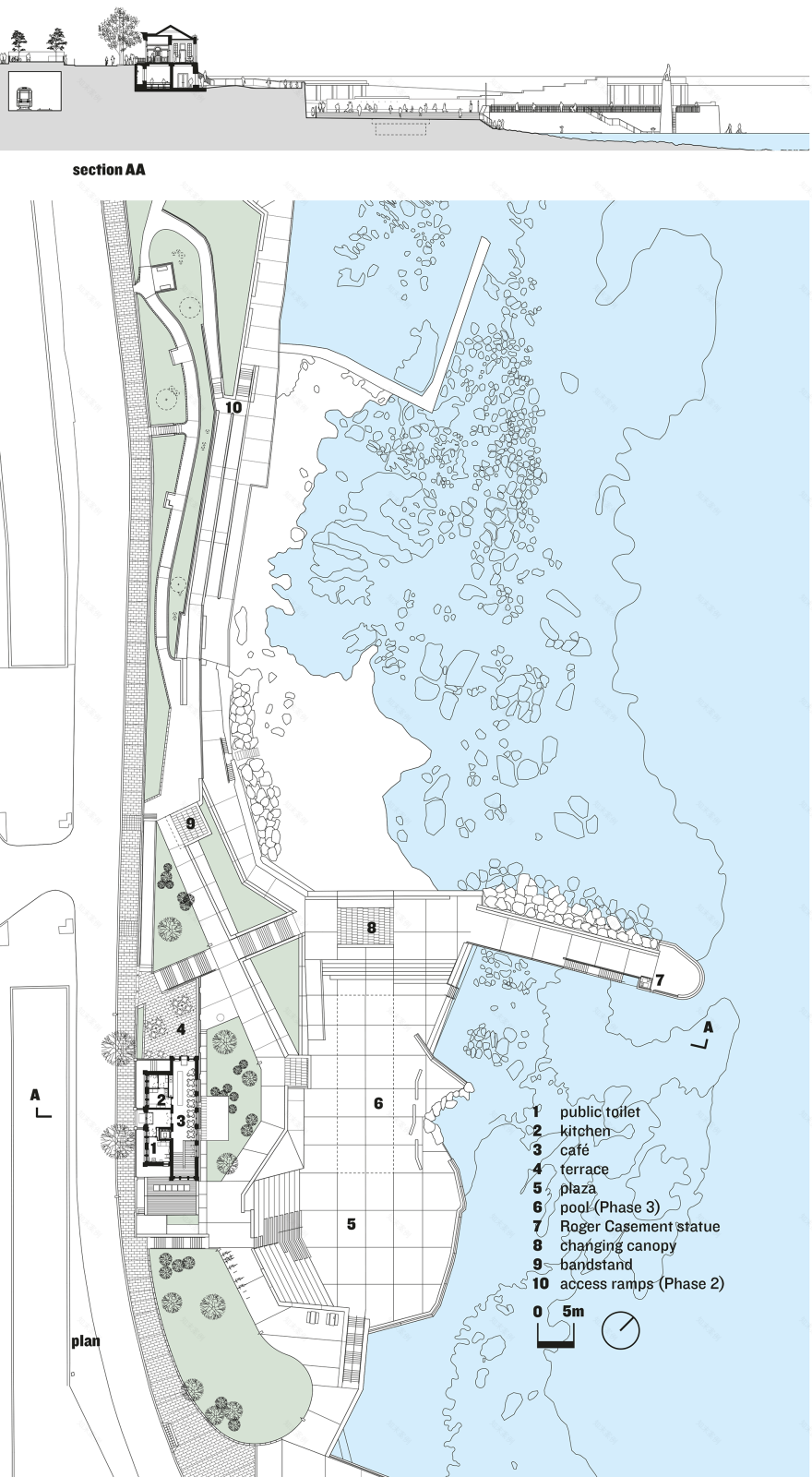
The first phase involved a major scheme on what Peter Carroll of A2 Architects describes as ‘a restricted and challenging site’ that drops down 9 metres from the street to the sea and is arranged across three levels to include a café, artists’ studios, a promenade, a bandstand, a plaza, outdoor changing facilities, a jetty and new access points to the sea. The project’s publicness is unimpeachable. Other than the café’s business hours, the entire site is always open, and even the café terrace is in use in the evenings for contemplative gazing across the water. A strong motivation is to remove barriers to the sea, which although visually present in the town has long seemed out of reach due to the challenging terrain and lack of ingress points. In that spirit, the second phase opens this summer and involves an accessible pedestrian route extending west from the bandstand to the east pier to allow users to travel closely parallel to the water.
The major architectural element is a pert white Edwardian building entered from Queen’s Road. Encountered firstly as a single‑storey pavilion, the café is one of the few indoor seaward spaces in Dún Laoghaire; a large‑scale staircase vestibule leads down to the artists’ studios and a potential exhibition space. This was the original entrance to the complex that accreted various additions over time. As architectural historian Candace White says, ‘the front elevation represented the earlier, spa typology while the rear expressed the new visual identity of mass leisure’.

Originally opened in 1843, the sea baths in Dún Laoghaire were rebuilt between 1905 and 1911
More than a century of changing cultures of bathing and swimming are indicated by the different cycles Dún Laoghaire Baths have been through. An official swimming site since at least the 1840s, the Edwardian version was focused on health and therapeutic relaxation, with the classical (Tuscan) exterior leading to decorous panelled interiors and a series of treatment rooms. During the post‑independence period in Ireland, from 1922, arguments for building lido‑style baths focused on athleticism, leisure and the necessity for improving the ‘national body’ that included a whisper of racial, as well as actual, hygiene. At Dún Laoghaire, this saw the building of a large outdoor pool as well as smaller children’s pools on the site, with a (now restored) terrazzo ‘BATHS’ mat at the entrance; similar if less elaborate baths were constructed or redeveloped around the Irish coast. With the building of indoor swimming pools in the 1960s and ’70s, unheated outdoor bathing became less popular, although Dún Laoghaire Baths remained open. The final use of the pavilion building before its decline into dereliction was as ‘Rainbow Rapids’, a set of ungainly plastic waterslides that opened in the mid‑1980s before the entire facility closed in 1997.
Having lain empty, and slowly rotting, a strong impetus for public interest in the restoration and redesign of the site was furious opposition to a proposal to develop it as a hotel in 2003. That was at the height of the ‘Celtic Tiger’ economic boom and the attendant privatisation and shrinkage of public spaces. In the context of a new urban framework plan and with the input of public representatives, DLR decided to bring the site into full public ownership and use; they took the new scheme to planning stage, and then appointed A2 through competitive tender to bring the project through the detail design and construction stage. The lengthy planning period saw the growing popularity of wild swimming in Ireland, and this more primary encounter with the water is reflected in the new design. While earlier coastal structures and street furnishings tended to use light‑hearted ‘resort’ colours and materials such as cyan blue and stucco, the architects’ palette of olive‑green and concrete speaks to a more elemental connection between the body and the sea.

After witnessing a few iterations, the site closed down in 1997, lying abandoned until Dún Laoghaire‑Rathdown (DLR) Architects Department and A2 Architects granted it a new lease of public life
In the café’s fine entrance lobby, the concrete floor incorporates fragments of oyster shell, and the concrete of the plaza seating, shelter and jetty receives different and increasingly robust treatments. Carroll explains that the aggregate includes granite from Dalkey Quarry a few kilometres away ‘to lighten its materiality when exposed’, and in reference to the material used for the two piers. The exposed finish of the concrete gives it a warmer colour than is typical and its treatment is deeply considerate of the user, with the tops of the walls where people lean polished ‘almost like a terrazzo’, the walls where swimmers are most likely to sit at a height so their ears are sheltered from the wind, and benches smoothed and rounded to protect bare legs.
Built on the footprint of the original baths, the expansive concrete plaza has no ostensible programme other than offering access to the sea, yet the wide steps leading to it provide amphitheatre seating, and a long low bench is built into the far sea side, looking out to where Dublin Bay itself puts on a show. When discussing the design with DLR county architect Andrée Dargan, she says the plaza was ‘almost incidental to the original brief’, which stressed the significance of creating the new lateral route. There have been occasional concerts here, but the space is also used by an ad hoc yoga group, roller‑skaters and sunbathers, with the high wall between the different levels thoughtfully faceted to reflect as much light and warmth as possible onto the north‑facing plaza.

The plaza’s western edge provides a changing shelter with a concrete canopy in an echo of beloved municipal shelters on the other side of Dublin Bay, and a jetty leads further out across the water. This is abutted by a tall concrete plinth topped by a bronze sculpture by Mark Richards of Roger Casement (1864–1916), the diplomat, humanitarian and martyred Irish nationalist who was born close by. The statue’s colour and verticality creates a welcome visual terminal in what is essentially a pale infrastructural landscape.
‘Walls are at a height to shelter swimmers’ ears, with benches smoothed and rounded to protect bare legs’
With the sea itself a turbulent and challenging material, seafronts are deeply demanding environments to design and build for. After almost a century of briny spray and soakage seriously degraded their steel and concrete, there was no way Dún Laoghaire’s 1930s pools could be restored. The wildness of the waves instead necessitated complex geotechnics to create a breakwater. Carroll explains the original showers were ‘taken by the sea’ and a ‘programme of repair’ has been part of the work; the railings around the jetty are already encrusted with salt, but will be repainted every year. He feels deep responsibility for the future publicness of the site, wanting it to be ‘part of quotidian life, almost disappearing into its context so anyone and everyone can use it’. This will be achieved partly through the Scots pine trees and other resilient vegetation planted around the site that, as they grow, will see the angles and concrete softened over time.
Attitudes to the new public space have warmed up considerably since its opening. Calling it a ‘roaring success’, a resident describes how the site has been animated by a variety of uses due to its openness and direct physical relationship with the water. In this, the intervention needs to be seen in the context of the council’s work over the past decade in creating new spaces that encourage people along traversal routes from the main shopping area down to the coast in an echo of their motto ‘from the mountains to the sea’. As May turns to June and the weather gets a little sunnier, the place is now intensely activated by swimmers, readers, socialisers and long lunchtime queues along the pavement outside the café. As the second phase of the project connects up Dún Laoghaire’s coastal spaces, the identity and history of this maritime town will be more fully articulated and its natural environment made more useful for the public, and the publics to come.
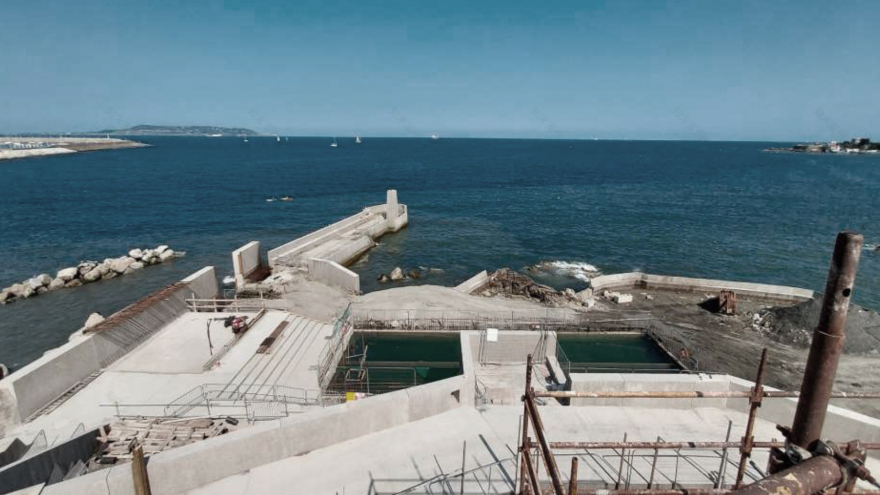
Below its concrete surface lies a 3m-deep sea-water pool, visible here during construction (below). The architects are eagerly awaiting the day when it will be uncapped
南京喵熊网络科技有限公司 苏ICP备18050492号-4知末 © 2018—2020 . All photos and trademark graphics are copyrighted by their owners.增值电信业务经营许可证(ICP)苏B2-20201444 苏公网安备 32011302321234号
苏公网安备 32011302321234号客服
消息
收藏
下载
最近