

创作上传
VIP
收藏下载
登录 | 注册有礼
查看完整案例

收藏

下载

分享

Margot Krasojević Architecture
London, GB

Qanat windcatcher hotel, Makran
The hotel’s
location is
Makran,
a
semi-desert coastal strip stretched along with south-eastern Iran to
Pakistan’s Baluchistan and borders the coasts of the Persian Gulf
and Sea of Oman. It is home to the strategic critical port of
Chabahar that sits in the vicinity.
The hotel will
make use of an existing yet currently redundant qanat, with the aim
to repurpose it as part of the hotel’s infrastructure.
This hotel
project is an eco-tourism resort that focuses on the context's
environmental conditions using this to inform the design process and
the architectural strategy. The main considerations are that of using
wind, heat, and aquifers to design a modern wind tower and Qanat
system, referencing the traditional Persian construction methods to
cool and ventilate desert buildings by circulating and recycling warm
arid desert air. The hotel appeals to the ecologically and socially
conscious individuals where the primary attractions are cultural
heritage, social, economic and environmental needs that are
prioritised to ensure sustainable development.
Ecotourism
prioritises programs that reduce the negative conditions of
conventional tourism and its effects on the environment by
encouraging and integrating the cultural integrity of local people.
Recycling, renewable energy and sustainability establishes economic
opportunities for local communities by using architecture to define
and introduce new cross-programmatic typologies.
Due to the
desert’s arid environment, we identified and used four areas of
direction as part of the design criteria, which include windcatcher
towers for ventilation and to assist evaporative cooling, solar
collectors for high to low-frequency radiation conversion, and a
Qanat infrastructure to further service agricultural irrigation
efforts and building interior cooling methods.
The hotel
provides shelter as well as a hospitable environment in a varied and
environmentally unpredictable landscape. The temperature fluctuations
and environmental diversity make it a challenge to survive
comfortably, which led us to refer to ancient Persian technological
methods of survival using aquifers and water wells to transport water
across the desert, introducing water as fountains and interior pools
in the hotel’s atrium and subterrain, which would use evaporative
cooling to lower the temperature throughout the desert hotel.
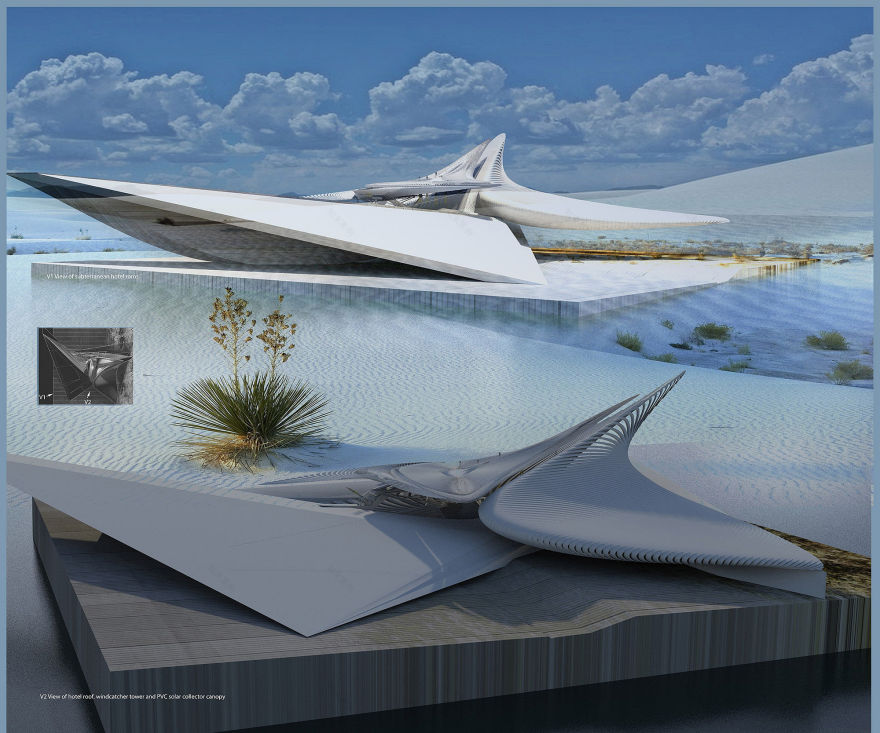
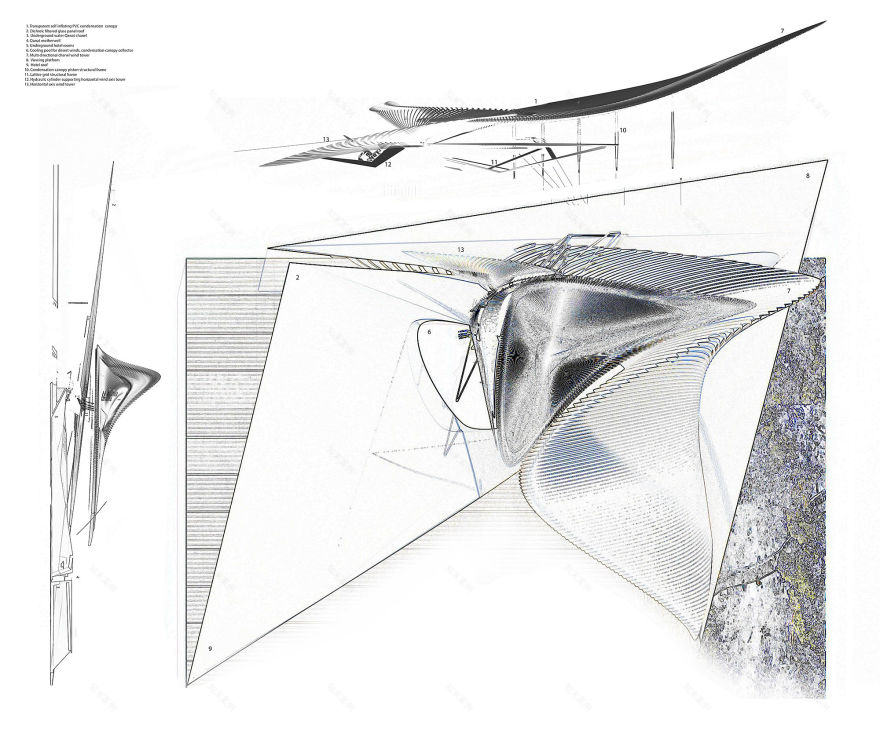
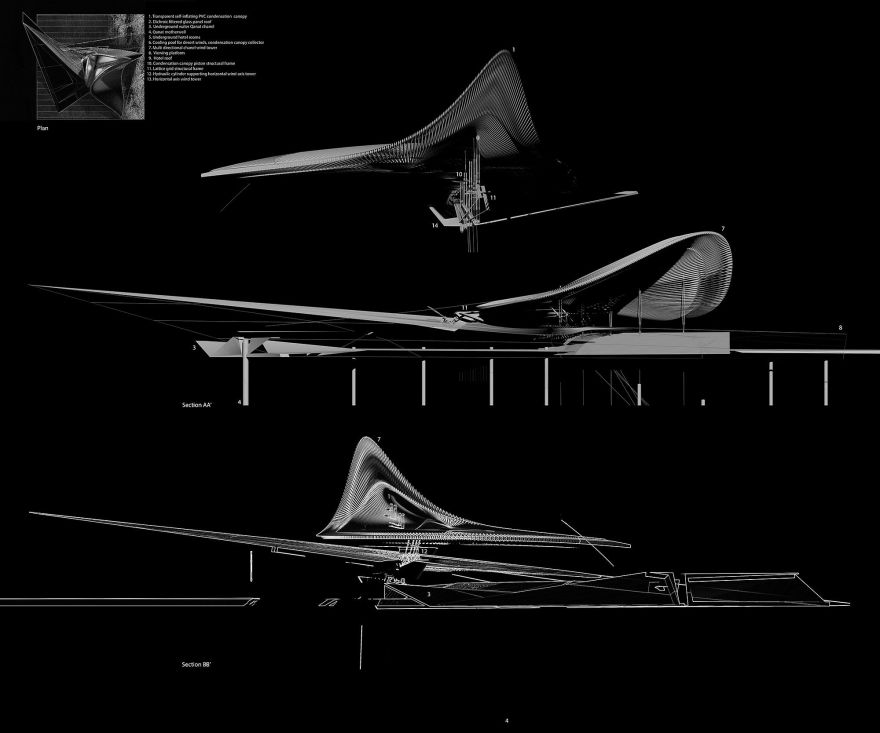
The striated
towers rise tall above the cooler desert floor catching warm air and
transporting it into the hotel's lower ground floor, which cools the
air as it passes over pools of water using evaporative cooling. A PVC
solar collector canopy is suspended over one of the hotel’s atrium
pools made from PVC the complex cylindrical sections that have a
reflective inner surface. This allows for the canopy to rise higher
above the desert floor, in turn collecting condensation. This
condensation is then released into the evaporation pool below it
whilst transforming high-frequency radiation into low, i.e., light
energy from solar turns into heat, which expands the air trapped in
the PVC solar collector making it rise from the ground to provide
shelter from the sun and generate electrical currents using
photovoltaic cells and piezoelectric cells. The lower ground hotel
vaults ventilation system is controlled/directed by the PVC canopy
and the windcatcher towers above ground. The pneumatic PVC canopy
rises and falls in the process, channelling the wind throughout the
hotel. The canopy can also be choreographed by the wind tower which
collects condensation from the desert air, filling the underground
reservoir and pools to aid with evaporative cooling in the hotel's
atrium, whilst the windcatcher tower is clad in striated flexible
aluminium and
GFRP
(glass fiber reinforced panels)
material
in order to capture multi-directional wind flow.
The design
also uses an ancient Persian water supply system called a Qanat.
Qanats are a series of
well-like
vertical
shafts, connected by a gently sloping tunnel delivering water
efficiently over large amounts of subterranean water to the ground
surface without the need for pumping. The water drains by gravity,
typically from an upland aquifer, with the destination lower than the
source. Qanats transport water over long distances in hot dry
climates without much evaporative water loss, making desert
cultivation achievable. The intention of this project is to
programmatically support by being a part of the irrigation and
ecological infrastructure in Makran. The qanat system is economical
and sustainable for irrigation and agricultural purposes. The hotel
is located on the route of an existing yet redundant qanat with the
aim to restore its efficiency and use, enabling the immediate
environmental context to become agricultural land whilst also flowing
underneath the hotel, which further cools and ventilates warm desert
air directed into the lower area of the hotel by the windcatcher
tower. A qanat can traverse long distances, reaching less populated
areas, and the hotel encourages this by distributing water throughout
its own qanat premises with channels travelling further into the
desert with the aim to provide more agricultural settlements in more
remote areas. This has an urban scale impact, by comparison, to
solely satisfying its immediate context and hotel programme.
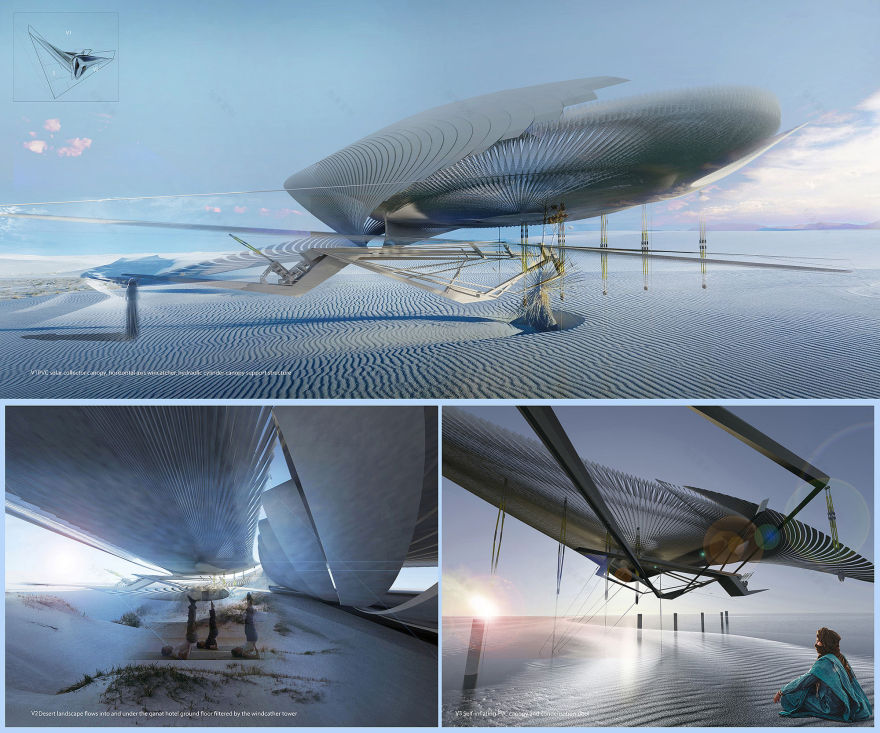
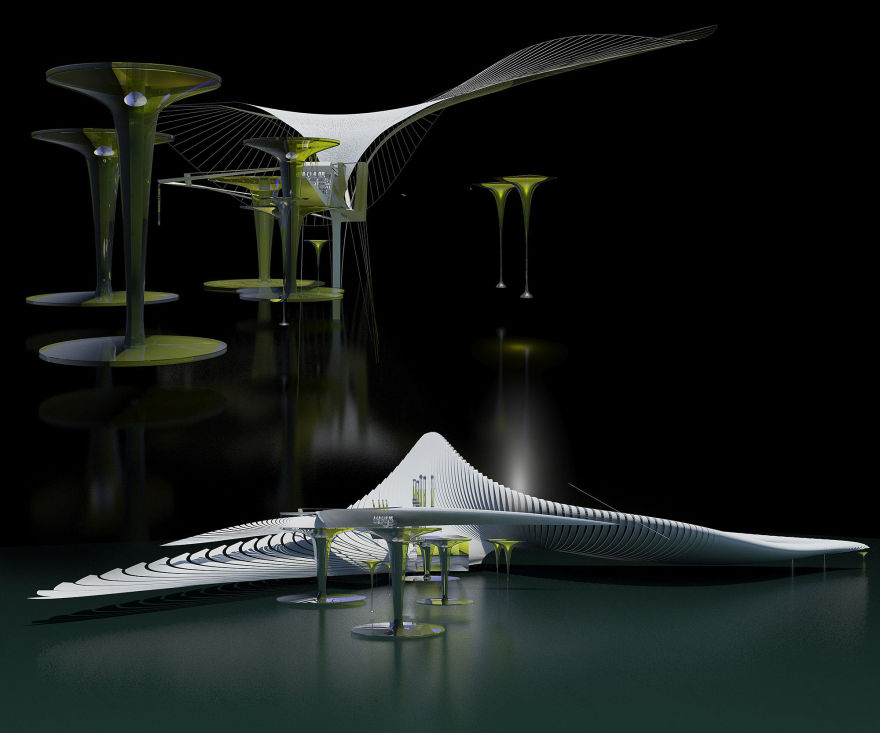
The employment
of solar energy is a logical response to the brief due to the hotel's
location. We designed a geometrically complex transparent PVC solar
collector canopy made from a series of cylindrical collectors (with
reference and great respect to architect Graham Stevens and his
desert cloud design for Kuwait in 1976) in order to increase surface
area to more efficiently absorb and convert light energy into heat.
The inner surface of the PVC solar collector canopy is lined with
highly reflective silver metalised polyester to increase the amount
of absorbed light energy, and in turn, its conversion into heat
within the canopy, prompting the canopy to elevate rising above the
desert and trapping condensation, which is filtered into the atrium
pool beneath it as well as harnessing more solar energy to convert
into electricity using photovoltaics and piezoelectric cells embedded
within the canopy. The design is influenced by tent structures used
by desert nomads as well as semiconductors and current technological
advances in micro conductors.
The canopy is
tethered to the ground yet gently drifts and shifts in the current,
supported by hydraulic cylinders acting as stanchions since they move
with the pressure exerted by the canopy's internal pressure and
temperature.
The hotel
rooms are partly buried in the desert and open to the vaulted
underground atriums. Natural light enters through the punctured roof,
which is a viewing platform, and gathering space is positioned around
the floating canopy. Long corridors pass cooled air through them,
creating cooler temperatures and shelter from the harsh desert sun.
The qanat runs underneath the hotel room with well like openings
dotted around the corridors. This is one of the hotels that features
seeing the water drift gently through the desert subterrain.
Status:
Under Construction
Location:
Makran, IR
My Role:
Principal architect






南京喵熊网络科技有限公司 苏ICP备18050492号-4知末 © 2018—2020 . All photos and trademark graphics are copyrighted by their owners.增值电信业务经营许可证(ICP)苏B2-20201444 苏公网安备 32011302321234号
苏公网安备 32011302321234号客服
消息
收藏
下载
最近