

创作上传
VIP
收藏下载
登录 | 注册有礼
查看完整案例

收藏

下载

分享
ETH Zurich’s 3D printed sculpture oscillates between ‘opaque boundary’ and ‘transparent curtain’

Niall Patrick Walsh
ETH Zurich
has unveiled a 6.5-foot-tall lightweight shell fabricated from
3D printing
.
Named 'Fluid Forms,' and created by the institution’s Digital Building Technologies group, the structure seeks to showcase “an innovative
robotic
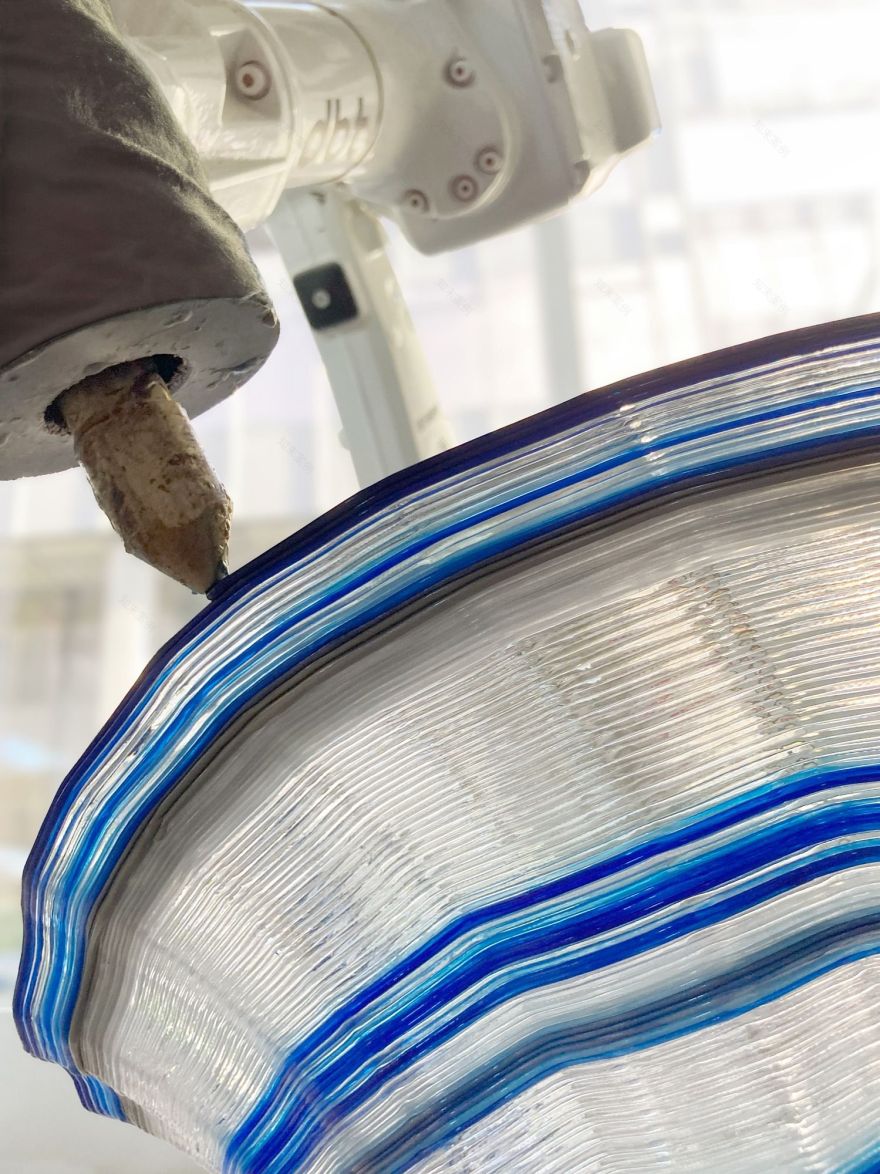
additive manufacturing method that enables the printing of doubly curved thin shells more efficiently.”
The design of Fluid Forms was inspired by the Costa minimal surface, which belongs to a family of shapes that minimize area for a given boundary, resulting in a geometry with strong structural properties. In contrast to horizontal plane printing, the fabrication process sees the print paths align to principal curvature directions, which, according to the team, reduces the need for external support and enhances the precision and surface quality of the curved surface.

“The print path orientation is controlled through a vector-field optimization method that has been fine-tuned for the specific needs and constraints of non-planar 3D printing,” the group explains. “To increase the rigidity of the structure, undulations are introduced that are orthogonal to the print direction. The prototype is put together using a dry-assembly method that facilitates easy disassembly for recycling after the project's lifetime.”
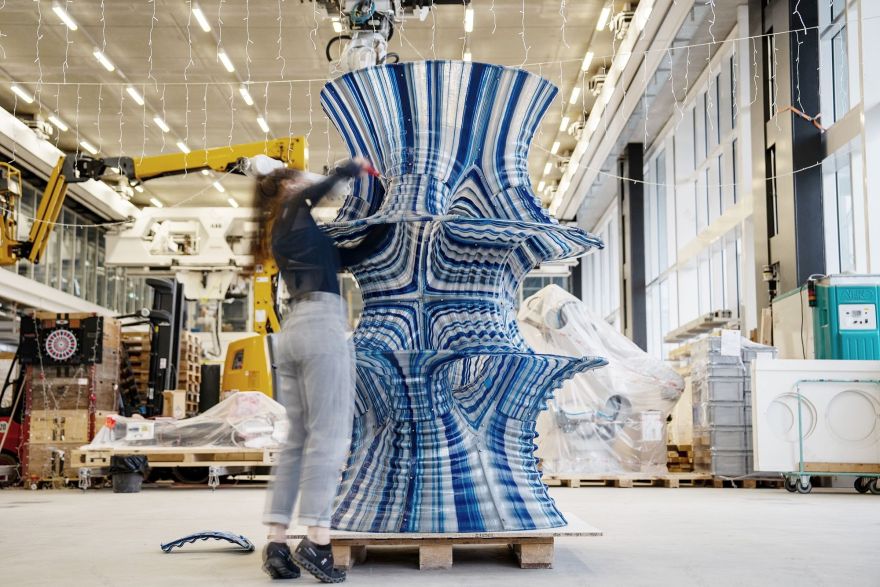

The structure’s 40 3D printed components are held together using screws, with the 3D printing
material
itself consisting of translucent PETG plastic intermixed with blue and silver colors at varying ratios. The project was delivered in three weeks, with a total of 140 hours of machining time.

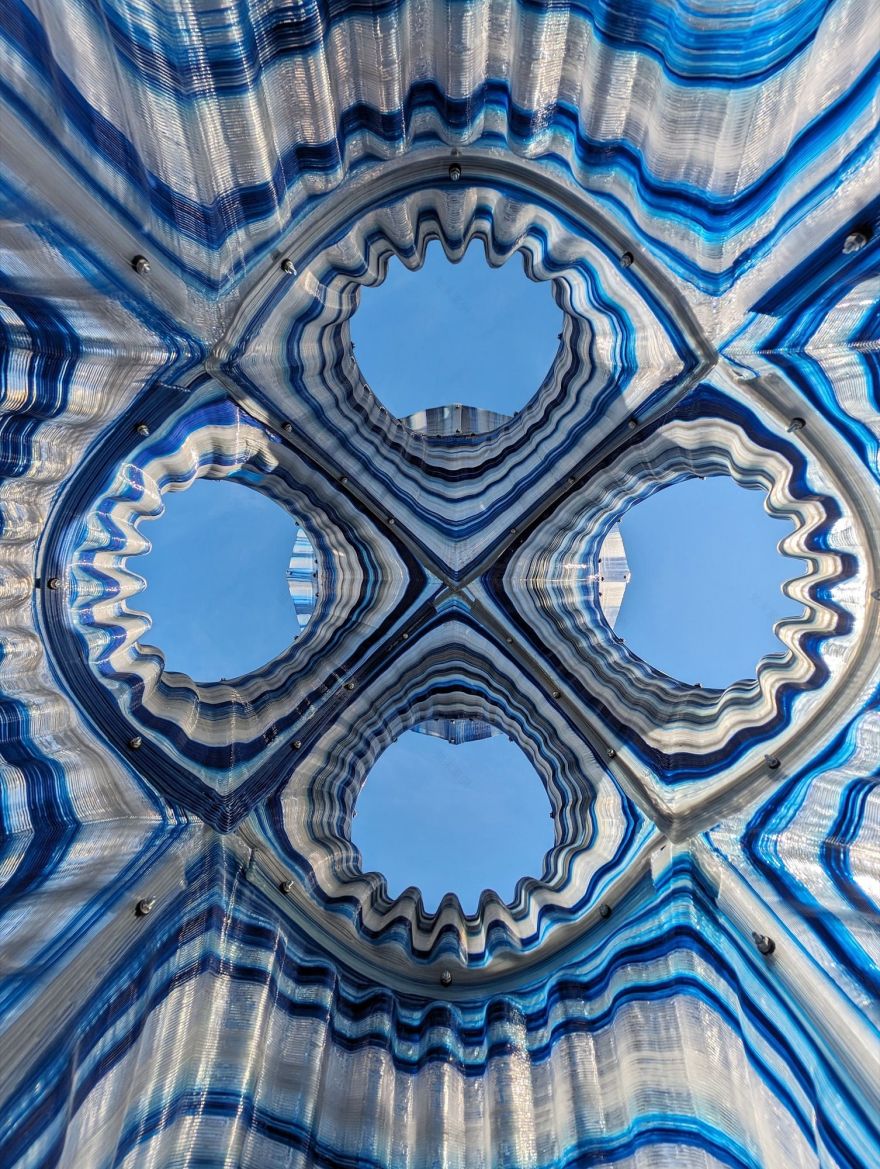
“The shape allows surprising look-throughs while walking around, at times taking the role of an opaque boundary and at times of a transparent curtain,” the group adds. “With this, it gives an outlook on an architecture that blurs boundaries between inside and outside and is full of colors and surprises.”

The sculpture represents the latest in a series of recent 3D printing developments. Earlier this week, ICON unveiled a
suite of 3D printing innovations
, including a new multi-story printer, while last week, ecoLogicStudio unveiled a
collection of biophilic design products
, including a 3D printed compostable stool.


In February, production began on the
world’s tallest 3D printed structure
while researchers at Chalmers University in Sweden
used cellulose and algae
to create a 3D printed architectural material. In January, meanwhile, Holcim and Zaha Hadid Architects debuted their
second 3D printed concrete bridge
concept.


南京喵熊网络科技有限公司 苏ICP备18050492号-4知末 © 2018—2020 . All photos and trademark graphics are copyrighted by their owners.增值电信业务经营许可证(ICP)苏B2-20201444 苏公网安备 32011302321234号
苏公网安备 32011302321234号客服
消息
收藏
下载
最近