

创作上传
VIP
收藏下载
登录 | 注册有礼
查看完整案例

收藏

下载

分享
Taking the plunge: Designing urban swimming sites
words: Simon Lloyd
Urban river swimming has taken off overseas, and now Australia is following suit. With water quality a key concern, can we navigate the health risks through design?
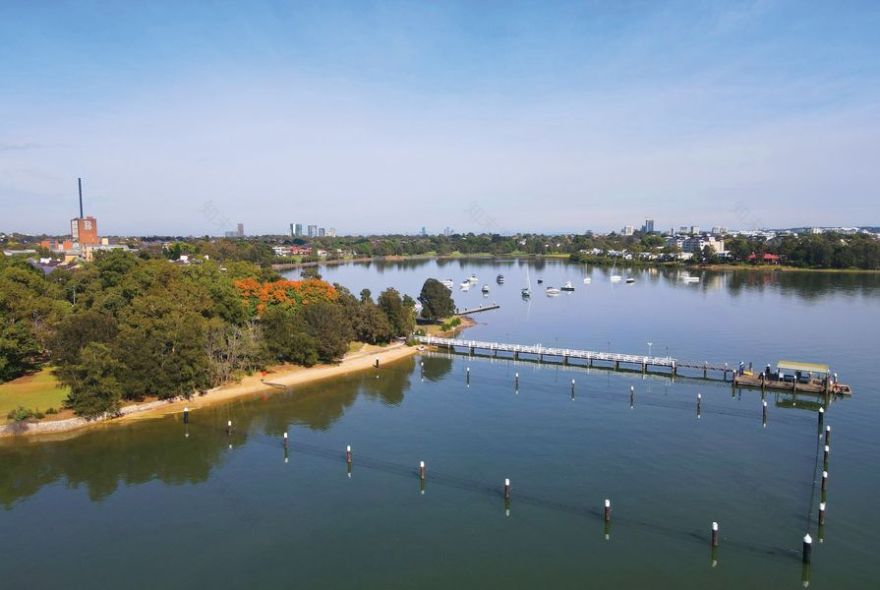
The Riverwatch model provides live water quality information to the public and was used to support the opening of the Bayview Park swimming site in Concord, New South Wales. Image: courtesy City of Canada Bay
Increasingly, cities are reclaiming rivers and unlocking their potential as places for urban cooling, ecological enhancement and water-based recreation including river swimming. Safeguarding public health in this pursuit is a priority, and as landscape architects we must navigate the public health risks associated with the design of urban river swimming sites.
Microbial water quality is the primary indicator of health risk and microbial water quality assessments are a critical starting point for urban swimming initiatives globally.
Health risks in the Parramatta River estuary
The primary source of acute health risk to people bathing in the Parramatta River comes from domestic sewage entering the stormwater network via leaking infrastructure and designed sewer overflows. Unlike coastal bathing sites, where ocean currents and wave energy provide natural “flushing” of microbial contamination, estuarine sites are often more vulnerable to local accumulation.
The central and upper parts of the Parramatta estuary are salt-dominated during dry weather and become freshwater (stormwater) dominated during heavy rain. This variable water exchange means that microbial water quality and health risks can fluctuate significantly between sites, even when they are close to one another. Current practices classify health risks retrospectively using extreme percentiles taken from water quality data collected weekly for one or more swimming seasons. This captures the risks of worst-case scenarios but overlooks the significant number of days when the estuary is safe for swimming. In addition, it currently takes 18 to 24 hours to sample, measure and report water quality conditions, which means the public may only be notified of hazardous conditions after the event.

At Callan Park on the Parramatta River, a proposed deep-water swimming site is located further out from the shoreline to avoid contaminated sediment.
Image: Concept design and image by Civille.
Communicating water quality in real-time
The Riverwatch model developed for the Parramatta River estuary provides live water quality information to the public, helping users determine when and where to access the river safely.
It supported the opening of the Bayview Park swimming site in November 2022, a location with water quality comparable to Warrane/Sydney’s coastal beaches for most of the year. To improve community awareness of health risks related to water quality, we need to integrate live water quality information into site design, as has been done in the wayfinding and digital signage project at Mission Bay, New Zealand.
3
A “graphical” model underpins the Riverwatch output, describing relationships between catchment characteristics, weather conditions and water quality. These models make clear the cause-effect relationships in environmental systems, presenting them in a way that is easy to understand. Based on empirical data, they are powerful tools for assessing the feasibility of design interventions in such systems. By integrating cause-effect and risk-based modelling into our design processes, we can better advocate for interventions that align with public health standards.
4
This integrated approach can help us to engage stakeholders with evidence-based decision-making.
Mitigating water quality risks
Cities are increasingly turning to nature-based technologies to improve waterway health. It is well recognised that nature-based treatment solutions need to be applied at the catchment scale to have any meaningful effect on water quality downstream. However, even when the majority of catchment run-off is intercepted and treated, recreational water quality downstream may not meet regulatory standards.
5
In-situ systems like floating treatment wetlands, riparian buffers, or “offline” natural pools that are not directly connected to the main waterway can provide an intermediate option at the scale of individual swimming sites.
Offline natural pools and floating vegetative systems have been proposed for waterways where in-river bathing may not be feasible.
6
Some cities have successfully implemented these systems, offering recreational opportunities such as the Naturbad Maria Einsiedel adjacent to the Isar River in Munich, the temporary public natural pool in Kings Cross, London, and the Wild Mile “eco-park” in the Chicago River, Chicago. The challenge with these systems from a recreational water quality perspective lies in properly understanding the extent to which they can remove harmful microbes.
Similar treatment technologies such as stormwater biofilters, constructed wetlands, green roofs, and green walls have been shown to both reduce but sometimes increase microbial contaminants in stormwater. 7 This dual effect makes their role in mitigating microbial health risks in rivers complex and challenging. Full-scale pilots like the floating wetlands in the Birrarung, Naarm/Melbourne, and the Wild Mile in the Chicago River, provide an opportunity to implement microbial monitoring programs that could reveal whether localised areas within urban river swimming sites can buffer microbial contaminants and thus provide “safer” places to swim. Data for in-river systems like these are needed in global databases to enable the integration of nature-based design interventions into modelling tools like the Riverwatch model. This will help assess the potential to mitigate risks at the scale of individual swimming sites.

A general concept for an “offline” natural pool designed by London-based architecture practice Studio Octopi for Sydney Water.
Image: Studio Octopi

Full-scale pilots like the floating wetlands in the Birrarung, Naarm/Melbourne and the Wild Mile “eco-park” in the Chicago River (pictured here) provide an opportunity to implement microbial monitoring programs. Image: Biomatrix Water Solutions
Designing for health risks and health benefits
To support the reactivation of urban waterways while safeguarding public health, we need to move towards real-time water quality monitoring and design interventions that address the specific locations and levels of contaminants in the river at any given time.
Adaptive management strategies, like those used for the swimming events held in the Seine during the Paris 2024 Olympics, can also be folded into the design and management of these sites, to open or close them based on real-time data.
Urban cooling through water-based recreation is increasingly recognised as a public health mechanism. By leveraging real-time data and accessible modelling techniques, we can better integrate both public health concerns and benefits into our design and planning.
2.The Riverwatch model was developed through a collaborative effort between Sydney Water and UNSW, as part of the author’s PhD dissertation.
3.Jesse Allpress (Research and Evaluation Unit, Auckland Council), “‘Nudging’ visitors to notice Safeswim signs,”
4.McGregor Coxall,
5.Jordan Wolfand et al, “Multiple Pathways to Bacterial Load Reduction by Stormwater Best Management Practices: Trade-Offs in Performance, Volume, and Treated Area,” 2018, in
6.Studio Octopi et al,
7.Simon Lloyd et al,

The Riverwatch model provides live water quality information to the public and was used to support the opening of the Bayview Park swimming site in Concord, New South Wales. Image: courtesy City of Canada Bay
At Callan Park on the Parramatta River, a proposed deep-water swimming site is located further out from the shoreline to avoid contaminated sediment. Image: Concept design and image by Civille.
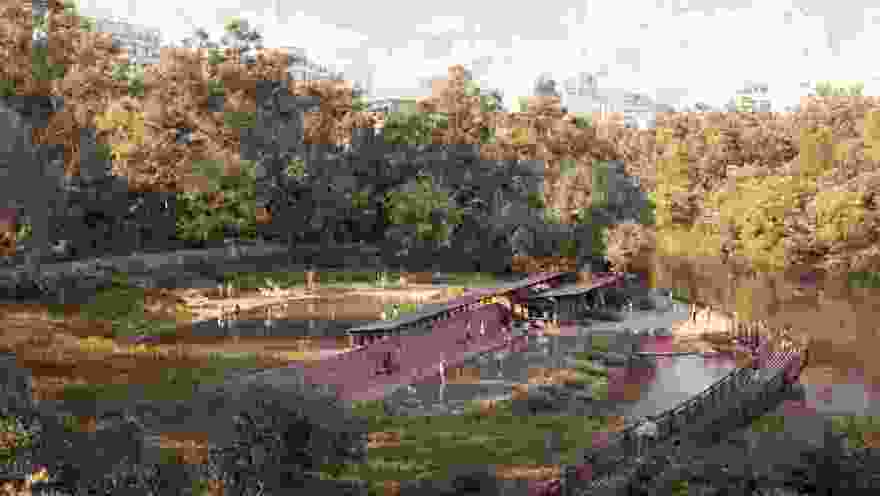
A general concept for an “offline” natural pool designed by London-based architecture practice Studio Octopi for Sydney Water. Image: Studio Octopi
Full-scale pilots like the floating wetlands in the Birrarung, Naarm/Melbourne and the Wild Mile “eco-park” in the Chicago River (pictured here) provide an opportunity to implement microbial monitoring programs. Image: Biomatrix Water Solutions
南京喵熊网络科技有限公司 苏ICP备18050492号-4知末 © 2018—2020 . All photos and trademark graphics are copyrighted by their owners.增值电信业务经营许可证(ICP)苏B2-20201444 苏公网安备 32011302321234号
苏公网安备 32011302321234号客服
消息
收藏
下载
最近