

创作上传
VIP
收藏下载
登录 | 注册有礼
查看完整案例

收藏

下载

分享
Cheré Botha School in Cape Town, South Africa by Wolff Architects

The distinctive silhouette of the Cheré Botha School by Wolff Architects reflects the internal structures, including the generous multipurpose corridors, which double as communal extensions to classrooms

It forms a landmark in the Bellville suburb of Cape Town, making a bold statement that public educational buildings should be a prominent feature of the urban fabric

A calm, consistent environment is crucial in spaces for neurodivergent students who may be sensitive to harsh light and loud noises. Indirect light filters into classrooms through a baffled skylight, and a custom pinboard which lines the wall is acoustically dampening
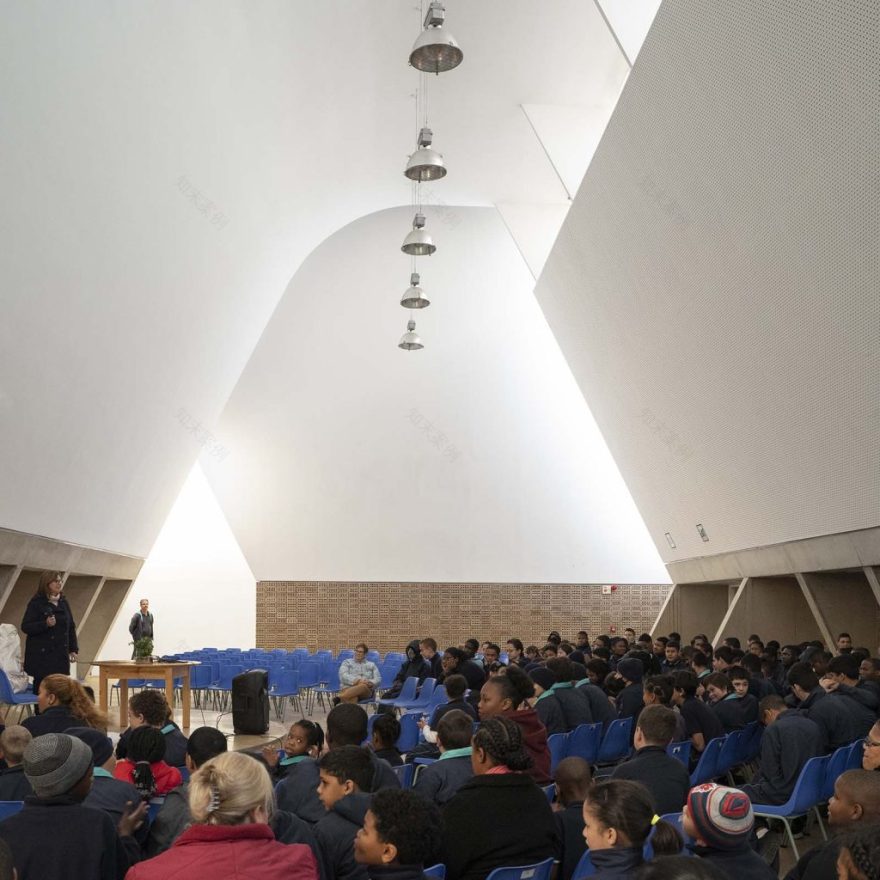
At the heart of the plan is the hall, where students, staff and parents gather in a semi-circle, rather than the typical, more linear stage set-up. Noise is dampened by panels in the soaring ceiling as well as the perforated brickwork, and diffuse light pours in through a skylight in the roof

The graceful curves of the interior contrast with the angles expressed externally

A central court allows
for the safe and controlled arrival and pick-up of students. Protruding eaves provide shade and shelter from the elements, and benches are a welcome place to sit and wait
Wolff Architects’ Cheré Botha School in Cape Town proves that a nurturing educational architecture for neurodivergent children is possible
(1994), bell hooks writes of the classroom as a place of opportunity and possibility. For hooks, education is central to the possibility of a more just world: when she writes that ‘the classroom remains the most radical space of possibility’, she provokes us to ask how inclusive teaching practices might translate into inclusive architectures. How could the architecture of pedagogy and curricula extend, or be reflected in, architectural practice and the research it is grounded in? In the context of educational buildings, how could a practice of design and engagement that ‘offers the space for change, invention, spontaneous shifts’ serve as a catalyst for radical possibility?
An architecture of inclusive educational spaces for neurodivergent learners is made possible at the Cheré Botha School through Wolff Architects’ approach to architectural practice, grounded in an ethos and practice of care. It is evident on first approach that this school is unique: unlike typical school buildings common throughout South Africa, the Cheré Botha School stands out amid the neat low-rise suburban houses of Bellville, an area east of the city of Cape Town, with an undulating profile which echoes the imposing Drakenstein mountains in the distance.
The building was commissioned by the Western Cape Provincial Government in 2017, as a new facility for an existing school. The school was established in 1981 by two parents whose child had Down’s syndrome, and who realised from their own experience
the limits of existing facilities for support. They identified a need in the community for a school which could provide educational support for neurodivergent children, along with guidance for parents and carers – which they understood to be integral. The end of apartheid in the 1990s meant that the school became more inclusive in multiple ways, serving greater and more diverse populations demographically, and with more divergent needs, as it opened to children on the autism spectrum too.

The architecture is defined by a series of collective outdoor and covered spaces, set around a large oval drop-off and pick-up zone. The arrival court enables a safe and controlled pick-up area and is in some ways the anchor point around which the six blocks of the school are structured. The central hall is the main focal point, situated at the end of the arrival court amid the jagged sculptural volumes of the workshops and kitchen. The multipurpose rectangular space has a triangular section sculpted into a series of soft, graceful curves which are broken at the peak to allow in light and enable ventilation.
The soft, consistent lighting and dampened sound result in a calm and almost monastic space; one side of the ceiling is clad in a perforated gypsum board, lined with sound insulation, which also lines the perforated blockwork walls. Autism can often lead to a hypersensitivity to bright, harsh light and loud sounds, and the attention to lighting and acoustics was essential to maintaining a calm environment.
In a distinct move to disrupt the rigidity that characterises South African education systems, in the hall the architects refocus the attention from a hierarchical linear assembly orientation to a semi‑circular gathering around a central stage. The result is a graceful centrepiece to the school that exemplifies the importance of dignified and special spaces for learning for all.
‘The architects have created a recognisable feature in the landscape: a suggestion that public buildings such as schools should be prominent landmarks’
The classrooms are both the mundane constituents of a school and central to where learning takes place. As Wolff Architects note, the precedent for special education schools in South Africa is a series of classrooms along an enclosed corridor; at this school, the ‘corridor’ has been pulled apart, creating a wider, semi-external thoroughfare for each classroom block. This space is sheltered by large A-frame timber structures which define the school’s exterior profile. In a context of strong winds throughout the year, and heavy winter rains, these courts are important sheltered play spaces, in addition to becoming extensions of indoor learning areas.
The timber frames are infilled with alternate polycarbonate panels, which diffuse light to minimise glare, and wood-wool insulated panels, which dampen the acoustics to reduce echo. These wide multiuse thoroughfares have soft surfaces for younger children, while those for older learners include vocational training facilities that allow classroom learning to extend out. The banking of classrooms into age groupings provides collective shared space beyond individual classrooms while allowing more effective care and behavioural management.
The classrooms set around these sheltered thoroughfares also carefully consider the needs of the children. The classrooms are simple, with muted colours to reduce potential sensory overload, and a standardised material palette. A skylight along the length of the classroom wings brings in natural light, which is softened and diffused by a series of fins. For days when it is needed, artificial lighting is placed out of view of learners near the skylight, and above a light shelf at the other end of the classroom, with the result that lighting is always indirect to limit glare. The party walls between classrooms are dressed in an extended custom pinboard, adding acoustic dampening and accentuating the distinctive section. These small adjustments from standard specifications create unique and highly functional classrooms on a tight budget.

The architects’ approach to designing in section is attendant to materials but also form, creating a recognisable feature in the landscape: a suggestion that public buildings such as schools should be prominent landmarks. Wolff Architects, led by Heinrich and Ilze Wolff, is a deeply grounded and relational practice that moves between building, research and pedagogy. In the Cheré Botha School, they embraced the task of working within a tight budget set by the Provincial Government, and the challenge of designing a pedagogical landscape that had to respond to differently abled learners across a diverse spectrum. ‘The main purpose of the design was to ensure that collective space was as important as individual classrooms, that a diversity of collective learning situations would be encouraged as much as focused individual learning,’ note the architects. Non-specific collective spaces are not typically part of school guidelines but were enabled by the simplification and standardisation of the classroom blocks to include these spaces. In the administrative block, these shared spaces accommodate much-needed parent support sessions and other uses.
The educational landscape in South Africa has long been a site of struggle. One of the key demands of the South African Congress Alliance’s 1955 Freedom Charter was the importance of spaces of learning being accessible and open to all. The youth protests in Soweto in 1976 were a foundational moment in South African history, asserting the importance of entangled struggles for freedom and education. These concerns were echoed in the 2015 Rhodes Must Fall/Fees Must Fall protests: part of longer and ongoing struggles for educational justice that have spanned sites and generations. These calls are focused on changes to curricula and pedagogy that are of vital importance, yet they are not distinct from questions concerning spatial justice. The increasingly neoliberal context has proved inadequate in its dispensation of care infrastructures, with funds thinly spread and frequently poorly managed, with many existing infrastructures suffering from breakdown, failure and neglect.
The promise and hope of education as a practice of possibility is central to the Cheré Botha School. Echoing bell hooks, this school calls for a ‘renewal and rejuvenation’ of how architectural practices make public works, to push ‘beyond the boundaries of what is acceptable, so that we can think and rethink, so that we can create new visions’. The architects have crafted unexpectedly beautiful and serene spaces, and stretched the expectations and understandings of what a publicly funded school could be.
There is a cautious sense of optimism in their design responses, proposing an educational architecture for a future that might just be possible.

南京喵熊网络科技有限公司 苏ICP备18050492号-4知末 © 2018—2020 . All photos and trademark graphics are copyrighted by their owners.增值电信业务经营许可证(ICP)苏B2-20201444 苏公网安备 32011302321234号
苏公网安备 32011302321234号客服
消息
收藏
下载
最近