

创作上传
VIP
收藏下载
登录 | 注册有礼
查看完整案例

收藏

下载

分享
Meet The People Shaping A Sustainable Future For Havelis In India
Havelis of Northern India, once icons of opulence, stand as reimagined repositories of legacy, blending colonial influences with classic splendour, showcasing adaptive reuse and sustainable design.
India pompously carries its legacy of rich culture, ancient traditions, and a distinct architectural past willed by majestic palaces—and Havelis that continue to whisper their regal tales. “These gained prominence during the Mughal period but rose to glory and hype during the colonial period,” says Atul Khanna Founder & Curator of Kathika Cultural Centre. As Sarah Tillotson mentions in her book, ‘Indian Mansions: A Social History of the Haveli,’ “These houses, the major building blocks of old Indian towns, are known by many different names, the choice of name varying from district to district; but they are often called as ‘Havelis.’ This word is of uncertain origin with various dictionary definitions, but among the alley of old North Indian towns its use suggests a distinguishable type of inward - looking courtyard house.” However, these capriciously planned multi - storey assemblies have already lived many lives in the country’s, dating back to 3300 BCE during the Indus Valley Civilization.
marvels corralled around massive courtyards with intricately carved facades, elaborate frescoes, delicate jharokhas and mystifying interiors, are steadfast accomplices to the hedonistic lives of affluent merchants, noble families, and royalty. From serving as evidence of India’s cultural heritage to becoming a backdrop for many Indian horror movies, these once - magnificent Havelis now stand weathered with climate changes and the nuisance of tourists. Enter the custodians who etch a slightly different tale on every stone, repurposing the Havelis to house contemporary expressions. DP traces three that now contain contemporary spaces, seamlessly entwining the past and the present.
1. Kathika Haveli: A Cultural Centre In New Delhi
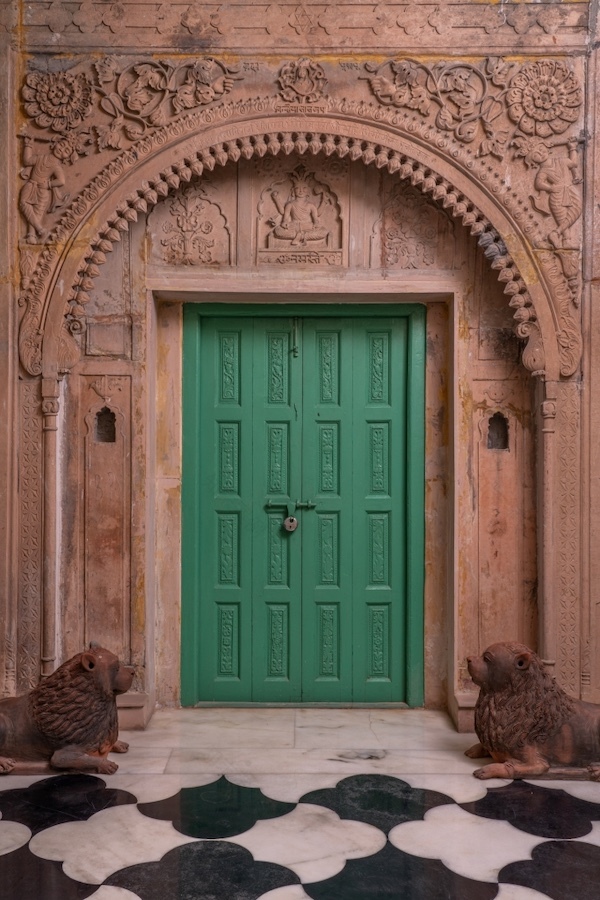
At Kathika Haveli in Delhi, the verdant door with carved arches and frames paired with lion gargoyles borrows references from Islamic culture. (Image Credits: Avesh Gaur)
The compelling, vintage charm of Old Delhi, paired with an article in a local newspaper mentioning the dilapidated conditions of the Havelis there, led Mr Atul Khanna down memory lane, culminating in the restoration of the Kathika Haveli. Nestled in Kucha Pati Ram in Sita Ram Bazaar, this 19th-century Haveli currently functions as a cultural centre with exclusive spaces for performing arts, workshops, screenings, experiences, photography, and heritage ‘baithaks’ (seatings). Having spent his nascent years in a magnificent Old Delhi haveli, Khanna was well acquainted with its rich legacy, simplifying the restoration of the Haveli’s two buildings over an eight-year stint. “The knowledge of Shekhawati Havelis (preserved by Khanna) with the help of traditional masons led to restoration, and establishment of Kathika Cultural Centre,” explains the team. “To make any conserved heritage space sustainable, it is best if they are given adaptive reuse and turned into centres of art and culture,” notes Khanna.

The door with transom windows, chequered flooring and petite collectables tell tales of a bygone era at the Kathika Haveli in Delhi. (Image Credits: Avesh Gaur)
“Heritage structures are vulnerable to unstable architectural or structural integrity,” Khanna reveals. Consequently, this haveli features a single entrance providing access to both buildings, leading to the quintessential architectural element—a central courtyard—surrounded with at the heart, serving as a beacon of natural light and ventilation. “If the architecture of the Havelis is studied closely, one will understand that it has always been smart and sustainable architecture, built in a fashion where a large number of people can be accommodated,” Khanna reiterates. Restoring the Haveli into a cultural centre abets the concept of communal living, sparking conversations and bringing together an eclectic mix of, art enthusiasts and locals. Much like the Havelis of yore, it transcends mere architecture—becoming a hangout space. The deep-rooted sense of community is reflected through various initiatives, notably ‘The Kindness Meal’—a multi-sensory dining experience hosted at the Neem ki Haveli, Kathika Cultural Center and Museum, during the India Art Fair 2025.

The open-to-sky courtyard at the Kathika Haveli, Delhi serves as the heart of the Haveli while dispersing light to every room. (Image Credits: Avesh Gaur)
In collaboration with conservation architects Bhawna Dandona and Aishwarya Tipnis, the intricately carved stone walls, vibrant chandeliers—a recurring component in Delhi’s contemporary style—and chequered century. “Heritage spaces have a long lineage of historical background, which, over the centuries have shaped the cultural of the communities. Any form of structural alteration is often met with resistance by these (local) communities,” Khanna explains. The community’s resistance to changes is dealt with through community engagement through initiatives like the Community Outreach Program and heritage education at Kathika, which fosters local ownership, appreciation, and understanding of the community’s history.
Here, walls adorned with prints, pay homage to the havelis’ tradition of patronage for calendar art—embodying the cultural and past artistic preferences. While sustaining even the smallest details, Khanna adds, “Many heritage Havelis have been replaced by modern structures; frescoes or carvings on the walls, covered with or concrete facades.” This haveli now travels between the past and the present where every detail hums with history, proving that heritage isn’t just something we preserve—it’s something we bring to life even after dilapidation.
Bichli Haveli: A Heritage Resource Center In The Making In Rajasthan
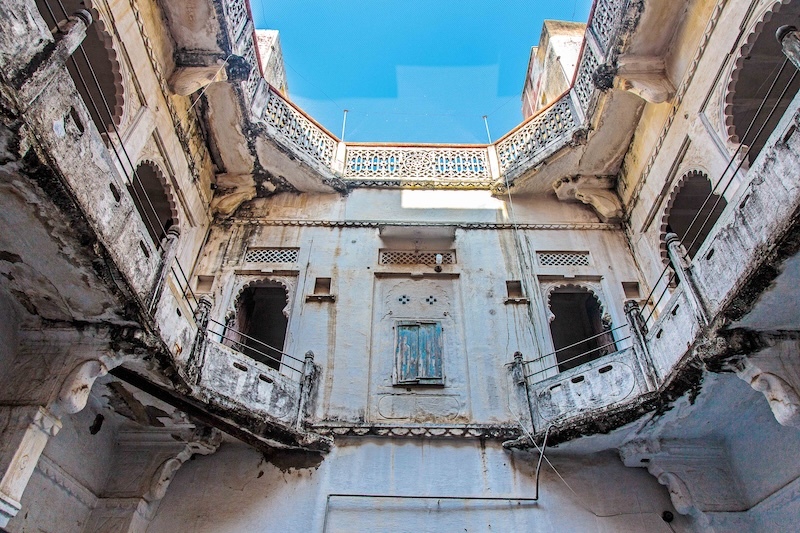
The nifty ridges on the arches at Bichli Haveli in Udaipur pay homage to the indigenous craftsmanship that mastered the skills. (Image Credits: Avesh Gaur)
The sun-soaked sands of Rajasthan cradle accounts of opulent palaces that once stood. Amidst the gamut of heritage structures awaiting restoration, a petite 140-year-old haveli in Rajasthan’s city, owned by the local Bachhawat Mehta clan, was salvaged by one of its own, when restoration began in 2017. Currently ongoing restoration, this Haveli intends to trace the roots of the inhabiting community and its ethos. “Rajasthan, particularly Udaipur, was a vibrant centre for trade and commerce, and Havelis often reflected the wealth and status of their merchant families,” notes Malvika Mehta, founder of MLIME or more than lime plaster.
city’s heritage local traditions. “These efforts have often begun with small local communities—artisans who once worked in the Havelis, and former residents who have witnessed the decay of these structures,” explains Mehta.

The intricately carved ‘jharokha’ at Bichli Haveli, Udaipur, adorn the facade in a homage to Rajasthani culture. (Image Credits: Ravi Dhingra)
“The conservation of havelis like Bichli Haveli is not only a task for architects or historians but has been deeply influenced by grassroots movements,” Mehta reveals. She adds, “While some have been repurposed into museums, hotels, or cultural centres, many remain in disrepair due to a lack of sufficient funds for restoration and the encroachment of modern developments around them.”
The Haveli’s with an intricately carved ‘jharokha’—a design element prominent in Rajasthani architecture—reinforced by ornate brackets leads into the quintessential space, a capricious courtyard. “The rapid growth of cities means that many havelis are being squeezed out by modern buildings, disrupting their surroundings niches, this haveli, when restored, aims to bring numerous subsidies to the community.

The scalloped arches with the restored stained windows and unfinished flooring allow a peek into Bichli Haveli’s ongoing restoration. (Image Credits: Ravi Dhingra)
In reverence to the past, the restoration uses similar materials originally used 140 years ago, such as stone masonry, mud mortar, and lime plaster. “The use of sustainable materials like MLIME, combined with a deep understanding of the haveli’s cultural and historical significance, ensures that this continues to stand proudly for generations to come,” Mehta reiterates.
Reviving the vibrant and intricate frescoes—a quintessential technique used in Shekhawati havelis—depicting scenes from daily life, or the owner’s lineage providing a portal into the rich cultural heritage. Mehta remarks, “Conservationists play a key role in guiding the technical aspects of the restoration, ensuring that traditional materials and methods are employed.”
With a focus on achieving the perfect concoction of the original material, this restoration project becomes a sustainable archetype. Contemporary edifices borrow heritage from the havelis—lofty ceilings for ventilation, drenched with natural light, and locally sourced materials that echo sustainability in every detail.
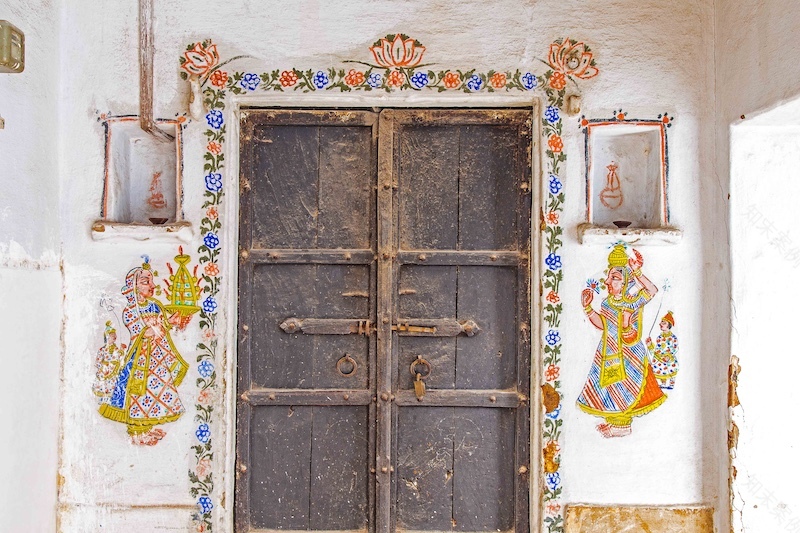
The ingeniously painted door frames add to the cultural appeal of the Bichli Haveli, Udaipur. (Image Credits: Ravi Dhingra)
3. Mangaldas Ni Haveli II: A Snug Homestay In Gujarat

The verdant and crimson facade at Mangaldas Ni Haveli II features ornate columns and stucco work. (Image Credits: Courtesy of the House Of MG)
A diplomatic synergy between the two nations—India and France—intertwined with Abhay Mangaldas’ steadfast commitment to heritage conservation—served as a backdrop for the Haveli’s restoration. Abhay Mangaldas, founder of House of MG, reflects on the current state of Ahmedabad’s Havelis, saying, “They are now residences for people who cannot afford to shift to newer alternatives or serve as godowns and shops.” However, with the increasing charm of the old Ahmedabad and its distinct design style, Mangaldas took it upon himself to restore a revered haveli. “I purchased Mangaldas ni Haveli 1 in 2008, it lay unattended for a few years and finally, I completed renovations in 2014 and opened it as a small BnB,” reveals Mangaldas.
Located in the old city of Ahmedabad amidst narrow alleys and bustling bazaars, this 150 - year - old is doused in heritage with a side of history lesson. “While this renovation was ongoing, people would approach me with their havelis to sell, as there was no interest in the old city houses that were already in disrepair and gradually being,” Mangaldas reveals. Giving the idea of the Haveli’s grounds, he remarks, “Mangaldas ni Haveli II was a cluster of three - row houses in a gated ‘pol’ with an in front.”
Mangaldas bought the other Havelis in 2011, to salvage them from dilapidation. He recalls, “I broke down two of them with no heritage significance to make room for a courtyard and a kitchen and opened it in 2016 as a six - room hotel and a restaurant.” He further adds, “(This Haveli features) 19th - century architecture, decorated with stucco work on the facade and one of only two circular wrought iron balconies in the old city,” explains Mangaldas.
Consequently, a flamboyant, verdant, crimson façade and pastel windows materialise, whispering tales of its previous owners amongst an array of contemporary concrete structures. A wooden door opens into a courtyard—a ventilation technique, prevalent in the hot climate of —which now serves as a café, and forms the heart of the Mangaldas Ni Haveli II. This heritage - inspired café, with paved brick flooring and a menu, exudes a blend of rustic and contemporary ambience.
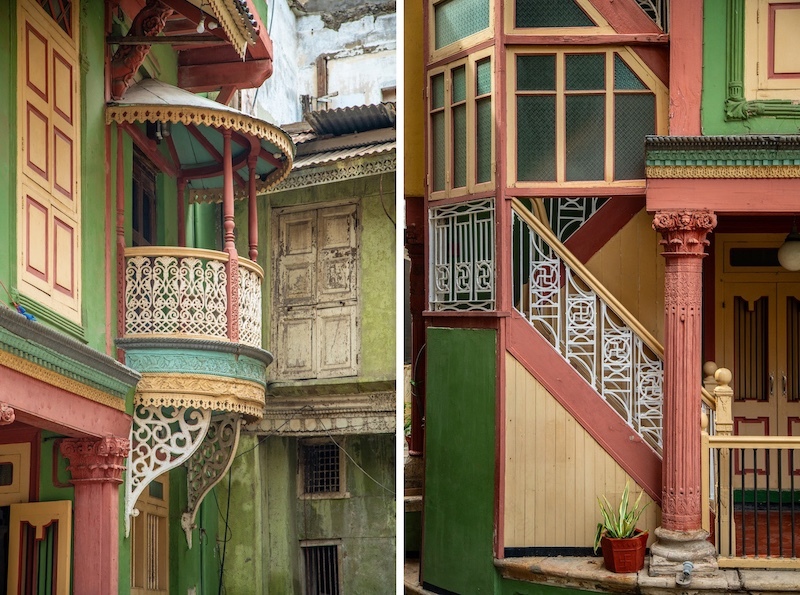
Left: The circular wrought iron balconies at Mangaldas Ni Haveli II supported by brackets glimpse at the cityscape. Right: The facade with ornate columns, wrought iron, and wooden accents reflects Ahmedabad’s rich history. (Image Credits: Courtesy of the House Of MG)
With historical elements like cast-iron latticework, panelled doors, and glass-stained panes paired with modern furniture and contemporary art, this Haveli strikes a perfect balance between heritage and modern design. Mangaldas states architecture seen in Ahmedabad’s Pol Houses reflects the varied influences on local merchants over the years, with a strong influence of the British examples.”
Paying homage to this layout of interconnected living spaces, the rooms open into the central courtyard or onto balconies, allowing for a seamless indoor and outdoor connection. Further, Mangaldas shares, “Seven years after Ahmedabad was announced as a UNESCO World Heritage City in 2017, the condition of the certified houses, barring a handful, continues to deteriorate, with a few breaking down each year.” He adds, “Unless public infrastructure is greatly improved, heritage walks, rickshaw tours, or food events are the only ways to attract people to visit these areas.”
According to Malvika Mehta, “Havelis have historically served as more than just residential spaces. They were cultural hubs where art, music, literature, and
Currently, facing the dual encumbrances of urbanisation and globalisation, the Havelis of Northern India stand at a crossroads. These stately structures, once the communities’ pièce de résistance, now grapple under the towering steel of modern cities. Yet, within this clash of eras, there lie an array of custodians who reimagine the role of these culturally rich assemblies with a dash of tradition with a pinch of modern magic. Under their deft hands, these Havelis are invigorated as living testaments to the past, where old relics and design elements proclaim the importance of heritage with intricate carving and weathered frescos.
南京喵熊网络科技有限公司 苏ICP备18050492号-4知末 © 2018—2020 . All photos and trademark graphics are copyrighted by their owners.增值电信业务经营许可证(ICP)苏B2-20201444 苏公网安备 32011302321234号
苏公网安备 32011302321234号客服
消息
收藏
下载
最近