

创作上传
VIP
收藏下载
登录 | 注册有礼
查看完整案例

收藏

下载

分享
Rolling on the river: Mziuri skate park and parkour ground by David Giorgadze Architects and Maxime Machaidze


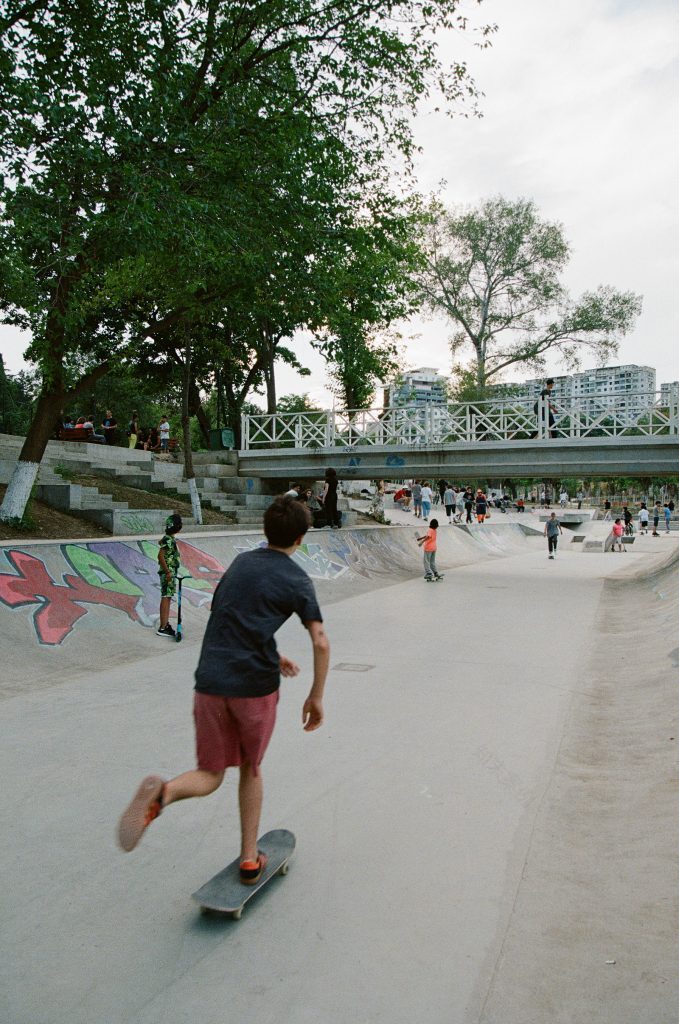


The Mziuri skate park and parkour ground in Tbilisi, Georgia, by Maxime Machaidze with David Giorgadze Architects, awaken an old dream for the banks of the Vere
It was just another hot summer day in Tbilisi and just another ordinary walk Maxime Machaidze took in Mziuri Park, walking under its bridge, the dry riverbed now colonised by crabgrass. With abandoned carousels and park stalls dating from the 1980s scattered around the landscape and reclaimed by nature, it was like a post-apocalyptic Disneyland. Water stopped flowing under the bridge in 2012, when the course of the Vere stream was artificially altered and partly culverted. From its source in the eastern slopes of the Trialeti Range near Mount Didgori, this 45-kilometre-long stream flows into the River Mtkvari, passing through the bowl-shaped valley of Tbilisi and creating an extraordinary natural landscape within the urban areas of the city, built on the two banks of the river. Continually manipulated by human behaviour throughout its history, the River Vere continues to carry people’s memories, their important and everyday moments, and the stories of the city’s transformations.

‘My whole childhood is connected with this park and its river’, recalls Machaidze. ‘This is where I used to go after school, where I first started to skate and practise parkour.’ Maxime Machaidze is an artist, and it was in 2017, after taking many walks in Mziuri Park, that he had the idea to build a new skate park here. This became the Mziuri skate park and parkour ground, which he realised in collaboration with David Giorgadze Architects, and which was completed in 2020.
Back in 1975, Georgian writer Nodar Dumbadze published an article with the name ‘It Never Hurts To Dream’ in the newspaper
Literaturuli Saqartvelo
, recalling his early childhood, ‘how we played, swam and even caught fish in the river’ in the mid 1930s, how ‘we would just sit the whole day’ and ‘when we were thirsty we would just drink the river water’. In this article he also presented his vision for a ‘children’s city’ on the banks of the River Vere, from the heart of Tbilisi to the Monastery of Betania 16km away – a small portion of this proposal became Mziuri Park. The idea was to create a long stretch of recreational and educational areas, including a botanical garden and even a small train line connecting Betania and the capital.

When the idea for a ‘children’s city’ reached the Soviet officials in Tbilisi, the local institute of architects was commissioned to work on its masterplan. Speaking of the importance of the river in the planning process of the park, architect Gia Abuladze explains, ‘It is very rare for this kind of green corridor to enter the city centre from the rural surroundings of the town’. The park sits halfway down the river’s course, stretching some 20 kilometres either side of the site, encompassing residential neighbourhoods such as Vake and Saburtalo. Seven years after Dumbadze’s article, in 1982, Mziuri Park, a ‘Georgian Disneyland’, opened its gates, but the idea to integrate the river with the park, and to turn its banks into a recreational area, unfortunately stayed on paper.
The planning and construction of Mziuri Park was interrupted in the late 1980s by the period of transformation in the former USSR from planned to market economy. After the amusement park was left deserted and unattended, its image and appreciation gradually became richer and full of potential and new possibilities. ‘The part of Mziuri Park that was built is still the beginning of a fabulous fairytale world’, says Abuladze, ‘from what was conceived to what was done to what could not be realised’. Its abandoned structures, like the bare frames of a building, allowed the wanderer to complete the picture, imagine their own adventure.
‘Manipulated many times throughout its history, the River Vere continues to carry people’s memories’
2000s, when Maxime Machaidze was a child, the urban chaos had grown and spread, absorbing some 1.5 million inhabitants. In 2010, the city hall of Tbilisi began construction of a highway along the River Vere in the Mziuri neighbourhood, to alleviate traffic in the city, insisting that it would not damage the forest areas of the zoo or the park – but unfortunately no prior environmental research had been undertaken. By 2012, five bridges had been built over the small River Vere, itself mostly enclosed in artificial concrete beds, in addition to a two-lane transport junction and three overpasses.
‘This is precisely what damaged us and the river, disconnecting the stream from the park, both visually and emotionally’, says David Bostanashvili, an architect living opposite Mziuri Park who has documented the landscape’s transformation over the last decade. ‘We can’t hear the river any more; the noise of the traffic is much louder.’ Prior to its construction, environmental activists had argued that a new highway would cause irreparable damage to the already scarce natural landscape of Tbilisi. They were proven right. While the River Vere has been characterised by periodic flash floods (in 1960, 1963, 1972 and 1995), flooding in the summer of 2015 was a particularly traumatic event, destroying the territory of the lower Mziuri Park and the entire Tbilisi Zoo: it was the deadliest flood in the city’s history.

The project for the Mziuri skate park and parkour ground is a direct response to the river’s recent history: the project recreates the original, natural bed of the river. ‘The flow of the riders – skaters and traceurs – maintains the life of the river’, says architect David Giorgadze. ‘It is youth flowing through it, free and wild like water.’
The parkour ground is designed ‘as a symbol of the city, the shapes of obstacles and its distribution creating an ambience of scaled-down buildings’, he explains. ‘It represents a circle and makes a metaphor of constant movement.’
The parkour ground and skate park are in close proximity, so the two ‘tribes’ can observe one another and communicate. ‘The skating area consists of two parts, starting out as a street plaza skate park and flowing into a halfpipe that goes under the bridge and then ends with a bowl tail, fully repeating the original shape of the canal’,
says Giorgadze. There are also several spaces for observation and for the wider public, like the bridge or the amphitheatre, so anyone can find a spot. ‘As soon as we announced that the concrete had set, it was full of people’, says the architect. Insisting on the importance of materialising the memory of the River Vere, Machaidze adds, ‘This space is done by us and for us’.
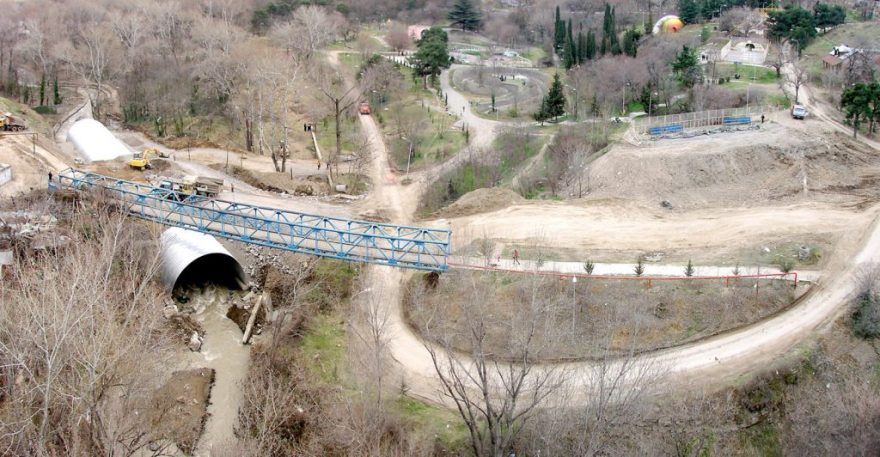


Photographs by David Bostanashvili document the changing relations between the river and the road from March 2010, before work on the highway had begun; in June 2012, after work had completed; in June 2015, after a catastrophic flood; and in December 2015, when the culverted riverway was restored following the flood
Producing a gathering space was crucial to the project, as a reinterpretation of the
Birzha
culture of Tbilisi patios. In Georgia, the
Birzha
designates a site for social togetherness usually located in creatively adapted public spaces. They are typically self-organised and operate at the scale of the neighbourhood (
Birzhastation
). Teenagers would previously hang out at the
Birzha
in their own neighbourhoods, but in the 1990s, the collapse of the Soviet Union and civil wars in Abkhazia, South Ossetia and Tbilisi led to the creation of informal urban gangs made up of teenagers in the different districts of the city. These anti-social processes had a negative impact on the culture of social interaction characteristic of Tbilisi’s inner courtyards and its
Birzhas
: recreational areas were no longer safe places for children.
In the post-socialist period of Tbilisi, the territory of the park suffered through land privatisation and exploitation, and Mziuri’s boundaries have shrunk considerably. Unlike the previous Stalinist-designed parks, Mziuri Park was a model dictated by a more Western entertainment culture, which is now very present in contemporary Tbilisi. Tbilisi’s street life has slowly reformed under the influence of, and in adaptation to, global forms of culture and healthier living – but this shift has also erased some important traditional urban activities of the city: the authoritarian street order neutralised at the expense of the emergence of new autonomous subcultures.
‘The flow of the riders maintains the life of the river. It is youth flowing through it, free and wild like water’
Today, the skate park provides a new kind of shared meeting space where groups of people, young and less young, from different neighbourhoods, can gather. Machaidze and Giorgadze’s project is very much connected with the wider transformation of Tbilisi’s social practices, encouraging a non-violent street life. The skate park can be perceived as a self-made common space, a space the users can become a part of.
‘What teenagers need the most is drive and action; to gain recognition, separate from their parents, and to establish themselves in the social realm of their peers’, says children’s psychologist Elene Koridze when describing the importance of spaces such as the Mziuri skate park. Evolving from subculture to mainstream culture, skating and parkour have already become a trend in Tbilisi. Another skate park at Dedaena Park has been completed this year, also designed by David Giorgadze. These two parks are part of an ongoing idea that has the potential to be extended and subsequently develop further. What will remain unique to Mziuri skate park is its concave form and its bridge, a constant reminder of the fate of the River Vere and how it has struggled to find its way through Tbilisi.
The idea to turn the banks of the River Vere into play spaces is not new. ‘Nodar Dumbadze would have been happy to see the skate park here’, believes Machaidze. Two very different characters who lived in very different versions of Tbilisi, Dumbadze and Machaidze shared a dream. It was the conviction to promote their ideas to city governments, and the determination to see them realised, that has enabled the creation of this new and important public place in the city.
南京喵熊网络科技有限公司 苏ICP备18050492号-4知末 © 2018—2020 . All photos and trademark graphics are copyrighted by their owners.增值电信业务经营许可证(ICP)苏B2-20201444 苏公网安备 32011302321234号
苏公网安备 32011302321234号客服
消息
收藏
下载
最近