

创作上传
VIP
收藏下载
登录 | 注册有礼
查看完整案例

收藏

下载

分享
This multigenerational Thrissur home nurtures warm family bonds
Atelier Republic Architects combine Japandi aesthetics with a touch of Kerala's traditional architecture in this elegant home.
Kasturi Gadge
Turtle Arts
Designing a family home is always a challenge—marrying the needs of the grandparents while sticking to the aesthetics the couple has in mind, and also ensuring the house ages well with the growing kids. With this in mind, Abdul Latheef of Atelier Republic Architects set out to design a family home for the Rahat family of
Thrissur
, Kerala. The key focus for this 3,000-square-foot house was ensuring the house gets ample natural light and ventilation, capturing the styles of the three generations living here and most importantly, ensuring there is a dedicated private zone for the family when they have guests over.

The Welcoming Facade
Latheef explains that the facade of the building was thoughtfully designed to seamlessly blend
old-world charm
with contemporary elements. “To achieve this harmonious fusion, a combination of glass and brick cladding was incorporated in a modern and aesthetically pleasing pattern. This mixture of materials added a depth and texture to the facade, creating an intriguing visual contrast that celebrated both traditional and contemporary design aesthetics.”

The roof tiles play a pivotal role in enhancing the overall architectural appeal. They not only served a functional purpose but also contributed to the building's character as it drew inspiration from
Kerala
's traditional architectural elements. “This thoughtful incorporation of old and new elements in the facade design resulted in a visually captivating and culturally rich exterior that honoured the past while embracing the present,” he adds.
Zoning It Out
The floor plan for this Thrissur home was carefully structured into four distinct zones—public, semi-public, semi-private, and private. The public space includes a welcoming sit-out, while the semi-public area houses the formal living room. The semi-private zone encompasses the study, library, family living area, and dining space, while the bedrooms on the ground floor and the first floor are provided with the utmost privacy. “A flexible approach was taken with the kitchen, allowing it to function as part of the semi-private space, yet offering the option to be partitioned off when necessary. The client also wanted to have a plan that did not follow the normal design procedure which had rooms partitioned as per function but rather follow an open plan,” explained Latheef.

A True Family Home
The design essence of the Rahat family home revolves around inclusivity and functionality. Every aspect of the house has been meticulously planned to cater to the diverse needs of this family. “Whether it's a dedicated study area for the father or a thoughtfully organised kitchen for culinary creativity, their house is a reflection of their aspirations. What sets this architectural project apart is the client's vision for a space that fosters interaction and togetherness. It's not just a house; it's a place where shared experiences and family bonds are nurtured, where interactive spaces bring everyone together in a harmonious blend of modern living and traditional values,” Latheef elaborates.

The architectural plan for this space followed a linear approach, creating a seamless flow from one area to another. Beginning with the formal living area, this design lends to an open space concept that maintains the linear layout throughout. Along this path, you would find the study, library, family living room, dining area, kitchen, and work area, all thoughtfully arranged in a logical sequence. The bedrooms were strategically positioned on one side of the building, with two located on the ground floor and an additional two on the first floor, accessible via a staircase.

Japandi Minimal
To capture the old-meets-new style, Latheef decided to opt for the
Japandi design
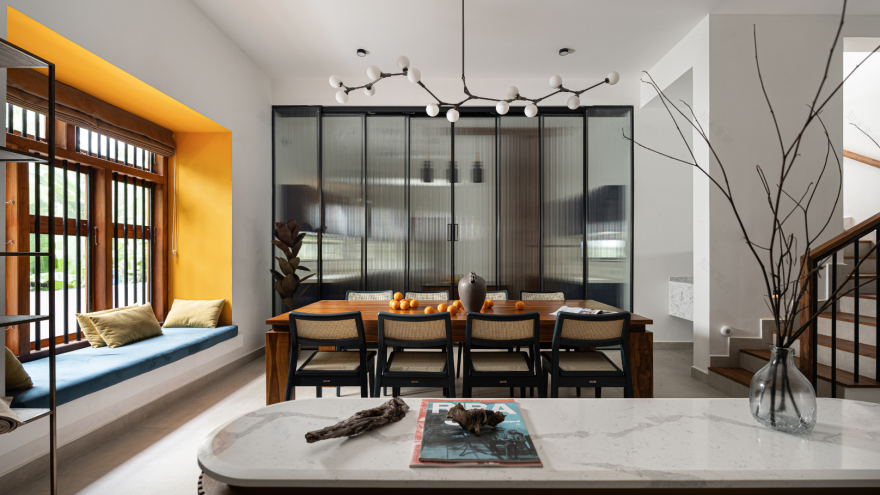
(a fusion of Japanese and Scandinavian elements). Throughout the interior, a subdued colour palette prevails, featuring shades of black, beiges, and soft wood tones. "This elegant selection of colours extends to the furniture, which was thoughtfully chosen to complement the overall theme. The flooring showcased the contemporary appeal of naked concrete finish tiles, adding an industrial touch to the space,” says Latheef. To maintain a sense of brightness and spaciousness, the walls and ceiling were kept pristine white, creating a serene backdrop for the design elements. The kitchen partition incorporates Japanese-inspired fluted glass panels framed in black. This addition not only added an element of privacy but also served as a striking design element, further enhancing the Japandi aesthetic.


Latheef continues, “To infuse a touch of Indian style and vibrancy into this Thrissur home, strategic colour accents were introduced. Indian blue and
Mitti
(Mud) yellow were the chosen hues to achieve this. Among these, the Mitti yellow took centre stage in the dining area, particularly within the bay window, creating a striking focal point. This infusion of colour not only added vibrancy but also enhanced the overall ambience, creating a well-balanced blend of Japandi and Indian design elements that truly satisfied the client's needs.”
南京喵熊网络科技有限公司 苏ICP备18050492号-4知末 © 2018—2020 . All photos and trademark graphics are copyrighted by their owners.增值电信业务经营许可证(ICP)苏B2-20201444 苏公网安备 32011302321234号
苏公网安备 32011302321234号客服
消息
收藏
下载
最近