

创作上传
VIP
收藏下载
登录 | 注册有礼
查看完整案例

收藏

下载

分享
Educational Architecture
Louis Kahn’s Indian Institute of Management in Ahmedabad
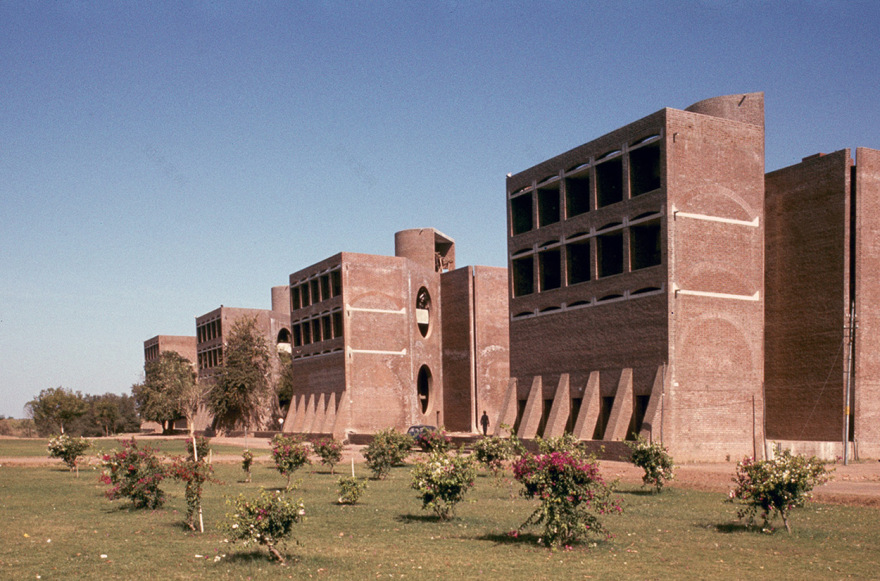
The Indian Institute of Management in Ahmedabad | © Dave Morris
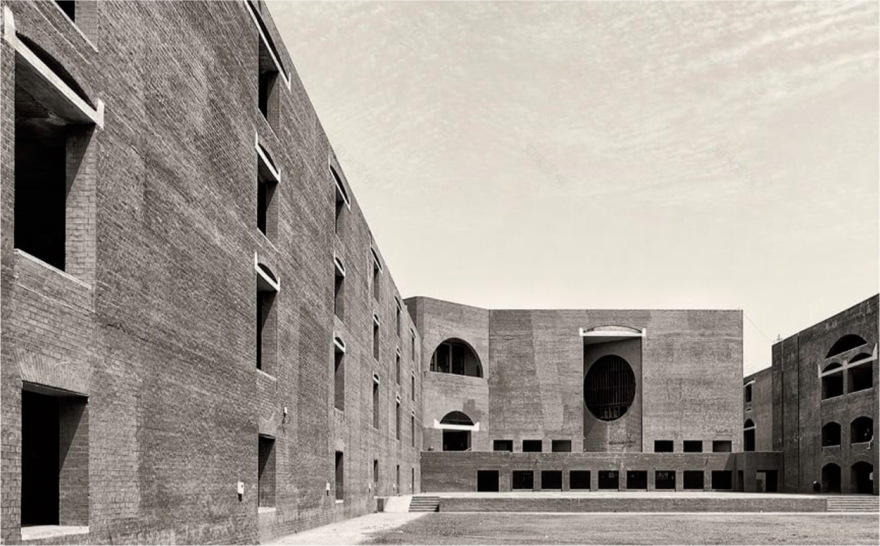
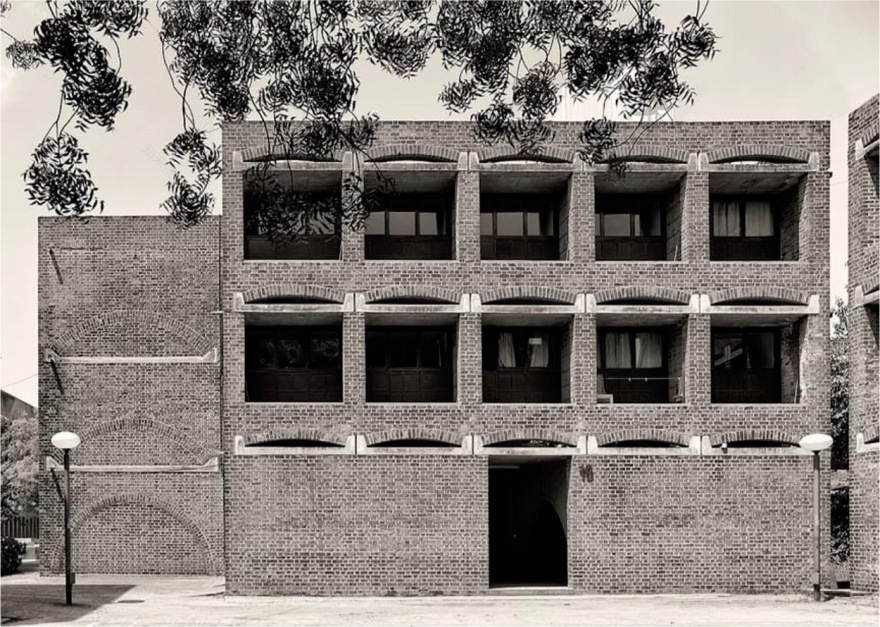
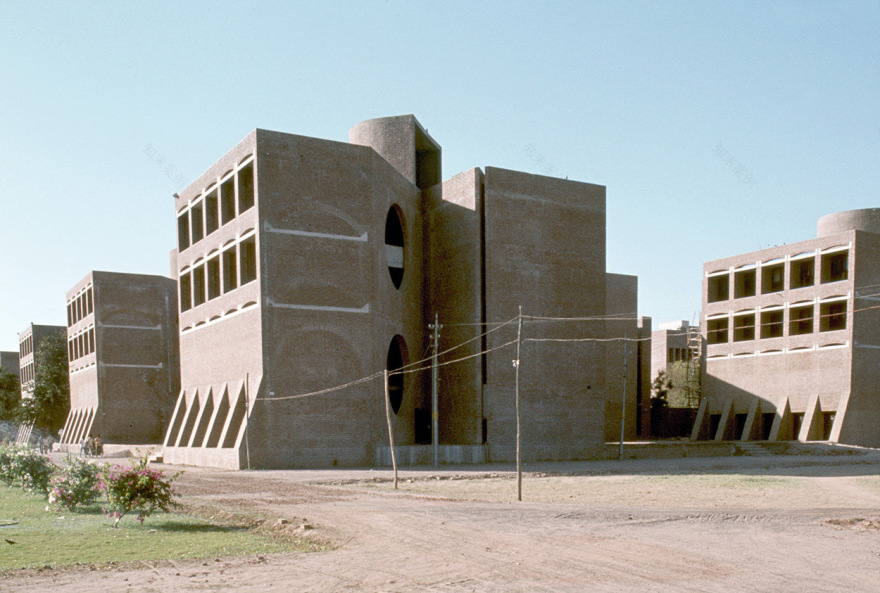
Completed in 1974, the Indian Institute of Management Ahmedabad, better known as IIM Ahmedabad or simply IIMA, is a management institute located in Ahmedabad, India. The old campus was designed by Louis Kahn, who was an exponent of exposed-brick architecture, with the help of B.V. Doshi & Anant Raje. The plan’s most distinctive features are the numerous arches and square brick structures with circles carved out in the façade. The extensive complex includes a library, teaching facilities, and residential buildings.
Kahn Indian Institute of Management Technical Information
Architects: Louis Kahn
Collaborators: Balkrishna Vithaldas Doshi & Anant Raje
Topics: Universities, Brick Architecture
Location: Vastrapur, Ahmedabad, Gujarat, India
Project year: 1962-1974
If you think of Brick, you say to Brick, ‘What do you want, Brick?’ And Brick says to you, ‘I like an Arch.’ And if you say to Brick, ‘Look, arches are expensive, and I can use a concrete lintel over you. What do you think of that, Brick?’ Brick says, ‘I like an Arch.’ And it’s important, you see, that you honor the material that you use. […] You can only do it if you honor the brick and glorify the brick instead of shortchanging it. – Louis Kahn
Louis Kahn Indian Institute of Management Photographs

© Cemal Emden
© Cemal Emden
© Cemal Emden

© Cemal Emden

© Cemal Emden

© Cemal Emden

© Cemal Emden

© Dave Morris

© Courtesy of Wikimedia Commons
© Courtesy of Wikimedia Commons
Rethinking Educational Spaces: The Indian Institute of Management
While Louis Kahn was designing the National Assembly Building in Bangladesh in 1962, he was approached by an admiring Indian architect, Balkrishna Doshi, to design the 60-acre campus for the Indian Institute of Management in Ahmedabad, India. Much like his Bangladesh project, he was faced with a culture enamored with tradition and an arid desert climate.
For Kahn, the institute’s design was more than just efficient spatial planning of the classrooms; he began to question the design of the educational infrastructure where the classroom was just the first phase of learning for the students.
In 1961, a visionary group of industrialists collaborated with the Harvard Business School to create a new school focused on advancing specific professions to promote India’s industry. Their main focus was to create a new school of thought that incorporated more Western-style teaching that allowed students to participate in class discussions and debates, unlike the traditional style where students sat in lectures throughout the day.
Balkrishna Doshi believed Louis Kahn would envision a new, modern school for India’s best and brightest. Kahn’s interests and even critical views on the educational system’s methods influenced his design to no longer singularly focus on the classroom as the center of academic thought. The classroom was just the formal setting for learning; the hallways and Kahn’s Plaza became new education centers.
The conceptual rethinking of the educational practice transformed a school into an institute, where education was a collaborative, cross-disciplinary effort occurring in and out of the classroom.
In the same ways he approached the National Assembly Building design in Bangladesh, he implemented the same techniques at the Indian Institute of Management. He incorporated local materials (brick and concrete) and extensive geometrical façade extractions as an homage to Indian vernacular architecture. Kahn’s method of blending modern architecture and Indian tradition into architecture could only be applied to the Indian Institute of Management.
The large facade omissions are abstracted patterns found within the Indian culture positioned to act as light wells and a natural cooling system protecting the interior from India’s harsh desert climate. Even though the porous, geometric façade acts as a filter for sunlight and ventilation, the porosity creates new gathering spaces for the students and faculty to come together.
Together, Kahn’s rethinking of India’s educational system’s traditional principles, along with a group of ambitious industrialists, helped create one of the most sought-after, influential, and elite business schools in the world. Unfortunately, Kahn could not see his design come to fruition as he died in New York City in 1974 before the project was finished. However, there is no question whether or not his design had utterly transformed how modern architecture establishes itself in one’s culture.
Indian Institute of Management Plans
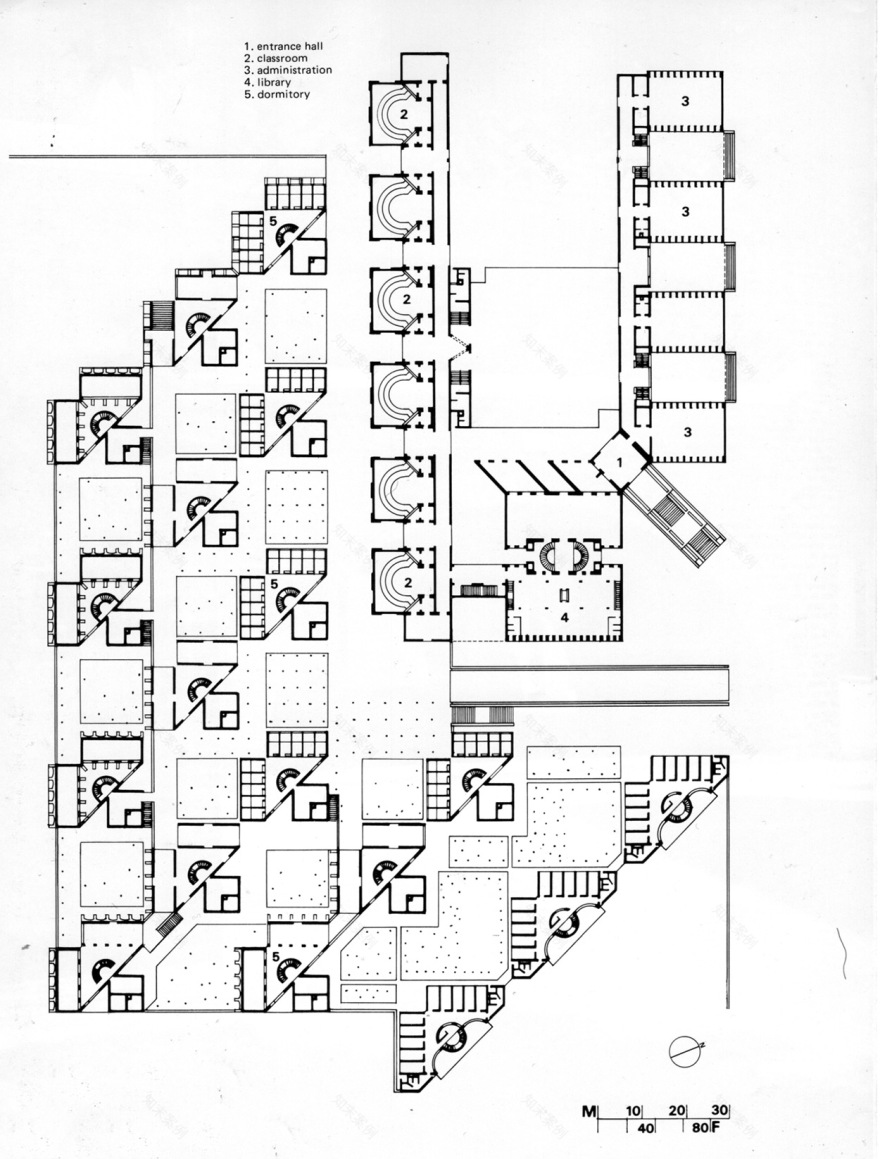
Floor Plan | © Louis Kahn

Floor Plans | © Louis Kahn Indian Institute of Management Gallery


About Louis Kahn
Louis Isadore Kahn (1901 – 1974) was an American architect based in Philadelphia whose proposals and teaching made him one of the most influential architects of the twentieth century. Kahn created a monumental and monolithic style. For the most part, his massive buildings do not hide their weight, materials, or the way they are assembled.
南京喵熊网络科技有限公司 苏ICP备18050492号-4知末 © 2018—2020 . All photos and trademark graphics are copyrighted by their owners.增值电信业务经营许可证(ICP)苏B2-20201444 苏公网安备 32011302321234号
苏公网安备 32011302321234号客服
消息
收藏
下载
最近