

创作上传
VIP
收藏下载
登录 | 注册有礼
查看完整案例

收藏

下载

分享


An Interim Campus Landscape Is a Master Class in Reuse
Kimley-Horn navigates the university’s rules on salvaging construction waste to pay homage to a campus icon.

Bricks are so ubiquitous on the campus of North Carolina State University (NC State) that it is a tradition for graduating students to take one as a memento. Hundreds of thousands of fired clay pavers adorn the campus, thanks to the geological composition of the Piedmont, where red clay dominates the soil. The most emblematic site on campus is University Plaza, which was initially paved with more than half a million red bricks donated by the North Carolina Bricklayers Association and white bricks purchased from South Carolina manufacturers.
Designed by Richard C. Bell Associates and completed in 1968, University Plaza was among the first landscape architecture projects to be funded by the state on an educational campus. The plaza is an example of the university’s incremental development, and it was largely designed in response to a circular classroom building called Harrelson Hall, completed in 1961. Known as “the Brickyard,” the plaza has become so central to the university’s identity that it was distinguished as one of the campus’s “Hallowed Spaces” by the 2023 Physical Master Plan.
From the beginning, however, Harrelson Hall was fraught with challenges. The wedge-shaped lecture halls had curved walls and sloping floors that caused an echo and excluded wheelchair users. A central ramp spiraled up the four-story structure, lending itself more to students’ wheeled shenanigans than efficient navigation. The round shape complicated wayfinding and proved disorienting to many students. The building’s fate was sealed in the mid-2000s when a study found that it would be financially impracticable to bring the building into compliance with the Americans with Disabilities Act, though about a decade passed before the moribund building was set to be demolished in 2016.
Brandon White, ASLA, a senior landscape architect at Kimley-Horn, saw the circular site as a great opportunity, “like a bullseye in the campus.”
The Brickyard is an expansive field of paving that connects several academic buildings, including the D. H. Hill Jr. Library, and two major green spaces with mature shade trees. Originally, these planted areas were counterpoints to Harrelson Hall, offering a refuge for students and faculty. “Many times, designers start with circulation and let that create space,” says Tom Skolnicki, the university landscape architect, “but the Brickyard seems to be the opposite. Spaces were envisioned first and that defined the circulation.” The plaza featured sweeping curvilinear forms that contrasted with an orthogonal paving scheme reminiscent of the Piazza San Marco in Venice, Italy. Hal McNeely, an associate in Bell’s office, designed the paving pattern using only whole bricks to cut down on time and costs. The plaza was then sand set to facilitate easy maintenance over the project’s lifespan, inadvertently encouraging the brick keepsake tradition.
For more than five decades, academic buildings had sprouted along the periphery of the Brickyard, slicing off pieces of the curvilinear landscape while steering more life to it. The plaza was rich with pedestrian activity and sensitive research facilities in neighboring buildings, both of which complicated the planned demolition of Harrelson Hall. In 2015,
Kimley-Horn
was retained to facilitate the removal of the 110,000-square-foot building. The site would be home to a new building, but the timeline was unknown, and the university wanted to provide a quality landscape in the interim. Brandon White, ASLA, a senior landscape architect at Kimley-Horn, saw the circular site as a great opportunity, “like a bullseye in the campus.” The interim landscape project area encompassed Harrelson Hall and several landscape walls and steps where it met the Brickyard along its perimeter. First, the building would be removed, then the interim landscape would be constructed and stitched into the existing Brickyard context.
NC State’s Design and Construction Guidelines require that all projects divert 75 percent of nonhazardous waste from landfill disposal through reuse and recycling. These robust guidelines also provide a structure for achieving the university’s waste reduction performance goals. At the start of a project, a Designer Waste Management Form helps designers identify regulated wastes and materials for salvage as early in the process as schematic design. The form is included with the construction documents and informs the contractor’s Waste Management Plan, which is reviewed by the university’s Waste Reduction and Recycling unit before work begins. During construction, it is standard practice for waste materials leaving sites to be tracked by the contractor using a form provided by the university.

This interim landscape within the Brickyard occupied the site from 2017 to 2023.
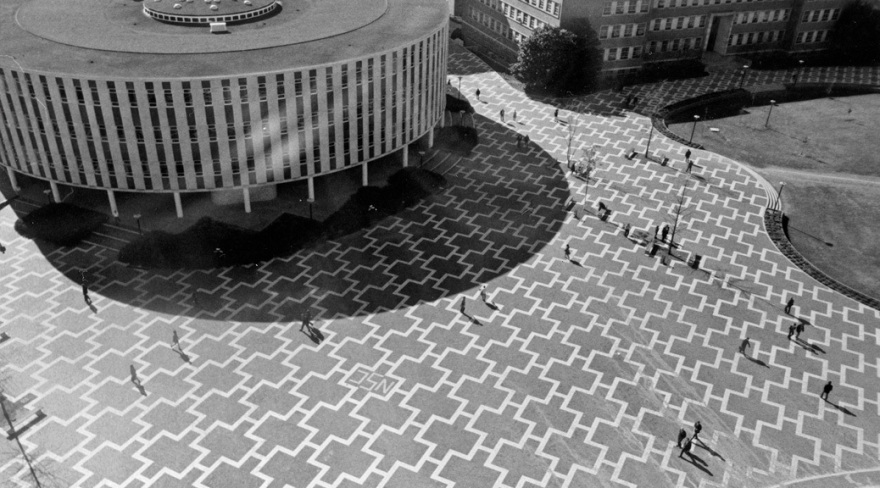
Harrelson Hall and the newly completed Brickyard, shown circa 1972, quickly became the core of NC State’s campus.
A 90 percent diversion goal was set for Harrelson Hall’s demolition, an ambitious objective given that it is not every day that an entire academic building is extracted from a campus. Several NC State entities, including the University Sustainability Office, Waste Reduction and Recycling, Design and Construction, and Campus Planning and Strategic Investment, collaborated to find waste destinations and coordinate construction logistics. The general contractor, D. H. Griffin, logged the weight, cargo, and terminus of every truck leaving the site, resulting in a comprehensive record of all material streams coming from the project. Aside from the environmental benefits, the waste reduction goal provided grounds for the salvage and reuse of building elements in the interim landscape.
To meet the university’s requirements, the design of the interim landscape needed to complement the Brickyard while facilitating pedestrian flow using minimal pavement. Harrelson Hall was once a keystone in the student experience at NC State, and another objective was to celebrate the building’s history. Early in the design process, White says the Kimley-Horn team identified the limestone panels on Harrelson Hall as recognizable attributes that could be rescued. Kimley-Horn also proposed preserving exterior ground-floor columns in the landscape, but they were edited out of the final design for the sake of simplicity. Mounding topography and the salvaged limestone elements were placed in the circular site to encourage travelers to stay on walkways, while also affording places to play and rest.
Harrelson, despite its flaws, had provided much-needed classroom space up until its final moment. Asbestos abatement was performed on the upper floors while the ground-floor computer labs were still in use, and removal began directly following graduation in spring 2016. First, furniture that could be taken out and reused—doors, desks, chalkboards—was donated to the fire department and a local K–12 school. Then limestone facade panels and bricks around the building perimeter were salvaged and stockpiled for use in the interim landscape. Finally, Harrelson Hall came down one slice at a time.
More than 4,000 tons of concrete from the building’s core became beneficial fill on sites around Raleigh, replacing natural aggregates and soil in projects that needed to raise grade with imported fill. Salvaged concrete is often reused as aggregate road base, but not in this case. Josh Griffin, a structural engineer at Kimley-Horn, says that “most people in the industry would rather just use granite from a cost standpoint,” given that granite was common in North Carolina. The contractor, D. H. Griffin, hauled more than 800 tons of reinforcing steel and other structural steel to be scrapped, and plucked mechanical, electrical, and fire protection components for use in other campus facilities. Together, these measures helped the team exceed its initial goal, with 95 percent of the project’s nonhazardous waste being diverted from landfills.

Palletized limestone facade panels and brick pavers, shown in June 2016, would return to the site the next year.
Seasoned by 55 years on Harrelson Hall’s exterior, the panels allowed students to remain in touch with the building.
Ten months after demolition began, the interim landscape was fully installed and the site reopened to the public. The new landscape referred to Harrelson Hall with several design gestures, including a 206-foot-diameter concrete band indicating the building’s former footprint. Horticultural cues, including a colonnade of longleaf pine, were installed in place of the loblolly pines that once lined the north face of the building, a move that simultaneously called back to Harrelson Hall and the ecology of the Piedmont. Nearly 100 limestone facade panels were integrated into the landscape as “book stack” seat walls, solitary fins evoking books standing on end, and as paving accents at thresholds to the space, a reference to the nearby Hill Library.
Building the limestone elements proved less difficult than matching the paving pattern required to stitch the project into the Brickyard. D. H. Griffin took photos and measurements of the existing pattern, but there were still “a lot of challenges in getting [it] to blend into the new landscape,” White says. The interim landscape would not see as much activity as the earlier Brickyard, given that classes were relocated from Harrelson Hall elsewhere, but that didn’t mean it went unused. Skolnicki says that students and visitors embraced it as a sunnier open space compared to the Brickyard’s other planted areas, especially in winter months. This sun exposure also afforded the Brickyard more visibility during the 2017 solar eclipse, which was one of the largest gatherings to take place on the plaza.
In 2023, seven years after the interim landscape’s completion, ground was broken for the new Integrative Sciences Building, which will restore activity in the Brickyard. NC State has asked Brooklyn-based
Michael Van Valkenburgh Associates
(MVVA) to site the new building within the Brickyard while maintaining Bell’s original design intent. Matt Girard, an associate principal at MVVA and design lead on the project, says he is excited to integrate several “incursions into the Brickyard” and “bring back more landscape foreground that we saw in [Bell’s] plan.” The project will fully replace the plaza’s well-trodden paving with permeable pavers laid in the distinctive Brickyard pattern.
南京喵熊网络科技有限公司 苏ICP备18050492号-4知末 © 2018—2020 . All photos and trademark graphics are copyrighted by their owners.增值电信业务经营许可证(ICP)苏B2-20201444 苏公网安备 32011302321234号
苏公网安备 32011302321234号客服
消息
收藏
下载
最近