

创作上传
VIP
收藏下载
登录 | 注册有礼
查看完整案例

收藏

下载

分享
缘起
Origins
永乐宫是来山西省芮城县城的第一旅游目的地,然而,这个道教全真派三大祖庭之一在60年前却坐落在距此约20公里远的黄河畔永乐镇。唐代道士、八仙之一吕洞宾(号纯阳子)相传出生于此地。元代吕祖被封帝,遂将其故里“吕公祠”扩建为皇家宫观。1950年代初永乐宫广为人知后,被列为第一批全国重点文物保护单位。同一时段,因计划在其下游修建三门峡水电站,为保存闻名于世的永乐宫壁画,从1959年起历时7年,永乐宫整体搬迁到芮城县城北。
Yongle Palace is the premier tourist destination in Ruicheng County, Shanxi Province. However, this temple, one of the three ancestral halls of the Quanzhen School of Taoism, was originally situated about 20 kilometers away by the Yellow River in Yongle Town sixty years ago. It is said that Lv Dongbin, a Tang Dynasty Taoist and one of the Eight Immortals, was born here. During the Yuan Dynasty, Lv was enshrined as an emperor, leading to the expansion of his former residence, “Lv Gong Shrine,” into an imperial temple. In the early 1950s, after Yongle Palace gained widespread recognition, it was listed as one of the first batch of major historical and cultural sites protected at the national level. Around the same time, due to the plan to construct the Sanmenxia Hydropower Station downstream, the entire Yongle Palace was relocated to the north of Ruicheng County over a seven-year period starting in 1959 to preserve its world-renowned murals.
▼从永乐宫旧址看黄河,Viewing the Yellow River from the original site of Yongle Palace © TAL

▼永乐宫旧址活化前后对比.,Comparison before and after the revitalization of the original Yongle Palace Site© URBANUS

这场世界文物史上都堪称奇迹的搬迁逐渐被世人忘却,但随着近年来山西把各县已有的沿黄河公路贯通为全长1238公里黄河一号旅游公路,只待沿线呼之欲出的深度游目的地,这为芮城段重点打造永乐宫旧址文旅项目提供了新契机。
This relocation, hailed as a miracle in global cultural heritage conservation, has gradually faded out from public memory. However, in recent years, Shanxi Province has connected existing county roads along the Yellow River into the 1,238-kilometer-long Yellow River No. 1 Tourism Highway. This has provided a new opportunity for Ruicheng County to focus on the development of the original site of the Yongle Palace into a cultural tourism project.
▼永乐宫搬迁地图,Map of the relocation of Yongle Palace© URBANUS

虽然三门峡水库设计变更并没有使永乐镇被淹没,但经历了60载的农耕后,这个有至尊价值的遗产地,现在成为找不到废墟的农田和村落,永乐宫旧址已踪迹全无。因此对其呈现不得不进行虚构的地表标记和空间叙事。
Although the modifications to Sanmenxia Reservoir design has spared Yongle Town from submersion, six decades of farming transformed this heritage site of immense value into farmland and villages where no trace of ruins remains—leaving the original site of Yongle Palace utterly unrecognizable. As a result, its presentation now relies on surface markers and spatial narratives to evoke its lost past.
▼黄河一号旅游公路,Yellow River No. 1 Tourism Highway© URBANUS

基地
Site
相天择地是中国古代建筑艺术的第一步骤,把永乐宫建筑群的平面再放回这方水土的意义在重构宫观与其原初天地环境的对话。实现这个目标却很艰难:被六十年的精耕细作抹平的永乐宫旧址区已是个杂糅的场所,除了田野,还叠加着村路、羊圈、粮仓多重农业生产层次。1980年代后民间道士修建的吕公祠,使这一带又恢复成集自然、宗教、文化为一体的小型旅游目的地,虽然与原来的永乐宫毫无关联,但多少延续了奄奄一息的香火。
Revitalizing the Yongle Palace site back onto rekindles the dialogue between the temple and its original natural settings. Yet achieving this goal is immensely challenging: the original site of Yongle Palace, erased by six decades of intensive farming, has become a fragmented space with new elements. Beyond open fields, it now intertwines with layers of agricultural activity superimposed over time with village paths, sheep pens, and granaries. In the 1980s, a Lv Gong Shrine was built by Taoist followers, turning the area once again into a local tourist destination. Though unrelated to the original Yongle Palace, it has been keeping a fading spiritual legacy alive.
▼永乐宫原址(1956年),Yongle Palace in 1956© URBANUS

▼拆卸后的永乐宫遗址,Original Yongle Palace site after relocation© URBANUS

▼永乐宫旧址地段与原宫殿位置,Yongle Palace site and locations of original buildings© URBANUS

营造二元格局
Creating a Dual Spatial Configuration
原宫观区只有一部分是可建设用地,其它是不可用的基本农田。在有限的建设用地上,用”西祠东宫”的二元格局来实现”吕祖故里”与”宫观遗址”的双重文化层积:西部再利用搬迁后民间重建的吕公祠打造”再生”场景,东部以永乐宫遗址为核心构建”再现”空间。景区流线是从西区“吕公祠再生”部分进入,去寻找东侧“永乐宫再现”,恢复了原永乐镇无序与有序并存的地气,延续了历史上官式秩序与民间烟火”宫市共生”的辩证传统。
Only a small part of the original temple site is legally buildable, while the rest are basic farmlands. Within these constraints, a dual spatial configuration is adopted to reflect both the heritage of Lv Ancestral Home and the historical temple site. The west side builds on the base of current ancestral shrine to create a renewed cultural field, while the east focuses on evoking the memory of the original Yongle Palace. Visitors come from the west to search for the east, retracing a path that begins from informal vitality and ends with a structured ritual experience, reviving the historical interplay between everyday life and official sanctity.
▼空间关系图,Relationships of the space layout© URBANUS
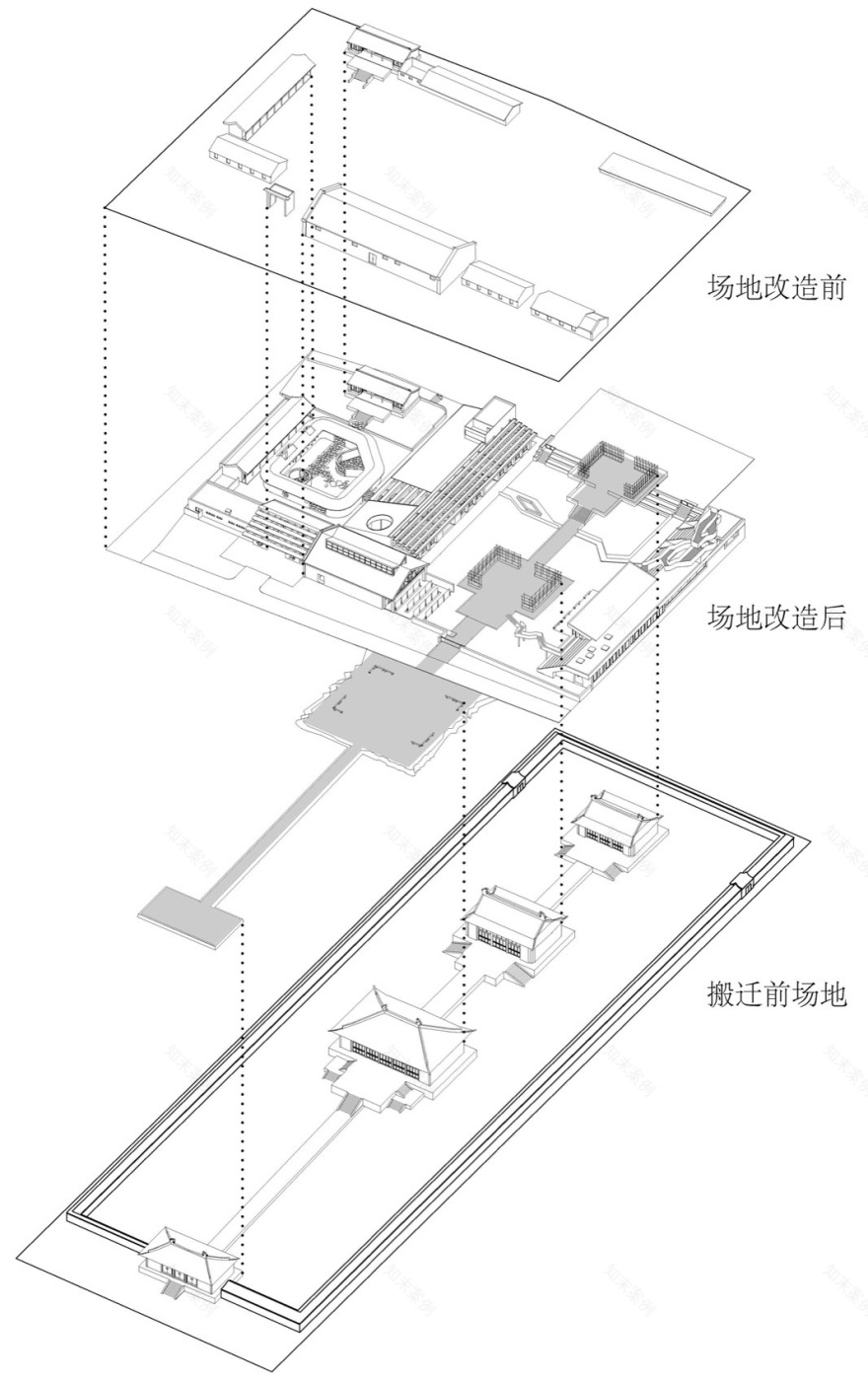
元代全真教从民间教派变成国教后,四代掌教潘德冲采用“法天象地”的空间语言设计永乐宫,隆重的轴线布局折射出建筑空间从个体修道载体升华为权力话语符号的深层逻辑。这种用宫殿形式把吕祖帝王化并不能完全描述吕洞宾在北面九峰山上归隐成仙的神采,因此,回到吕祖故里的基础基因,西区用杂糅的方式对冲中央主轴的庄严,回归了王重阳创立全真教时主张“茅庵草舍”的简朴修行观,强调建筑与自然共生的隐逸精神。
The grand axial layout reflected a deeper shift, transforming the built environment from spaces serving individual cultivation to symbols of political power. Yet framing Lv Dongbin as an imperial figure through palatial architecture only partially captures the essence of his transcendence on the northern Jiufeng Mountains. Returning to the foundational essence of Lv Ancestral Home, the western zone adopts a hybrid approach to counterbalance the central axis’ formality.
▼“吕公祠再生”与“永乐宫再现”,”Regeneration of Lv Gong Shrine” and “Re-emergence of Yongle Palace”© URBANUS

西区”吕公祠再生” Western Zone: “Regeneration of Lv Gong Shrine”
“吕公祠再生”的设计策略是在现有房屋无序的肌理上,以中央环廊为媒介重构景区的开场。环廊保留了12棵原生树,完全巧合了道教文化中数字12丰富的象征意义。例如 “十二重楼” 在吕洞宾所创立的内丹学中是指人体咽喉部位的十二节软骨,连接下丹田与中上丹田,象征气机上升的通道。这一内气运行的关键路径,也隐喻着环廊对引流的关键作用。
The design strategy for the “Regeneration of Lv Gong Shrine” restructures the site’s existing elements around a central circular corridor, which serves as a spiritual Taoist garden. The corridor preserves 12 native trees—a number that serendipitously resonates with the rich symbolism of “twelve” in Taoist culture.
▼将离散的门房、谷仓、袇房、吕公祠等建筑与原生树木整合在一起,Integrating gatehouses, granaries, monastic cells, and the Lv Gong Shrine—along with native trees—into a cohesive ensemble centered around a garden© URBANUS
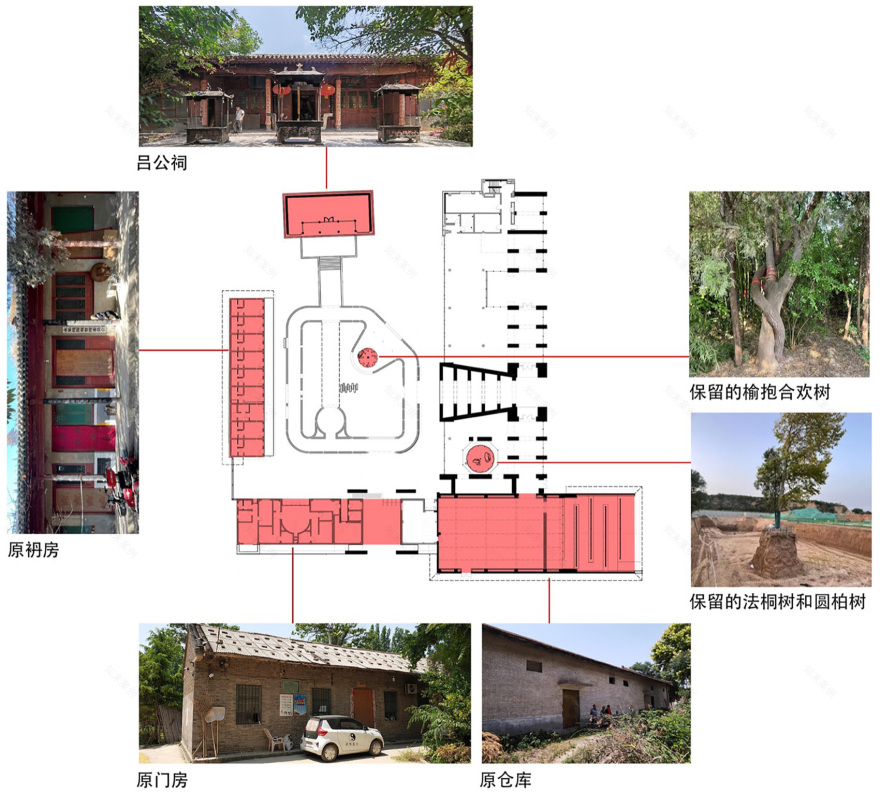
环廊有三重空间作用:首先,作为历史碎片的整合器,将离散的门房、谷仓、袇房、吕公祠等建筑与12棵原生树木编织成以”洞天福地”园林为核心的共同体。其平面形态顺应现状树木,重点部位还点睛了”榆报合欢”等保留树木,并通过雾喷系统营造仙境氛围。
The circular corridor serves three spatial functions: First, as anintegrator of historical fragments, it weaves scattered structures—gatehouses, granaries, monastic cells, and the Lv Gong Shrine—along with the 12 native trees—into a cohesive ensemble centered around a garden. Its layout adapts to the existing trees, with key focal points highlighting preserved specimens such as the intertwining Elm and Mimosa, while a mist-spray system enhances the ethereal, otherworldly ambiance.
▼环廊庭院,Circular corridor © TAL

▼环廊庭院,Central courtyard © TAL
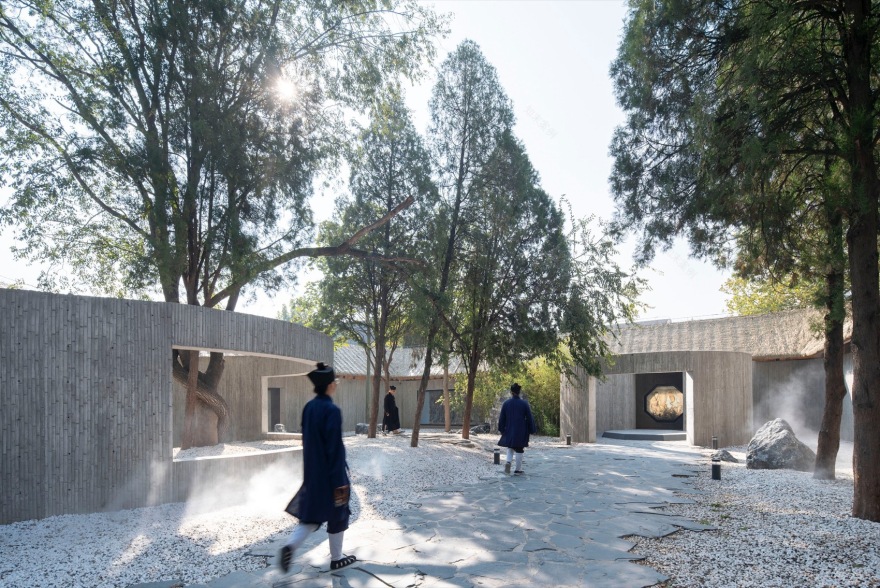
▼环廊庭院内保留的榆抱合欢树,Intertwining Elm and Mimosa as a focal point in the central courtyard © TAL

其次,作为功能序列的组织者,以逆时针动线串联倒座房(整合门房/厕所/宿舍)、袇房雅居(旧管理用房改造为客房)、修葺后的吕公祠及遗址过渡区。外侧墙面形成四个独立意境场所,内侧围合出中心园林,构建”五方自组织”的漫游体系。
Secondly, as an organizer of functional sequences, the corridor connects in a counterclockwise flow, starting from the original guardian houses (gatehouse, restrooms and dormitories), refined monastic quarters (converted from old administrative buildings into guest rooms), the restored Lv Gong Shrine, and finally to the transition zone of the original site. The outer walls create four distinct poetic spaces, while the inner perimeter encloses a central garden, together forming a self-organization system for wandering through the site.
▼园区入口空间,Entrance © TAL

▼环廊入口空间,Entrance to the circular corridor © TAL

第三,作为时空逻辑的转译者,通过迷宫般的引导,将游客从“无”引入到“有”,将道家”有无相生”的宇宙观转化为空间体验:既能触摸返乡农民的岁月痕迹,又能感受仙境园林的精神升华;既见证无序建造的自组织演化,又体会设计介入的克制智慧。这种”一笔成环”的简约手法,最终实现了历史真实性与空间诗性的双重守护。
Thirdly, as a translator of temporal and spatial logic. The corridor employs a maze-like journey to lead visitors from nowhere to somewhere, transforming the Taoist cosmology into spatial experience. One can simultaneously touch the traces of time left by local farmers and feel the spiritual sublimation of the celestial garden. This minimalist approach of using a single stroke to form a continuous loop ultimately achieves both the preservation of historical authenticity and spatial poetry.
▼吕公祠,Lv Gong Shrine © TAL

▼环廊,Circular corridor © TAL

这个区域最重要的部分是北端吕公祠发展出的南北轴线,轴线南端头是环廊墙上镶嵌的玻璃画“钟吕论道图”,复制了纯阳殿神龛背面的核心壁画,描绘道教仙人钟离权度化吕洞宾。
The most significant element of this area is the north-south axis developed from the Lv Gong Shrine at the northern end. The southern terminus of this axis features a glass-embedded mural on the corridor wall, replicating the core mural from the back of the Chunyang Hall shrine, which depicts Taoist immortal Zhongli enlightening Lv Dongbin.
▼圆形庭院中的“内经图”和背景上的“钟吕论道图”,The Neijing Diagramin the Circular Courtyard and the Zhongli enlightening Lv Dongbin on the backdrop © TAL

环廊在此又弯曲出一处圆形庭院,中央隆起的八边形石块上刻着“天人合一内经图”,这个道教内丹修炼的秘传图像与此处北起九峰山、南至永乐宫旧址的12处元代道教宫观遗址高度吻合,既是道教的符号,又是一张迷人的本地道观主题文旅路线图。这个主题化的景点强化了吕公祠的南北中轴线。
The corridor curves to form a circular courtyard, where an octagonal stone slab at its center is engraved with a “Cosmic Landscape Diagram”. Serving simultaneously as a profound Taoist symbol and an enchanting cultural tourism map of local Taoist temple sites, this thematic feature reinforces the north-south central axis of the Lv Gong Shrine.
▼环廊庭院,Courtyard © TAL

东区”永乐宫再现” Eastern Zone: “Re-emergence of Yongle Palace”
环廊东西轴线指向东侧的“永乐宫再现”。因为建设用地(封闭的景区部分)是处于纯阳殿和重阳殿部位,如何拦腰出入遗址区是个难题。通过竹林障景的方式,用层层拱券造成的洞天福地意境把人从西区接引到遗址核心区。
The east-west axis of the circular corridor directs visitors toward the “Re-emergence of Yongle Palace” in the eastern sector. Given that the buildable area within the enclosed scenic zone corresponds to the original locations of the Chunyang Hall and Chongyang Hall, it is a big challenge to design a pathway that starting from the middle of the palace. The solution employs bamboo groves as visual barriers, using layered archways to create a sacred atmosphere, thereby guiding visitors from the western zone into the heart of the relic site.
▼从西区环廊走向“洞天福地”,Walking from the Western Corridor towards layered archways © TAL

▼用洞天福地意象引导游客进入神秘的遗址区,Layered archways guiding visitors from the western zone into the heart of the relic site © TAL

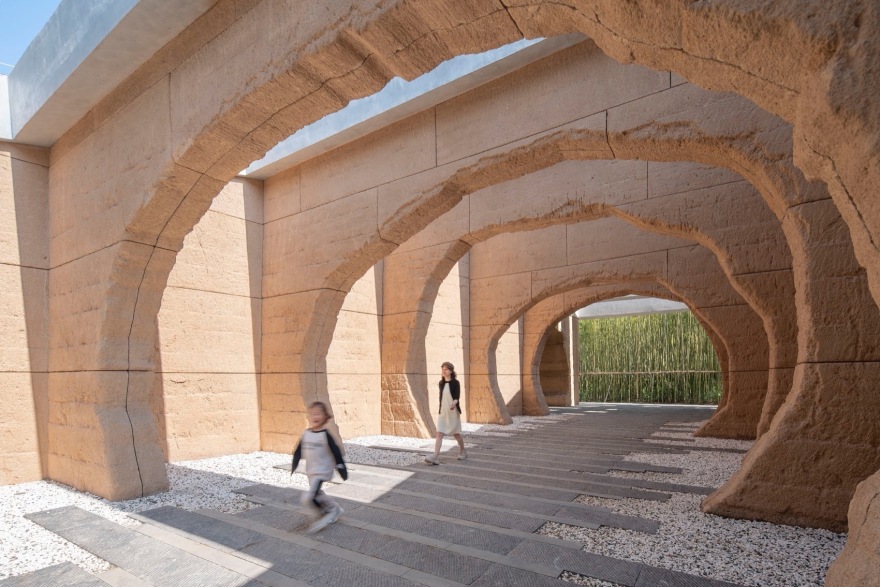
引道端头的北侧是游客中心。
At the northern end of the entry path sits the visitor center, while to the south lies the exhibition space preceding the relic site.
▼游客服务中心,Tourist Service Center © TAL

南侧是进入遗址区前的展陈空间。展陈空间的序厅环绕原生双树而建,主厅是原粮仓三分之二空间,斩断其东侧伸进了永乐宫的界域部分,保留了南北两侧部分残垣断壁,用开放的东端将观众导流进遗址区。粮仓拆除部分设几道迂回的玻璃墙,玻璃上的线描神仙图让游客进入遗址场域前先和神仙相识。
The introductory hall of the exhibition space encircles two preserved native trees, while the main hall occupies two-thirds of the original granary structure. The eastern portion of the granary – which had encroached upon Yongle Palace’s historic boundary – was deliberately removed, preserving only fragments of the north and south walls. This intentional eastern opening channels visitors into the relic site. Where the granary was dismantled, a series of winding glass walls now stand on the demolished site. Etched with images of Taoist immortals in the mural, these transparent barriers acquaint visitors with the celestial pantheon before they enter the sacred archaeological site.
▼展陈空间序厅的八角庭院,The Octagonal Courtyard in the Exhibition Space’s Prelude Hall © TAL

▼出展厅后东侧玻璃墙,The Eastern Glass Walls beyond the Exhibition Hall © TAL

针对地表无遗存的困境, “永乐宫再现”采用”虚空显影”策略:两侧坡向中轴的建筑体量界定中间50米宽的宫墙边界,东西两厢在宫殿区以外用实体内容勾勒出作为墟空的中轴区,空中视角的条状台阶种植面强化其空间感知。
To address the challenge of having no surviving surface relics, building volumes sloping toward the central axis on both sides demarcate the 50-meter-wide palace wall boundaries. Outside the palace zone, the east and west wings use solid architectural elements to outline the central axis as a void. From an aerial perspective, a strip of stepped planting beds further reinforces the spatial presence of this void, making the invisible once again perceptible.
▼中轴夜景,Night View of the Central Axis © TAL

中轴的宫殿区是文物的本体所在。虽然地表已没有文物痕迹,地下还是有考古价值。地表展示不做实体,为未来考古留出了宽容度,并用种植留白来表达四大殿的轮廓。由于可建设用地之外是基本农田,只能用抬高的地坪来表述龙虎殿、三清殿及两者之间的甬道。所剩下可塑的空间只有密林中的纯阳殿和重阳殿了,用纤细的钢筋勾勒出与原壁画墙等高的墙体,使观众对壁画的体量有个感性的认识。
The central axis palace zone preserves the original relic site without heavy construction. Employing planting strategy to mark the four main halls’ footprints, it is feasible for the potential of archaeological digging in the future. With farmland occupying all non-buildable areas, only elevated terrains could demarcate the Dragon-Tiger Hall, Sanqing Hall, and the connecting corridor between them. The Chunyang Hall and Chongyang Hall nestled within dense woods in the buildable area. Slender rebars are used to outline walls at the original height of the mural surfaces, giving visitors an intuitive, physical sense of the murals’ original scale and presence.
▼纯阳殿旧址再现,Re-emergence of Chunyang Hall© URBANUS

纯阳殿所在位置原先是场院,已有一层厚厚的混凝土垫层,垫层上竖起用钢筋笼围合成的树池,没有破坏地下层。
The site where the Chunyang Hall once stood was originally a courtyard covered with a thick concrete sub-base. On top of this slab, tree planters with rebar cages were erected, avoiding any disturbance to the underground layers.
▼重阳殿旧址再现,Re-emergence of Chongyang Hall© URBANUS

重阳殿北端是一个高坎,为了达到那个标高,重阳殿的台基轮廓用了架高钢格栅的方式,彻底脱离了场地,以减少对基地的干预。
At the northern end of the Chongyang Hall site, a raised steel grating platform accommodates the steep terrain, allowing access while minimizing ground disturbance and preserving the site’s integrity.
▼从中轴线看向瞭望塔,View toward the Watchtower along the Central Axis © TAL

整个设计的制高点作为”空间之眼”,设在东北侧建筑屋顶,选择了一个能够体会永乐宫与天地山川环境关系的全景视角,以回答现在的永乐宫所无法回答的选址问题。这个瞭望实现了风水堪舆的现代转译——悬挑楼梯隐喻”青龙”升腾,与西区”卧虎”园林形成天地呼应,用俯瞰揭示中轴线与周边山脉的空间关联,直观地解答永乐宫选址的地理密码。
The highest vantage point is positioned on the northeastern rooftop. This strategic location offers a panoramic view that reveals Yongle Palace’s original relationship with its surrounding landscape, addressing a fundamental question the nowadays temple itself can no longer answer: why it was sited here. This overlook achieves a modern interpretation of feng shui geomancy. A cantilevered stair rises in the east as an ascending dragon, echoing the garden in the west as a crouching tiger. From above, the central axis is visually aligned with the surrounding mountain ranges, allowing visitors to intuitively grasp the geographic logic behind the temple’s original placement.
▼洞悉天地人关系的瞭望塔,Watchtower Revealing the Relationship Between Heaven, Earth, and Humanity © TAL

▼瞭望塔构造,Structure of the Watchtower© URBANUS

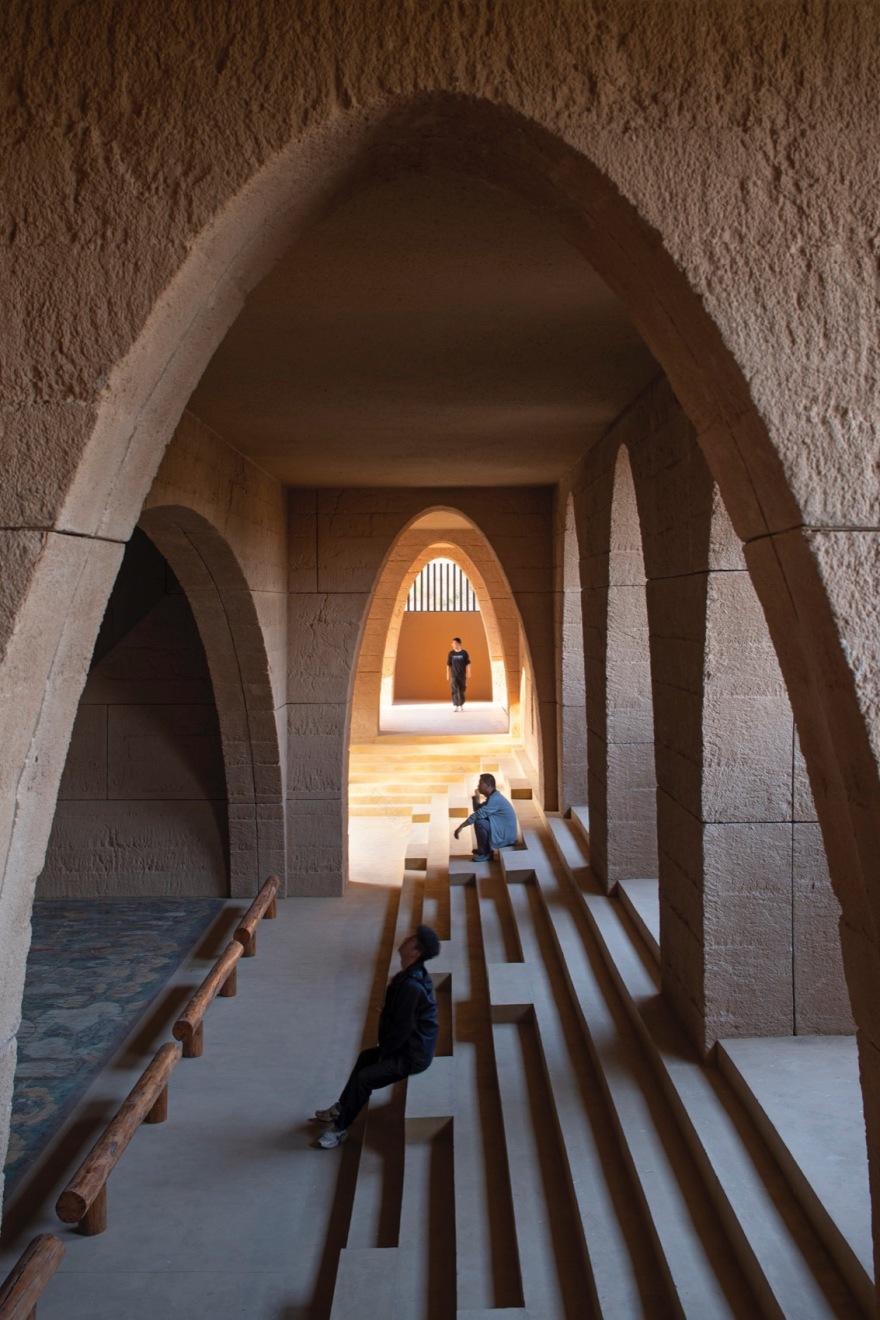
遗址东界设置百米长壁画体验厅,内部拱廊强化了三个体验区所形成的递进式空间叙事。北部的与神仙共舞体验区,是在地面铺装上与三清殿东壁壁画等大的大块印刷瓷板,再用与地面相夹45度角的不锈钢镜面,把地面的壁画反射成直立的镜像,游客躺在地面可看到自己在垂直的墙面上与镜中神仙相邻,仿佛置身于壁画中。
Along the eastern boundary of the archaeological site, a hundred-meter-long mural experience hall is constructed. Its internal arcade structure reinforces the progressive spatial narrative created by three distinct experiential zones. The northern “Dancing with Immortals” zone features the full size mural of the Sanqing Hall’s eastern wall, installed as a ceramic floor pavement. Angled stainless steel mirrors at 45 degrees reflect these floor murals into a vertical projection. When visitors lie on the floor, they see themselves side by side standing with the celestial beings on the vertical wall, creating an immersive illusion of entering the mural itself.
▼体验壁画的空间,A Space for Experiencing the Murals © TAL
▼地面上的朝元图被45度镜反射为垂直壁画,The Chaoyuan Diagram on the Ground Reflected Vertically as a Mural Through a 45-Degree Mirror © URBANUS / TAL

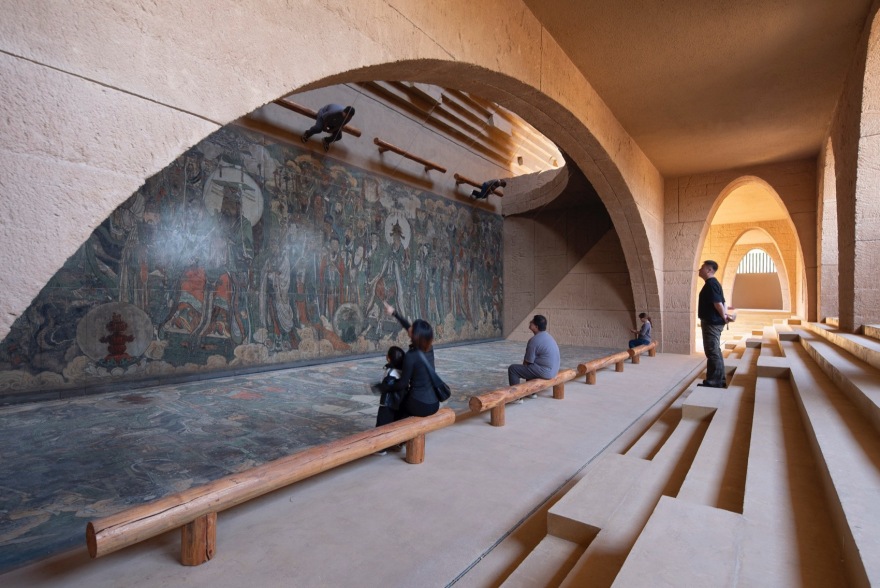
中部是点亮壁画体验区。永乐宫壁画是隐藏在殿内的昏暗光线中,但在这里,三清殿西壁壁画1:1地丝网印刷在玻璃上,在阳光的背光下,神仙们个个发光,为游客带来全面的壁画观看体验。
The central zone features the “Illuminated Mural” experience. While the original Yongle Palace murals were hidden in dim temple interiors, here the west wall mural of Sanqing Hall is reproduced at 1:1 scale through silk-screen printing on glass. Backlit by sunlight, the celestial figures glow with ethereal radiance, offering visitors an unprecedented complete viewing experience of the mural masterpiece.
▼自然光中观看玻璃上丝网印刷的朝元图,Viewing the Screen-Printed Chaoyuan Diagram on Glass in Natural Light© URBANUS / TAL


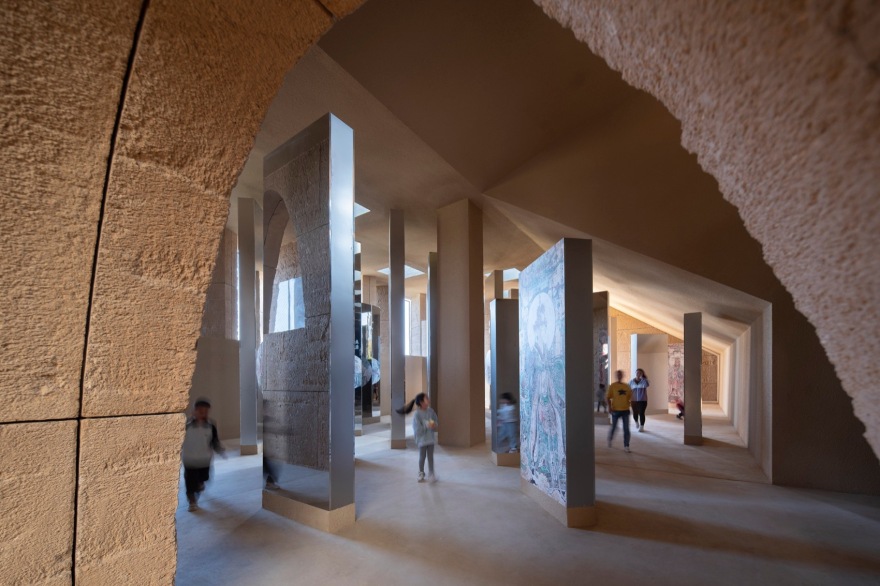
南部是迷离的仙境体验区,观众穿行在一个镜面迷宫,寻找自己在永乐宫壁画中的生肖图像。整个互动长亭提供了现代游客与古老壁画零距离的对话。这些装置化的增强现实为未来深度运提出引导性的方向。这个向未来开放的平台,还会累积出更厚的展示层次。
The southern zone presents an ethereal “Celestial Maze” experience, where visitors navigate through mirrored labyrinths to discover their zodiac likenesses among the Yongle Palace murals. This entire interactive corridor facilitates dialogue between contemporary visitors and ancient frescoes. These installation-like forms of augmented reality offer a guiding framework for the future operation.
▼十二生肖镜面迷宫,Zodiac Mirror Maze © TAL
永乐宫旧址的活化为黄河一号旅游公路提供了一个历史叙事。未来的黄河一号旅游公路将串联起整个黄河文明国家公园。在这个预设下,把一个历史废墟点作为“文化磁场”,用增强现实的方式去放大和显影黄河流域上一个个消失的文明点,让人们更多地实地体验历史的层积,中华文明的图像才会更清晰。这也是芮城县把一个县级文物保护单位活化为一个景区的做法所具有的历史合法性、当下有效性和未来可持续性。这是一个符合国家整体文化利益的地方文旅战略。
The revitalization of the Yongle Palace site provides a historical narrative for the Yellow River No. 1 Tourism Highway, which will ultimately connect the individual cultural spots into the Yellow River Civilization National Park. Within this framework, the project transforms historical ruins into “cultural magnets,” using augmented reality to amplify and reveal vanished civilization sites along the Yellow River basin. This approach enables visitors to physically experience the stratifications of history. Ruicheng County’s transformation of a county-level protected heritage site into a cultural destination thereby demonstrates its historical legitimacy, contemporary relevance, and future sustainability – constituting a local cultural tourism strategy that aligns perfectly with the grand national cultural ambition.
▼平面图,plan©URBANUS

▼剖面图,sections©URBANUS

项目地点:山西芮城
建设单位:芮城县永乐镇人民政府
设计时间:2022-2024
建设时间:2023-2024
用地面积:11,941㎡
建筑面积:3,808㎡
建筑&景观设计:URBANUS都市实践建筑设计事务所|王辉(主持建筑师)| 姚咏梅(技术总监)| 郑娜(项目经理)| 张富军,赵萍,卢勇,豆勇辉,张书岩,陈宇,王竞飞,周彦邦,李晓烨,罗惟宁,孙凡奇,王敬宇,汪蕾,何静涵,柴秉江,胡家铭,温一阳,张婷 | 杨梦汀(实习生)
施工图合作:澳创国际工程设计(深圳)有限公司 | 刘旭、李东(建筑),白国元(结构),许荣(给排水),张开(暖通),王谦(电气)
钢结构咨询:HJI/荷捷顾问|李永明,赵艳国
施工单位:山西随易生态建设有限公司
摄影:TAL
Project Location: Ruicheng County, Shanxi Province
Client: People’s Government of Yongle Town, Ruicheng County
Design Period: 2022-2024
Construction Period: 2023-2024
Site Area: 11,941㎡
Floor Area: 3,808㎡
Architecture & Landscape Design:URBANUS |Wang Hui (Principal Architect) |Yao Yongmei (Technical Director) | Zheng Na (Project Manager) | Zhang Fujun, Zhao Ping, Lu Yong, Dou Yonghui, Zhang Shuyan, Chen Yu, Wang Jingfei, Zhou Yanbang, Li Xiaoye, Luo Weining, Sun Fanqi, Wang Jingyu, Wang Lei, He Jinghan, Chai Bingjiang, Hu Jiaming, Wen Yiyang, Zhang Ting | Yang Mingting (Intern)
Collaborators: Construction Drawing: Aochuang International Engineering Design (Shenzhen) Co., Ltd. | Liu Xu, Li Dong, Bai Guoyuan, Xu Rong, Zhang Kai, Wang Qian
Steel structure consultation: H&J International | Li Yongming, Zhao Yanguo
General Contractor: Shanxi Suiyi Ecological Construction Co., Ltd.
Photographer: TAL

南京喵熊网络科技有限公司 苏ICP备18050492号-4知末 © 2018—2020 . All photos and trademark graphics are copyrighted by their owners.增值电信业务经营许可证(ICP)苏B2-20201444 苏公网安备 32011302321234号
苏公网安备 32011302321234号客服
消息
收藏
下载
最近