

创作上传
VIP
收藏下载
登录 | 注册有礼
查看完整案例

收藏

下载

分享
How the sets of Sanjay Leela Bhansali's
Gangubai Kathiawadi
recreate 1950s' and ‘60s’ Bombay
Gangubai Kathiawadi
, we get an insight into Bhansali’s own personal, childhood experiences of space and architecture, and how it informs his cinematic vision.
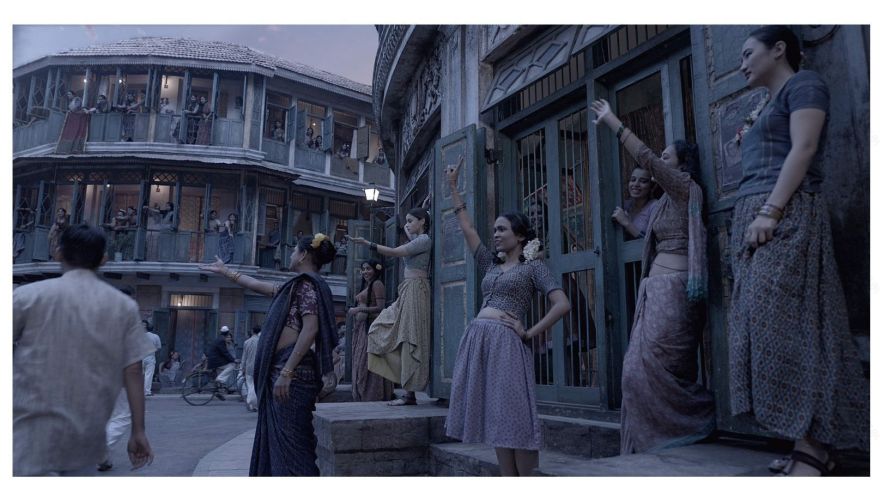
Gangubai Kathiawadi was recreated and shot entirely on a set in Film City, Mumbai
The art and production design in every Sanjay Leela Bhansali film is a whole mood in itself. Whatever the setting or the story, audiences have come to expect that signature look—dripping with rich detail and the maximal use of Indian textile, artwork, colour and texture.
Gangubai Kathiawadi
is no exception. Visually, it plays out almost like a painting come to life. But it goes a step further, in that this is probably his most personal work yet. But more about that in a bit.
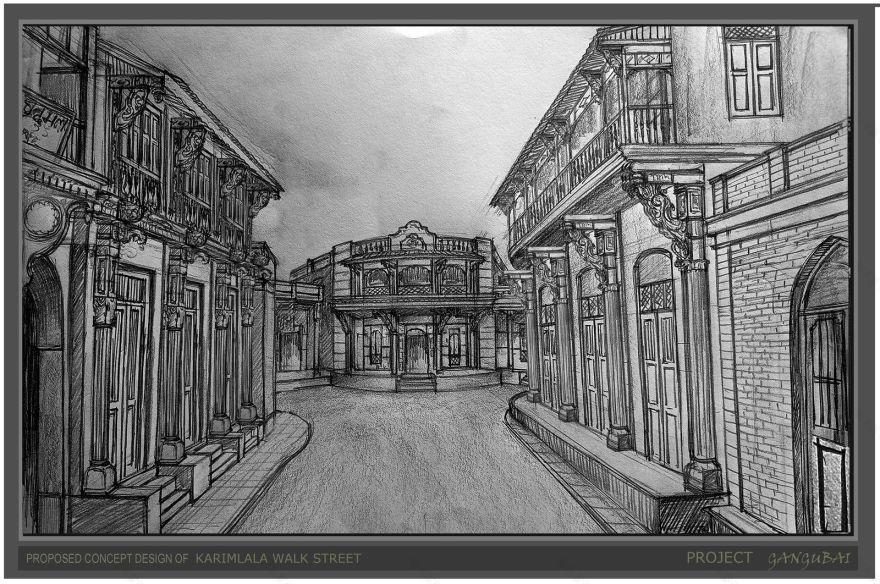

Sketches of the exterior lane as seen in the featured image above.
The movie is a biographical crime drama set in 1950s' and '60s' Mumbai about Ganga Harjeevandas, a.k.a Gangubai (played by
Alia Bhatt
). Based on Hussain Zaidi’s book
Mafia Queens of Mumbai: Stories of Women from the Ganglands,
we follow the fall and rise of a young girl sold into prostitution, who eventually becomes not just the madam of a brothel, but the voice of the cause for the recognition of the welfare and rights of sex workers—unacceptable and unheard of in polite society at the time. And all of this is set against the backdrop of Mumbai’s infamous red light district Kamathipura—essentially a cluster of squalid lanes in the heart of south central Mumbai, where the women went about their business.

A still from the scene where a Qawwali is being performed on the streets by Huma Qureshi's unnamed character.

A sketch of the street corner where the Qawwali sequence was shot, as seen in the image above.
And this is where it gets interesting. Till he was almost 30,
Bhansali
lived with his family just one street over from where he sets the film. His school route to and fro took him past the brothels and all the characters who inhabited that world every single day. So while the film, its story, the architectural structures and key characters are based on historical facts, what he has done with the look and art design is a homage to some of his earliest childhood memories.

Sanjay Leela Bhansali on the sets of Gangubai Kathiawadi
The way he tells it, the lane was dotted with six (now derelict) theatre buildings—because of which they called it “Playhouse” then localized to “Peela House”—which formed a carousel of assorted impressions that he internalized.


During the monsoons, the “outdoor” locations were protected by 70-foot-tall trusses, which were built as a superstructure to protect the sets.
One such was the Art Deco design details he soaked in from those buildings, as well as that unique hand-painted movie poster art that began to be developed around Indian cinema in the 1920s. This was a kitschy, over the top way to get people into the cinemas that were made instantly recognizable by the images of enticing cleavages, vixen red lips, lurid colours, broad visible brush strokes and an almost 3D-style typography.
Then there is the café that stood at the start of the street that he associates with images of the girls he saw standing around, smoking, waiting—all of it bound by the tinny Hindi film tunes that played on the jukebox in the corner, as the soundtrack to their lives. He sets several important scenes of the film here.

Other fragmented memories also show up—the camaraderie of the girls as they helped paint and powder each other, a red ribbon being plaited into a braid, a hardly there
blouse
with a long floral skirt, a saucy pose struck against a door—moments in the film capture all of these visual vignettes as the story unfolds.
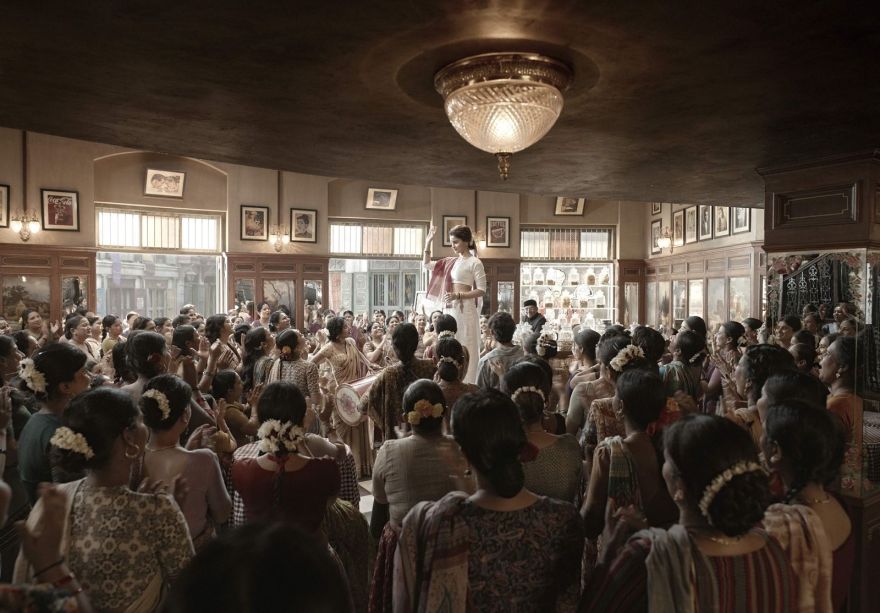


The world outside: Inside the cafe
For all the sets, the design team created realistic, fully functional, three-dimensionally accurate spaces. Many of the textiles, door and window frames were sourced from Ahmedabad.
The other strand that runs through both the story and its cinematic representation is the idea that even a ruin can and must have dignity. Gangubai’s life is a study of this theme. She rises up to meet her circumstances using anything and everything at her disposal—from wrestling privileges for herself and the other girls by leveraging her popularity with the regulars, to eventually becoming the undisputed leader and almost mother-like figurehead of an entire community, of one of society’s most disenfranchised segments. Along the way, she uses corrupt cops, a strategic alliance with Rahim Lala (played by Ajay Devgn), one of the most feared and powerful underworld dons of Mumbai in that era, and journalist Amin Faizi (played by Jim Sarbh), who helped to evangelize her cause.
By about 27, she had already reached a position of significant power, and in a strategic masterstroke, she took to wearing only white from thereon. The colour white—that universal symbol of purity (and widowhood in India), feels especially loaded and visually visceral in the film. The contrast of her girl-woman persona with its compelling mix of vulnerability and fierceness, and the way she stands out against the gaudiness and sordidness of her environment, is built into the way the scenes are styled and mounted.


Architecturally, Bhansali is obsessed with space. Or perhaps the lack of it when he was growing up.
He admits that he often made up a parallel reality where he could literally push out the walls of their tiny family home to something larger, grander. This manifests in every
film set
he has ever had constructed. He is also deeply fascinated by the idea of beauty in distress. In this film, the production design team gives literal expression to these preoccupations, especially in the detailing of the brothel walls—peeling, faded, broken—as well as to all the elements and distressed textures in the rooms, which include artefacts, textiles and practical props like utensils that would have actually been used in his own home at the time.


Inside the brothel: The rooms
The film was originally planned to be completed in four months. Eventually, it withstood three lockdowns and the Mumbai monsoons and took two years to get done.
From a treatment and design perspective, the maker admits that he has chosen a romanticized expression of a tough neighbourhood, and a dark and often fearful time in his own formative years. Using his craft, he prefers to show his audiences an artistic interpretation rather than the oppressive reality, and in that process has his own cathartic moment that in a way helps set right the world his five-year-old self once inhabited.
'Gangubai Kathiawadi' is coming to Netflix on 26 April.
A Sanjay Leela Bhansali film. Music and Direction: Sanjay Leela Bhansali; Produced by Sanjay Leela Bhansali and Dr. Jayantilal Gada (PEN); Co-Producer: Prerna Singh; Co-Producers (PEN): Dhaval Gada Aksshay Gada, Reshmaa Kadakia; Screenplay: Sanjay Leela Bhansal and Utkarshini Vashishtha; Production design: Subrata Chakraborty and Amit Ray; Costume designer: Sheetal Iqbal Sharma.
南京喵熊网络科技有限公司 苏ICP备18050492号-4知末 © 2018—2020 . All photos and trademark graphics are copyrighted by their owners.增值电信业务经营许可证(ICP)苏B2-20201444 苏公网安备 32011302321234号
苏公网安备 32011302321234号客服
消息
收藏
下载
最近