

创作上传
VIP
收藏下载
登录 | 注册有礼
查看完整案例

收藏

下载

分享
In an old Art Deco building, Dara Mehta's South Mumbai home is an art collector's paradise
In a charming Art Deco building in Mumbai’s heritage precinct, with the bustle of Oval Maidan across the road, collector Dara Mehta lives among a staggering collection of art in a starkly minimal home that is meditative and restrained in its interiors—designed by Neterwala Aibara Interior Architecture—and all for the art to shine through.

Atlas Concorde’s Boost Pro Tobacco tiles in the living room serve an intense counterpoint to the beige walls and the array of Molteni&C furniture. An untitled 1969 work by MF Husain and Adi Davierwalla’s sculptural homage to Homi Bhabha, Crystal and Gold: A Monument to a Memory (extreme left), an Amrita Sher-Gil self-portrait (right) and a rare Vijaynagara trio of Vishnu and his wives on the center table are the key conversation starters in the seating area.
The long drawing room of Dara Mehta's apartment bears a pristine quietude. The house, located on the second floor of a charming
art deco
building in Mumbai’s heritage precinct, seems wholly impervious to the bustle of Oval Maidan across the road. The globetrotting, racehorse-loving Mehta, managing director of one of India’s oldest brokering and investment banking firms (Darashaw & Co), has made a departure from convention while doing up his home. “I found myself more inclined towards brass, metal work, tiles, and use of dark-coloured flooring instead of traditional choices such as marble and wooden panelling. My brief to the designers [Neterwala Aibara Interior Architecture] was about creating something unique and different from what we usually see in homes. Somewhere along the way, it evolved into a Soho-meets-Upper-West-Side aesthetic,” says the 52-year-old.

An untitled SH Raza painting lends a splash of rich color to one of the walls in the bedroom. The painting traveled to the Centre Pompidou in Paris last year for SH Raza (1922–2016)—the first major retrospective of an Indian artist to be held in mainland Europe, and appeared on the cover of the book released to mark the occasion. The Baxter Keramikè coffee table and striped upholstery from the Pure Concept further underline homeowner Dara Mehta’s “less is more” design choices.

SH Raza’s much-acclaimed Haut de Cagnes commands attention from behind the customized wooden bar topped with black glass alongside a Glasremis studio vase sourced from Maison Sia.
Mehta, clad in black shorts and a sweatshirt when we meet on a weekend, minces no words as he describes his preference for minimalism. His choice of uncommon materials underlines his stance—be it stucco beige walls and dark tobacco tiles in the drawing room, a light oak wooden floor in the bedrooms, a flat rejection of curtains and drapes, imported Quantra backsplash tiles for the kitchen, or the glass-topped dining table with sculptural legs cast in concrete. Architect and designer Phirosa Neterwala feels Mehta has ended up raising the bar on simplicity and minimalism by several notches. “He wanted everything to be understated, with clean, straight lines, no curves, and a muted palette of grey, beige and brown—so much so that he didn’t even let us put cushions on his sofa. Dara wanted his collection of art to speak for itself. He had a clear vision of how he wanted it displayed, and lit with art-specific Erco lights from Germany. His collection is a feast for the eyes!”

An FN Souza oil on canvas, Untitled (Landscape with Black Moon), and Somnath Hore’s famous sculpture Refugee Family, placed atop the cabinetry customized by Neterwala Aibara Interior Architecture, present two different statements on society and humanity.

Arpita Singh’s famous oil on canvas, Munna Apa’s Garden, commands a strategic spot in the drawing room. Below are a Maxalto Febo chair and Molteni&C side table.

A major section of the passage is devoted to MF Husain’s only series of drawings dedicated to Mumbai’s popular landmarks.

An untitled ink on paper by Ram Kumar (left) and an untitled blue cityscape by FN Souza (right) are displayed on either side of the window in the study, with an early 10th-century Parvati statue from the Chola period on the coffee table. Poufs by Natuzzi Italia and a Baxter Marilyn chair add to the disarming simplicity of Mehta’s work area.
Aside from being a visual feast, Mehta’s collection packs an emotional sucker punch for any art fiend who walks in. Right at the entrance to the house, a massive glass wall separates the drawing room and the passage, offering a spectacular view of some of the most impressive works in modern Indian art: an
MF Husain
hanging above the sofa (that was previously in the ownership of legendary Asian art collector Masanori Fukuoka and that Mehta “chased” for seven years); on a side table, Tyeb Mehta’s bronze work, Two Heads, which recently made the world auction record for a modern Indian sculpture; on a wall near the bar, SH Raza’s legendary Haut de Cagnes; casting intriguing shadows on a wall, Adi Davierwalla’s splendid cruciform installation, Crystal and Gold: Monument to Memory, specially made as a tribute to Homi Bhabha; and Jehangir Sabavala’s venerated masterpiece Vespers I.
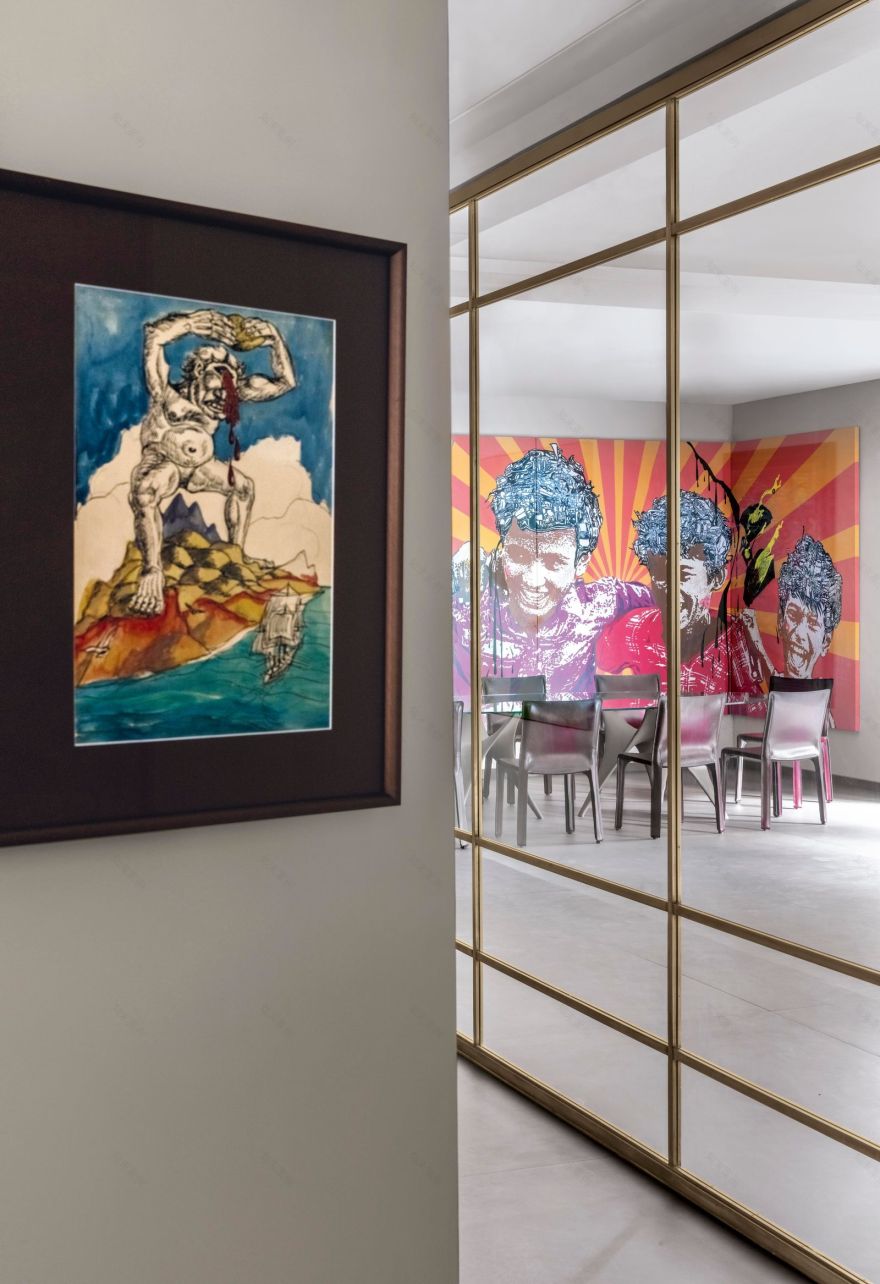
The glass wall that runs along the passage imbues generous breadth to the otherwise long, narrow living room and provides a clear view of a massive Jitish Kallat work spread over two walls. One of FN Souza’s earliest works, done when he was 13 and picked by Mehta at the artist’s estate sale, is placed at the curve of the passage.

Akbar Padamsee’s celebrated Seated Nude looks over the Molteni&C dining table and Cab 412 Bordeaux leather chairs from Cassina.
There is more jaw-dropping stuff waiting on the other side of the glass wall that is not instantly revealed, at least not till you enter the drawing room and see the dining area. A gigantic mixed-media work by Jitish Kallat that Mehta had purchased in 2011 is a force all by itself. Mehta removed it from its packing crates a decade later and split the artwork to spread over two walls near the dining area. To his credit, by mounting the art in a unique manner, he has only made it more magnificent than it already was. “It’s not like I read a lot about art, but I do trust my eye and instinct to identify quality and the significance of each work within an artist’s oeuvre. There have been instances when I have known very little about an artist, yet simply fallen in love with the piece and had the courage to stretch and set a world record. However, it’s not merely about outbidding others. I have also identified seminal works ahead of their time and bought them at incredibly low prices. Something I had heard long ago has resonated with me throughout my journey as an art collector—quality is remembered long after price is forgotten.”

A moment of contemplation awaits at the turn in the passage with Ragpicker as Artist (right), one of KH Ara’s seminal works, and an untitled 1950s work by Akbar Padamsee (centre).

The bedroom door is embedded with FN Souza’s Untitled (Nude with Garters), while a wall near the entrance to the bedroom displays a collection of works, from the early to mid 1950s, of the great masters—VS Gaitonde (top), Tyeb Mehta (centre) and GR Santosh (bottom).
Raised in a family of art patrons, Mehta admits that it is a strange alchemy of passion, instinct, sentimentality, ego and addiction that drives him to collect art, ever since he bought his first artwork when he was barely 19. Today, the long-winding passage from the entrance to his house right up to his bedroom is no less than a gallery of astonishing Modern Indian works and ancient south Indian and Himalayan art.

An untitled Ganesh Haloi painting (reflected in the mirror), created while the artist was working towards his presentation at Documenta 14 (a contemporary art exhibition held every five years at Kassel), is displayed in the primary bathroom. On the left is a Ganesh Pyne 1962 gouache on paper. The sleek washbasin from the Dogma collection by Idea complements the overall stark theme.
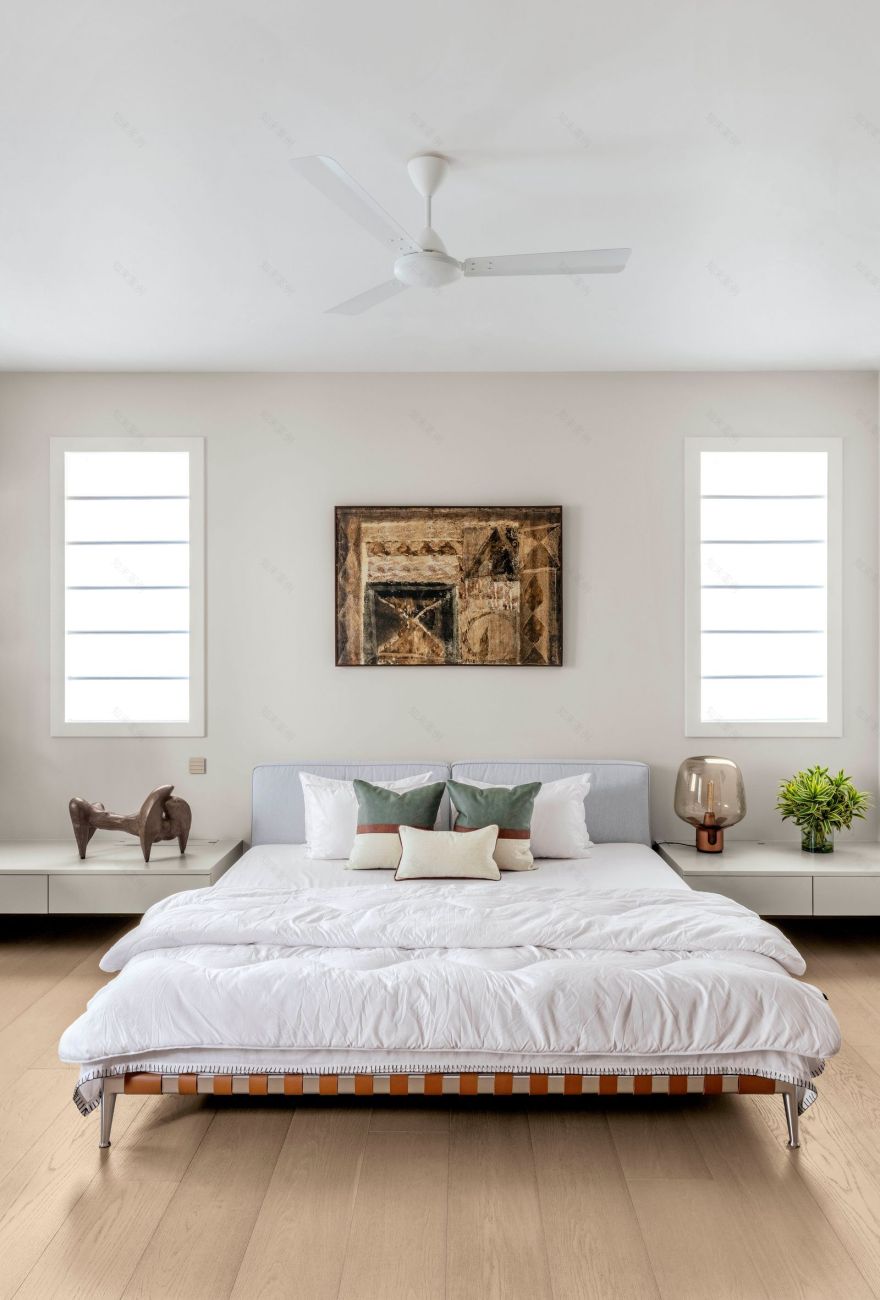
An untitled work (1992) by J Swaminathan and an abstract human torso by Sarbari Roy Choudhury hold pride of place in the bedroom.
The beige stucco paint on the passage walls relents to a sudden burst of colour only in the powder bathroom, where a Sarbari Roy Choudhury sculpture stands out amid the figurative dark blue and gold wallpaper specially commissioned from Italy. “Thanks to that dramatic wallpaper, the monotone of the passage is broken by a sudden where-am-I moment in the powder room,” says Neterwala. Truth be told, the art in his house can be overwhelming but it is never oppressive. One can focus on any work and not be distracted by another. Mehta appreciates the inputs of various friends in helping him achieve this fine balance, especially Khorshed and Dadiba Pundole, Diane Bilimoria and Udit Bhambri.

VS Gaitonde’s Untitled 1960 masterpiece, his largest painting on canvas, was originally commissioned by Air India—to commemorate the historic moment when its first Boeing 707 jet began transatlantic services—and later became part of the storied Bal Chhabda collection. Its ethereal palette is matched by the sophisticated Poliform Stanford chairs and the three-legged Moroso Yumi coffee table under it.
Along the same vein, he points out that as much as he knew what he wanted his space to look like, it was the expertise and dedication of his designers and contractors that made it possible. Above all, Mehta believes in never taking his privilege for granted. “It’s a humbling feeling to know that I can collect and care for these works that reflect South Asian cultural heritage over the millennia.”
Mehta also realizes that joy can come from the simplest of places. Sometimes, in the middle of a noisy party in his drawing room, he finds himself staring at the abstract sculptural glass vase placed at a far window. Made using mouth-blowing techniques at Lithuanian artist Remigijus Kriukas’s studio Glasremis, the vase is not exactly expensive or iconic. But amid all the buzz, it still makes him pause and smile. “Its beauty has made me endlessly happy every single day that I have had it.”
南京喵熊网络科技有限公司 苏ICP备18050492号-4知末 © 2018—2020 . All photos and trademark graphics are copyrighted by their owners.增值电信业务经营许可证(ICP)苏B2-20201444 苏公网安备 32011302321234号
苏公网安备 32011302321234号客服
消息
收藏
下载
最近