

创作上传
VIP
收藏下载
登录 | 注册有礼
查看完整案例

收藏

下载

分享
The open book: The Pinch, Shuanghe village, China by Olivier Ottevaere and John Lin / the University of Hong Kong


The undulating timber roof serves as memorial, pedestrian ramp, playground and meeting place for all ages in the community

The ramp of The Pinch descends to the piazza and has become an impromptu slide for the children of Shuanghe village. The highest point of the roof is expressed as a pitched gable


Rows of books on interlocking timber frames are suspended from the ceiling

The existing concrete retaining wall has been repurposed as a load-bearing wall for
the ramp
AR Library Highly Commended: community needs, the role of the public domain and disaster relief all coalesce in The Pinch, an imaginative timber structure by Olivier Ottevaere and John Lin of the University of Hong Kong
Western media regularly features the remarkable story of urbanisation in modern China. Through an ongoing and unprecedented collective effort of planning, infrastructure and construction, its urban population has increased from 72 million to 770 million (13 to 57 per cent of the country’s total population) since 1950. And according to the World Bank, 500 million Chinese have been lifted out of extreme poverty since 1981, a staggering achievement by any measure.
In rural China, however, poverty is still endemic, and economic migration of the working-age generation often means that children are left behind to be cared for by frail grandparents. The government’s Coordinated Urban-Rural Development (CURD) programme aims to tackle rural poverty, with initiatives covering re-training, infrastructure, stimulation of new industry, controlled migration to urban areas and rural pension subsidies. Rural areas are now being transformed through the construction of new road and rail infrastructure, re-housing, industrial buildings and the promotion of local economies, such as new farming techniques, rural tourism and consumerism.
Complex formal expression shifts from the rectilinear geometry of the entrance, through the curvilinear slide to the triangular gable
Lying in the mountainous Zhaotong Prefecture, in north-east Yunnan Province, Shuanghe village is typical of disadvantaged, yet rapidly changing, rural China. Its current population is 2,872, of whom around 500 are children. Other than a small government office, the village has no public facilities and the nearest junior school is in a larger neighbouring village 1.5km away.
The undulating timber roof serves as memorial, pedestrian ramp, playground and meeting place for all ages in the community
In 2012, a series of disastrous earthquakes razed most of Shuanghe’s buildings, which were originally constructed from adobe and stone rubble. Residents lived in tents while the local government led disaster relief and rebuilding, using reinforced concrete and block construction. A large public memorial square was also created. Habitat for Humanity – an American NGO with regional offices in Chengdu and at the University of Hong Kong, which hosts the Knowledge Exchange programme – joined the effort. Responding to local needs, it allocated limited funds to The Pinch, which was initially conceived as a temporary shelter in the square where children could read and play safely. A second phase involved adding screened enclosures, bookcases and benches.
project, completed in 2014, was led by Olivier Ottevaere and John Lin, both assistant professors at the University of Hong Kong’s Faculty of Architecture. ‘The project took on another life abroad’, says Ottevaere. ‘It continues to be used as a case study in various pedagogical contexts, demonstrating a form of knowledge transfer beyond its realisation.’ John Lin had set up the Rural Urban Framework with Joshua Bolchover in 2005, a hybrid non-profit collaborative that practises within the University of Hong Kong and works on innovative projects and initiatives in remote parts of China.
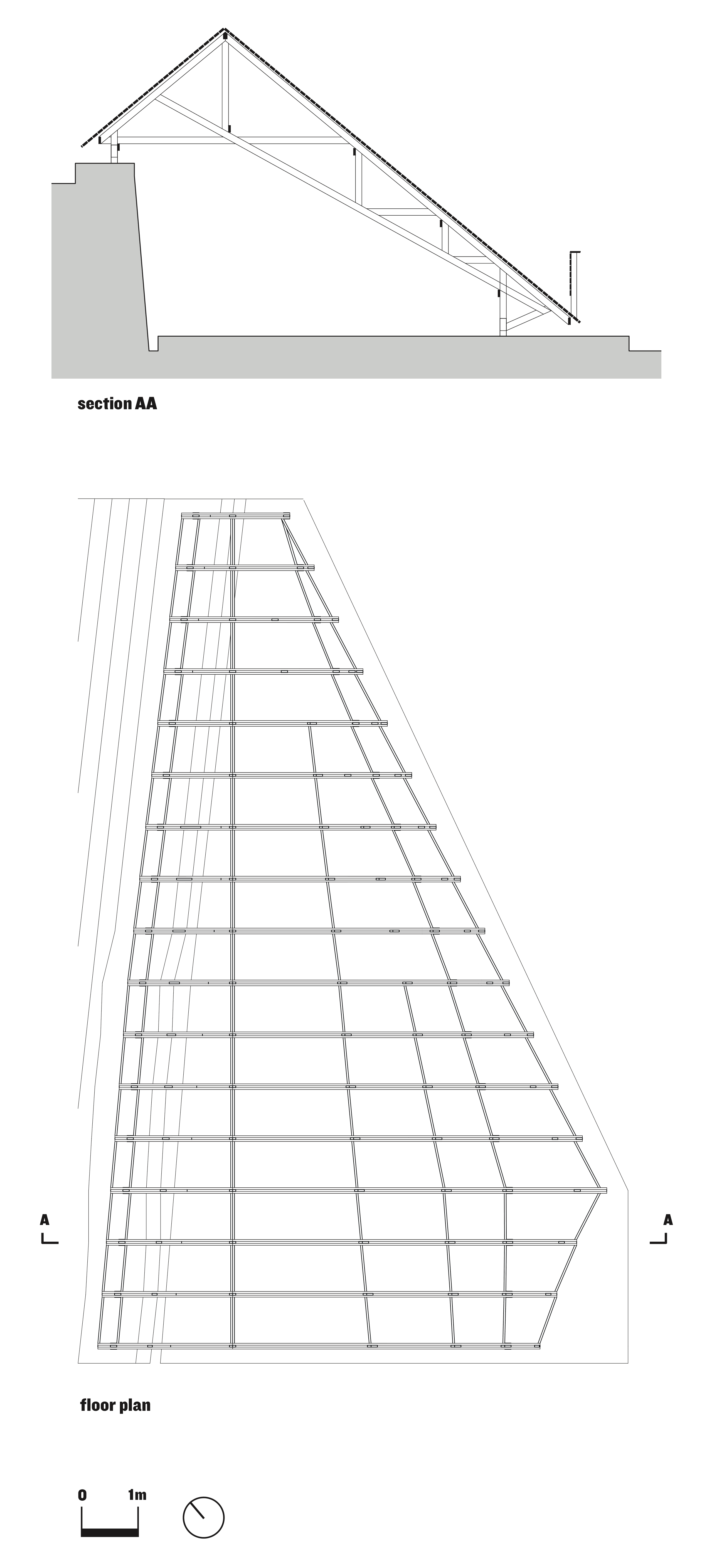
Built against a pre-existing 4m-high road-retaining wall, the new structure forms a viewing platform overlooking the square at one end. The central part of the roof ramps steeply down to connect road to square and is used as an impromptu slide by children. The highest part of the roof peaks up and is expressed as a pitched gable. Inside, an engaging and subtle geometric shift of trusses and space opens on to the square. Bookshelves suspended from trusses and stool benches for children populate the central space.
Library manager Mr Jiang explains that the building is open in the evenings and holidays, and is regularly used by children as a lending and reading library. He stresses that many of the books are about farming skills to benefit local children. Ms Sun, a local member of the village committee, adds that children from outside the village also visit, another unintended consequence. Parents are happy for children to be alone in – and on – the library, where it is safe and overlooked. And with easy access to books, the villagers’ reading and literacy levels have increased. Ms Sun points out that locals enjoy using the roof, which offers views of dancing, basketball and festivals in the square. I ask villagers what people call the building. The reply is quick: ‘We call it The Open Book, because from the square it looks like one, and it’s a library for reading’.
Being inspired by site topography, the merging of outdoor context with interior, the blurring of ground with roof and ‘architecture-as-landscape’ are familiar contemporary design narratives. Here, however, there is also a measure of complex formal expression, which shifts from the rectilinear geometry of the entrance, through the curvilinear slide to the triangular gable.
The ramp of The Pinch descends to the piazza and has become an impromptu slide for the children of Shuanghe village. The highest point of the roof is expressed as a pitched gable
As a sculptural symbol, urban component and community facility, the building and its construction methods are deeply intertwined. The choice of timber also differentiates it from ‘normal’ masonry construction and alludes to memories of older building types. ‘Rather than submitting to the abandonment of wood construction – as with the houses after the earthquake – the project reasserts the ability to build contemporary timber structures in remote areas of China’, says Lin.
The design process ‘resulted in the development of a surprisingly diverse form through simple means’, he says. This is a complex three-dimensional form constructed from readily available timber components. Compared with processes of algorithmic form generation, such as parametric modelling, it is not arbitrary. Although small, it embodies a richness of form, space and association, while being highly responsive to its urban role in public space and to its practical daily uses.
The new ground slab was provided by local government. To this a series of trusses – each drawn in elevation and with full-size printed drawings provided for the contractor – were fabricated on site from standard timber sections and simply bolted at joints. The Russian timber was milled from logs in Inner Mongolia and treated with preservatives at the contractor’s depot before delivery to site. External timber was painted with an oil-based waterproofing agent. Lapped, untreated aluminium sheeting was tacked to the top of trusses, with timber decking on battens then fixed through the aluminium into the trusses.
Some of the decking plank ends have rotted and been replaced with new untreated wood, although in China it is still normal to see unfinished or decayed buildings. Expectations – and so standards – are low. Like the rest of the village, the surrounds of the building and square have not been finished. As the building was designated a temporary structure, it did not have to meet formal earthquake resistance criteria or approvals and the detailing reflects this. However, the massive canted concrete retaining wall and light, flexible, bolted roof construction would seem to be a reasonable starting point if designing for earthquake safety and collapse.
The existing concrete retaining wall has been repurposed as a load-bearing wall for the ramp
Local temperatures vary from below freezing at night in winter, to 25°C on summer days. Life in these villages is lived very much outdoors: front living rooms and shops facing the streets are mostly unheated, without doors or windows. The library is augmented by rudimentary screens for winter and openings for cross-ventilation in summer. Generally, however, villagers did not think overheating or cold in the building was an issue.
Amid the immense disadvantage and vast terrain of rural China, the project is a drop in the ocean. But, despite its modest scale and budget, it is an imaginative realisation of interwoven ideas about disaster relief, community needs and the role of the public domain. It touches on collective memory, creates identity, successfully experiments with contemporary form and construction, and is used and liked by the villagers. Potentialities and associations are aggregated here – with great effort – through profound and simple means. The ideas behind it suggest a model not only for the village and its children, but also for wider development and environment agencies – and architects.
Architects: Olivier Ottevaere and John Lin / the University of Hong Kong
Project team: Olivier Ottevaere, John Lin, Crystal Kwan, Ashley Hinchcliffe, Connie Cheng, Johnny Cullinan, Jacky Huang, Joyce Ip, Yvonne Xu Meng
Photographs: courtesy of the architects
南京喵熊网络科技有限公司 苏ICP备18050492号-4知末 © 2018—2020 . All photos and trademark graphics are copyrighted by their owners.增值电信业务经营许可证(ICP)苏B2-20201444 苏公网安备 32011302321234号
苏公网安备 32011302321234号客服
消息
收藏
下载
最近