

创作上传
VIP
收藏下载
登录 | 注册有礼
查看完整案例

收藏

下载

分享
Revisit: High Line by Diller Scofidio + Renfro and James Corner Field Operations


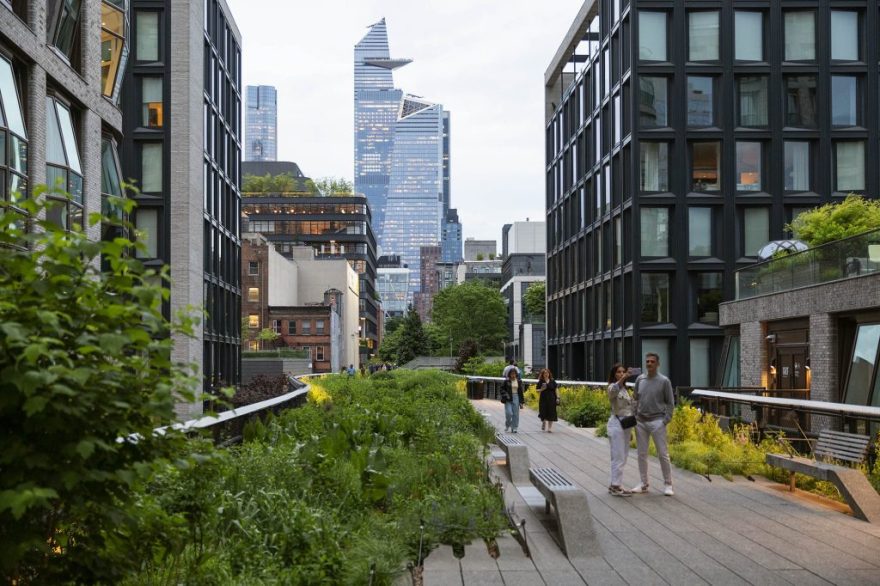


The repurposed elevated railway in New York City has become an engine of neoliberalism
A pair of siblings, no older than five and seven, smooth their hands over one of artist Tishan Hsu’s distorted orifice sculptures, covered with images of matured nipples, ear canals and several unidentifiable apertures. The artwork is perched on the High Line, above Little West 12th Street. Their father examines the installations; confused and slightly disturbed, he asks them not to put their hands ‘in it’ – except there are no visible openings. The family leaves, and I ask myself: who is this for?
The High Line extends for a mile and a half (around 2km), elevated 9m above the Meatpacking District and Chelsea neighbourhood in West Manhattan. Until the early 20th century, this stretch of New York City was a commercial centre for meat and produce shipping and was later home to manufacturing companies such as Nabisco, whose factory the High Line now cuts through. Freight trains used to push along the ground‑level railway lines, but unwieldy traffic caused significant casualties. By 1910, more than 540 people had been killed by trains, earning the passage the nickname ‘Death Avenue’.

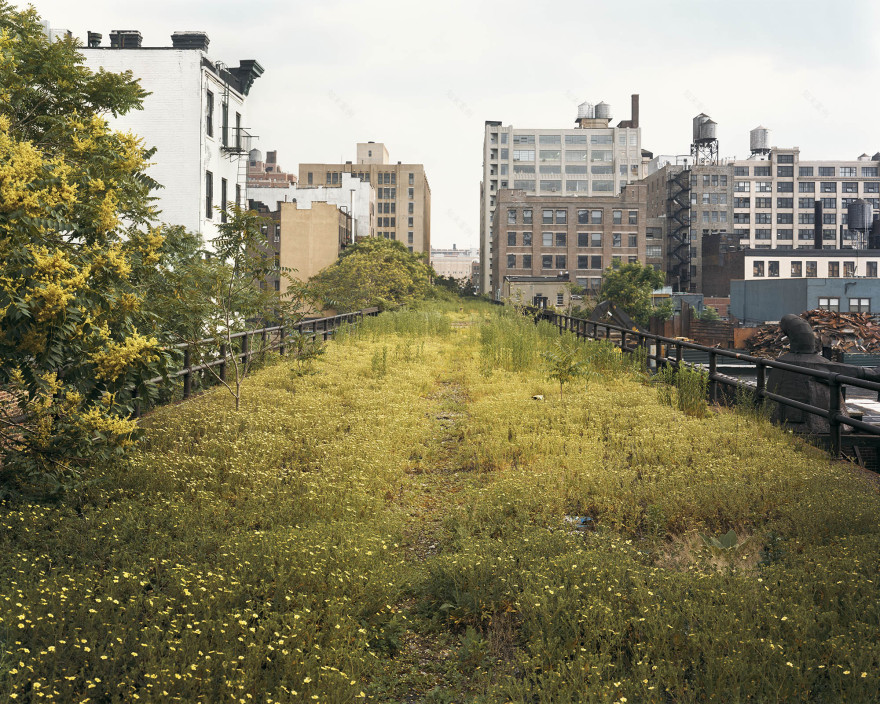
The ‘West Side Elevated Line’ was born, and freight trains continued to service Manhattan with meat, dairy and other produce on a raised railway. The last rail carriage crossed the High Line carrying frozen turkeys for Thanksgiving in 1980, before the structure was deserted as the trucking industry expanded and businesses relocated. By 1990, the railway had succumbed to nature, and unkempt vines and wildflowers engulfed the derelict structures: a fitting image for a post‑industrial United States. At the end of the decade, two days before leaving office, then mayor Rudy Giuliani signed a demolition order.
Joshua David and Robert Hammond, two local residents who met at a community board meeting in 1999, saw something in the defunct rail line, but they were the only ones. ‘By the end of the meeting we realised everyone in the room was in favour of demolition except for us,’ Hammond told Jared Green in an interview for the American Society of Landscape Architects in 2017. ‘So we exchanged business cards and we said, “Well, why don’t we start something together?”’ David and Hammond launched the Friends of the High Line, a non‑profit for this urban reclamation project, in 1999, with the help of photographer Joel Sternfeld. In 2003, Friends of the High Line launched a promotional ‘ideas competition’ for what to do with the park that received more than 700 submissions (my personal favourite being the ‘Big Apple Roller Coaster’, proposed by Front Studio Architects). A year later, a more practical ‘design competition’ was held. Construction of the winning design – by architects Diller Scofidio + Renfro, landscape architecture practice James Corner Field Operations and garden designer Piet Oudolf – began in 2006 and was completed in stages between 2009 and 2019.


The southernmost point of the park, and the first section to be completed, is at the junction of Gansevoort Street and Washington Street, next to the Whitney Museum and the only remaining meat markets in the area, offering one of 15 access points along the High Line’s length. As the High Line prepares to celebrate its 15‑year anniversary, the neighbourhood bears little resemblance to its dingy past life. The area has swapped butchers’ coats for haute couture: a store for designer brand Hermès opened in 2019, another for Loro Piana in 2020, and an Yves Saint Laurent store is set to open this year; events are regularly hosted by similar high‑end brands in the neighbourhood.
Above, on the High Line itself, barefoot adults can cool off their feet on warm days and nappy‑clad babies can splash about in a gossamer‑thin layer of running water. The old railway tracks serve as the base for reclaimed‑teak park benches which are lined with people tanning in the sun, unobstructed by the skyscrapers that line most of the park. (Timber from the Amazon rainforest was originally planned but abandoned after pressure from local climate activists.)


A little further north at 15th Street, where the High Line cuts through the repurposed Nabisco factory (now home to the Chelsea Market), a row of vendors offer anything from authentic vegan Szechuan food to paletas (ice lollies) or chip baskets. The corridor sliced through the factory is routinely overcrowded with visitors, highlighting the more commercial nature of the park. While it is common, and indeed beneficial, for bigger parks in the city to have a variety of sanctioned food and drink options on‑site, here it can feel like the market below has impinged on the park.
Ahead, the walkway is currently crowded with the scaffolding around One High Line, the 84,000m2, 236‑unit luxury towers by Bjarke Ingels Group – one of many recent projects that have sprung up along the High Line’s length since the 2005 West Chelsea Zoning Proposal was approved. Now, prospective residents can purchase a one‑bedroom apartment in Heatherwick Studio’s Lantern House for $2.9 million, a two‑bedroom apartment designed by Zaha Hadid Architects for $5 million, or a $17.5 million penthouse by Thomas Juul‑Hansen.


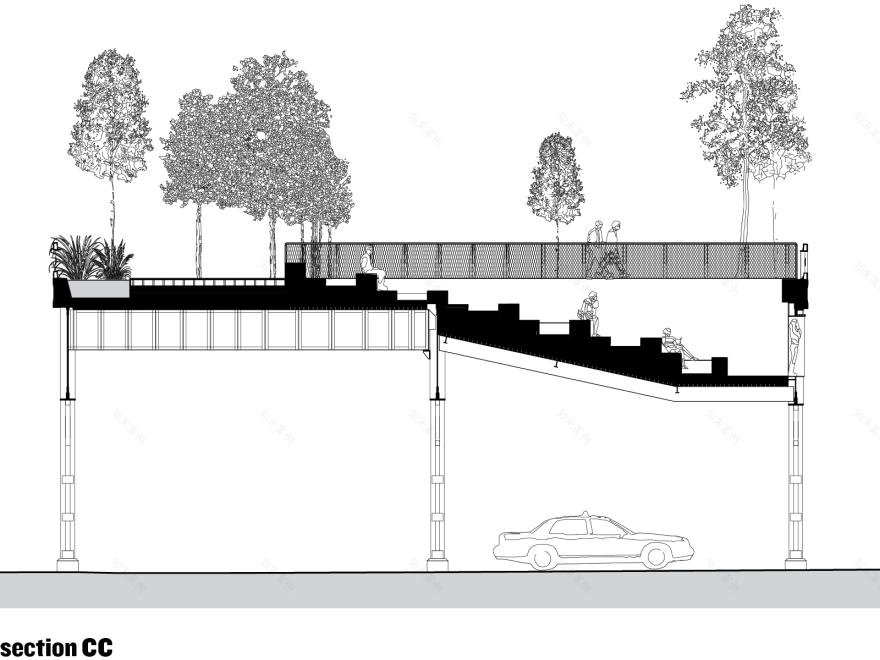
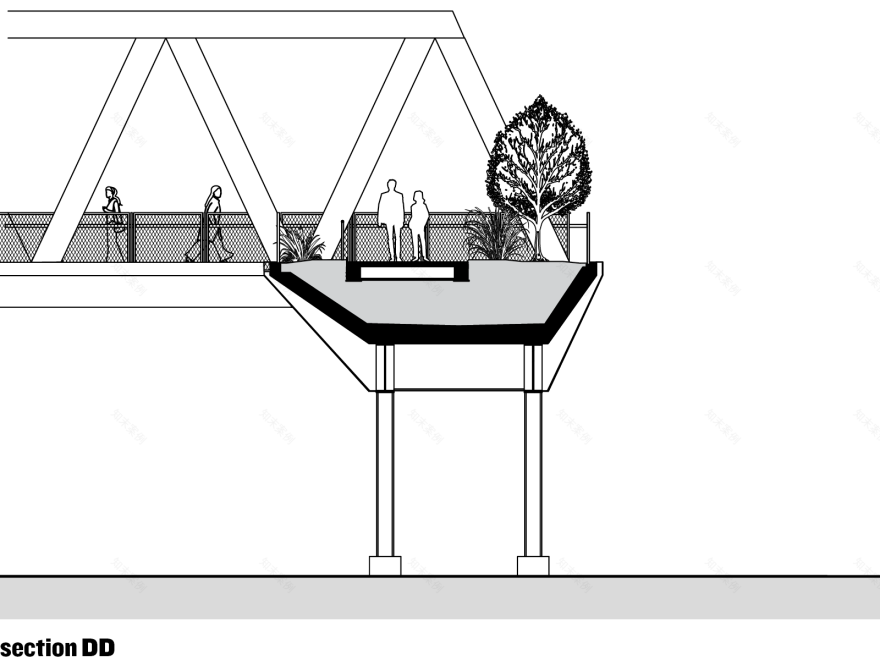
Above 10th Avenue and 26th Street, the narrow mini‑bridge of the Flyover features magnolias, sassafras and serviceberry trees among the original rail spikes; with trees extending over the guardrails to shade the path, it is a brief aesthetic departure from the High Line’s intensely manicured gardens. It is a far cry from the once ubiquitous Ailanthus altissima photographed by Joel Sternfeld 25 years ago along the disused rail line. Diversity of plant species in its reincarnation as the High Line has doubled; according to the Landscape Architecture Foundation, the park ‘sequesters over 1.3 tons of atmospheric carbon annually in 750 newly planted trees’.
Friends of the High Line have championed the sustainability of its botanical project with drought‑resistant plants, and emphasise a robust support system that includes innovative watering and irrigation practices, local plant sourcing and ‘bee hotels’ to inflate the pollinating population. But the High Line incorporates green space – including 200 types of perennial plants, 40 different grasses and more than 150 species of trees and shrubs planted on‑site as of 2017 – at a steep cost; with yearly maintenance and operations fees totalling north of $500,000 per acre (primarily funded by private donations to Friends of the High Line), it is the city’s most expensive park.

The park widens at 30th Street, before The Shed which was designed by Diller Scofidio + Renfro and Rockwell Group in 2019. Just beyond is the soon‑to‑be reopened Vessel, designed by Heatherwick Studio, which has been closed since 2021 after being the site of several suicides. (Multiple safety measures have been added, including ‘cut‑resistant’ steel mesh nets.) To the right, the path forks into the High Line–Moynihan Connector, a $50 million L‑shaped pedestrian bridge by Skidmore, Owings & Merrill (SOM) and James Corner Field Operations, which links the High Line to the Magnolia Court pedestrian plaza by James Corner Field Operations and the Moynihan Train Hall at Penn Station, also by SOM. Brookfield Properties, which owns the adjoining commercial market complex, and New York State each gave $20 million to the project, and Friends of the High Line rounded it up with an additional $10 million through private fundraising, which accounts for most of their annual budget.
The High Line disrupts classical notions of a park – instead of communing on a picnic blanket on a sprawling lawn, visitors move through a garden surrounded by high‑rises. Like all public parks in New York City, visitors are subject to rules which are outlined at entrances: ‘No smoking, no bicycles, no pets, no skating, no alcohol’. The park is looked after by Parks Enforcement Patrol, which is the city’s public park security. But unlike Central Park or Prospect Park, where those rules are routinely violated, the High Line seemingly remains less susceptible to both petty recreational transgressions and felonies. The harmony of the High Line is enforced by its built environment; more than 9m high, narrow throughout and peppered with surveillance cameras, it is not an inviting space to violate norms.

In total, the first two sections of the High Line cost about $152.3 million to build, almost entirely funded by federal, state and city subsidies, on the promise that it would pay for itself – and that it has. David and Hammond made promises that the High Line would generate more than $200 million in taxes – a gross underestimation; the project has stimulated over $5 billion in urban development and created 12,000 new jobs, according to SOM. Today, more than eight million locals and tourists visit the park annually – significantly higher than the initially projected 400,000 figure that Elizabeth Diller, co‑founder of Diller Scofidio + Renfro,
The High Line has spurred a boom in luxury development in the area. This has seen criticisms of eco‑gentrification levelled against it, which economists

Rent control and stabilisation are obvious bulwarks against such drastic rent increases, and at their best also serve to curb the political power of the developers driving the phenomenon. As local community organiser Asad Dandia explains, ‘There does not have to be a dichotomy between pro‑climate development and rent protections. In fact, the two must go together.’
Despite the almost folkloric legacy of two do‑good neighbourhood activists hoping to inject life into a city with desperately needed urban greening, the High Line is not an altruistic project; however it started out, Friends of the High Line is no longer a small‑scale neighbourhood not‑for‑profit. It was an economic promise sold to former mayor Michael Bloomberg as a way to generate tax revenue, backed by billionaires such as Barry Diller (no relation to Diller Scofidio + Renfro), and which far exceeded its goals. But the Friends of the High Line and the architects are not malevolent forces that alone created gentrification in Chelsea, and neither are David and Hammond as individuals. To their credit, they have acknowledged their contribution to the issue; Diller admitted in the

David and Hammond’s grassroots activism around saving an industrial relic, suffocated by untamed vegetation, transitioned into an ambitious attempt to reimagine urban parks through public‑private partnership that would resonate around the world. In their humble goal of preserving the post‑industrial flowerbed, the Friends of the High Line became the standard bearer for green, urban adaptive reuse, and sprouted imitations, domestic and abroad. The optimism of the neoliberal era in which the High Line was conceived could not even predict this boom, and its posterity lacks that youthful bliss, instead producing cynical copycats such as the Underline in Miami, Phase 2 of which by GSLA Design opened in April this year, or
It has been argued that neoliberalism is dying. Perhaps, then, we can move beyond neoliberal approaches to urban design that foreground the interests of massive developers, and proclaim the death of hyper‑gentrification and commercialisation as the inevitable outcome of greening the urban environment, too. Even then, urban renewal projects that are not genuinely public ventures, buoyed by increased taxation on individuals like those who fund the High Line, will fail in their effort to repurpose the ruins of the city’s past lives.

南京喵熊网络科技有限公司 苏ICP备18050492号-4知末 © 2018—2020 . All photos and trademark graphics are copyrighted by their owners.增值电信业务经营许可证(ICP)苏B2-20201444 苏公网安备 32011302321234号
苏公网安备 32011302321234号客服
消息
收藏
下载
最近