

创作上传
VIP
收藏下载
登录 | 注册有礼
查看完整案例

收藏

下载

分享
Next of kiln: terracotta workshop in Quảng Nam province, Vietnam by Tropical Space
A new addition to this family-run kiln has deep roots in the landscape
‘Look at the landscape across the river,’ says the terracotta artisan Lê Đức Hạ. ‘It was once the capital of the lost Champa kingdom, Trà Kiệu.’ The Cham civilisation flourished for centuries here, in Quảng Nam province on the central coast of
Vietnam
, before falling into ruin in the 19th century. The Thu Bồn River, which runs past Hạ’s kiln, studio and workshop just north of Đông Khương village, provided the rich red clay used to construct its spectacular temples, and continues to provide material for Hạ’s workshop. It is also the inspiration for two buildings on the site by Ho Chi Minh City‑based architects Tropical Space:
a studio completed
eight years ago, and a new workshop space finished last year.

Completed in 2023, a new workshop space for Lê Đức Hạ’s terracotta practice showcases the kiln’s wares prominently within the landscape from which the clay is sourced. Credit: Trieu Chien
Hạ’s early career was in the military. After retiring in 1982, he pursued a number of unsuccessful business ventures, before moving back to his home village of Đông Khương and reviving his late father’s abandoned kiln. In 1994, Hạ and his family moved their practice to the outskirts of Đông Khương, to the present site on the river bank, where the business took off: they recruited a group of locals, many of whom were relatives, and expanded the workshop. By 2016, Hạ was in a position to commission Tropical Space to design a new studio space reserved for his own artistic practice, with his potter’s wheel at its centre. The kiln’s team of local artisans were working in an older building, however, which was beginning to deteriorate. During the harsh storms of 2022, its corrugated metal roof became unsafe, and Hạ approached Tropical Space again to design a new workshop.
Under the management of Hạ’s children, the business had grown considerably, exporting its wares internationally. The architects were briefed to expand the premises and include public areas, where visitors can attend workshops and fire their own pieces in small gas kilns, in addition to workspaces for the kiln’s artisans. The old workshop building was duly dismantled, but the central kiln was kept because, explains Hạ, ‘it holds so many memories of the family’s past two decades’.
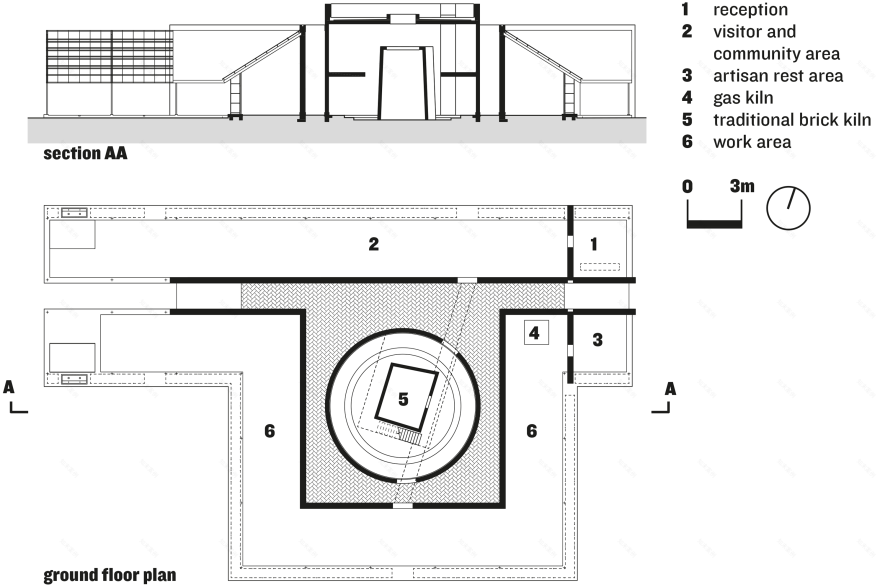
Tropical Space understood the deep significance of the family kiln and enclosed it within a cylindrical perforated brick structure. Around that focal point, they constructed walls in a rectangular plan, echoing the layout of the 2016 studio space. From these walls, steep gables supported by light steel frames provide generous shading for production areas and public activities. From street level, the tin roofs look modest and blend in with the local houses. But as you enter the corridor space between the walls, the building dramatically unfolds to reveal the monumental kiln inside, its bright orange textures contrasting against the clear blue sky of Quảng Nam.

At its heart is the family kiln, which architects Tropical Space have enclosed within a perforated brick structure. Credit: Trieu Chien
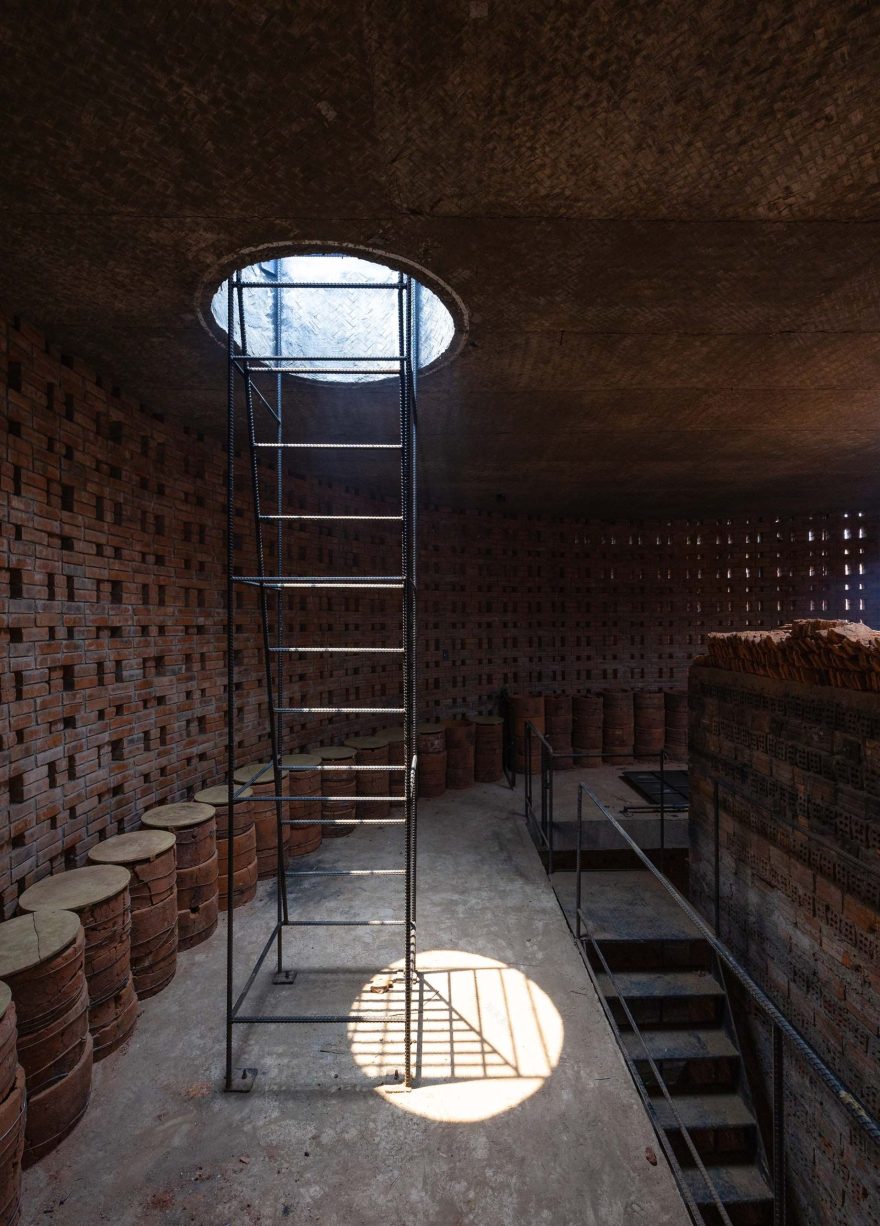
Credit: Trieu Chien
Narrow gaps in the new workshop’s perforated brick walls offer glimpses into the production space, so that visitors can observe the artisans at work. The architects explain that the height of these gaps is designed to accommodate the movement and posture of the terracotta workers. All of their tools – moulds, clay, potters’ wheels and unbaked artworks – are laid on the rammed earth floor, and the artisans sit on low chairs or stools to work. From this low position, different functional zones are connected by uninterrupted lines of vision carefully choreographed by the interplay of gaps, through which the artisans can oversee the whole working process and chat with each other. These lines of vision extend to the garden and the river, while also helping to cross‑ventilate the space. It is a simple yet sophisticated building that allows for an intimate relationship between people and the landscape around them.
Fired brick is the dominant material in the restrained palette that characterises many of Tropical Space’s projects. For the new workshop building, bricks were produced in neighbouring villages, cutting down the cost of construction as well as transport emissions. The material is well adapted to the local climate, its porous texture absorbing humidity and heat to maintain a comfortable interior microclimate.
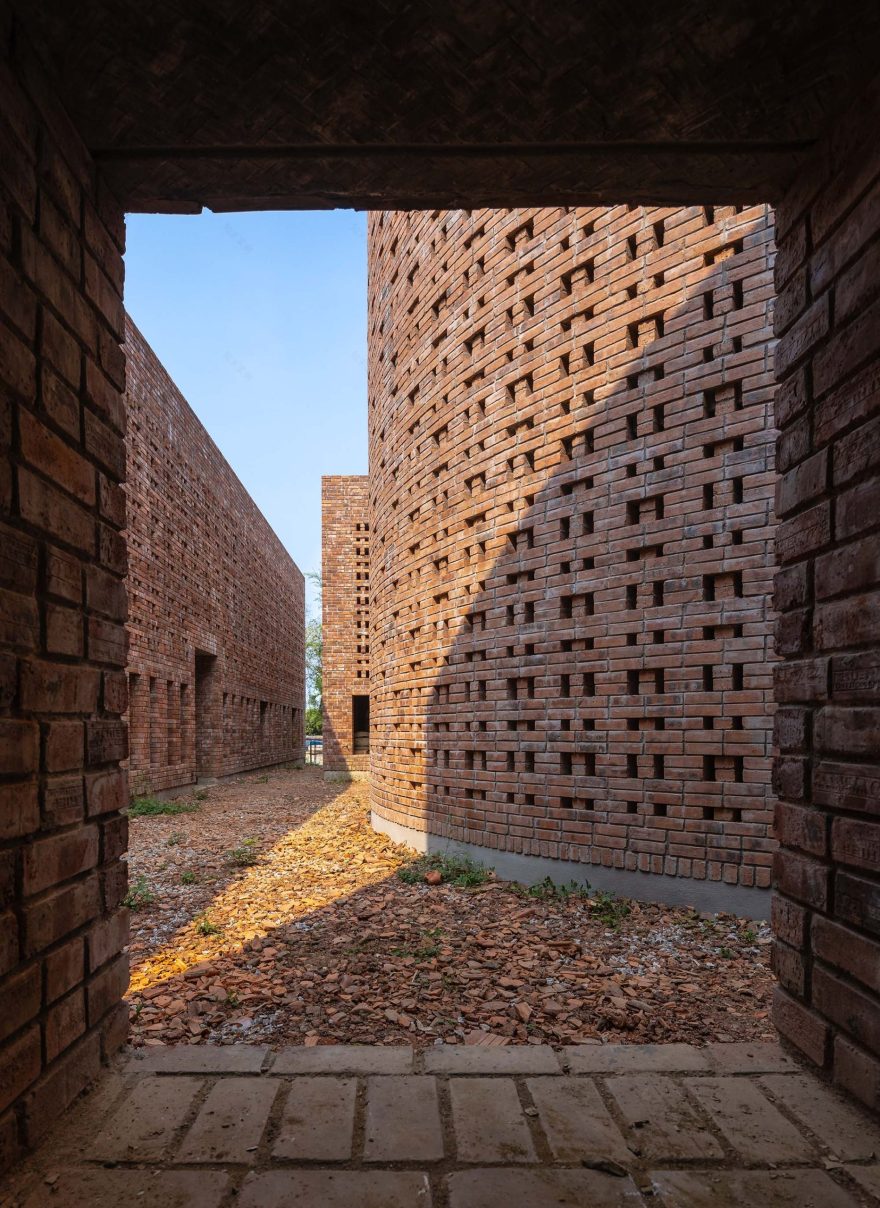
The space between the kiln and ancillary workshop areas creates an interior courtyard, where the wares can be prepared before firing. Credit: Trieu Chien

The artisans’ workspaces and visitor areas are arranged around the central focal point of the kiln. Credit: Trieu Chien
Tropical Space founders Trần Thị Ngụ Ngôn and Nguyễn Hải Long argue that all building activities are, in a sense, destructive. ‘What architects can do,’ says Ngụ Ngôn, ‘is to reduce the extent of emissions and return to underappreciated solutions that have proved efficient for a long time.’ For Hạ, the use of brick expresses his and his family’s attachment to the land’s geology, history, memory and forgotten Cham wisdom – much like terracottta, his own material of choice.
Using brick allowed Tropical Space to work with local builders. Some of the craftspeople who helped construct the new workshop are the children of those who built the 2016 studio – a second generation of builders working on the same site, developing and retaining local building techniques and knowledge. The pressure to rapidly construct buildings alienates workers from their work – on this site, the builders worked slowly, taking time to contemplate and enjoy the execution of the bricklaying. ‘In our practice, we want the workers to see their contributions reflected in the finished building,’ explains Hải Long. ‘It is a collective creation that nevertheless embraces individual identity in the face of the homogenisation of the modern building industry.’

The business has grown over the past few decades, and the family wished to include not only new workspaces for its staff, but also public areas for training and community workshops. Credit: Trieu Chien

From the Cham civilisation and up to the present day, the region's clay-rich soils have produced a fine tradition of terracotta artistry. Credit: Trieu Chien
The new workshop is responsive to the extreme climate patterns of Quảng Nam province. The Thu Bồn River bursts its bank every October, flooding the whole landscape and submerging the ground under water. Local people have arranged their lives to adapt to the flooding pattern of the river: when the water rises, they move all of their belongings up to the attic. The design of the workshop anticipates this annual occurrence: the electrical wiring is installed one metre above the ground, while the iron shelves provide storage space to safeguard the artworks and equipment during the floods. The perforated wall moderates strong wind and allows the water to pass through it. ‘Nature will always win,’ says Ngụ Ngôn. ‘We can only choose to design with nature.’
On the ground surrounding the kiln are broken terracotta shards left from the handling process. Hạ’s daughter, Nguyên, who helps manage the workshop, imagines that the pieces will eventually become a part of the soil from which they originally emerged. ‘The local authority has leased this lot to our family for 30 years,’ she explains. ‘When commissioning and developing the workshop, we have had to think about the possibility of not being able to extend the lease. In that case, the workshop will become a village property and will continue to be enjoyed by the public.’ Just like the terracotta pieces being reclaimed by the ground, the building might itself one day be subsumed by the community from which it has emerged.

Every October, the Thu Bồn River bursts its banks, meaning that the buildings must be designed to adapt. In the new workshop tools and wares can be raised on ample shelving, and wiring sits one metre above ground. Credit: Trieu Chien
南京喵熊网络科技有限公司 苏ICP备18050492号-4知末 © 2018—2020 . All photos and trademark graphics are copyrighted by their owners.增值电信业务经营许可证(ICP)苏B2-20201444 苏公网安备 32011302321234号
苏公网安备 32011302321234号客服
消息
收藏
下载
最近