

创作上传
VIP
收藏下载
登录 | 注册有礼
查看完整案例

收藏

下载

分享
Resource pool: conversion of a swimming pool into a public hall in Istanbul, Turkey by So? Architecture and Ideas

The Florya Atatürk Forest, planted in the 1930s as the modern state of Turkey was in its infancy, was slowly occupied by second homes for the political elite
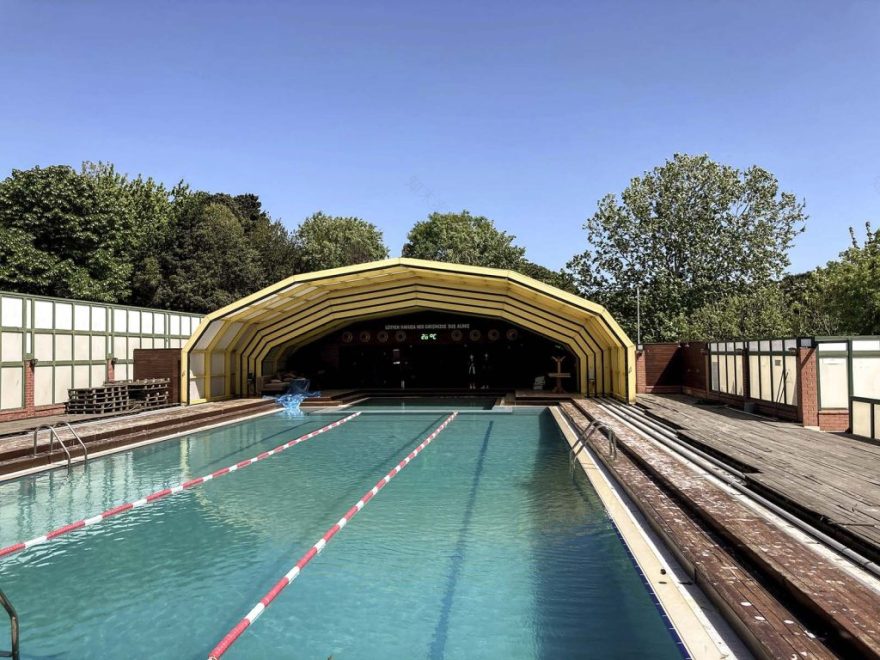
A swimming pool for their use was constructed in the 2010s

Since the election of centre-left mayor Ekrem İmamoğlu, the forest has become the Istanbul Planning Agency’s (IPA) campus and the pool transformed into a public hall

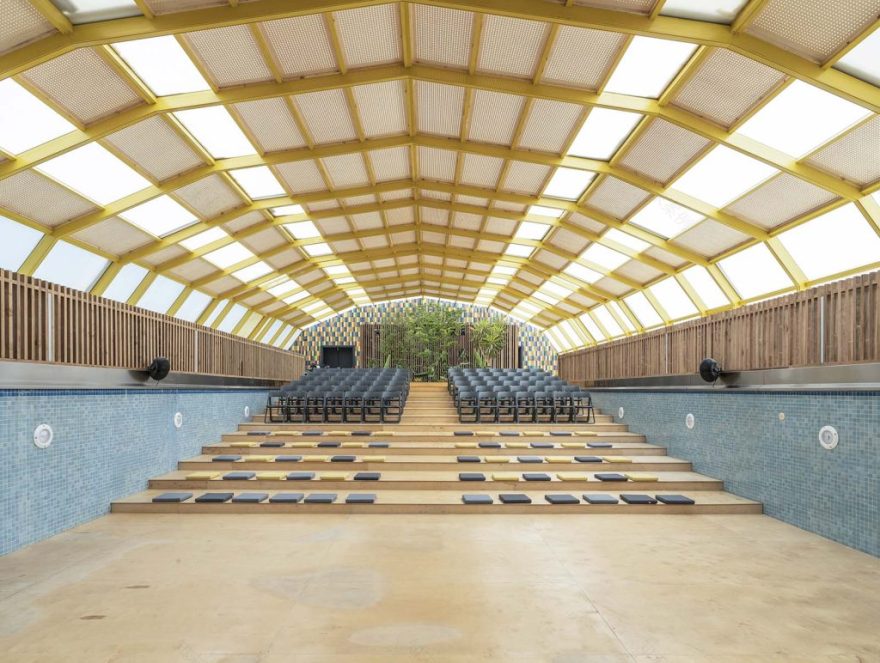
The former pool now provides a sunken auditorium. The underwater lights
and blue mosaic tiles have been kept to preserve the memory of its previous use – and unsavoury history

The roof, which once protected the political elite from the elements on their afternoon dips, has maintained its retractable function so that public events can also be outdoors

Centre-left mayor of Istanbul Ekrem İmamoğlu has just been re-elected for another five-year term, in local elections that saw the autocratic President Recep Tayyip Erdoğan’s ruling party widely defeated. İmamoğlu’s re-election is good news for architects, who have seen a rise in public commissions since the start of his first tenure in 2019
The transformation of a private swimming pool into a public hall is indicative of a shift in urban governance taking root in Istanbul
In Istanbul’s western suburbs, near the coast of the Marmara Sea, a plot of land was set aside in the mid‑1930s to create an urban forest. The government of the newly formed Turkish Republic was attempting to reshape the old Ottoman capital into its vision of a modern city. In the time since then, the pine trees planted there have grown tall and thick, dampening noise from the highway that now separates the forest from the sea.
The 170‑acre Florya Atatürk Forest is on paper designated in full as a natural protected area, but in practice has been slowly encroached on by development. Small lodgings, initially built in the 1950s for the Istanbul mayor and his deputies, were enlarged into two‑ and three‑storey villas during the tenure of Kadir Topbaş, a member of the country’s ruling party who served as mayor from 2004 to 2017 and allocated the homes to district mayors from his own party. A swimming pool and other recreational facilities were also constructed during Topbaş’s tenure.
When opposition candidate Ekrem İmamoğlu was first voted in to the Istanbul mayor’s office in 2019, one of his election promises was to return this leafy enclave to the public. The villas that once served as second residences for favoured city officials have been converted into municipal offices, and the politicians’ private pool into a public event space – a physical transformation symbolising a broader shift in urban governance that is helping redraw the country’s political map.
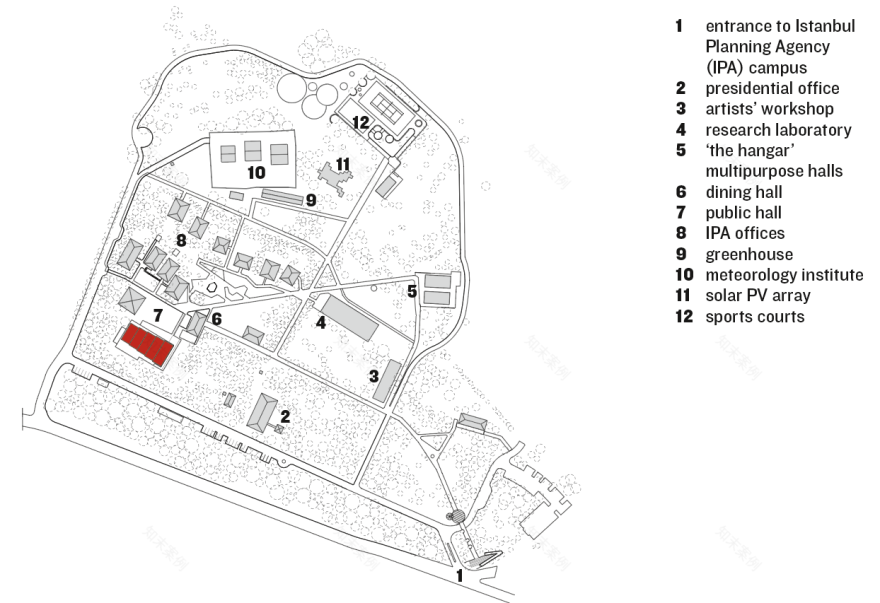
Turning the villas into offices for the Istanbul Planning Agency (IPA), a branch of the Istanbul Metropolitan Municipality established after İmamoğlu’s election, required only limited interior renovations. Figuring out what to do with the pool, though, was another story. Architects Sevince Bayrak and Oral Göktaş were invited to help re‑envision the IPA campus as a publicly accessible space. The IPA was already familiar with the work of the Istanbul‑based studio SO? Architecture and Ideas as they had redesigned a cultural centre in 2018 for the Beylikdüzü district where İmamoğlu started out. They had executed this project not from the ground up, but from the inside out – the reimagining of an unattractive existing building.
The pair proposed to bring this same adaptive reuse approach to the Florya forest; the municipality wanted to establish two public halls at the site, and the architects suggested that the pool be converted to become one of them. Though visitors must check in with security, events are open to the public, and NGOs, students and others can use its facilities free of charge for activities contributing to urban dialogue.
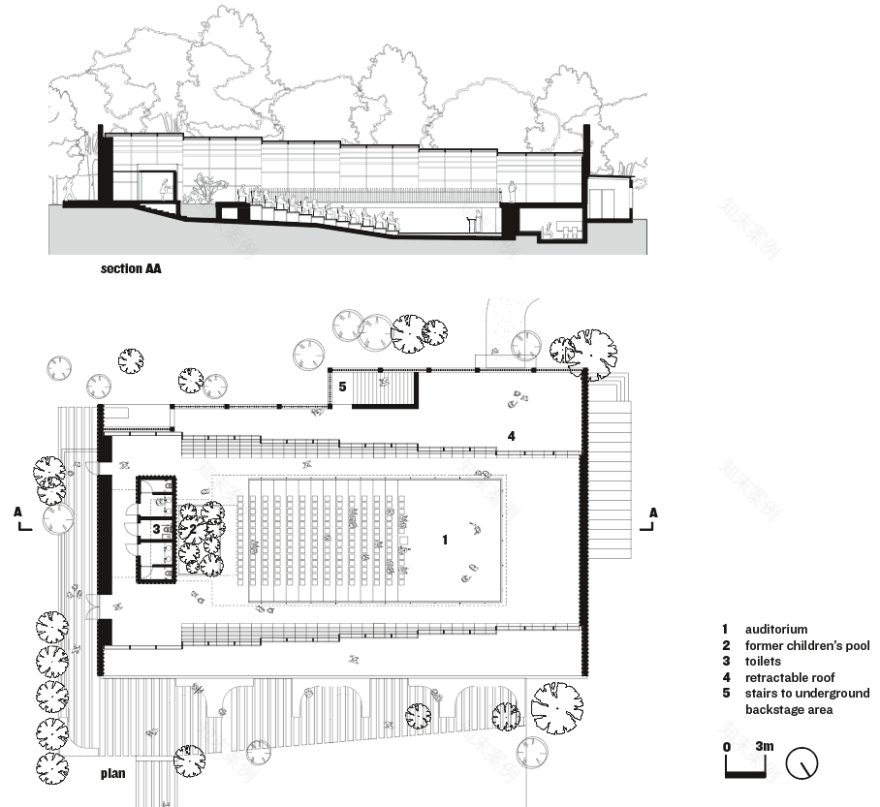
Working with a minimal budget and an ethos of minimal intervention, SO? drained the pool and laid wooden flooring over its concrete base that blends into stepped seating rising to the pool edge. They erected a picket fence around three sides of the pool so overflow crowds can stand safely around its rim, and planted the adjacent children’s pool with greenery. The technical room that housed the pool’s filtration system has been converted into a backstage area and heating units added to the building’s rear wall. The pool’s telescopic polycarbonate roof was fitted out with timber panels to help improve the acoustics in the space, one of the essential requirements for its new function as an event hall.
After a whirlwind four months following the architects’ initial meeting with the municipality, the pool had its grand opening in October 2022 as a 1,000m
public event venue with a 400‑person capacity that can be used in both closed and open form depending on the weather. The SO? team also led a similar transformation of another existing building on the IPA campus, a warehouse known as ‘the hangar’ that now serves as a 550m
multipurpose activity space hosting workshops and exhibitions.
Converting extant structures takes less of an environmental toll than building new ones, which made the architects’ proposals for the pool and hangar an ideal fit for the green vision that the Istanbul municipality has sought to demonstrate at the IPA campus. Asphalt roads have been torn up and replaced with permeable paths, seasonal flowerbeds substituted by low‑maintenance perennial plants, and a rainwater harvesting system installed. Solar panels power the outdoor lighting, while organic waste is composted and used in a garden that provides vegetables for the campus café.
The concept of adaptive reuse stands in sharp contrast to what Bayrak calls the ‘construction era of Turkey’. This decades‑long building boom under the current socially conservative national government has improved infrastructure and living standards while encroaching on public and green space. Opposition politicians including İmamoğlu and other critics charge that public officials have too often turned a blind eye as builders take shortcuts, leaving residents vulnerable to deadly earthquakes (such as the one that devastated a vast swathe of the country in February 2023), and that the focus on rapid construction‑based growth has contributed, eventually, to an ongoing economic tailspin of soaring inflation. Understanding the politicians’ private pool in the Florya forest as a symbol of these excesses, the architects intentionally left key visual elements intact – the retro blue mosaic tiles in its basin, the brash yellow beams of its roof – to preserve its story.
This idea of a building as a vessel for collective memory became the basis for the exhibition that Bayrak and Göktaş subsequently curated for the Turkey Pavilion at the Venice Biennale in 2023 – the initial press announcement was held, fittingly, at the refurbished IPA pool. Titled
Ghost Stories: The Carrier Bag Theory of Architecture,
the exhibition (and accompanying book) draws from a concept previously explored in the fields of anthropology and fiction that posits the replacement of ‘heroic’ narratives of conquest with more collaborative stories that embrace complexity, multiple actors and gradual change. The exhibition included hundreds of unused buildings all around Turkey, ranging from factories and sporting facilities to high schools and hotels, and prompted viewers to consider how such sites could be transformed instead of demolished.
Under İmamoğlu, some of the Istanbul municipality’s highest profile projects have included restoring and repurposing these kinds of abandoned structures – among them a century‑old gasworks, a fez factory, and petrol silos – into multipurpose cultural centres. Though some criticisms have been raised about the lack of clear cultural management strategies in partnership with existing actors in the field, and how well the sites’ histories are presented, the free venues have been popular with the city’s residents.
‘The transformation of the politicians’ private pool into a public event space symbolises a broader shift that is helping redraw the country’s political map’
Creating new public spaces and encouraging public input in city planning have been key parts of the administration’s political strategy to position itself as a more transparent, inclusive and participatory alternative to its predecessors in Turkey’s ruling party, which suffered a resounding defeat in nationwide local elections held on 31 March 2024. Fuelled by voter frustration with the ongoing economic crisis and the two‑decade rule of autocratic President Recep Tayyip Erdoğan, opposition candidates were elected to govern Turkey’s largest cities and made unexpected inroads elsewhere in the country. In Istanbul, İmamoğlu easily won another five‑year term and gained a majority on the municipal council as candidates from his centre‑left party captured new districts across the city.
The re‑election of İmamoğlu is a boon to local architects, whose practices have received a surge of commissions from the municipality under his tenure. Bayrak and Göktaş say the administration’s projects have also increased public expectations for, and a sense of ownership over, Istanbul’s urban spaces, essential to the kind of architecture they are championing. This kind of architecture doesn’t end with the construction – or restoration – of a building, but continues with its inhabitants’ use.
‘If we define architecture as a collaborative and messy process, then transforming an existing building lies at the heart of it,’ the architects write in the text for
Ghost Stories.
They acknowledge that these structures may be more complicated and less predictable to work with than an empty lot, but believe repurposing them is not only essential to cope with environmental and economic crises, but also allows architecture to encompass a broader range of stories.
南京喵熊网络科技有限公司 苏ICP备18050492号-4知末 © 2018—2020 . All photos and trademark graphics are copyrighted by their owners.增值电信业务经营许可证(ICP)苏B2-20201444 苏公网安备 32011302321234号
苏公网安备 32011302321234号客服
消息
收藏
下载
最近