

创作上传
VIP
收藏下载
登录 | 注册有礼
查看完整案例

收藏

下载

分享
This ingredient-first restaurant in Bandra defies the rules of fine dining
With a clean monochrome palette and a contemporary vibe, Nava in Mumbai’s Bandra beckons its patrons to allow themselves the pleasures of an ingredient-first menu in the most accessible way.
Recently, when the world’s number one restaurant, Noma in Copenhagen, decided to shutter and transform into “Noma 3.0”—a food lab-incubator of sorts, the culinary world once again assessed whether the future of fine dining was
sustainable
. After all, head chef René Redzepi admitted that his approach to fine dining was no longer emotionally and financially viable. And yet, no one can deny that his foraging approach to seasonal menus inspired endless
chefs
around the world, successfully even.
When Anushka Pathak’s Nava restaurant in Bandra opened its doors, the idea was not to add to the laundry list of “pan-Asian” and “ingredient-first” restaurants in Mumbai that all seem to be rehearsing the same seven old techniques of
food
presentation and research. The approach was simple–they were not planning to be the best restaurant in the country, far from it. After all, what are the standards of the best and worst in a world confronting the horrors of recession and a historic economic slowdown?

As the name suggests, the idea for the restaurant stemmed from its meaning, as it translates to “new, recently created, invented, innovative.” Pathak says that the team kept harping on the idea of how Bandra needed something new, something different and
unique
in its own right, without necessarily aping the models of restaurants in Mumbai and beyond the city. This new restaurant, as it were, had to be rooted in the local realities of the space.
“The goal was to have a chef-forward and ingredient-driven restaurant, wherein one ingredient was the hero in each dish, and a variety of other smaller elements came together in a tasteful
flavour
pairing,” she says. “We wanted the food to be at the epicentre of the dining experience at Nava. Since our chef Akash specializes in French cooking, we decided to source ingredients from across the country, some of which also appear in the
modern
European cuisine landscape, but use classic French techniques to cook them.”

Pathak explains that while conceptualizing the space, the team had two non-negotiables—they were keen on predominantly using
white-and-black
marble tables across the space so that the colours of every dish would pop when it reached the guests, and on Instagram too, of course. “Through the medium of Nava, the goal was to fill the void of an ingredient-driven restaurant in the suburbs. We always wondered why all restaurants of this nature were always on the other side of the sea link,” she adds.
The list of ultra-local ingredients that feature in the menu is exhaustive: kaitha (wood apple), sprouted ice apple (tadgola), kokum, java apple (jaam), starfruit, elephant fruit, persimmon (also known as shizi or amarphal), gondhoraaj lebu (lime), banana stem, and amla (gooseberry).
When interior designer Tejal Mathur came on board, she was acutely aware of these constraints. In a restaurant where the food was the hero, how could the space take on a
personality
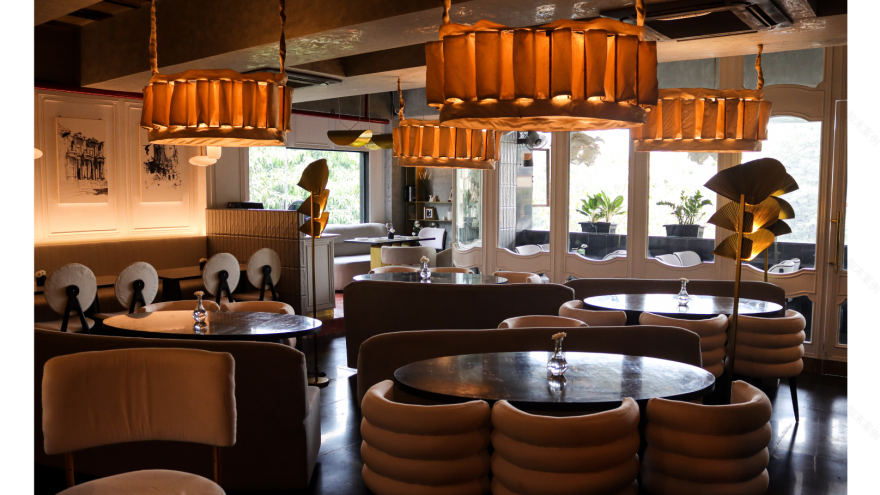
of its own? The space, a clinic in its past life, is situated on the second floor of the building with a long window at the end. For an unimaginative shell, it made sense to cull out a long balcony for outdoor seating and create large white French vintage glass doors to frame the space beyond.

“We developed the design to infuse European classical elements in the doors and walls and keep the furniture and lighting edgy. Typical of a Parisian apartment that became a 65-seater restaurant. And so it began, bit by bit with non-obtrusive black limestone flooring and subway tiles and mirrors to spruce up an old structure with the new,” says Mathur.
Curvaceous sofas squatting in the centre of the
square
space also break down a linear formal seating plan. Tufted white-and-black marble tops, softly pleated linen chandeliers add a glow to each table and diffuse the network of low beams all over. Bespoke tall gold palm frond lamps add glam and inference to nature around the sofas. On one side a linear seating with clean white moulded panels is dotted with Banksy-inspired prints.
Mathur explains that to counter the whites on tall balcony doors and walls, the team decided to go all-black with the subway tiles and smokey mirrors on the opposite wall. This is where a huge glass exposes the kitchen theatre—it almost feels like a black-and-white movie with chefs in uniforms bending over the micro plating of
visually
arresting desserts. A slim wine rack and deep green sideboard add depth to the wall adjacent to the bar.

“The bar inspired by Bareau’s avant-garde design was intended to make it look like it was cut out of a deep wall and its irregular form and shape clad in clay with succinct touches of brass to make it sharper in effect. The ruggedness of the clay on the
bar
front and back along with the gleam of bottles on gold shelves and guest bar top create an arresting contradiction. Pools of light look heady over their cocktail fare, and the bar has comfortable white upholstered stools for those late weekend nights,” she says.

“The benefit of having chefs from these regions also helped us find our suppliers directly as they know the local vendors in that region, thereby making logistics easier for us as well. Nava’s menu is a team-driven and
memory
-driven menu. We don’t just want to cook food, we want to cook memories,” says Pathak.
南京喵熊网络科技有限公司 苏ICP备18050492号-4知末 © 2018—2020 . All photos and trademark graphics are copyrighted by their owners.增值电信业务经营许可证(ICP)苏B2-20201444 苏公网安备 32011302321234号
苏公网安备 32011302321234号客服
消息
收藏
下载
最近