

创作上传
VIP
收藏下载
登录 | 注册有礼
查看完整案例

收藏

下载

分享
1988 - 1996
Josep Emili Hernández-Cros
Rafael Vilà Rodríguez
Restoration of the Façade and Refurbishment of the Main Floor of Milà House


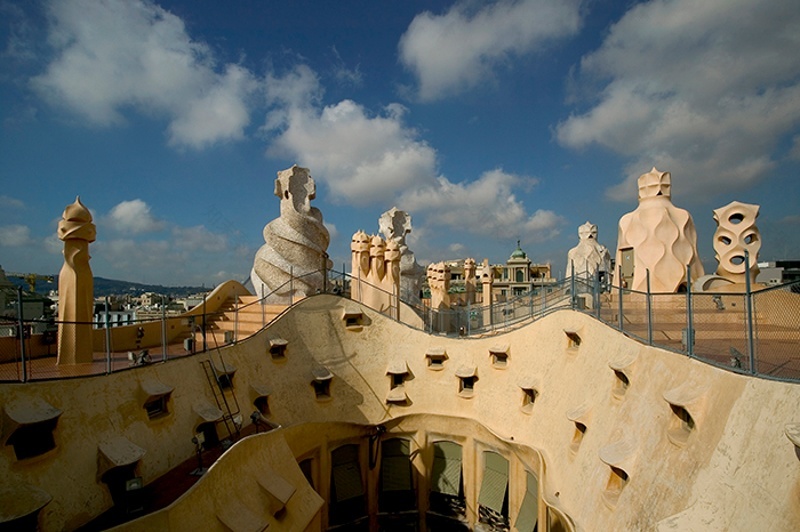
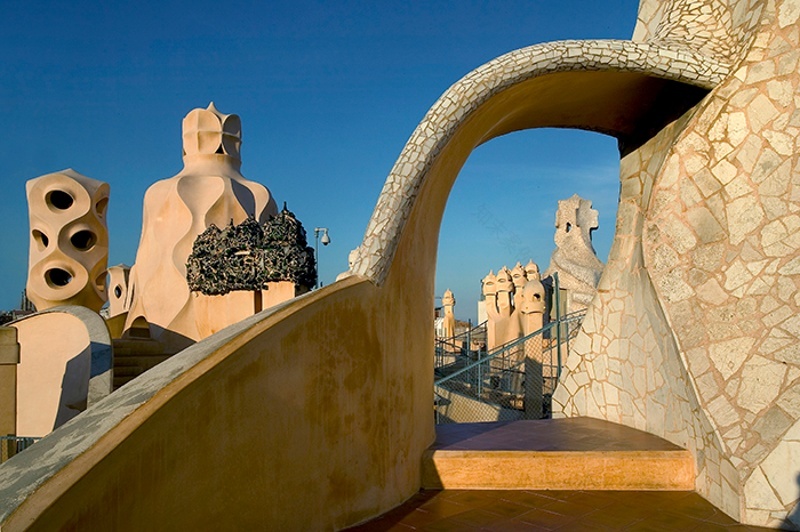


Pg. de Gràcia, 92
Barcelona
Restauració de la Façana i Condicionament de la Planta Principal de la Casa Pedrera com a Espai d'Ús Cultural
Building
Multi-family Dwellings (between party walls)
Museums / Artistic Spaces
BCIN (Bé Cultural d'Interès Nacional)
BPH (Béns del Patrimoni de la Humanitat)
This is Gaudí’s latest civil work, in which he places full emphasis on the experimentation with the structure and opts for risky and well-differentiated solutions from traditional procedures. The load-bearing straight feet are made of limestone from Garraf, combined with metallic elements, and are dimensioned and configured according to the casuistry of their specific position. The slabs are made of metal beams, which follow an irregular order according to the configuration of the floor. The façades on the street merge with the perimeter pillars in a monolithic and self-supporting system. Gaudí proposes to detach the forms from their material content and to look for a synthesis between the abstraction and the evocation of the elements of nature. This led him to turn the building into a large monument dedicated to the Virgin, which was to crown the house as if it were just a pedestal. The help of a naval engineer or the shapes suggested on the deck reveal a Gaudí forerunner of modern architecture, interested in freeing himself from the rows of masonry, orders or the weight of building materials. The Pedrera is a completely unfinished work that solves every spatial and constructive challenge through unpublished and sometimes incomprehensible solutions.
The attic area of "La Pedrera" was, in addition to being a deposit of useless junk, filled with rats when they commissioned me to study a solution that would allow it to be incorporated into the useful and profitable part of the building.
The structure is simple and interesting. The roof rests directly on partition parabolic arches which are about 80cm apart and whose nails are linked by brick ribs that follow catenary guidelines.
The approach was logical: rings of passage around the large central patios provide access to the various units, which take advantage of the height of the undulating ceilings by means of mezzanines forming "duplexes".
Main idea.
The main drawing board has been the floor of the ground plan, with a firm intention of defending "architectural honesty both in the structure and in the materials", valuing a solution for its simplicity, even at the cost of the perfection of the finish. I have clung to this idea to flee from the decorative and baroque styles that have attacked me, as is logical, in an exuberant environment of shapes, discarding the use of manufactured materials in industries that our country does not have.
Materials.
All of them have been simple materials, even elementary. Essays with raw common brick, refractories of various kinds, ceramics, stones, Galician pine in some coating… In kitchen and bathroom veneers, after some trials in glazing, I have returned to tile, a material with great possibilities, which I have treated in groups of 3 or 4 colours per piece. I believe that the greatest success achieved has been with earthy materials, particularly with refractories because of its hot and vibrant quality.
Shapes.
These are the result of working in an organic environment with no other forced base than the clean structure, free from the prison of the grid and the 90-degree angle, a logical consequence of industrial standardization, or the use of load-bearing walls, but without justification in structural projects. Open spaces that allow us to conceive a world that is freer and closer to nature that was not created in a grid. I have come to the conclusion that we must take advantage, even in the state of our industry, to allow ourselves certain design liberties that would not be acceptable in more advanced countries, and which allow us to achieve a more humane and attractive architecture.
Ground plan management law.
The goal is to make life easier with the minimum effort and the maximum sensation of well-being, looking for minimum distances when traveling and adapting the closing lines of the environments whose enclosures are repeatedly floating in plan and elevation to these layouts.
Studying the perspectives from the fundamental areas: sleeping, eating and being.
Standardisation.
It is impossible to normalise anything other than the fundamental idea; I have been able to create a "standard" element that regulates the functions between the little kitchen and the sleeping area, a large polychrome wardrobe that has simplified the work greatly.
Colour.
As Mediterranean people with red blood in our veins and a blue sea in our landscapes, we cannot see life in black and white; colour is our fourth dimension in Architecture.
Essays of contrasting polychromies, ranges of colours of the same order and neutral backgrounds with polychrome parts. The type of paint used is glue; in my opinion, it is the one that gives the best quality.
Furniture.
It has been necessary to invent all the furniture, due to not finding anything decent on the market. We have had to even invent the Saarinen armchair, already invented.
As an experience, a chair with a continuous back and seat and a group inspired by the Moorish "pouf" in the last apartment that reflects the experiences of all the others and in which I have tried to respect "architectural honesty" as much as possible, both in shapes and materials.
Conclusion.
After living "La Pedrera" daily for more than a year, I have met Gaudí, a true master of our bravest functional architecture.
“La Pedrera” began in 1905, when Gaudí was 53 years old, for the couple from Barcelona Mr. and Mrs. Milá, ending in 1910. It is one of the most important works, apart from the Expiatory Temple of the Sagrada Familia, by the great architect.
FAD Award
Finalist. Category: Interior Design - Public, Commercial and Professional Interiors
Restoration of the Façade and Refurbishment of the Main Floor of Milà House
Josep Emili Hernández-Cros
Rafael Vilà Rodríguez
Restoration of the Façade and Refurbishment of the Main Floor of Milà House
Josep Emili Hernández-Cros
Rafael Vilà Rodríguez
FAD Award
Award-Winner / Winner. Category: Ephemeral Spaces
La Pedrera de Nit 2000
Emiliana Design Studio
Anna Mir
Emili Padrós
FAD Award
Award-Winner / Winner (opinion). Category: Ephemeral Spaces
La Pedrera de Nit 2000
Emiliana Design Studio
Anna Mir
Emili Padrós
Acció-Exposició: "Vers Un Nou Equilibri Natural..."
Toni Gironès i Saderra
FAD Award
Award-Winner / Winner. Category: Intervencions Efímeres
Acció-Exposició: "Vers Un Nou Equilibri Natural..."
Toni Gironès i Saderra
Auditorium and Gaudí Hall at Milà House
MBM Arquitectes
Oriol Bohigas i Guardiola
Oriol Capdevila i Arús
Francesc Gual i Traginé
David Mackay
Josep Maria Martorell i Codina
The adaptation of the basements of La Pedrera for Auditorium and Sala Gaudí, tries to be very neutral and respectful of what remains of the original work. This is not a restoration that tries to return everything to its origin. It is about not adding, being neutral and discreet and avoiding imitations of Gaudí. It was necessary to assume the required structural reinforcements, the passage of the installations and comply with the current regulations.
Caixa Catalunya Auditorium: 185 seats, side boxes for 78 seats extendable to the 110 m² outdoor patio, two simultaneous translation booths, a control room, three screens for cinematographic and audiovisual sessions, and a stage with a technical platform for conferences, with talks and theatrical or musical shows in a small format.
Sala Gaudí: 92 seats, a control room interconnected with the translation and control booths of the Auditorium, a screen and a space for multipurpose shows and events without a fixed stage.
General spaces: an entrance ramp/lobby, a gate, two cloakrooms, eight toilets, a toilet for the disabled, two dressing areas with toilets, showers and changing rooms, a kitchen-office and a guest room.
南京喵熊网络科技有限公司 苏ICP备18050492号-4知末 © 2018—2020 . All photos and trademark graphics are copyrighted by their owners.增值电信业务经营许可证(ICP)苏B2-20201444 苏公网安备 32011302321234号
苏公网安备 32011302321234号客服
消息
收藏
下载
最近