

创作上传
VIP
收藏下载
登录 | 注册有礼
查看完整案例

收藏

下载

分享
Building with bamboo: trans-Himalayan practices

More accessible than timber in the trans-Himalayan belt, bamboo offers a way to build ecologically, but Indigenous stewardship is critical
The Chepang people, originally nomadic foragers now settled across central and southern Nepal, have always lived close to the forests. They are especially known for their exquisite handicrafts and intricate double-weaving exhibited in their bamboo basketry. They forage bamboo shoots to consume and preserve for the less abundant months of the year, make mats and flooring out of it to adorn their homes, and use it to make fish traps, and bows and arrows. Many similarities can be found in the use of bamboo, from cuisine to construction, across north-east India, Nepal, Bhutan, Bangladesh, and neighbouring regions.
Bamboo is actually a giant grass belonging to the family
Poaceae
, with an estimated 1,250 bamboo species, but like timber, bamboo is a renewable resource. It reproduces at a much faster rate, sequestering carbon throughout its bounteous life cycle, in some species spanning 60 to 80 years. Bamboo grows at record speed, some species developing to their full height in just a few months. The initial mother plant takes about three years to establish its rhizome and mature into a parent plant, after which fully mature culms can be harvested each year.

The homes of the Marma people in Bangladesh use bamboo both as structural frame and woven walls
Processed bamboo is strong, hard and versatile like timber. It has a definitive skin like timber, though it is tender when green, making it very pliable, easy to cut, carve and bend, and hardens naturally in a few days. The bamboo sheath exhibits a range of colours, but once cut, most bamboo skins turn a pale yellowish-brown similar to an ash wood or a pale pine. Unlike wood with its ripples and knots, bamboo grain is uniformly one-dimensional throughout the internodes, getting denser at the nodes.
Bamboo grows across tropical and temperate zones across the world: north-east India boasts 63 bamboo species, Nepal over 54, and China over 500, most of which form an integral part of the social, cultural and economic life of Indigenous people. Indigenous people capitalise on the fact that this thriving yet robust grass variety is easily accessible and replenished every year with little or no human intervention. Bamboo is self-propagating and requires no chemicals or pesticides to thrive, its own fallen leaves mulching the soil and providing all the necessary nutrients. It is lighter than wood, requires fewer hands to carry it across the forests, and is relatively easy to process in bulk, in order to share the harvest among many households.

Bamboo strips can be used to make floors
The Marma people – indigenous to the highland valleys of the Chittagong Hill Tracts in Bangladesh – choose and harvest mature bamboo, tying them flat or in small bundles and floating them down the Sangu River. These culms are then collected at the dock in the plains that are home to their settlements, and sun-dried, or in some cases smoked for additional pest resistance, and readied for use. These processes replace the internal sweet sap with fresh or saline water, becoming the material we see in construction. The Chepang people believe that bamboo harvested on a full moon is more prone to being attacked by insects, whereas those picked just shy of the new moon are least susceptible, the starch and water content being at their lowest levels. This makes them lighter to carry and means they dry faster. The time of day matters too, between 12pm and 6am, just before sunrise when most of the starch is believed to still be in the roots.
Foraging and harvesting patterns honour the life cycle of forest resources and have been noted to protect biodiversity and prevent forest fires. If old bamboo is not cleared it can rot or decay, and improper harvesting or not harvesting can do more damage to the plant and land itself. Even bamboo forests are susceptible to forest fires if not managed properly. Bamboo forests rise the water tables, improve the water retention of soil and attract species of birds and other animals to nest in their canopy. Initiated by our practice Abari, the bamboo corridor project along degraded flood-prone lands near the Rapti River in Chitwan, Nepal, has stabilised the lands and proves its resilience with every passing year’s floods – we then buy back bamboo from the farmers, whom we have trained to cultivate and care for it, to use in buildings.
Bamboo can be used as whole culms, alone or bundled together as frames after being split open. It can be made into strips and used as panelling or shingles, broken into mats or planed into tiles, or used as cordage in weaving. The scale of bamboo buildings was traditionally dependent on lengths of bamboo; more recently, there have been experiments playing with the dexterity of green bamboo, such as the curious case of moulding young bamboo shoots into uniform rectangular tubes with ring moulds. Then there are the steam and heat treatments used to bend freshly cut bamboo poles or strips into arcs, to submit to large-spanned trusses or engineered bridges such as those materialised by Jörg Stamm in Colombia and Indonesia, and Vo Trong Nghia’s curved sculptural public spaces in Vietnam. Some have reported that bamboo has the strength of steel, while others prove its bundled strength is far superior and it is critically lighter in weight.
Rattan or rope ties were historically used to bind two culms, but some practitioners have developed jointing systems which outlive traditional methods, requiring minimal adjustments or maintenance. Steel joints allow for prefabrication and the easy replacement of bamboo parts. Concrete grouting is also used but takes more effort to deconstruct in order to replace parts, while composite epoxy binding is expensive and more ecologically harmful in comparison.
‘Bamboo is self-propagating and requires no chemicals or pesticides to thrive, its own fallen leaves mulching the soil and providing all the necessary nutrients’
Indigenous bamboo construction does not use chemical processes, making it susceptible to insects and decay, although maintenance is not seen as a chore but more as a ritual. The bamboo wall panels of the buildings built by the Garo people of Meghalaya in north-east India are cyclically replaced within their timber frames after the monsoons. It is an architecture of impermanence and it is celebrated for it. However, in the past few decades, the treatment of bamboo has been pursued with rigour. Abari have developed a mobile treatment set-up for the benefit of rural farmers in Nepal, where they can treat up to five culms at a time with a salt solution, ensuring longevity and pest resistance. On a more industrial scale, the pressurised treatment of bamboo with borax, where up to 150 pieces of bamboo can be treated at once, is preferred among other chemical treatments for the minimal impact it has on the environment – the bamboo continues to be compostable and biochar can be created from waste.
Bamboo performs well in an earthquake as it is hollow, light and, though it shakes and shivers during a tremor, elements return to their place after it subsides. The hot tropics and riverine settlements of southern Nepal and north-east India use bamboo as substructures and stilts, as a preventive measure for floods, and flaunt intricate weaving in their exposed bamboo-frame walls to allow for evaporative cooling. In the mountainous areas in the hills of Nepal, Darjeeling, Sikkim and other north-east Indian states, bamboo is used slightly differently, as a composite with earth, timber or stone walls, to ensure thermal comfort, and structurally as columns, beams, rafters and partitions for its lightness and ductility in the case of an earthquake.

Mechanical tools can be used to make connections between elements
Over the past few decades, there has been a structural obliteration of the ancient practices and socio-cultural identities related to forest resources, especially those pertaining to bamboo. Its traditional use is almost extinct, with the exception of communities living in protected areas or where the older generations still hold the skill and knowledge of using bamboo as a building and crafting material. In 1957 the Private Forests Nationalization Act was introduced in Nepal, whereby Indigenous people’s access to forest resources was restricted. Most National Parks in India, Nepal and the trans-Himalayan belt have co-opted the territories of Indigenous people; when the Chitwan National Park was established in the 1970s, the Tharu community was displaced from their lands and forcibly moved elsewhere. Tharu basketry and traditional bamboo and clay cobbing techniques are slowly diminishing as a result. As recently as June 2020, the Chepang people were evicted and displaced from their lands in the same National Park, their homes burned down and the community resettled without consent.
Communities that once built using local, mainly forest-dependent resources are now market-dependent. They have slowly shifted to using cement, steel and corrugated sheets for roofing. Not only does this mean that their ancestral skills and cultural identity are at stake, but it also pulls them out of a barter-based system into capitalism, encouraging a talented weaver to take on a day job of breaking stones at a local quarry or road construction site to earn a living to pay for the things they have to buy. It is possible, however, to grow bamboo in small clusters, harbouring a decentralised economy and supply chain catering to local needs. This localised approach seems to be an ideal game plan to promote the material at larger scales and potentially industrially.
‘Some report that bamboo has the strength of steel, while others prove its bundled strength is far superior and it is critically lighter in weight’
In some bamboo construction practices today, frequently led by foreign designers, the material is often used just as a facade to a steel and concrete structure, questioning not just its sustainability but also its ethics: is it used just to enforce a ‘built by the locals’ narrative? Some of the most popular visuals of bamboo construction are tropical getaways or pavilions, and many fail to ensure the bamboo is protected from exposure to sun or rain, inadvertently setting it up to fail.
The material screams ‘there are no rules!’ in the face of uniformity. Bamboo differs from species to species, and each culm of bamboo is different to the next in diameter, length and taper. Grading separates bamboo according to its girths to mitigate complex calculations for structural safety. The bottom of the pole is wider and is used for structural members while the tops are thinner and used to make strips or other non-structural members of the building. Building codes can drive one to abstraction when it comes to bamboo; an absent technical standard, although allowing for much creativity, also leaves room for error.
Those who choose to work with bamboo today often don many hats: from researcher to activist, farmer to entrepreneur, engineer to craftsperson. Using bamboo in an architectural practice requires iteration and constant awareness in order to use it structurally, not just as a facade. Space for failure at design or execution stage is important, and the ability to fix on the go can only be taught or learnt on the job. Architectural drawings are not conclusive but an opening to further dialogue between designers and carpenters; real-time changes to buildings happen on many occasions, and the drawings are adjusted accordingly. There is a colossal gap between modern design pedagogy and the practice itself – materials like bamboo are not as easily accessible as some of the standardised materials in terms of research, prescriptive codes or assimilation into the curriculum, to encourage young designers to pursue its practice. ‘I think we will get to a point where bamboo is not “alternative” or an outlier,’ insists John Naylor, bamboo researcher and educator, ‘but one of a palette of mainstream materials like steel, timber or concrete.’
Kopila Valley School in Surkhet, Nepal by Abari


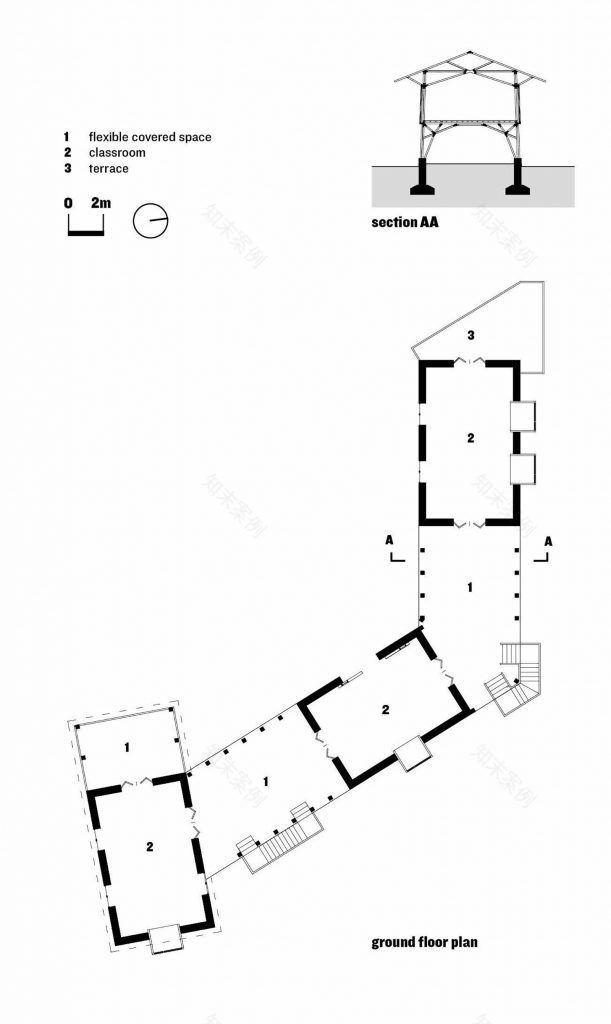
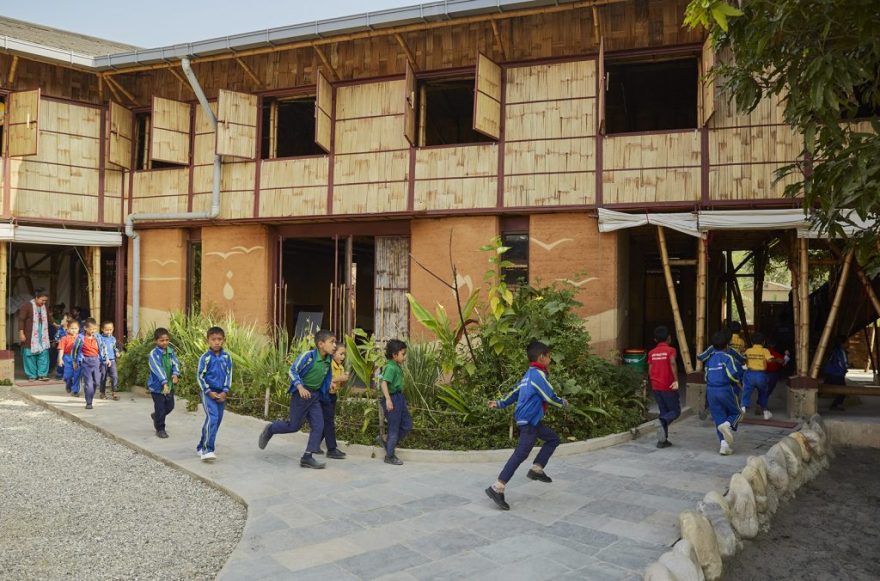
Abari’s Kopila Valley School nestles among forested hills in rural Surkhet, towards the far-west of Nepal. Driven by the assertion that access to high-quality education can be transformative, the school wanted to build a campus that was ‘a model for the way we can all take care of our environment’. Abari’s school building provides learning spaces for around 400 students from nursery ages upwards. In plan, it is a simple kinked arm, with spaces created by an elegant bamboo structure whose skeleton provides ample moments for play for the students spending their days in the building. Larger classrooms are enclosed with rammed-earth walls, reinforced for earthquake resilience, and a small amount of concrete to reduce moisture. The redness of the earth and the golden bamboo give the set of spaces a warmth – and at certain moments the stain in the rammed-earth walls is used to depict landscapes, birds and patterns. A skeletal bamboo truss raises an elegant roof, that flicks up at its ends as if it has been caught in a passing breeze. This lightness is also felt in the skin of the building; a woven facade of bamboo panels lets in light and air. Incorporating measures such as solar-powered cooking facilities, a large rainwater recycling system and constructed wetlands to treat waste water on site, the project’s aspiration was to be at the forefront of both sustainability and pedagogy.

Anandaloy community centre in Rudrapur, Bangladesh by Studio Anna Heringer

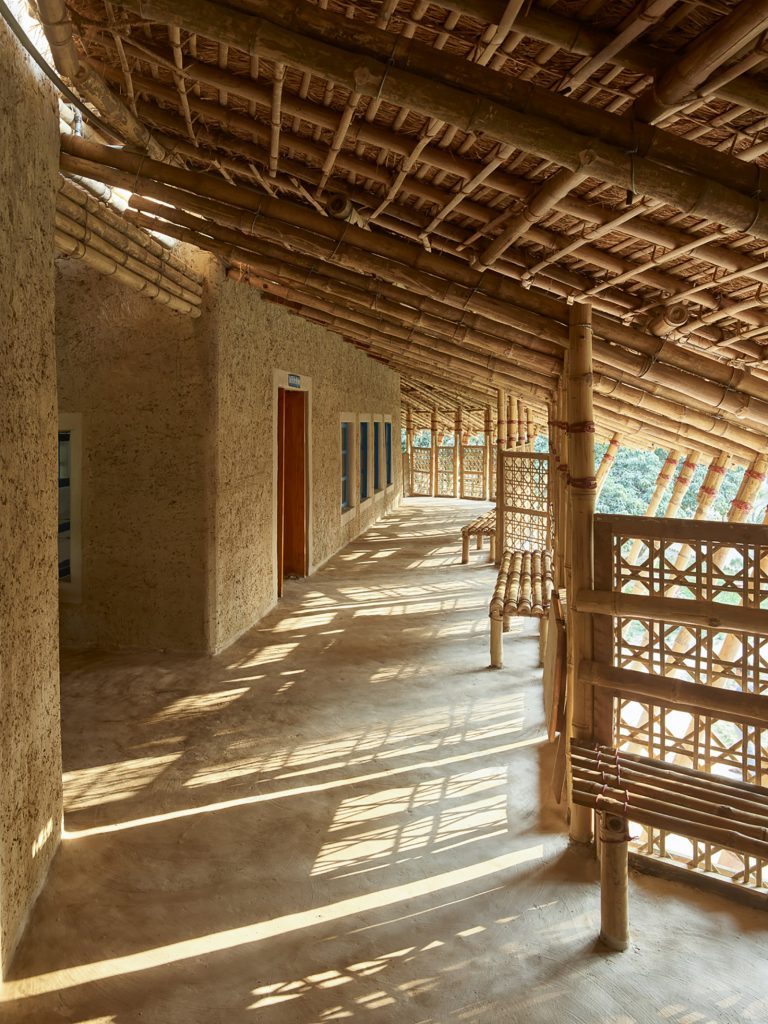

‘Anandaloy’, the name of Anna Heringer’s project in Rudrapur, northern Bangladesh, means ‘place of deep joy’ in local dialect. The building provides generous spaces for the local community – a centre for people with disabilities, as well as a textile workshop, run by Dipdii Textiles. The initiative was launched by Veronika Lang and Heringer with the NGO Dipshikha to support local textile traditions in the region. The process of construction was as important as its form; materials were supplied by local farmers, and local bamboo craftspeople worked on the construction. Heringer’s work encourages the continuation of traditional craft in this way, engaging deep-rooted knowledge about place and material. The body of the building is made from cob, a rammed- earth technique which does not use formwork and is easily moulded into sculptural curves, such as the large ramp that winds up to provide access to the first floor. Heringer, who has embarked on sustained research into the uses of rammed-earth as a construction material, uses ‘less concrete, more earth’ and believes in mud’s ‘plastic abilities’ to create a stronger identity. The centre is a manifestation of this, with its leggy bamboo facade whose columns camouflage with the tall tree trunks in the surrounding landscape, and that from afar might appear as warps of a woven textile

Safe space for Rohingya women and girls in Teknaf, Bangladesh by Rizvi Hassan
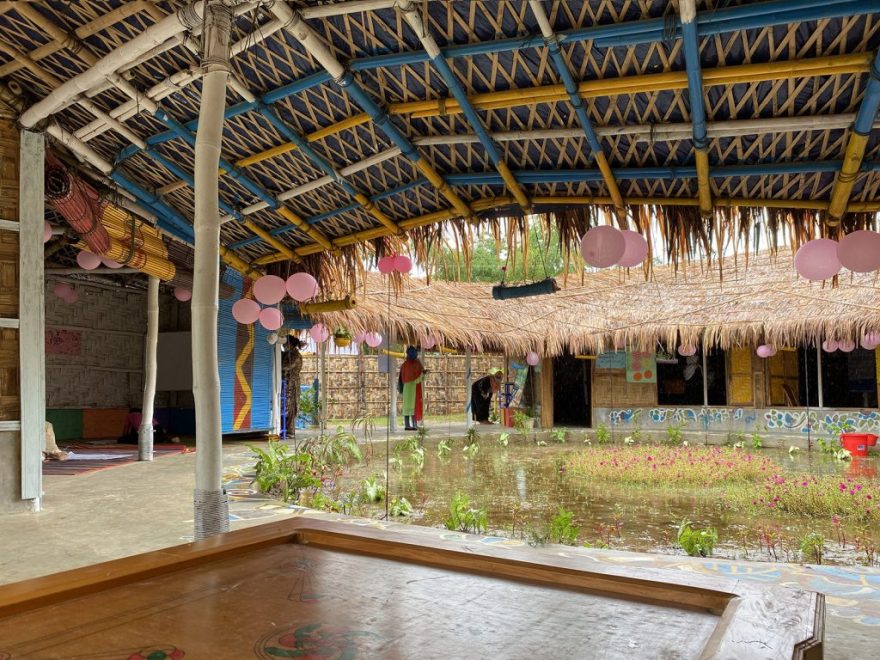


The Rohingya refugee crisis is one of the largest and quickest displacements of people in recent history. For centuries the Rohingya lived in Myanmar, before being forced to flee genocidal violence following decades of persecution and systematic discrimination in the country. They are the world’s largest stateless population, with the majority having sought refuge in Bangladesh. Designs for a building in Teknaf only emerged after extensive discussions with the residents of the camp, whom the architect Rizvi Hassan recounts told ‘incredible stories of elephants, mountains, flowers’. The construction techniques and designs were worked out together with local craftspeople who were living there, and a simple courtyard figure was chosen to provide well-sized flexible activity rooms that open out into a secluded central space. Untreated bamboo was used for the structure and straw for the roof, materials which are readily available and found nearby but which, used in this way, will need replacing within the year. For Hassan, who acknowledges the complexities of an architect working within such a context, it was important to be ‘fluid and adaptive’, allowing for the maximum involvement of those who would use the centre. After completion of the building, the women who came to the centre painted its structure and linings colourfully

南京喵熊网络科技有限公司 苏ICP备18050492号-4知末 © 2018—2020 . All photos and trademark graphics are copyrighted by their owners.增值电信业务经营许可证(ICP)苏B2-20201444 苏公网安备 32011302321234号
苏公网安备 32011302321234号客服
消息
收藏
下载
最近