

创作上传
VIP
收藏下载
登录 | 注册有礼
查看完整案例

收藏

下载

分享
Pavitra Rajaram and Paul Abraham lovingly restore a 115-year-old colonial bungalow in Coonoor
The town of Coonoor is an
favourite—for its rolling hills, its Neelakurinji flowers, its sunsets, and its colonial bungalows. And now for another reason: Pavitra Rajaram and Paul Abraham’s restored home that embodies a very particular kind of love for collecting and curating.

The restoration of Nenagh was done with great reverence to preserve the character of the old home. Every brick that was dug up from the driveway through careful and slow extraction was put back once the underground water- harvesting tanks were installed. The exterior was given a serene white finish while the original tin roof was painted aqua.
"We always tend to measure history through humans but never via plants. I often gaze at the 100-year-old ficus or the native 300-year-old woodland tree and wonder what they must have witnessed over the years,” says Pavitra Rajaram as she stands at the entrance gate to Nenagh, a 115-year-old bungalow, nestled in the Nilgiris in
Coonoor
, that she has lovingly restored along with her husband Paul Abraham.
Pavitra, an
and a prolific aesthete, and Paul—a banker but truly an avid historian and collector, as well as the founder of the Sarmaya Arts Foundation—have always lived in stunning homes but never in one that they created together. Nenagh for them is a dream fulfilled.

Window seats along the periphery of Nenagh, the Coonoor home of Pavitra Rajaram and Paul Abraham, overlook the blossoming garden and the mountains beyond.

The floor and roof were retained from the original home. Decorating this space are (from left) the Sipahi carpet from the Pavitra Rajaram x Jaipur Rugs collection; a vintage Goan church bench; and a 100-year-old Burmese chest in black with gold leaf, a traditional technique known as shwe zawa. Above the chest is a sketch by Desmond Lazaro, from his 2022 show “Cosmos”, a favourite artist of the couple and especially their son Sahil. Paul’s mother’s rocking chair, on the far left, is a 150-year-old traditional “charu kasera” (easy chair) from his maternal ancestral home.
I spent a few days at their home to experience its magic. Before I began to admire the bungalow, with its magnificent colonial bones—its name can be traced to an old Irish fort town—it was the gardens that captivated me. Nurtured by the couple, along with their knowledgeable landscapist Zakeer Zackaria, it is a labour of love. From the soft pink azaleas to the deep purple melastoma, from vibrant red roses to fiery orange alstroemerias, the garden was like mother nature’s favourite child in full bloom.

Fresh sunflowers decorate a desk at the mud-room entrance, which is flanked by two topiaries of nesting bulbuls; the pink repurposed Christopher Moore toile, bought in a seconds sale, on the love seat is offset by a jute rug on the floor.

The painted terracotta rakshasa mask was gifted to the couple by their septuagenarian driver, Prabhakaran, whose Nilgiris cab service is legendary in the hills.
To Pavitra, Nenagh is a trip back to her childhood and the memories of her great-grandmother’s rose garden. She’s brought in the salvia and cosmos as a meaningful tribute to lazy summer afternoons spent with her mother. The blooming magnolia tree has been planted in remembrance of her late mother-in-law who adored the fragrant flower. Serendipitously, it was also the tree outside Pavitra’s terrace while growing up. A mix of hydrangeas, rambling roses, fragrant lavenders, and arum lilies evoke an English country cottage garden albeit wilder and more boisterous. “I am eternally inspired by the colours and texture of the garden of
Dar-Es-Salaam
in Srinagar on Nigeen Lake. I am obsessed with topiaries and conservatories because of all the regency romances I’ve read,” reminisces Pavitra. For Paul, a wildlife enthusiast, to be surrounded by nature and have birdsong for company is a precious gift. He says, “A family of porcupines lives in our garden and we have bulbuls, Malabar hornbills, and hundreds of sun birds, flycatchers, and barbets for visitors.”
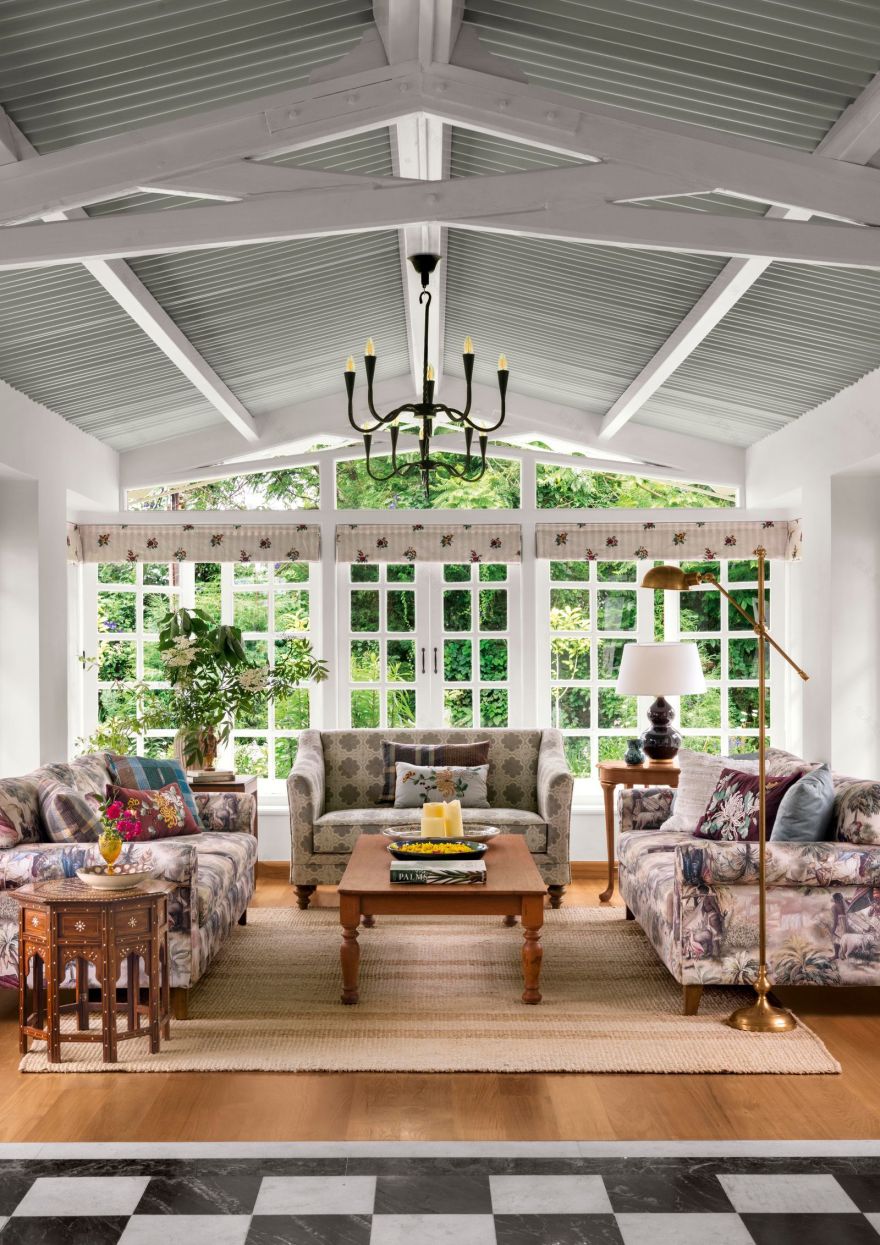
The sunroom is the perfect spot for their son Prithvi to do some bird-watching. The room is decorated with customized toile upholstery, cushions made from repurposed fabrics, an Italian ceramic platter that was a gift from Pavitra’s friend, Ahsan Ansari, and a metal chandelier above, with hooks to hang mistletoe on Christmas.
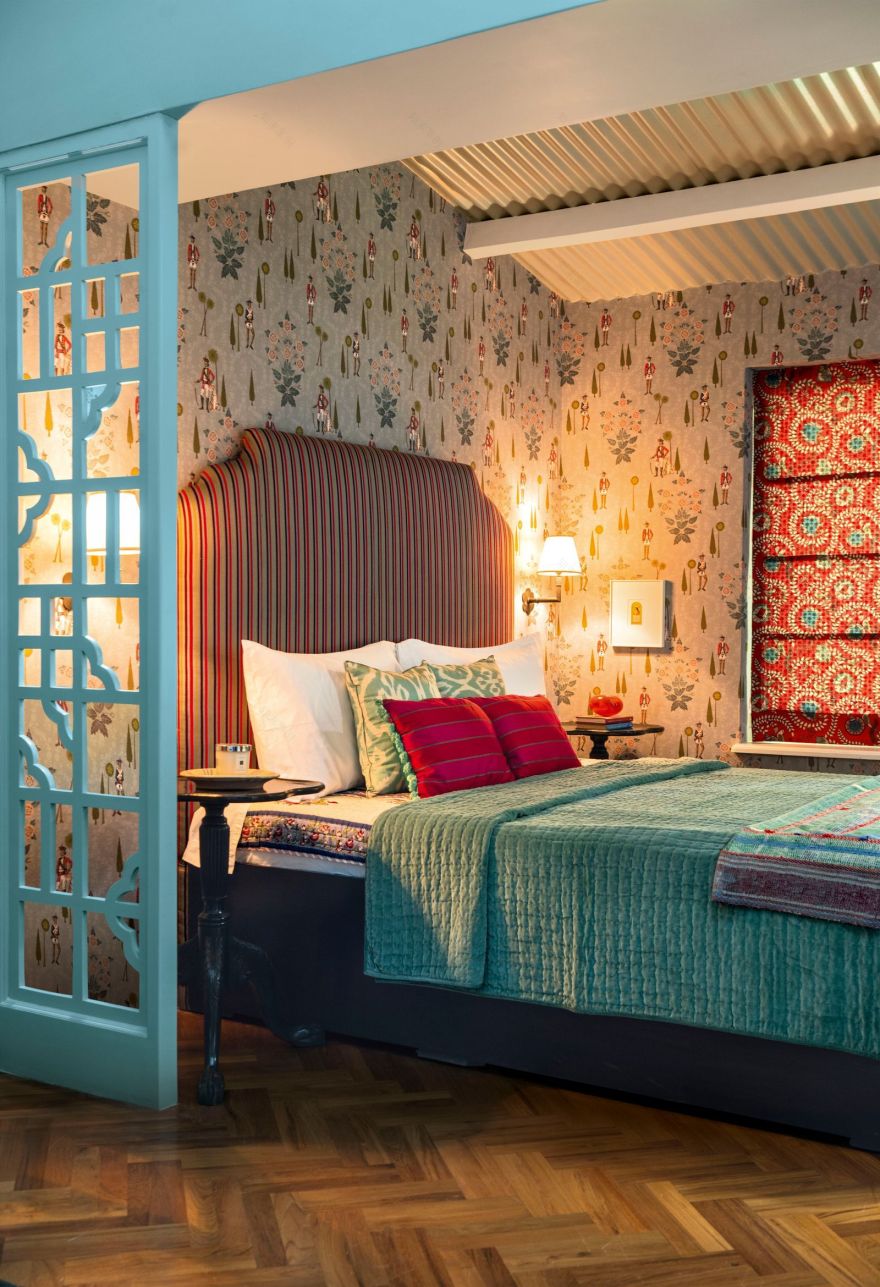
Pavitra tucked the bed under the sloping roof, partially enclosing it with a chinoiserie-inspired screen. The custom wallpaper was made in the Pavitra Rajaram Design Studio, featuring a fantasy world of sepoys and tigers amongst the Nilgiri mountains. The headboard is in a handwoven mashru stripe and is paired with different cushions in vibrant blues in her signature style.
A sense of lightness permeates the bungalow. Large windows and skylights create a chemistry between the indoor and outdoor. Natural wall finishes, repurposed fabrics, and a mix of books and objects from their previous homes bring about a sense of nostalgia and the comfortable feeling of a life well lived. While much of the original tin roof covered with baked Mangalore tiles, checkered marble floors, and the three fireplaces have been mindfully restored, Pavitra and Paul have brought in some thoughtful changes, like a sunroom to bring in much needed light and to allow for window seats—typical of hill homes. A mud room has been created at the entrance as a holding space for outdoor shoes and jackets. And then there is an intimate sit-out for the primary bedroom—a nod to a beautiful memory from their first holiday together in the south of France. “This home is as much about our memories as it is about all the things we love. I wanted to create a mixed aesthetic of quaint hill station homes, charming old English clubs, and the colours and patterns that define India.”

The custom wallpaper—created in the Pavitra Rajaram Design Studio— was inspired by a woven textile fragment from Iran. The watercolours are by the artist Aditi Singh and the papier-mâché rooster was a flea market find.

The striped tiger chair from Jaipur is their son Madhav’s favourite.
Fabrics, many of which she already had, range from custom-printed linen toile in the sunroom to block-printed upholsteries, hand-woven
mashrus
, printed cotton toiles from Christopher Moore, woven kala cotton from Khamir, repurposed
gudhris
and Uzbeki silk ikats. In her words, “It was really exciting to curate the art and we mixed traditional ‘English country home’ style of maps, engravings, and botanicals with Persian miniatures, indigenous Bhil art, a leather puppet by Chidambara Rao, hand-painted photographs, and artworks from many of our favourite artists like V. Ramesh, Rithika Merchant, and Varunika Saraf.”

In the library lives the couple’s shared collection of books on art, history, textiles, and crime fiction novels—a favourite of their eldest son Rishad. The striped throw is a blanket woven in cactus fibre found in Essaouira, a seaside town in Morocco. The green silk ikat cushion was made from fabric woven by the master Telangana craftsman Yadagiri. The sketch of Delhi and original 18th-century engraving of the Mughal emperor Akbar are two of Paul’s favourites. Beside the sofa is a vintage Chinese garden stool. The Sakya carpet is from the Pavitra Rajaram x Jaipur Rugs collection.

Locally made ceramic dolls with bobbing heads, gifted to the couple by their electrician’s daughters.
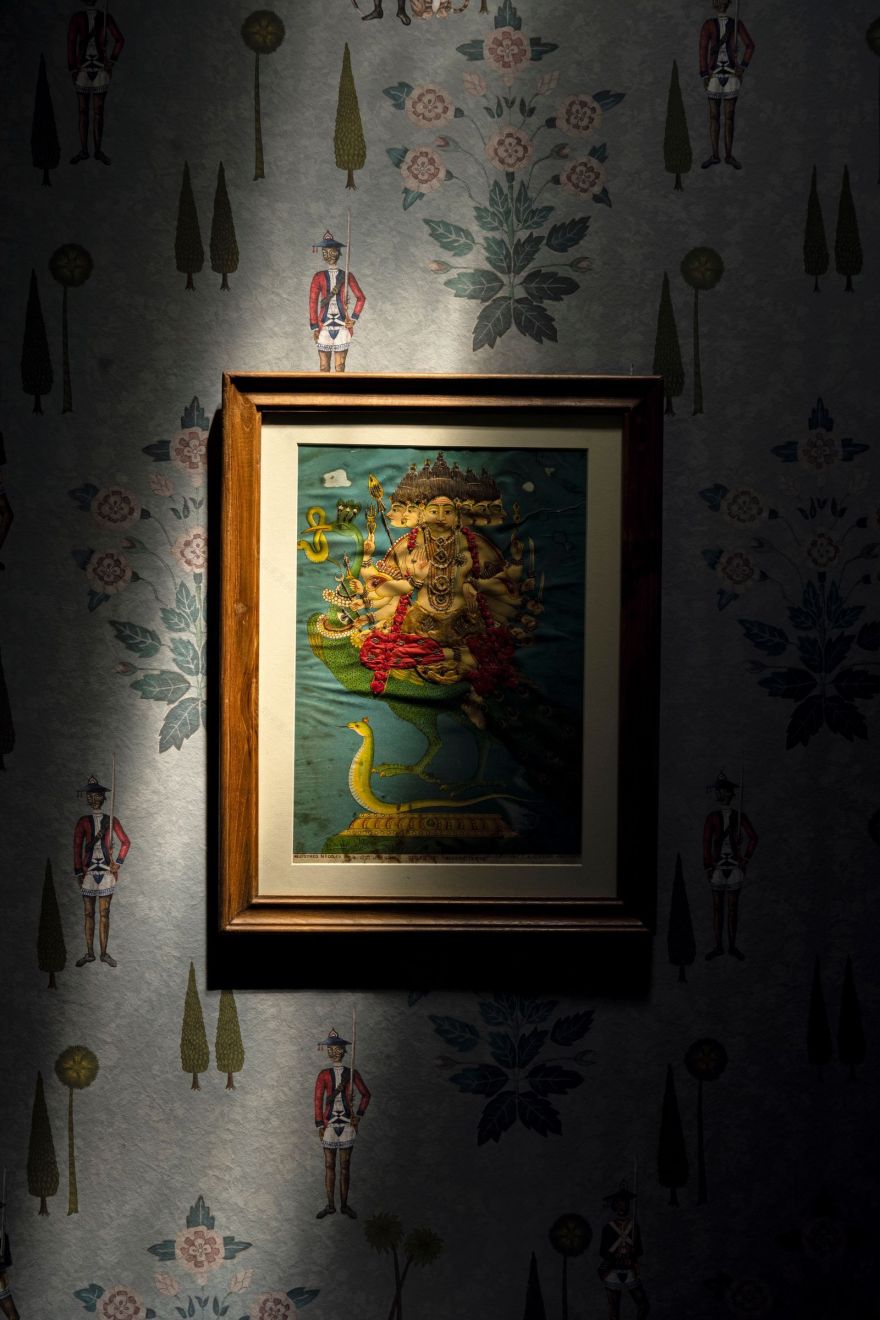
One of a series of reverse glass paintings by Chinese artists, made for the Anglo-Indian market in the 19th century, was sourced from Chor Bazaar in Mumbai.
As Pavitra leads me away from the sunroom into the main house, we enter a well-equipped library that opens into an atrium with deliciously high ceilings and a skylight revealing the tops of high conifers. It is flanked by the primary bedroom on one side and the guest rooms on the other. A sense of whimsy is in the air, be it the fantastical wallpapers, tiger chairs from Jaipur, or a pair of wooden shoe lasts bought at a flea market in New York.
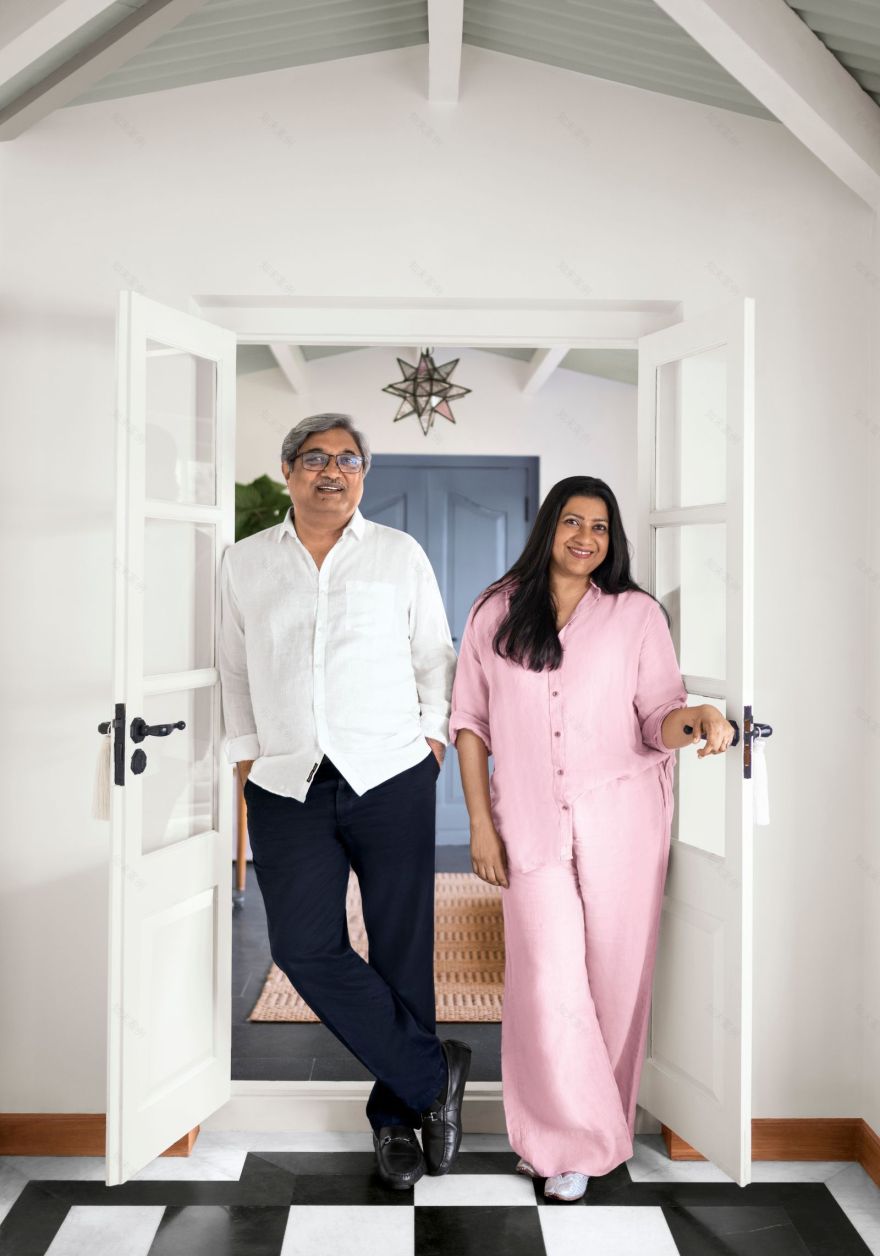
Homeowner Paul Abraham and Pavitra Rajaram.
The most magical part of the house, however, is the dining observatory, where Pavitra has unleashed her eclectic genius. A glass-encased conservatory engulfed by the branches of a century-old fig tree has been carved out of empty space between two rooms. While Tanjore glass paintings compete for attention with larger-than-life botanicals painted on the walls, it is the perfect spot to study the sky that goes from a pristine blue dotted with fleece-white clouds during the day to a dramatic mix of orange and purple in the evenings and finally to a jet-black sheet, spray painted with a million stars in the night.

The study at the end of the corridor overlooks an ancient jacaranda tree. The walls are lined with rare lithographs from the Sarmaya Collection. The carpet is a vintage Caucasian soumak woven by Uzbek Carpet Weavers. On the bookshelf is a collection of circa-1950 porcelain figurines in European military attire by the artist Bruno Merli. An Anglo-Indian rosewood table is paired with a Peranakan bentwood chair from Malacca. The wallpaper is from Sabyasachi’s “Heartland” collection, curated by Pavitra for Nilaya from Asian Paints.

The glass dining room—which also acts as a conservatory—was created to highlight a magnificent fig tree. The wall is decorated with botanical paintings made by the team at the Pavitra Rajaram Design Studio, Tanjore glass paintings, and topiaries.
To sum it all up in Paul’s words, “For me, this home is about the quieter, more intimate life to be shared with family and friends. It is wonderfully expansive and yet compact in many ways delivering both the blessing of light and nature. This is finally a place that Pavitra and I call ours and where we spend our time enjoying the present and each other.”
南京喵熊网络科技有限公司 苏ICP备18050492号-4知末 © 2018—2020 . All photos and trademark graphics are copyrighted by their owners.增值电信业务经营许可证(ICP)苏B2-20201444 苏公网安备 32011302321234号
苏公网安备 32011302321234号客服
消息
收藏
下载
最近