

创作上传
VIP
收藏下载
登录 | 注册有礼
查看完整案例

收藏

下载

分享
A greener outlook: IGLU Summer Hill
360 Degrees Landscape Architects’ design for a student housing complex in Sydney’s inner-west nurtures individual and communal life while accommodating a diversity of changing uses.

IGLU’s layout echoes the courtyard-and-loggia typology with a calm central space flanked by more actively programmed rooms. Summer Hill in Sydney’s inner-west looks like a toy town, the kind a railway miniature enthusiast might make. A lively high street leads to a train station dating from the late nineteenth century. Parks a walkable distance from public transport are shaded by long-established trees. The skyline is punctuated by a familiar mix of Victorian chimneys, sandstone steeples, jacarandas and palms. In a city that continues to sprawl, the combination of amenity and the fine-grain scale of the urban fabric found here is a rare and increasingly expensive proposition. I’m here to visit Bates Smart and 360 Degrees Landscape Architects’ design for the IGLU student accommodation, curious to see how a new typology of student accommodation sits within the historic fabric of this urban village.
The first thing I notice about the building is that I almost don’t notice it. Discreetly slipped in among a collection of brick warehouses, the building’s facade is refreshingly quiet for student housing, no vulgar cladding adding synthetic cheer. Instead, I’m able to spy the structure’s interior life – a streetside window offering a peek into communal spaces and a green courtyard beyond. The design approach here feels like a gesture of safety but also an invitation – on a stretch of street that lacks activated frontages, passers-by can both see and be seen.

The exterior of IGLU Student Accommodation Summer Hill; window planters present a planted facade to the street.
From inside the building, these eye-like windows are always directed towards the central courtyard, which is open to the sky. 360 Degrees Landscape Architects studio director Liam Bowes explains that the courtyard was designed to perform multiple roles, helping to nurture the building’s social ecology. Communal areas around the courtyard’s perimeter host social seating, while the courtyard’s centre is less programmed and more densely planted, offering students opportunities for respite, green outlooks to rooms and seasonal display. This layout echoes the courtyard-and-loggia typology, where a building’s calm inner sanctum is flanked by more actively programmed spaces – a typology with a long connection to learning spaces across cultures (albeit an uncommon one in Sydney). Here, the courtyard’s scale feels both comfortable and familiar. IGLU is located along a busy road, yet these students’ quarters look inwards to life – the life of other residents as well as the plant life that is the building’s focal point.
It’s this quality of life, in particular, that interests me. If, like me, you romantically think of education as a universal good rather than as an industry, the reality of the education sector’s place within Australia’s economy – with education one of Australia’s top five exports – may come as a bit of a shock. Closer to the IGLU site, the University of Sydney, where I imagine many of IGLU’s residents study, generated almost 50 percent of its recent annual revenue from international student fees, a total of $1.4 billion. With a housing crisis in Australia’s major cities and such heavy reliance on international student fees to fund universities, reports of international students facing homelessness are hard to square with these numbers.
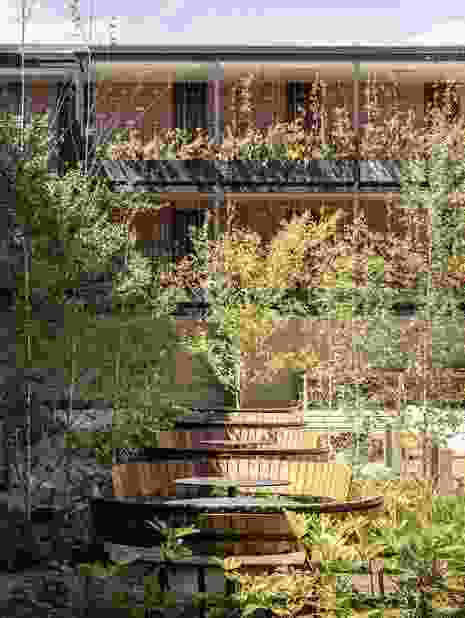
The central courtyard is open to a diversity of uses and is supported by the surrounding communal spaces, which include a kitchen and meeting rooms.
Of course, landscape architects can’t untangle these knots alone. But given the chance to shape a space for those such as international students, who are so often reduced to economic units, the choices made matter. Any project runs the risk of being informed by a potentially patronising idea of someone else’s utopia, and we have all seen the renders of these places – impossibly golden sunlight shining on relentlessly fit people. Designing is an imaginative act that envisions the future, but how do you accommodate and anticipate the needs of shifting clients, from different backgrounds and with changing aspirations? Bowes argues that the project reflects a shift in the approach to the design of student housing. The key intention of the design team here was to create flexible communal open space that allowed for a diversity of uses and was resilient enough to accommodate an ever-changing clientele.
I’m heartened by the lack of lazy gestures. There’s no central lawn, no imposition of suburban life; instead the design interventions are refreshingly urban in nature. The central courtyard avoids over-programming and is complemented by the surrounding in-demand communal spaces, including a large kitchen and media and meeting rooms. There’s a maturity in this move, an understanding that a central space shared by residents who may not know each other isn’t always likely to see the barbecues, sport and weekly parties that renders promise – but it may offer a quieter, equally potent space of respite.
Vegetation here belies a belief in the ability of planting to enhance a resident’s quality of life. Plant beds are neat and tidy, with selection emphasizing exotics and seasonal display: the glossy round leaves of Ligularia dentata (leopard plant) strung along the courtyard’s edge, for instance, and the striking trunks of silver birches (Betula sp.) dotting its centre. While this planting palette is reliable, I can’t help wishing we could see Sydney’s own six seasons here, with the bark of endemic species as worthy of celebration as that of a birch’s.

Planting on structure enhances the open-air corridors that lead to the student rooms, bringing life to circulation spaces.
There are familiar moves here in the form of green walls and planting on structure. I’m rarely moved by these. So often in high-rise developments the plants seem as if squished into shoes that don’t fit – kept alive on liquid fertilisers like on life support. But here, these structures are both decisive and logical – rather than flattened against inoperable glazing, the planting enhances the open-air corridors that lead to the student rooms, taking advantage of Sydney’s soft climate and bringing life to circulation spaces with vegetal subtlety. Elsewhere, window planters face the adjacent park, screening views for residents and generously putting forth a planted facade.
Though modest, IGLU student accommodation feels dedicated to liveability. More people than students deserve to experience the kinds of benefits this project provides.
Plant list
Trees: Betula nigra (river birch), Melaleuca leucadendra (weeping paperbark), Michelia alba (white champaca), Ulmus parvifolia (Chinese elm)
Shrubs and grasses: Acmena smithii ‘Sublime’ (‘Sublime’ lily pilly), Adenanthos sericeus ‘Silver Lining’ (‘Silver Lining’ woolly bush), Asplenium nidus (birds-nest fern), Begonia ‘Gryphon’ (‘Gryphon’ begonia), Blechnum gibbum ‘Silver Lady’ (silver lady fern), Elettaria cardamomum (green cardamom), Fatsia japonica (Japanese aralia), Helmholtzia glaberrima (stream lily), Ligularia dentata (leopard plant), Lomandra longifolia ‘Tanika’ (mat rush), Neomarica gracilis (walking iris), Ophiopogon jaburan (giant mondo grass), Philodendron xanadu (philodendron), Rhaphiolepis indica ‘Snow Maiden’ (Indian hawthorn), Rhapis excelsa (lady palm), Sarcococca confusa (sweet box), Strobilanthes gossypinus (Persian shield), Thysanolaena maxima (tiger grass), Westringia fruticosa (coastal rosemary)
Ground covers: Plectranthus ‘Nico’ (Swedish ivy), Rosmarinus officinalis ‘Irene’ (prostrate rosemary), Viola hederacea (native violet)
Facades: Aeonium arboreum ‘Green’ (tree aeonium), Bauhinia corymbosa (butterfly vine), Cissus ‘Ellen Danica’ (grape ivy), Crassula ‘Max Cook’ (Max Cook), Dipladenia ‘Rio White’ (Rio White), Hoya australis (common waxflower), Liriope ‘Just Right’ (Just Right), Neomarica gracilis (walking iris), Philodendron ‘Congo’ (Congo), Russelia ‘Lemon Falls’ (firecracker plant), Senecio cylindricus talinoides
(narrow-leaf chalksticks), Stephanotis floribunda (Madagascar jasmine), Vigna caracalla (corkscrew vine)
Details
IGLU Summer Hill Student Accommodation
Design practice
360 Degrees Landscape Architects
Sydney, NSW, Australia
Project Team
Daniel Baffsky, Liam Bowes, Glenn Dixon, Karen Ruthven
Architect
Bates Smart
BCA consultant
Steve Watson & Partners
Builder
Hansen Yuncken
Services engineer
Integrated Group Services
Structural and hydraulic engineers
Taylor Thomson Whitting (TTW)
Aboriginal Nation
Built on the land of the Wangal and Gadigal people
Site type
Urban
Status
Built
Design, documentation
14 months
Construction
18 months
Category
Residential
Type
Outdoor / gardens
Client
Client name
IGLU
Website

IGLU’s layout echoes the courtyard-and-loggia typology with a calm central space flanked by more actively programmed rooms.
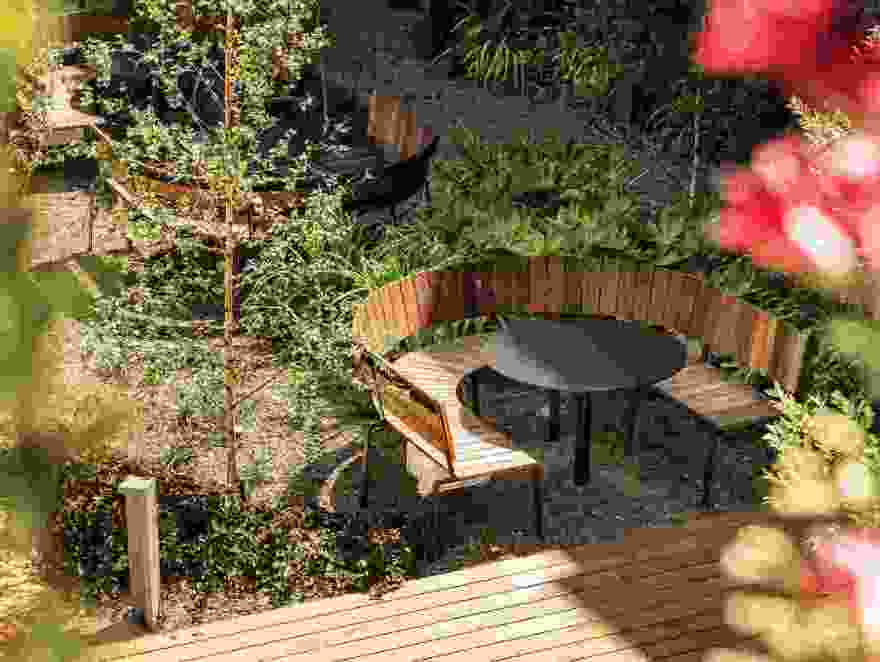
Within the central courtyard, areas of seating provide opportunities for small gatherings, doubling as outdoor workspaces for residents.
The central courtyard is open to a diversity of uses and is supported by the surrounding communal spaces, which include a kitchen and meeting rooms.
The exterior of IGLU Student Accommodation Summer Hill; window planters present a planted facade to the street.
Planting on structure enhances the open-air corridors that lead to the student rooms, bringing life to circulation spaces.
南京喵熊网络科技有限公司 苏ICP备18050492号-4知末 © 2018—2020 . All photos and trademark graphics are copyrighted by their owners.增值电信业务经营许可证(ICP)苏B2-20201444 苏公网安备 32011302321234号
苏公网安备 32011302321234号客服
消息
收藏
下载
最近