

创作上传
VIP
收藏下载
登录 | 注册有礼
查看完整案例

收藏

下载

分享
Inside Chhaava: How the film's set design revives the Maratha Empire in breathtaking detail
Wadas, ramparts, and war rooms— this is how Chhaava, starring Vicky Kaushal, brings Sambhaji Maharaj’s Maratha strongholds to life.
Chhaava, Maddock Films
In an age of fleeting digital interactions, period dramas like Chhaava offer something rare—a tactile, immersive world built from stone, wood, and memory. The film, centered on Chhatrapati Sambhaji Maharaj, is not just a chronicle of war and resistance; it is a study in how architecture wields power. Through durbars lined with towering pillars, latticed
jali windows
filtering the sun’s golden glow, and the throne that anchors the empire, Chhaava crafts a visual narrative as commanding as its protagonist.

Chhaava, Maddock Films

Chhaava, Maddock Films
Maratha architecture was never ornamental; it was strategic. Built to withstand invasions and assert dominion, it carried the weight of history in its fortifications and the whispers of governance in its durbar halls. Subrata Chakraborty and Amit Ray, the film’s production designers, root their vision in this legacy, constructing spaces where every beam, every arch, and every fresco reinforces authority.
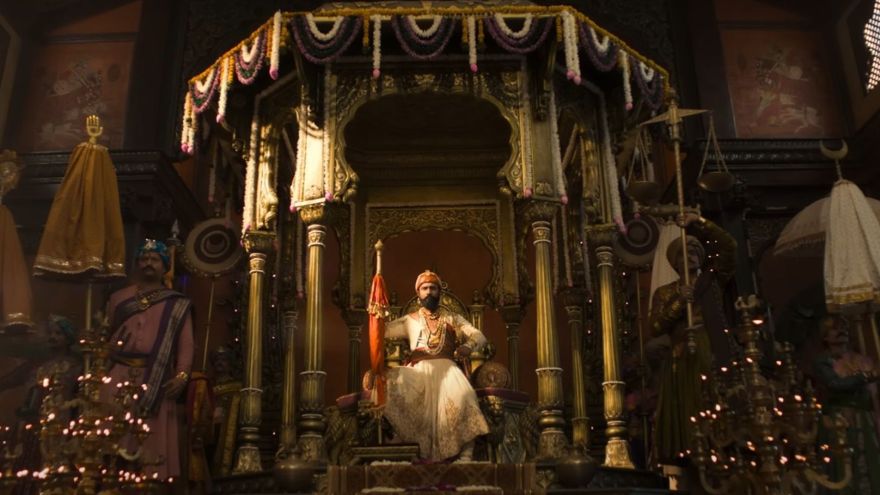
At the heart of Chhaava lies its grand courtroom—a palatial expanse where justice is not just delivered but performed. The set isn’t a passive backdrop; it breathes with the tension of diplomacy and the echoes of battle. High wooden columns, their surfaces intricately hand-carved and gilded with restrained opulence, frame the space. The polished teak and dark rosewood lend a gravity that balances both power and warmth, creating an arena where words carry the weight of war drums.

Chhaava, Maddock Films
Above, carved beams stretch across the ceiling, their filigree work catching the flicker of oil lamps. The latticed jali windows punctuate the heavy stone walls, casting shifting geometric patterns on the floor—an interplay of light and shadow that mirrors the ever-evolving stakes of rule. When Vicky Kaushal’s Sambhaji Maharaj steps into this space, the architecture frames him as much as the cinematography does. The natural illumination silhouettes his form, lending an almost sculptural quality to his presence, reinforcing his authority before he even speaks.

Chhaava, Maddock Films

Chhaava, Maddock Films
No detail in the throne’s design is incidental. Unlike the elaborate thrones of Mughal courts, the Maratha seat of power is defined by restraint—commanding without excess, ornate without ostentation. Its high back is sculpted with motifs that speak of conquest and continuity. Perhaps a nod to the empire’s insignia, the sacred tiger emblem, or intricate war formations etched into its wooden frame, the throne is an extension of Sambhaji himself—steadfast, deliberate, unyielding.
Positioned at the head of the courtroom, it governs not just the space but the very rhythm of the film’s key moments. The careful choreography of the set places it against a backdrop of murals— frescoes depicting cavalry charges, diplomatic councils, and royal processions. These paintings, rendered in a palette of deep ochres and muted indigos, weave the past into the present, ensuring that history is never just spoken of but seen, felt, and lived.

Chhaava, Maddock Films

Chhaava, Maddock Films
Beyond the throne, the very surfaces of the courtroom tell stories. The walls are more than barriers; they are a canvas of power. Murals stretch across their length, illustrating the empire’s military strategies, its alliances, its triumphs. The gold filigree running along the wooden beams does not merely suggest wealth—it reflects an era where artistry was as much a statement of endurance as it was of opulence.

Chhaava, Maddock Films
The seating arrangement is equally deliberate. While the throne commands the highest platform, the court members are seated on low divans and plush floor cushions in deep crimson and gold. The use of silk brocades and velvet, embroidered with fine zari work, adds a tactile richness that contrasts with the cool stone underfoot. The space is hierarchical yet fluid, allowing for both governance and discourse, mirroring the dynamics of a court where allegiances are forged and fates are sealed.
What Chhaava achieves through its production design is more than historical recreation—it resurrects a world where architecture is an extension of politics, where spaces are as integral to storytelling as characters themselves. In this vision of the Maratha court, power is not just seen—it is felt in the weight of the wood, the gleam of the brass inlay, the quiet authority of an unembellished throne. As the film unfolds, these spaces do more than contain the narrative; they shape it, becoming as indelible as the legacy of the warrior-king himself.

Chhaava, Maddock Films

Chhaava, Maddock Films
This courtroom, which is in many ways the prime location for many vital scenes, where friends and foes walk in to face Sambhaji, is not just a cinematic construct—it is a bridge to a bygone era, a meticulous recreation that pays homage to a time when architecture was both functional and deeply symbolic. Every arch, every carving, and every fabric choice in Chhaava’s
set design
contributes to an immersive historical experience, one that ensures the audience does not just watch history unfold but steps into it.
南京喵熊网络科技有限公司 苏ICP备18050492号-4知末 © 2018—2020 . All photos and trademark graphics are copyrighted by their owners.增值电信业务经营许可证(ICP)苏B2-20201444 苏公网安备 32011302321234号
苏公网安备 32011302321234号客服
消息
收藏
下载
最近