

创作上传
VIP
收藏下载
登录 | 注册有礼
查看完整案例

收藏

下载

分享
Rethinking the Urban Space with the ASLA Headquarters
ASLA headquarters, by Michael Van Valkenburgh Associates, Inc. and Conservation Design Forum, in Washington, D.C.
The ASLA (American Society of Landscape Architects) green roof project seeks to demonstrate the environmental benefits of green roofs, as well as to showcase what landscape architects contribute to this type of project. Located on the rooftop of the headquarters of the American Society of Landscape Architects in the heart of Washington D.C., the ASLA Green Roof project transformed an existing 3,000 square foot roof into an expressive display of green roof technology that supports an active social space.

ASLA Green Roof. Image courtesy ofASLA
Some Benefits of Green Roofs Worth Mentioning
Green roofs help to cool cities, clean the air, build habitat and manage storm water. The plants and their growing medium filter rainwater and some of its pollutants. The plants produce oxygen that improves air quality. A green roof reduces a building’s heating and cooling costs, acting as a form of insulation. And they lessen the heat island effect, in which buildings warm up so much that they heat their surroundings.
On the ASLA green roof, Styrofoam forms the base for each 25 foot (7.6 m) long ‘wave’ of plantings, which minimizes the weight of the structure. It features many different soil depths, ranging from 3 inches (75mm) on the flat portion to 21 inches (525mm) on the elevator shaft, to accommodate the roof’s varying strength in different areas while also showing different types of green roof designs.

ASLA Green Roof. Images courtesy ofASLA
THE WAVEFORMS BLOCK THE NOISE and views of the building’s HVAC units (Heating, Ventilation, and Air Conditioning), providing a more peaceful environment. In addition to sight and sound aesthetics, the HVAC runs more efficiently in the summer as they stay cooler in the shade of the waves. The roof creates the most energy benefits during the winter, as the insulation provided by the roof helps decrease heating costs by 10 percent.
“…reduced building energy costs by hundreds of dollars a month…”
ASLA set up an extensive monitoring system to measure air temperature, water runoff, and building energy use. A comprehensive report found that the green roof retained thousands of gallons of storm water, reduced building energy costs by hundreds of dollars a month, and significantly lowered outdoor air temperature.

ASLA Green Roof. Image courtesy ofASLA
Creating New Views
With the barrel-shaped mounds at the north and south ends of the roof, the designers have created new horizons for visitors, clearing the immediate urban foreground and focusing views on the more distant Washington skyline. The plants on the north wave include native perennials such as purple love grass (Eragrostis spectabilis), butterfly milkweed (Asclepias tuberosa), and black-eyed Susan (Rudbeckia hirta).
Right Plant, Right Place
The overall plantings include many “experimental” plants which are not typical green roof plants. This is done in an attempt to find plants that can withstand the harsh environment on a green roof.

ASLA Green Roof. Image courtesy ofASLA
ON THE SOUTH wave of the green roof grows prickly pear cactus (Opuntia sp.), along with other desert-adapted succulents, including varieties of Sedum that help to cool the air by as much as 43 degrees F (6.1º C) in the summer. In addition, these plants reduce the urban heat island effect. The plants also provide a habitat for many birds and insects. Covering the elevator shaft and rooftop access is trumpet vine (Campsis radicans), joined by a sumac tree (Rhus). This part of the roof is the strongest, allowing for more soil (up to 21 inches). Sumac trees, which can grow to nearly 30 feet tall (9m) require a greater depth of growing medium.
A Balance of Nature and Function
Balancing social use and ecological benefit, a unique element to the design is the aluminum grate that has Sedum growing below it. By using the aluminum grate, significantly more roof space is made accessible for visitors while providing a greater growing area.

ASLA Green Roof. Image courtesy ofASLA
ASLA Green Roof. Image courtesy ofASLA
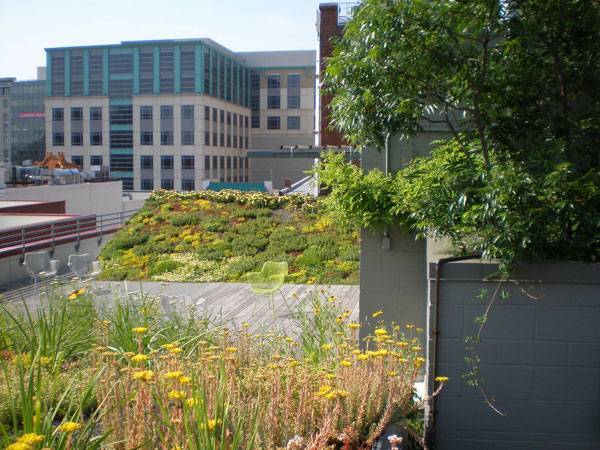
ASLA Green Roof. Image courtesy ofASLA
The success of each plant species is being monitored in order to identify a more diverse palette of plants that could survive on an urban rooftop without active maintenance after the first several years of establishment. This is a great project for landscape architects in the city and is a new way to look at the profession. This project provides proof that by using the correct amount of plants, we can provide a good living space within a semblance of nature, even within the built environment.

ASLA Green Roof. Image courtesy ofASLA
Full Project Credits For The ASLA Headquarters
Project: ASLA headquarters
Location: Washington, D.C.
Build: 2006
Size: 3000 sq. ft.
Prime Consultant/Landscape Architect: Michael Van Valkenburgh Associates, Inc.
Website:
Green Roof Consultant: Conservation Design Forum
Website:
Client: American Society of Landscape Architects
Project Team: Conservation Design Forum, Michael Van Valkenburgh Associates, DMJM, Robert Sillman Associates, Forrester Construction
Completion: 2006
Publications: Landscape Architecture Magazine, 2006, Metropolis Magazine, 2006
南京喵熊网络科技有限公司 苏ICP备18050492号-4知末 © 2018—2020 . All photos and trademark graphics are copyrighted by their owners.增值电信业务经营许可证(ICP)苏B2-20201444 苏公网安备 32011302321234号
苏公网安备 32011302321234号客服
消息
收藏
下载
最近