

创作上传
VIP
收藏下载
登录 | 注册有礼
查看完整案例

收藏

下载

分享
Revisit: Charleston in Firle, UK
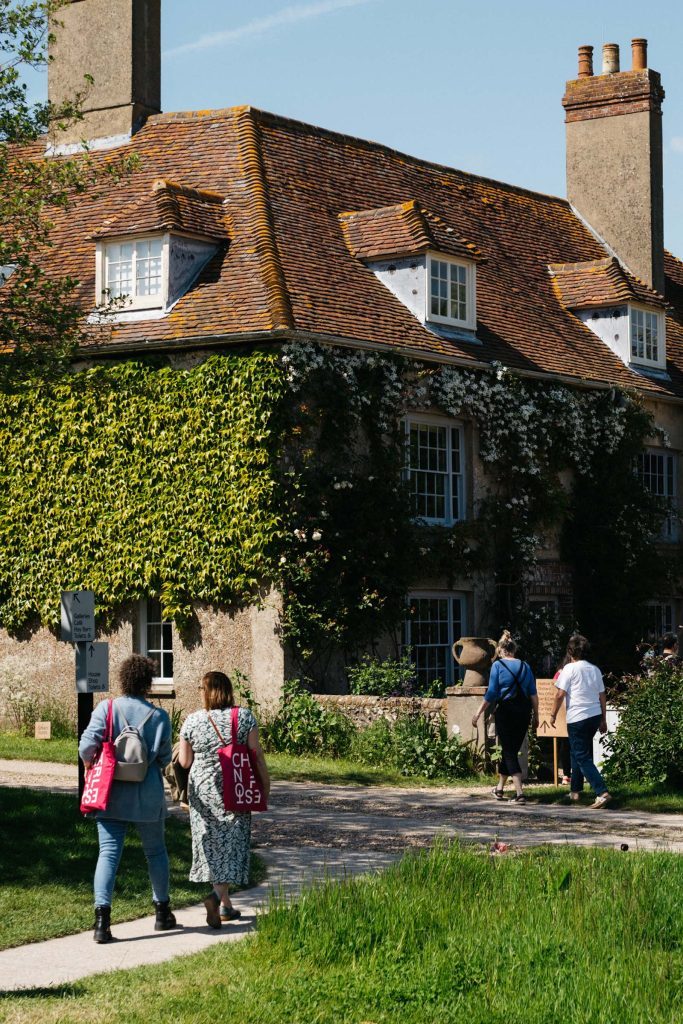

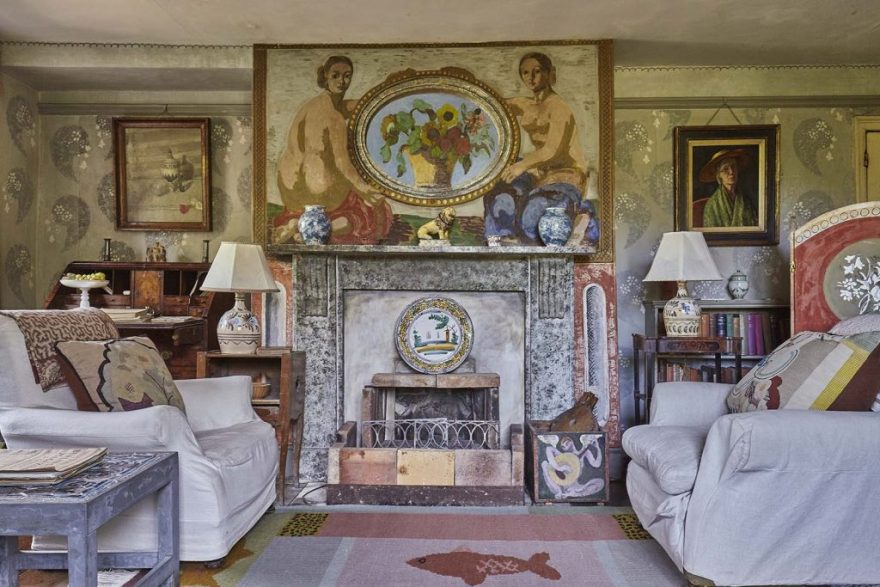


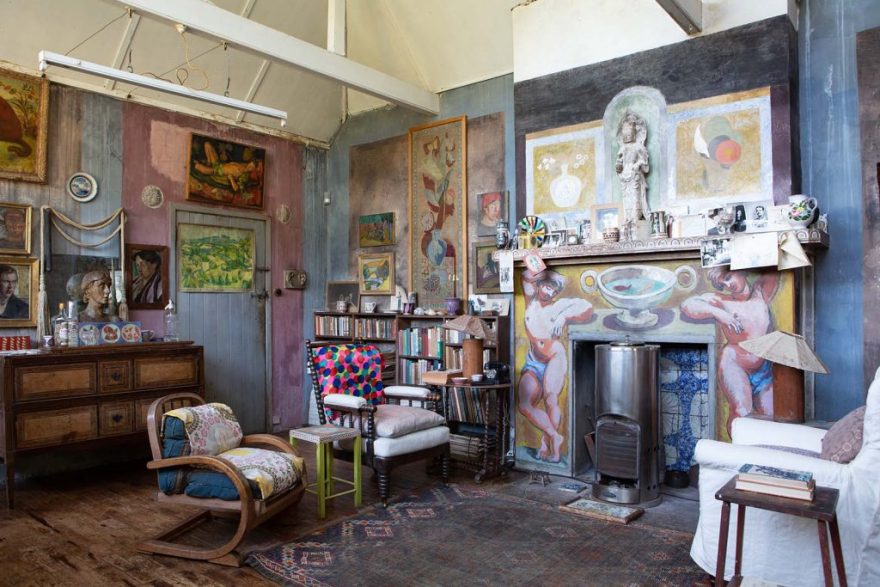


For decades, polite society has been scandalised by the lives of the Bloomsbury Set, a group of artists, writers and thinkers who gathered in the London home of sisters Vanessa Bell and Virginia Woolf (then Vanessa and Virginia Stephen) between 1905 and the outbreak of the First World War. What might be understood today as polyamorous pansexual liberation was – and often still is – fetishised as deviant promiscuity, which mainstream curators often argue ‘overshadows’ the work of the Bloomsbury Group, preferring instead to discuss the group’s output without mention of their open‑minded sexual and gender politics.
But the group’s progressive attitudes remain a critical touchstone more than a hundred years later, as argued by the exhibition,
Bring No Clothes: Bloomsbury and Fashion
(until 7 January 2024), on show at the new arts centre known as ‘Charleston in Lewes’. The arts centre is the latest augmentation of Bell and Duncan Grant’s home in the Sussex countryside.Charleston, a 17th‑century farmhouse in Firle, 11km from Lewes, was rented by the pair from 1916 – while Grant and one of his partners David Garnett were looking for agricultural work as conscientious objectors in the First World War – until Grant’s death in 1978.
Bell, Grant and Garnett initially lived at Charleston with Bell’s two children from her marriage with the art critic Clive Bell, plus a nanny, a maid, a cook and Henry the dog. Vanessa Bell and Grant’s relationship was intensely close: they had a child together in 1918, but their connection was largely platonic and was always an open relationship. Over time, many members of the Bloomsbury Group and their wider cultural ecosystem passed through Charleston, including artist Dora Carrington and writers EM Forster and Lytton Strachey, as well as Bell’s sister, who was a frequent visitor and lived just 13km away at Monk’s House in Rodmell.

In a letter sent to Duncan Grant in September 1916, Vanessa Bell included a drawing of Charleston , for which she was about to sign the lease. In the same letter, Bell writes of a conversation with the landlord: ‘I said I should probably white or colour wash many of the walls and he said he didn’t mind what I did’ – this was fortunate, as otherwise the house would not be the work of art it is today
The queer identities of many of these protagonists were able to flourish in the relative privacy (and privilege) of Charleston’s countryside setting, which became a refuge and deeply productive space for these creative practitioners. The home and garden were the backdrop for raucous dinner parties, long arguments about art and politics, and experimental performances – often complete with handmade costumes. As well as a space in which Grant and Bell worked, and which provided endless inspiration, the fabric of the house itself was also a site for art: every surface and piece of furniture received the Bloomsbury treatment of bright geometric shapes, blousy floral patterns and lazily reclining nudes, painted predominantly by Bell, Grant and Roger Fry, who also designed Charleston’s gardens in 1918 and the ground‑floor studio in 1925.
Economist John Maynard Keynes visited Charleston so often that he had his own bedroom in the house. As chair of the Council for the Encouragement of Music and the Arts (CEMA, the forerunner to the Arts Council), Keynes, with Bell and Grant, proposed an arts centre in 1943, not dissimilar to Charleston in Lewes – a theatre, gallery and café for small British towns, using Lewes as a model. The idea was presented in the touring exhibition
Designs by Various Artists for Decoration in the Theatre
, in which the participants displayed objects that might embellish such a building. Grant wrote that the project was in support of ‘a proper collaboration between the artist and the architect, a state of which ... has latterly become very rare’.
In some ways, Charleston in Lewes partially fulfils this vision – creating galleries and a café in central Lewes, minus the theatre – though rather than a project of embellishment in collaboration with artists, this was an exercise in stripping away. The new arts centre inhabits Southover House, designed by the county architect EA Verger in 1939 for the East Sussex County Surveyors Office, and home to Lewes District Council from 1998 until last year when it was transformed by Material Cultures. The architects have dismantled the office fit‑out on three floors to reveal the handsome bones beneath and ‘celebrate the existing fabric’, as practice co‑founder George Massoud explains. They have made room for a large café and shop at street level, as well as for two galleries, learning spaces and offices for the Charleston Trust, with minimal alterations to the existing building.
‘The protagonists’ queer identities were able to flourish in the privacy of Charleston’s countryside setting’
Unlike the rooms of Charleston, crowded with the lives and artistic production of Bell and Grant, the undressed armature of the new arts centre is both physically and metaphorically ‘less restrictive’, in Massoud’s words. This space allows the trust to make the compelling case that contemporary society can still learn from the Bloomsbury Group’s progressive attitudes towards pacifism, feminism and queerness.
Commentary at Charleston itself is provided largely by assistants distributed through the house and can be very uneven, dependent on what questions visitors ask and the views of the assistant (the Bloomberg Connects app, introduced during the pandemic, also provides detailed information for those happy to pore over their phones). At Charleston in Lewes, the
Bring No Clothes
exhibition clearly articulates the nuanced and often erased queer identities of many members of the Bloomsbury Group, including Keynes, whose ‘image of heterosexual patriarchal power’ and eugenicist tendencies are also mentioned.
Charleston in Lewes is in many ways more accessible than its Firle counterpart: 98 per cent of visitors to the house arrive by car, while the arts centre located in central Lewes is around the corner from the train station. There is a clear ambition to be ‘relevant to a modern audience’, according to Charleston Trust project manager Polly Jones, and visitors to the Lewes arts centre may not have heard of the Bloomsbury Group. Bared in the spaces of Charleston in Lewes, the Bloomsbury Group’s liberated lives – made possible largely due to their immense privilege and generational wealth, which allowed them to live their truths insulated from judgemental publics – are accessible to new audiences and stand a chance of evolving mindsets so that more people may live without judgement.
The desire to carve out room for artists and themes beyond the confines of the Bloomsbury Group began with the addition of an exhibition centre by Jamie Fobert Architects in 2018; shows here have included the
Very Private?
exhibition in 2022, which combined a series of Grant’s erotic drawings with commissioned responses from six contemporary artists, and the current Osman Yousefzada exhibition (until 10 March 2024). The ambition and radicalism of some of this recent programming and curation has been directly enabled by these additional spaces at Firle and in Lewes, necessarily apart from the farmhouse itself.

When the garden was restored in 1985, it was returned to its 1950s state through a detailed plan
Charleston’s augmentations over recent years are also a clear indication of its need to diversify (and increase) its income: Charleston in Lewes includes 200m
of new gift shop and café, and Jamie Fobert Architects’ exhibition centre was accompanied by the conversion of cavernous barns restored by Julian Harrap Architects into a café and events space. PUP Architects added an outdoor stage to the Firle site in 2021, allowing a Covid‑compliant summer programme to take place, and it remains today. Exhibitions and cafés attract repeat visits from locals rather than one‑off pilgrimages, and numbers were steadily climbing, reaching nearly 39,000 in 2018 when Charleston started to remain open year‑round and extended its opening hours. Over a year of closure due to the pandemic came at a particularly vulnerable time when the trust needed to recoup funds; the Corten roof of Jamie Fobert Architects’ exhibition centre has not been installed five years later (plans remain to complete the roof but no date has been set).
Revenue is urgently needed to fund the ongoing maintenance of the farmhouse, as the Charleston Trust receives no public funding. The trust was set up in 1980 to purchase and restore the house after Grant died in 1978, at which point the house and its contents were in a state of grave disrepair. As well as structural damage – the roof had to be entirely replaced and the house treated with poison gas to eliminate pests – many of the decorated surfaces and objects were decayed and heavily worn; unsurprisingly, the furnishings were not created with their permanence – and museumification – in mind and were restored to their ‘lived‑in’ state rather than mint condition. The house and garden stand as they would have in the 1950s, a time which living relatives remember, and additions and changes made in the proceeding decades were peeled away. The house finally opened in 1986.
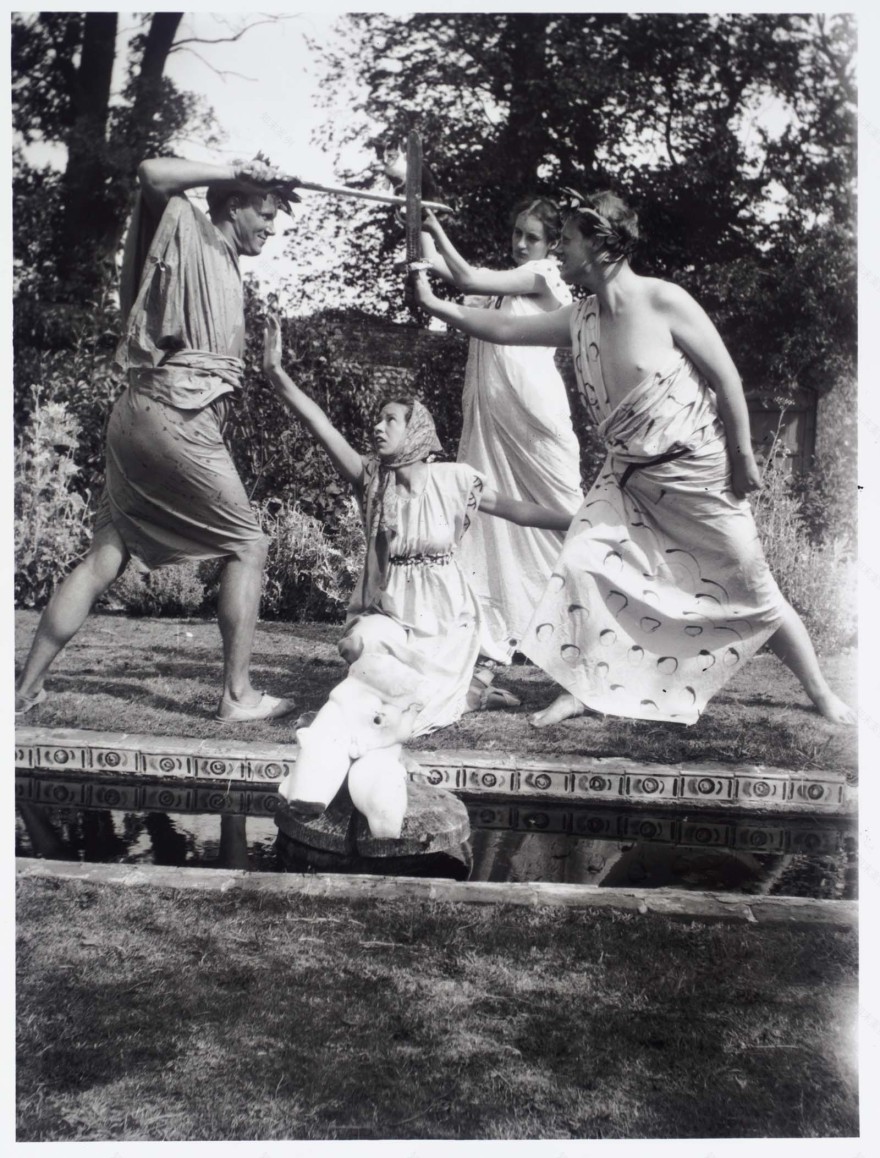
Charleston’s garden was designed by Roger Fry when they moved in and features several artworks, including pond tiles decorated by Bell
Visitor numbers are now growing exponentially, with 65,000 visitors in 2022, and Charleston in Lewes is raising the institution’s profile among the general public: according to the Charleston Trust, studies have shown that Charleston in Lewes ‘could deliver 100,000 new visitors to the Lewes district annually, providing an addition £4.2 million in visitor income for the local community’. The Sussex Art Shuttle – a minibus running between Charleston, Charleston in Lewes and the Towner gallery in Eastbourne, which is hosting this year’s Turner Prize – was also launched this September.
But Charleston’s future remains precarious. The new arts centre is in fact a ‘pop‑up’ and may prove to be temporary; the building’s destiny beyond 7 January is still unclear. For now, the project is merely ‘an experiment’ to ‘test the hypothesis of a triangle of Bloomsbury‑connected places’ – Charleston in Firle, Charleston in Lewes and Virginia Woolf’s Monk’s House (owned by the National Trust) – and to establish interest and support from the local community for an arts centre in the town. In the context of widespread intolerance for queer communities, particularly outside metropolitan centres, the progressive message propagated by this project deserves a permanent home. It is testament to both the architects’ artful execution and the Charleston Trust’s forward‑looking agenda that this supposedly temporary project feels so enduring.
Exhibition centre in Firle, UK by Jamie Fobert Architects (2018)

The timber trusses and quarry tile floor of the exhibition centre belong to the agricultural language of the barns on the site

The new building creates a new yard (above) adjacent to the neighbouring barn – converted to house a café and events space – providing visitors with an outdoor seating area

The exhibition centre is yet to receive its crown of Corten roofing due to a shortage of funding; Corten was chosen as it will slowly rust to the colour of the lichen which covers the neighbouring buildings
In 2009, Jamie Fobert Architects and Julian Harrap Architects won a competition to develop Charleston’s site in Firle. Nine years later, in September 2018, the additional 570m
of floor space, in the form of a new exhibition centre and an 18th-century barn converted into a café and events space, finally opened to the public. Jamie Fobert Architects designed a new‑build exhibition centre out of cross-laminated timber, referencing the exposed timber skeleton of the historical barn which Julian Harrap Architects had restored next door. In contrast to the analogue restoration methods employed in the barn, the exhibition centre’s structure was prefabricated in Germany. The new building includes three gallery rooms and a central foyer, and allowed the Charleston Trust to display its own exhibitions for the first time. ‘Much like the artists who lived here, our programme will be radical, unconventional and international,’ Charleston Trust director Nathaniel Hepburn stated at the project’s opening.
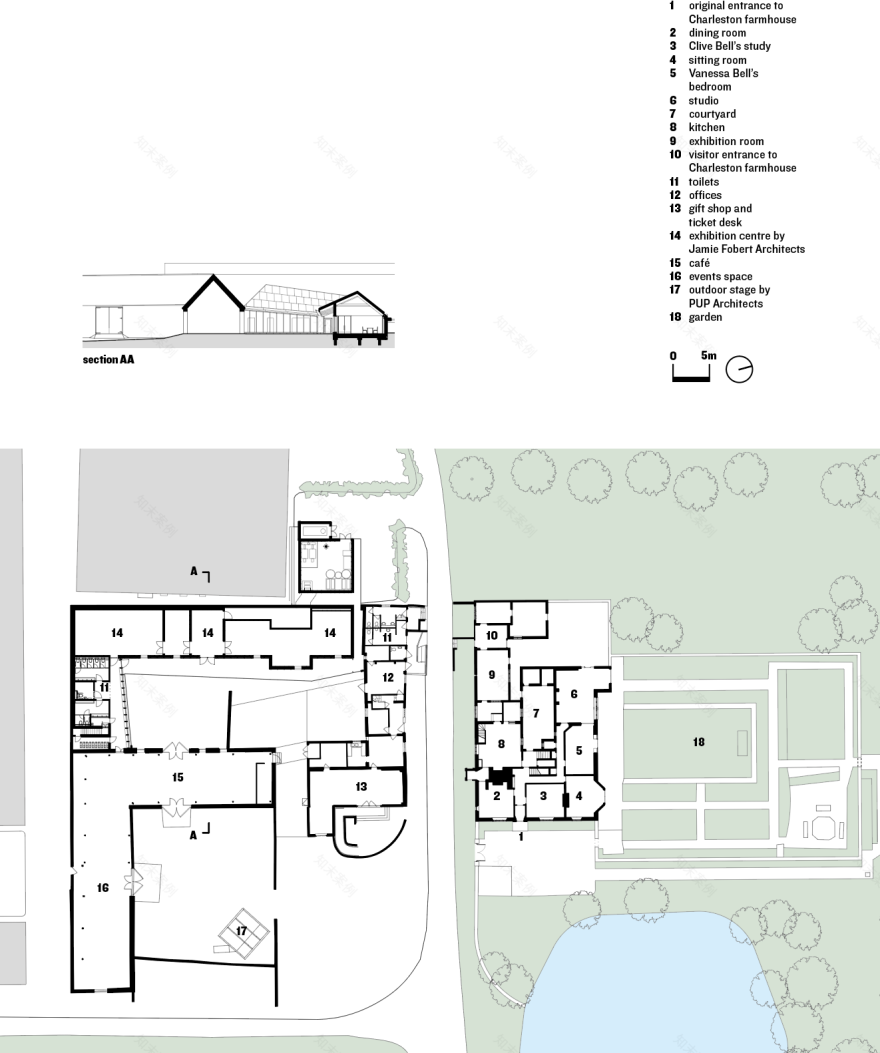
Outdoor stage in Firle, UK by PUP Architects (2021)

The Charleston farmhouse site functions alongside an operational farm in the South Downs National Park in Sussex

PUP Architects’ outdoor stage joined an assemblage of buildings, including barns converted into a café and events space

The stage hosted Charleston’s summer programme in 2021 and remains
In 2021, in the context of pandemic restrictions, PUP Architects designed a stage to facilitate a socially distanced summer programme at Charleston’s site in Firle. The steep monopitched roof takes its cue from the surrounding agricultural buildings and those found more broadly across the Sussex countryside. The stage opens up towards the yard cradled by the L-shaped barn, which was converted into a café and events space in 2018. The bright colours of the stage roof are inspired by the palette of Charleston’s interiors; the paints are natural and environmentally friendly, and were provided by a local paint supplier. The painted roof is complemented by the warmth of the timber structure, which was sustainably sourced and is 100 per cent reusable, recyclable and biodegradable. The stage was constructed in just five days by the architects themselves. The summer programme hosted on the stage included talks by artist Jeremy Deller and actor Helena Bonham Carter.

Charleston in Lewes in Lewes, UK by Material Cultures (2023)

Located on Southover Road, close to Lewes train station, Charleston in Lewes inhabits a municipal building from 1939

A large gift shop and exhibition spaces attract repeat visitors and a younger public than the house in Firle

The historical entrance hall was encased in a garish modern fit-out (below), which Material Cultures removed to reveal its handsome original features
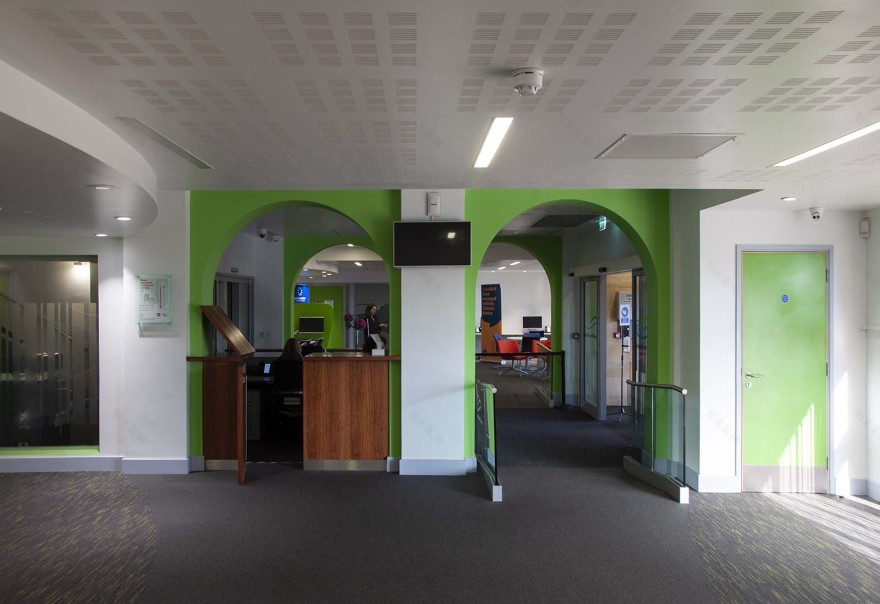
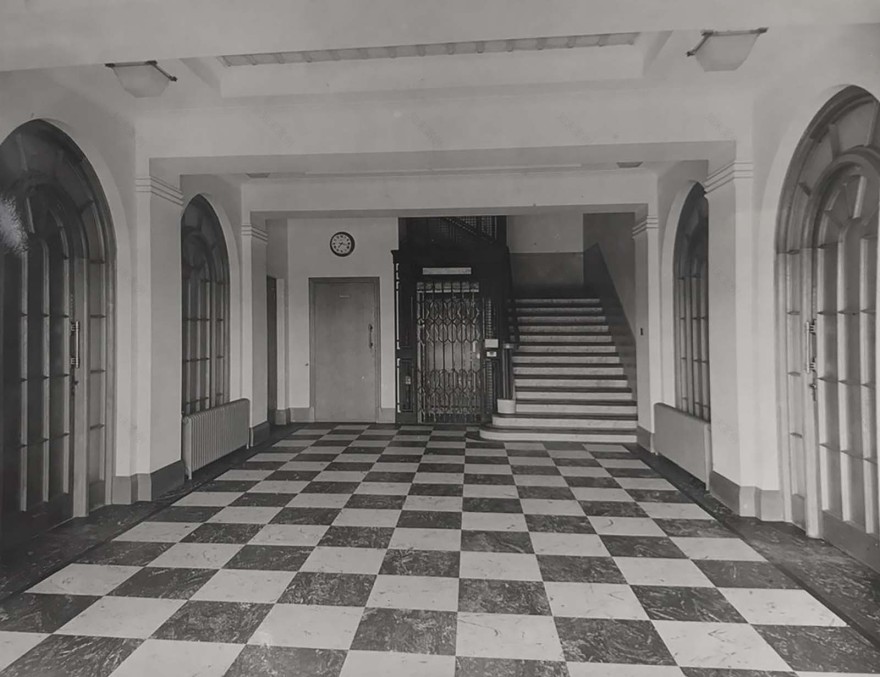


The rehabilitation of the 1930s Southover House has created space for the arts centre known as ‘Charleston in Lewes’. The transformation, designed by Material Cultures, was driven by strategic stripping away of suspended ceilings and plasterboard.The original tiled floor has been revealed, and elsewhere a cheap but artful finish of brushed latex has been applied, resonating with the chalky colour washes featured in the house itself. The key insertions are in the form of joinery – of signage, furniture and exhibition displays.
accordingly, the budget was just £600,000 and the timescale was compressed to just a few months – Material Cultures won the public competition in December 2022 and by September 2023 the centre was welcoming visitors. The architects have deftly handled material economy to create generous and dignified spaces for conversations that expand beyond the confines of the Bloomsbury Group.

南京喵熊网络科技有限公司 苏ICP备18050492号-4知末 © 2018—2020 . All photos and trademark graphics are copyrighted by their owners.增值电信业务经营许可证(ICP)苏B2-20201444 苏公网安备 32011302321234号
苏公网安备 32011302321234号客服
消息
收藏
下载
最近