

创作上传
VIP
收藏下载
登录 | 注册有礼
查看完整案例

收藏

下载

分享

Archaeological space in Daroca by Sergio Sebastian
[Daroca] Spain
Archaeological space in Daroca by Sergio Sebastian
Within the historic village of Daroca, the project for Museo Arqueológico y Ampliación de la Sede Comarcal appears as a big cover floor which protects the heritage and generates a public space for pedestrians.

Sergio Sebastián
designs a building to house a series of ruins and, at the same time, the roof becomes a public square. During the night this square is illuminated giving rise to a contemporary interpretation of the traces of the ancient walls of the lower layers.
The ground of the historical villa of Daroca folds and lifts to show the richness of its past to the public!
The surface layer rises like a great cover revealing its core from the street, the valuable archaeological remains which have appeared under it. The building is generated from the urban fabric, as a new public space which covers and protects the history of this city and the representative character of the regional institution founded above this former place.
The historical relevance of the remains allows to date back the city foundation nine centuries before, from medieval hypothesis origin to celtiberian period. Due to this the institution promoted an ideas competition, with the aim to solve the relation between the initial need of a parking area and the presence of the archaeological finding, considering that this attitude could be an example for the private local promoters.
The winning project built a new public place in the village, understood as an overlapping of layers that belong to different times, since 2000 years ago untill now, where the relevance of them is notxa0 in each one but in their conciliated addition; as a museum opened to the street, that shows to the citizen the richness of his own past.
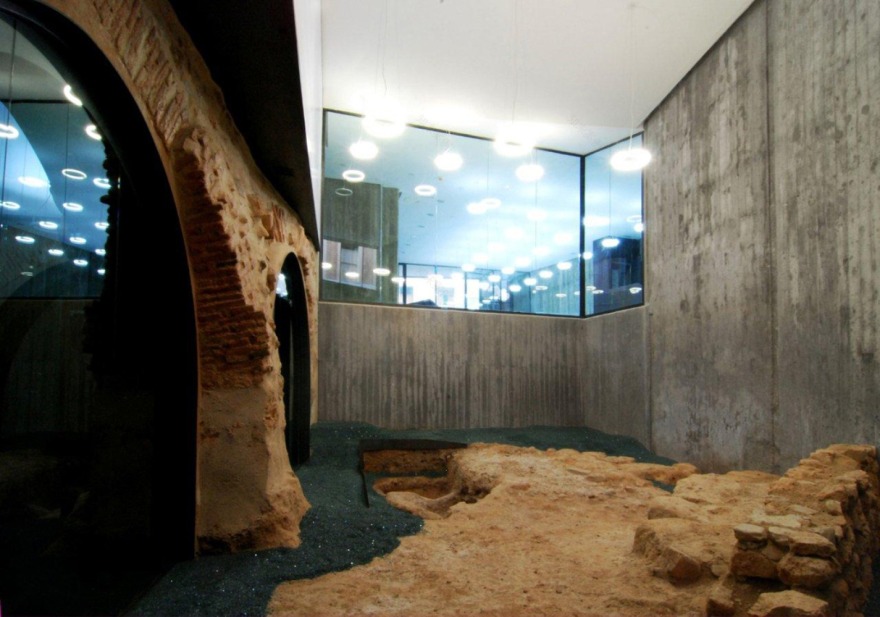
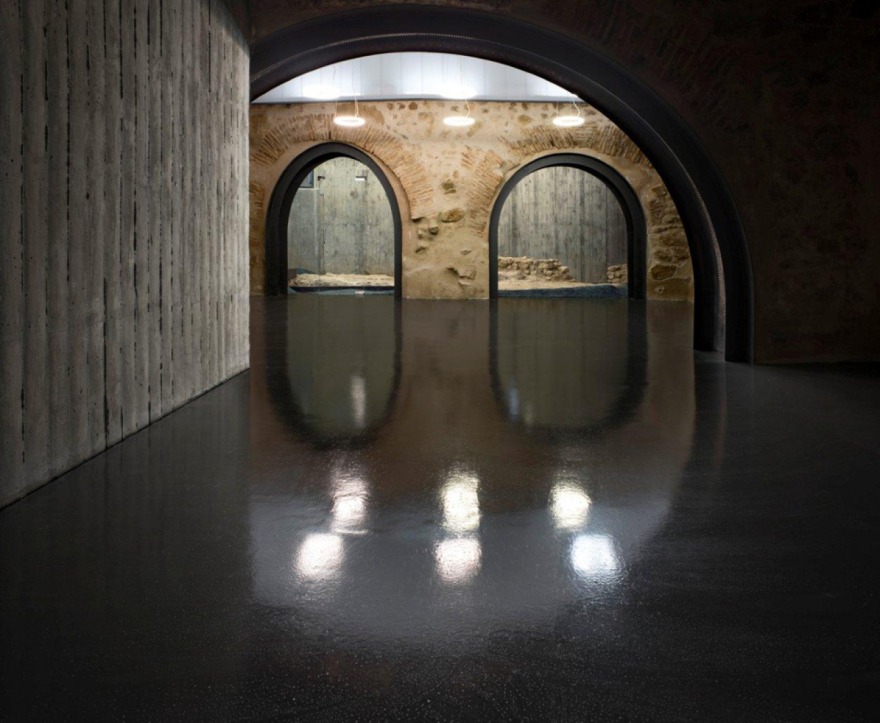
The archaeologist team found the walls of two 10thC. islamic medieval houses, five arches that probably took part of Almudi´s Palace (a mythical 15thC. medieval construction not founded untill then), a piece of an important roman causeway, and two celtiberian silos, from the1stC.
The new institutional programs established a rich dialogue with these historical structures, sculpting a multilevel space that generates a conference hall in the first level, a room for singular meetings into the space of archs and a little museum, as the treasure chest that contained the small pieces(ceramic, coins, etc.) founded in the excavation, both in the lower level. It is not a question of bringing the past to our time, but is about finding a way to live with it.
Covering and protecting all, the deck-square incorporates the outside uses of the regional head offices and a temporary parking. Conceived as the main façade of the building, it is developed in continuity with the narrow streets of the historical city, expanding their same stone texture in a new public square, and integrating a contemporary interpretation of the ancient walls of the layers below, by lights that appear at night coloring the place.
To build in a historical city demands a meticulous choice and use of material, and a more important thing, the adoption of an attitude about it. The attitude in this case is the choice of coexistence instead of mimicry, from a construction of concrete and steel, sensitive with the place, attentive with the historical memory, and coherent with contemporary needs. A strong concrete shell protects the inside, and allowed to complete the excavation comfortably outstanding the perimeter forces. Its effort is shown naturally as the interior texture. The use of cort-en steel flats allows to delimitate the area, to articulate the walkarounds, and to preserve the findings.
A single image is generated within the city, a silent palimpsest born from the respect for it, not from a mere conservation strategy but understanding the place.
Architect.- Sergio Sebastian.
Collaborators.- Fernando Muñoz (architect in project), Miriam Tambo (structure assistant in project and co-direction in construction), Jesús Molinos (technical architect), María Jesús Velázquez (technical architect), Pablo Sebastián (technical architect), José Delgado (Fidias Trade, archaeologists).
Location.- Calle Maestro Mingote. Daroca. Spain.
Surface.- 350 m2
Contest date.- 2007
Completion date.- 2012






Sergio Sebastián Franco
Sergio Sebastián
´s Architecture Office was founded by
Sergio Sebastián Franco
in 2006 and is based in Saragossa.
Sergio Sebastián Franco.
Calatayud (1976). Architectxa0ETSA Madrid. xa02002. PhD Architectxa0 ETSA Madrid. 2016
Architectural Design at the University of Zaragoza since 2009. Among his main works are the City of Justice in Zaragoza, or the Palace of Justice in Huesca, or the Master Plan for the rehabilitation of the Palace of the Audience of Zaragoza. Among the fields of art and architecture, they have been developing pieces of artistic lighting since 2004.
Currently, he is developing various studies for the recovery of the Camino De Santiago in Aragon and the enhancement of various dispersed and abandoned heritage in various nuclei to its He passed. He is also a contributing critic at Zenda Libros.
Selected in the Spanish Pavilion of the Venice Architecture Biennale 2020. Gold Medal for the DOMUS Restauro e Conservazione Award (2014). Architecture Award with EÑE (2018 and 2016). Ricardo Magdalena Awards (2020, 2018, and 2013). Construlita Mexico Award (2019). Paysage Triennale di Milano Award (2019). Innomatnet Awards Award. New materials in Building Industrie (2014). Excellence Award in Historic Architectural Renovations in Build Magazine’s Architecture Awards (2015). Rethinking The Future International Awards Award (2018 and 2015). Blue Stone Awards Archi-World Award (2013). Special mention Europa Nostra Awards (2014). Selected in various editions of the European Landscape Biennial, the Spanish Architecture Biennial, the Urban CCCB Awards, or the CSCAE Architecture in Positive Awards. Finalist in the Arquia / Próxima awards, Piranesi Accademia Adrianea di Roma, ASCER, García Mercadal COAA, Prémio Jornal-Larus architecturas urban equipment Iberian, and LUMEC CLU Foundation Philips, SAIE Selection Contest´12 Archi-Europe.
南京喵熊网络科技有限公司 苏ICP备18050492号-4知末 © 2018—2020 . All photos and trademark graphics are copyrighted by their owners.增值电信业务经营许可证(ICP)苏B2-20201444 苏公网安备 32011302321234号
苏公网安备 32011302321234号客服
消息
收藏
下载
最近