

创作上传
VIP
收藏下载
登录 | 注册有礼
查看完整案例

收藏

下载

分享
Expressing transformation: School of Design and Built Environment – Curtin University
The design for the courtyard of a university building in Perth’s south creates a refuge for students and a canvas for the expression of First Nations culture.
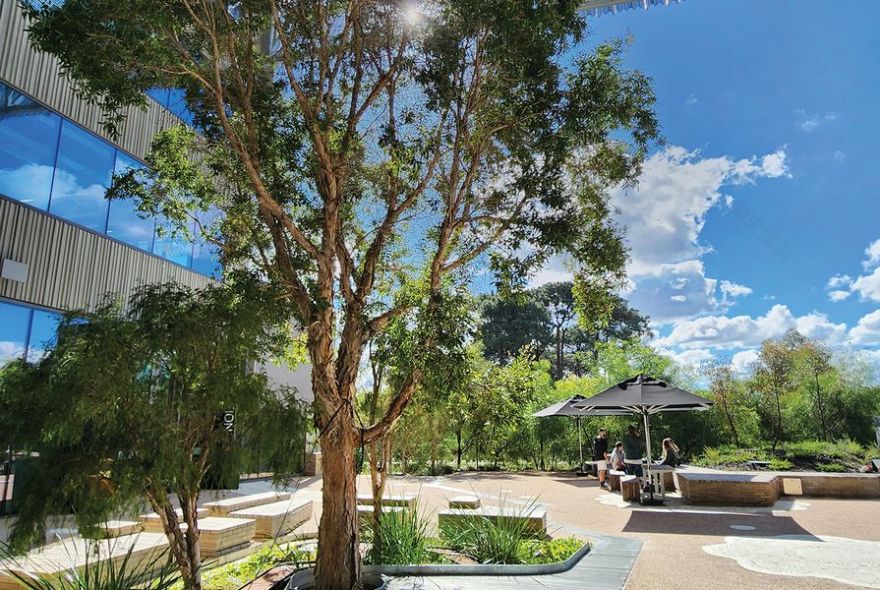
Deep-soil planting areas support a grove of advanced trees in the courtyard’s sunken rain garden. Diversifying to include an array of online platforms, many Australian universities have been facing the challenge of justifying a sprawling suburban existence. Tactical placemaking efforts have been looking to counter this trend, but their effectiveness has been limited, with some universities choosing to relocate to the CBD.
The new Exchange Innovation Precinct (Exchange) at Curtin University’s Bentley campus provides a model for supercharging flagging suburban campuses through dense mixed-use urbanism. Located towards the periphery of the campus, this dynamic precinct features four significant new buildings: a hotel by Six Degrees (completed in 2021), two student accommodation buildings designed by Nettleton Tribe (completed in 2022) and, most recently, the School of Design and Built Environment (SDBE) by Wardle (also completed in 2022). Knitting these together is the design of a substantial public realm that funnels visitors from a regional bus hub through a vibrant retail strip, connecting the SDBE with the broader campus.

Deep-soil planting areas support a grove of advanced trees in the courtyard’s sunken rain garden.

A shared underground irrigation reservoir and limited water availability shaped the landscape design and its low-water-use planting palette.
The Exchange, which forms the first stage of AECOM’s 2014 Greater Curtin Master Plan, was funded – and is maintained – by a $500-million public-private partnership. The wider masterplan was a mammoth project that spanned four years, with local practice Realm Studios undertaking the role of landscape architect. As one of the few design consultants whose scope extended over the entire precinct, the practice became an impromptu custodian, responsible for weaving the 3.1-hectare site together.
Within the Exchange, the SDBE building is a standout element – an iconic building that will serve as inspiration for its population of future designers. The landscape around the building is more understated, but works hard to serve a variety of functions: a conduit through the campus, a naturalizing backdrop for the architecture, a comfortable refuge for staff and students, a versatile events space, and – perhaps most powerfully – a canvas for the expression of First Nations culture.
The primary landscape feature is a northern courtyard around which the building hangs. A functional hardstand with movable furniture, the space provides a year-round platform for events, supporting exhibitions, installations, and the (sometimes informal) display of the various prototyping efforts of the students working in the makerspace on the SDBE’s ground floor.
Beyond these functional requirements, the landscape design takes its cues from the Greater Curtin Living Knowledge Stream Design Guidance, a key part of the early planning work undertaken for the entire Bentley campus. Developed by Syrinx Environmental and Sync7 with prominent Noongar Elder Noel Nannup, this work mapped ancient blue-green systems, palaeochannels and songlines – Kujal Kela (Twin Dolphin) and Djiridji (Zamia) – to establish a framework diagram for the wider campus that outlined a network of landscape armatures and cultural trails. In the diagram, these songlines intersect at the SDBE, further establishing the importance of the site. The songlines were one of the starting points in a conversation between Realm Studios and the site’s Traditional Custodians (facilitated through Curtin’s Centre for Aboriginal Studies). The conversation has led to a spatial response that goes beyond symbolic representation to embed natural process through the creation of a “living steam” enriched with Noongar design.
Conversation between the site’s Traditional Custodians and Realm Studios yielded a songline-informed response, including a “living stream” enriched by Noongar design.

Noongar artist Kamsani Bin Salleh’s work enriches the paving with bold patterning that is legible from the upper levels of the SDBE building.
In the courtyard’s centre, a sunken rain garden and tree grove form a focal point. Crucially, Realm Studios negotiated the inclusion of deep soil planting areas as a central element in the landscape, cutting directly through basement carparks below and allowing for the planting of advanced trees on what would have otherwise been a raised planter on slab. While clearly a recent addition to the space, these melaleucas will, hopefully, thrive in the deep soil and slowly enhance the naturalistic wetland character of the space.
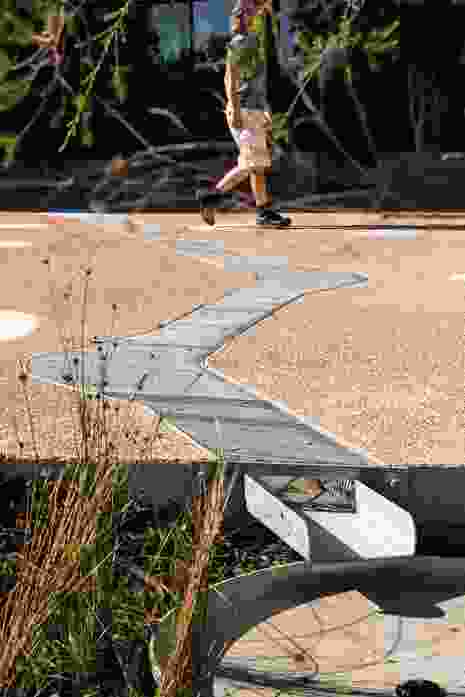
The central rain garden is also the starting point for a journey about water that takes one along an ephemeral “living stream.” The technical aspects of the water system have been skilfully thought out. Stormwater is collected in an underground tank and filtered. When the tank is full, a portion of the water is released into the rain garden, nourishing the wetland grove and gradually infiltrating through the deep soil to the aquifer beneath. Another water portion is channelled above ground, through a series of steel rills and platforms that flow beneath grates across the plaza, to emerge in a landscaped swale beyond. This stream continues to transform into a sculptural steel ribbon that meanders off into the vegetation. Although the ribbon itself is not intended to be walked on, it invites people to move away from the paved ground and into the vegetated areas, as a shortcut to the pedestrian promenade in the distance.
This living stream was driven by a collaboration with Noongar artist Kamsani Bin Salleh, who is also responsible for the bold patterning on the concrete paving that is clearly visible from the upper levels of the SDBE. Here, the skill of the landscape architect has been in stepping aside to create a canvas for allegorical expression by others. The project has been a key stepping stone for Bin Salleh and demonstrates how, through project delivery, emerging artists can establish finance and management processes that help position them for future opportunities.

As it flows from concrete toward vegetation, the living stream becomes a sculptural steel ribbon that marks an unpaved pedestrian shortcut.

Kamsani Bin Salleh with his artwork in the Curtin University School of Design and Built Environment courtyard.
At the scale of the precinct, the prioritization of natural systems extends to water management. The design relies on the collection of rooftop rainwater, which is collected from all new buildings in the wider Exchange precinct and stored in a shared underground reservoir for campus landscape irrigation. The tank’s size influenced the design of the SDBE landscape, with the extent of irrigated landscape and the low - water - use planting palette directly correlated with water availability. This initiative is a departure from Perth’s characteristic one - building - at - a - time development approach, which often overlooks larger - scale sustainability opportunities.
When it comes to incorporating First Nations perspectives in built environment projects, factors like a project’s process, economic implications and cultural influence are often more significant than any formal design outcomes. In this context, the journey taken to realize the SDBE and the broader Exchange precinct is a valuable case study, demonstrating the unique role that universities can play in catalysing distinct and novel forms of urban transformation. Traditional Custodian engagement is now common in Australian university campus design, with an increasing number of yarning circles, gardens, cultural walks, signage and art co - designed or authored by First Nations designers. In the Exchange, through collaborative campus - wide planning, this process has translated an organizational commitment (Reconciliation Action Plan) into a constructed built form embedded with Aboriginal cultural representation and landscape outcomes that encourage natural processes to thrive.
Plant list (abridged)
Allocasuarina humilis (dwarf sheoak), Banksia attenuata (candlestick banksia), Banksia menziesii (firewood banksia), Baumea articulata (jointed rush), Baumea juncea (bare twig - rush), Conostylis aculeata (prickly conostylis), Dampiera trigona (angled - stem dampiera), Darwinia citriodora ‘Sea Spray’ (prostrate darwinia), Eremophila glabra ‘Kalbarri Carpet’ (tar bush), Eremaea pauciflora (eremaea), Eucalyptus victrix (little ghost gum), Haemodorum spicatum (bloodroot/mardja), Hemiandra pungens (snakebush), Juncus pauciflorus (loose - flower rush), Kennedia prostrata (running postman), Macrozamia communis (burrawang), Macrozamia riedlei (zamia palm), Melaleuca preissiana (modong), Patersonia occidentalis
(purple flag/komma), Themeda triandra (kangaroo grass), Verticordia densiflora (compacted featherflower)
School of Design and Built Environment – Curtin University
REALMstudios
Damien Pericles, Brett Schreurs
Wardle
Kamsani Bin Salleh
Lendlease
Artitecture
Stantec (formally Wood and Grieve Engineers)
ETC Solutions
Pinion Advisory
Schuler Shook
Apparatus
Built on the land of the Whadjuk people of the Noongar nation
Urban
Built
36 months
12 months
Landscape / urban
Universities / colleges
Curtin University

Deep-soil planting areas support a grove of advanced trees in the courtyard’s sunken rain garden.
Conversation between the site’s Traditional Custodians and Realm Studios yielded a songline-informed response, including a “living stream” enriched by Noongar design.
As it flows from concrete toward vegetation, the living stream becomes a sculptural steel ribbon that marks an unpaved pedestrian shortcut.
Kamsani Bin Salleh with his artwork in the Curtin University School of Design and Built Environment courtyard.
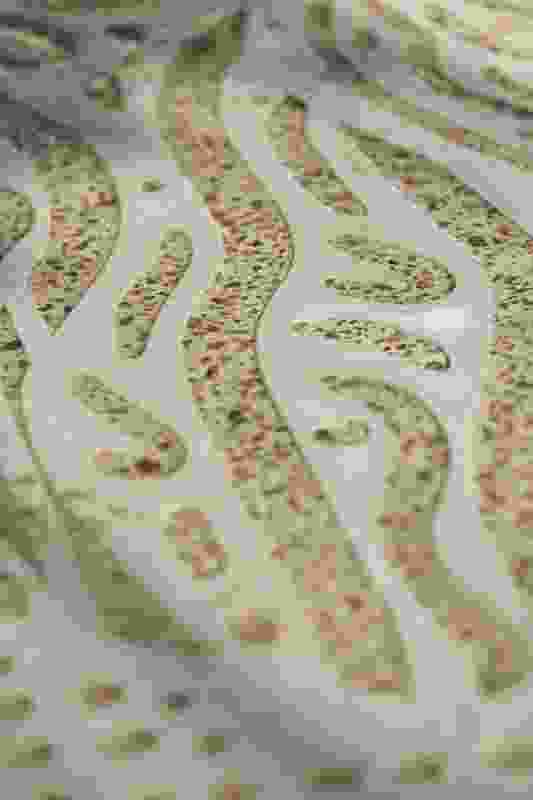
Providing a canvas for the expression of First Nations culture is one of landscape’s many roles in Realm Studios’ design.
Noongar artist Kamsani Bin Salleh’s work enriches the paving with bold patterning that is legible from the upper levels of the SDBE building.
A shared underground irrigation reservoir and limited water availability shaped the landscape design and its low-water-use planting palette.
南京喵熊网络科技有限公司 苏ICP备18050492号-4知末 © 2018—2020 . All photos and trademark graphics are copyrighted by their owners.增值电信业务经营许可证(ICP)苏B2-20201444 苏公网安备 32011302321234号
苏公网安备 32011302321234号客服
消息
收藏
下载
最近