

创作上传
VIP
收藏下载
登录 | 注册有礼
查看完整案例

收藏

下载

分享
Set against the Hampi ruins, PAMPA showcases the rich textile history of Karnataka
Curated by Lavina Baldota and Mayank Mansingh Kaul, PAMPA – Textiles of Karnataka revives and celebrates the lost textile traditions of the region.
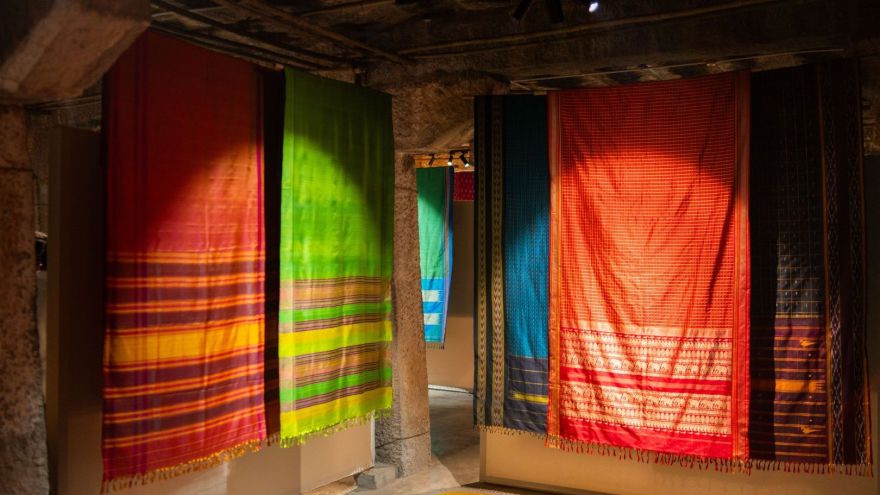
In the ruins of Hampi, where stone carries the weight of centuries, an
exhibition of textiles
unfolded—sturdy, vivid, and deeply tied to the rhythms of labor. On an archaeological site, soft weaves, humble cloth, and stories of the hands that make them stood in quiet defiance against the permanence of rock—an ephemeral archive of Karnataka’s textile traditions, revived and celebrated thread by thread.

Installation view of the exhibition.
The PAMPA – Textiles of Karnataka exhibition, set against Hampi’s ruins, presents over a hundred handmade textiles that weave together Karnataka’s diverse histories of craft, labor, and identity. Co-curated by Lavina Baldota and Mayank Mansingh Kaul, the exhibition is part of a much larger research and revival project by the Baldota Foundation. Curator-designer Priya Saxena, and textile scholars Pragati Mathur and Nupur Saxena are among the researchers who worked with weavers, indigenous communities, and other stakeholders to bring this project to life.

Lavina Baldota & Mayank Mansingh Kaul
The exhibition was small but splendid, a study in contrasts: ancient walls met fluid drapery, light, and bamboo structures that framed supple folds, the monochrome of stone holding the hues of khann, Ilkal, and kasuti embroidery. It was an exercise in spatial storytelling, where fabric, like architecture, held our attention in its warp and weft. As sunlight filtered through slits in the roof along the periphery of the room, casting shifting shadows on both stone and cloth, the exhibition posed a question: What if we thought of textiles not just as garments, but as architectures of the body, carriers of memory, and blueprints for reviving worlds?

The Lambani enclosure, featuring the Day and Night Sky tent, showcases the intricate stiches of the Lambani tribe along with the dupatta, bangles, and lehenga-choli of Banjara women.
Spanning handwoven, embroidered, and quilted traditions—from Ilkal sarees to Lambani embroidery and kaudi quilts—the exhibition highlights fabrics shaped by working hands and worn in daily life. Housed in the 17th-century Mantapa Photo Gallery, it is accompanied by a conference and performances that situate Karnataka’s textile legacy within its broader cultural and historical landscape.
“Anything but a white cube, right?” Mayank exclaims as I duck my head to enter the softly lit room. I ask him about the spatial planning of the exhibit. “The layout is grid-like, and the structure demands non-invasive approaches. This means no drills, no nails, no heavy interventions. So we created simple bamboo structures to make hanging devices, really letting the textiles flow, drape, fall, in ways that their weaving allows them to.” Structure here is tensile, soft, malleable, and comforting.

From left to right – Kasuti saree designed by Gaurang Shah; Ek-taar Chandrakali designed by Sujaya Mahesh, Sameeksha School of Embroidery, Bangalore; Do-taar Chandrakali designed by Asha Savla.

Inspired by the exquisite temple carvings of the Vijayanagar Dynasty and the drawings of Dr. Pierre-Sylvian Filliozat, these textile panels are block printed on handwoven silk-cotton fabric.
The spine of the space holds the Ilkals, the most familiar of Karnataka’s textiles. Viewers can move in and out of intimate pockets, each section anchored by a specific researcher or curator, a distinct weave, a lineage, and a story of revival.
The Hampi Bazaar, once a kilometer-long pavilion, lined a chariot-wide path. Its ruins—rows of stone pillars—still frame the route, recalling a time of processions, elephants, and the rhythms of a thriving town. Among Hampi’s rigid permanence, the textiles in the exhibition spoke of a different kind of endurance—one carried in cotton, wool, and even banana fiber, each thread shaped by hand and history. The khadi dhotis of Hubballi, the handwoven kambli blankets of Deccan pastoralists, and the embroidered kasuti cloths of Dharwad embodied centuries of making, where fabric was not just clothing but a record of place and practice.

Silk ghagra and silk dupatta with Kasuti embroidery designed by Gaurang Shah.
There is a tension between human consumption—excess—and the idea of what is precious and must be treated with delicacy and expertise. How does that translate in a show about highly utilitarian textiles?
“There is a conscious attempt to showcase how a weaver experiences these textiles, rather than a wearer. We found a balance between treating these textiles with reverence without museum-ifying them. These textiles are presented in the conditions they were produced, and not in a controlled environment.”
The exhibition space was alive not just with textiles but with the voices of those who make them. Some of the weavers whose work was on display stood by their fabrics, answering questions with an ease that comes from years of intimate, embodied knowledge.

Ghagra choli of Banjara women, accompanied by the traditional headgear used to carry their deity
“This exhibition is an excuse for celebration, collaboration, and a bheti (a gathering) of minds and spirits.” Mayank believes that the reproduction of textiles is a form of conservation. “In addition to preservation—measures to keep historical objects as close to their original form—the replication of technique, material, and even some improvisation is what keeps textiles alive and revives those that have faded.”
These were no opulent brocades but the everyday weaves of Karnataka’s working class—lungis, sarees, blankets—crafted for wear, not display. Their utility did not preclude beauty; the bold colors and intricate patterns spoke of indigenous hands, histories of making, and the body’s relationship to cloth. Set against the permanence of ruins, these fabrics, woven to endure, became a quiet testament to resilience—of craft and of the people who shape it.
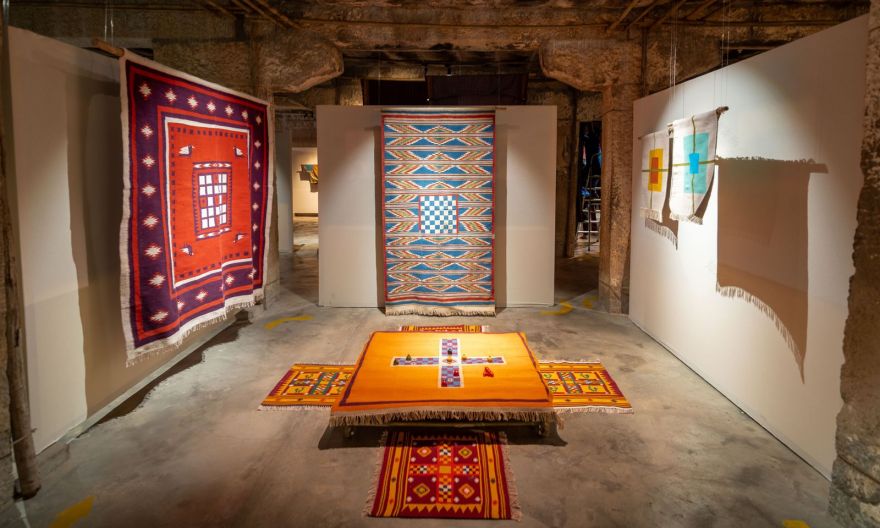
Installation view of the exhibition – Navalgund durries
The name ‘PAMPA’ is no coincidence. It recalls the Tungabhadra River, once called Pampa-Teertha, whose waters have shaped the land, trade, and stories of
Karnataka
. It also evokes the goddess, a reminder that many of these textile traditions—kasuti, Lambani embroidery, kaudi quilts—are carried forward by the hands of women. Like the river, these textiles have flowed through time, adapting, evolving, but never disappearing. The exhibition, then, is not just an act of revival but of recognition—of craftspeople who have long sustained these traditions, and of a future where these textiles, like the river, will continue to move, shape, and endure.
南京喵熊网络科技有限公司 苏ICP备18050492号-4知末 © 2018—2020 . All photos and trademark graphics are copyrighted by their owners.增值电信业务经营许可证(ICP)苏B2-20201444 苏公网安备 32011302321234号
苏公网安备 32011302321234号客服
消息
收藏
下载
最近